
Resurrection – a poem by Diane Elayne Dees

Resurrection

Summer—
Duranta erecta is a shower
of violet blossoms, buzzing 
with bees and hummingbirds,
mirroring the purple dragonfly
wind chimes that sway nearby.

Autumn—
Duranta erecta is a bouquet 
of golden orange berries,
glowing in unison with the fallen
leaves—each golden dewdrop
a gem in a cluster of sunlit jewels.

Winter—
Duranta erecta, too massive
to be covered, turns brown
and plays dead, while it waits
for the blade to remove 
its branches, restore its roots.

Spring—
Duranta erecta emerges
from the ground, slowly at first,
then, picking up green momentum,
begins its virescent evolution,
a promise of future violet and gold.

To be beautiful is to die, frozen,
then be cut down to the ground,
so that essence, which thrives
in the dark, can manifest true colors.

Diane Elayne Dees is the author of the chapbooks Coronary Truth (Kelsay Books), The Last Time I Saw You, (Finishing Line Press) and The Wild Parrots of Marigny. Diane, who lives in Covington, Louisiana, also publishes Women Who Serve, a blog that delivers news and commentary on women’s professional tennis throughout the world.
Numen – a poem by Alicia Hoffman

Numen

Everywhere has it. A gleam. A slant. An answer
to a question no one has thought to ask. Look

into the sheer-faced eye of any cliff. A monument
to observance. Any city street is a template of behavior.

Human to human, I must admit my hesitance. Firm 
progress and constant growth went out the window

and we never caught the memo. We never paused 
to stare out the glass and catch the light as it bends

and circles and refracts through the cirrus clouds
into an infinitude of sublimation. Prismatic. Cutting.
 
Like straight through the heart mind-blowing. Pity,
how we screen-timed the journey. How our passage 

was a blip in time like a small microchip in a smart 
watch we learned how to take in, ingest, forgetting 

how to feel the spirit of this place, the way it travels 
laser focused, pinpointed through us, like a surgeon

with his scalpel or a capitalist with his wealth. I hope 
soon we can stop what we are doing and see this for 

what it really is—this incredulous expansiveness. This 
awe and sum an equation multiplying with every yes.


Originally from Pennsylvania, Alicia Hoffman now lives, writes, and teaches in Rochester, New York. She is the author of three collections, most recently ANIMAL (Futurecycle Press). Her poems can be found in a variety of publications, including The Atticus Review, The Rise Up Review, The Night Heron Barks, SWWIM, The Penn Review, Typishly, and elsewhere. Find her at: www.aliciamariehoffman.com

praying with icons – a poem by Sister Lou Ella Hickman

praying with icons

an icon 
waits 
it waits as a door or window waits 
 
heaven has a face 
and patient hands blessing 
extended in welcome 
then 
the silence opens 
for our waiting in return 
                        

Sister Lou Ella Hickman, I.W.B.S. is a former teacher and librarian whose writings have appeared in numerous magazines and anthologies. Press 53 published her first book of poetry in 2015 entitled she: robed and wordless. She was nominated for the Pushcart Prize in 2017 and in 2020.   

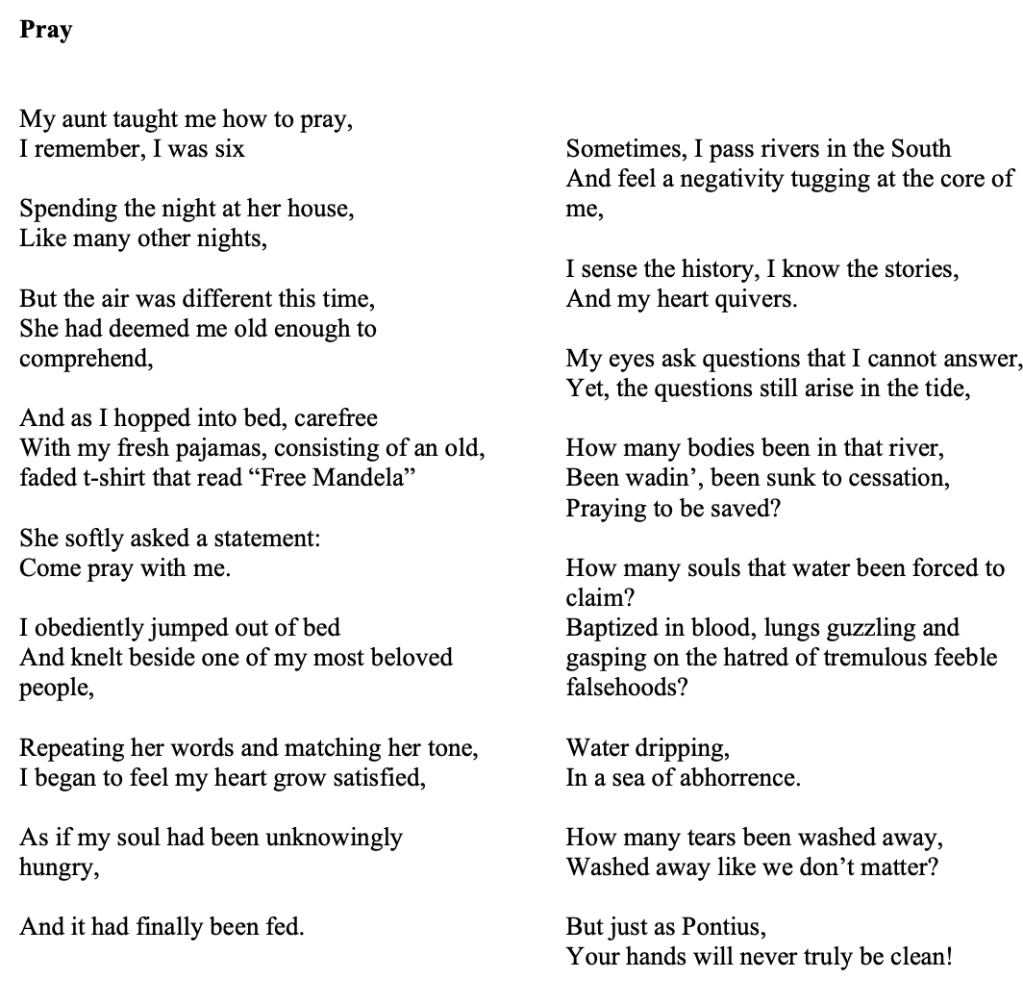
Pray – a poem by E.J. Batiste

E.J. Batiste (she/her/they) is a writer, screenwriter, and artist originally from Raeford, North Carolina. E.J. holds an MFA degree in Creative Writing from Queens University of Charlotte. Her creative work has appeared in various literary publications in North America and Europe. Find more of her work at ericajasmin.com or on Twitter and Instagram: @TheEricaJasmin.

Linley Valley on the First Warm Day in April – a poem by Kaye Nash

Linley Valley on the First Warm Day in April

Someone playing duduk, slowly, 
the heavy notes filling me up, sealing me tight,
like the mourning sea pouring in through my ribs. 

I remember strings and peaks, glacial sopranos once,
looking as long as the light held. The world filled
with blackness before my eyes could be filled
with distance and time. Here, there is
only woodwinds and marsh. Turning upwards, paper-skinned birches
against the watery sky. The denuded earth pale, fading.
I search, among the low quaver of the blow, for something
you could call the sublime, that thing we are trained
to seek out and devour. Brown grass,

brown water, grown geese. Mud
on my boots. The desire that has been gnawing me
all week, suddenly silenced, died, cooked off. A blackbird
darts across the bars of the metal dam, his epaulettes
flashing scarlet, like a Prussian soldier. 

Mountains left me raw and wanting, empty,
weeping, snowblind. The marsh has not wits or edges enough
to be at all cruel. I should be crying, but wonder
at wonderlessness distracts me. There is nothing here
that I haven’t seen every lunch-hour walk this winter.
The only difference is that I can stop, now, and look at
the nothing, and for the first time, hear, unfrozen. 

Trees fallen in the last windstorm, a week downed
and already become muted, washed out; skinless, cored by
ravenous ants. See how the storm has reshaped the trail
like a river moves to spare a stubborn hill. I trip,
and, rather than wait for a steadying hand full of contempt
and sharp fingernails, I spring up, walk faster. You
are not here. I have no reason not to bruise my knee,
no one to preserve it for, no reason not to cry out, wipe dirt
on my cheek. You are not here. It is only pain. It doesn’t 
mean anything, unlike this salal growing directly
from a douglas root, which means, of course, everything.

Kaye Nash is a teacher, poet and closet novelist living on Vancouver Island. She can be best reached on Twitter @knashingmyteeth.

We the Lucid Brink – a poem by Melanie Green

We the Lucid Brink
 
  
Let us woo
   amplitude
 
we gratitude sisters
and brothers
 
We ask
      the open
   to inhabit us
 
Cloudfall
earthen
 
   peace it down
      to root

Melanie Green‘s most recent poetry collection, A Long, Wide Stretch of Calm was published by The Poetry Box of Beaverton, Oregon. The titles of her earlier collections are: Continuing Bridge and Determining Sky. She is a resident of Portland, Oregon. 

It was hare – a poem by Julie Sampson

It was hare 


who did it, twisted my inner logic.
I had to reconsider the pantheon -
cow parsley waving from the April hedge 
chervil gesticulating her witchery litany,
the ancestors calling out, again
We’re Still Here

inviting, chiding us
to pay our respects
as once all the others did.

Opening the door, flies suss the car, 
apparently I’m their target.

We were beside the River Valley Walk 

undulating down to the tranquil Little Dart,
hare arriving with sideways skips,
lollops into, then over the verge 
a-zigzagging here and there over the over-there criss-cross field,
then, pausing on hedge’s crest 
gazing intently north 
she steadily surveys the treasure map, half-tamed, her universe.
Goldeneye of Masquerade on mission,
or one of the mysterious triad,
hare’s turning, 
spinning in her spiralling  gyre –
   
she’s watching for her young, half-
buried in the fold in the next field, you say

but I know where she goes 
I am to follow – 

tunnel through the secrets brushing the long reed-grass,
shuffle into wheat’s hidden kernel 
where the reapers swipe their glinting scythes.

There’s transformation in the sunlit field  
sent by those marking the elongating midday shadows
who gifted these finches to sing -

where she goes I
know  I am 
   to follow – 
walking sideways, always after out of sync.


Note: Hare appeared by our car just south of Affeton castle West Worlington, in Devon


Julie Sampson’s poetry is widely published. She edited Mary Lady Chudleigh; Selected Poems, 2009 (Shearsman Books); her collectionsare Tessitura(Shearsman Books, 2014) and It Was When It Was When It Was (Dempsey & Windle, 2018 ). She received an ‘honourable mention’ in the Survision James Tate Memorial Prize, in 2021. Her main website is at JulieSampson. 

Thoughts on Another Spring – a poem by George Freek

Thoughts on Another Spring (After Tu Fu)  

It’s April. Everything is
reborn, but nature
is against me. Wherever
I look, I feel scorn.
Flowers hang their heads.
Birds scream at me.
Squirrels scatter, as if
they wish I were dead.
Alone, I drink wine.
It’s natural to grow old,
but on this spring night,
it seems like a crime.
But from the lake,
I have to laugh,
hearing the mocking cry 
of an unseen loon.

George Freek‘s poetry has appeared in numerous Journals and Reviews. His poem “Written At Blue Lake” was nominated for a Pushcart Prize.

Spring Service – a poem by Victoria Twomey

Spring Service

I bow to east, the mother of day
her azure fingers 
hang white cotton candy blouses out to dry in the sun

I confess my sins
fold them like a prayer
tuck them into cracks between the stones in the fence

I offer sunshine lily and buttercup bulbs
kneel and place them
onto the tongue of the thawing soil

I sit silently before the blessing trees
in spring shadows
beneath moving dappled gestures, made with budding arms

at a distance, on the porch steps
a white cat attends
arriving like an angel, on a puff of air

Victoria Twomey is a poet and an artist. She has appeared as a featured poet at venues around NY, including the Hecksher Museum of Art, The Poetry Barn, Barnes & Noble, and Borders Books. Her poems have been published in several anthologies, in newspapers and on the web, including Sanctuary Magazine, BigCityLit, PoetryBay, Autumn Sky Poetry Daily, The Tipton Poetry Journal and the Agape Review. Her poem “Pieta” was nominated for a Pushcart Prize.

April – a poem by Rita Moe

April

In a snow deep
meadow
of suburban
backyards
on a clothesline,
a single sweater,
bright crocus yellow, 
swings 
on a hanger,
as if my neighbor, 
impatient, 
has folded this field
into a chalice of white,
spiked it 
with yellow stamens
and made her own spring.  

Rita Moe’s poetry has appeared in Water~StonePoet Lore, Slipstream, and other literary journals.  She is the author of two poetry chapbooks, Sins & Disciplines and Findley Place; A Street, a Ballpark, a Neighborhood.  She has two grown sons and lives with her husband in Roseville, Minnesota.