Provisional Psalm – a poem by Rupert M Loydell

Provisional Psalm
 
Down by the creek we remember the lost:
those who have died, those who have been
carried away by families or removal vans.
 
I saw David earlier in the Spar, wasn't sure
whether he recognised me or not, but he was
happy to chat without making much sense.
 
The radio is discussing migration, suggesting
we are all on journeys to elsewhere, that home
is always provisional. Why don't you ever call?

Rupert M Loydell is a writer, editor and abstract artist. His many books of poetry include Dear Mary (Shearsman, 2017) and The Return of the Man Who Has Everything (Shearsman 2015); and he has edited anthologies such as Yesterday’s Music Today (co-edited with Mike Ferguson, Knives Forks and Spoons Press 2014), and Troubles Swapped for Something Fresh: manifestos and unmanifestos (Salt, 2010)

Autumn Dunes – a poem by Jennifer Lagier

Autumn Dunes
 
Indian summer succumbs to cool morning mist.
Sun burnt chaparral flaunts scarlet, maroon.
Pearly everlasting outlasts green foliage,
displays autumnal gold.
Red berries appear among drying ruins.
Sticky monkey overshadows silvery sage.
 
I approach September’s familiar portal,
traverse a threshold of seven decades on earth.
Ahead, gray fog delivers delicate drizzle,
melds with low clouds, sullen ocean.
Moving slowly, with care for aching bones,
I contemplate coming finale, dawning unknown.
 

Jennifer Lagier lives a block from the stage where Jimi Hendrix torched his guitar during the 1967 Monterey Pop Festival. She serves two rescue dogs, dabbles in photography, taught with California Poets in the Schools, edits the Monterey Review, helps coordinate Monterey Bay Poetry Consortium Second Sunday readings. Website: jlagier.net

Dante’s Tombs – poetry by Anne Whitehouse

Dante's Tombs 

I
Seven hundred years ago, 
Dante died in exile in Ravenna 
and was buried there.

His native Florence 
refused his body, 
but two centuries later,
Florence wanted him back. 

The Pope approved the transfer,
but the monks in Ravenna 
returned an empty coffin 
to Florence’s new memorial. 

They had removed the poet’s bones
from his tomb for safekeeping
and interred them in the basilica wall 

where they lay forgotten
for three hundred years,
until a renovation revealed them,

and they were buried 
in a mausoleum near the church
on a side street so narrow 
it is easy to miss.

Forty years ago we visited Ravenna
and found Dante’s tomb,
the worn white marble
softened by lichens,
the inscription so weathered 
it was hard to read.

How modest it seemed
after a day of monuments
already ancient in Dante’s time,
Justinian’s mosaics in blue and gold 
and the tomb of Gallia Placida
that inspired Purgatorio and Paradiso.

Once the western outpost 
of a great empire, today’s
Ravenna is a backwater, 
surrounded by marshes
dotted with oil wells.

		II
One hundred years ago,
after the Great War, 
an Italian immigrant to Argentina

resolved to build Dante
a worthy monument
in his new country
on the other side of the world,

a building emerging
from the depths of the earth
reaching to the heavens,

in every detail and at every level
an embodiment 
of Dante’s great poem,

elaborate and fantastical,
a celebration of the imaginary
over the mundane,

realized as a skyscraper
named for himself,
the Palacio Barolo.

Twenty-two floors representing
twenty-two stanzas
sit on a foundation
scaled to the golden ratio.

The visitor begins in hell,
progresses to purgatory,
and ascends to heaven.

The lobby, crowned
with Latin inscriptions
and statues of serpents, 
dragons, and condors,

radiates from a central dome
into nine vaulted archways,
the nine circles of hell,
lit by red lights
set in metal flowers.
Geometric patterns 
representing alchemist’s fire 
and Masonic symbols 
decorate floors, ceilings,
and elevator walls
in red, white, and green tiles,
the colors of the Italian flag.

The higher levels,
corresponding to heaven,
begin at an observation deck
overlooking the sprawl
of Buenos Aires,

crowned by a lighthouse
at the highest point
of one hundred meters,
like the Divine Comedy’s
one hundred Cantos,
topped by a statue of Dante
ascending to heaven.

Architect Pilanti intended
the light from the tower
of the Palacio Barolo
to cross the light 
from the Palacio Salvo,
his sister building across
the Rio de la Plata
in Montevideo,

the two beams mingling
like the heavenly union 
of Dante and Beatrice,
welcoming visitors
to the great estuary
like the Pillars of Hercules
to the Mediterranean.

By a miscalculation
of the earth’s curvature,
the beams never crossed,
and the cupola, intended
for Dante’s remains,
remains empty.

Anne Whitehouse is the author of six poetry collections Meteor Shower (2016) is her second collection from Dos Madres Press, following The Refrain in 2012. She is the author of a novel, Fall Love, as well as short stories, essays, features, and reviews. She was born and raised in Birmingham, Alabama, and lives in New York City. You can listen to her lecture, “Longfellow, Poe, and the Little Longfellow War” here

Canvas – a poem by Susan Brice

Canvas 

Blow gently on a dandelion clock.
What is the time?	The time is now.

Seeds drift dainty on a summer breeze,
they waft across a light blue day, float meadow-ward.

Bees are feeding on a nectar canvas:

cornflowers	yarrow	harebells,
	cowslips	thistles 	cranesbill
corncockle	 nettles	daisies
	allium		anemone	borage

random splashes of colour, of scent, of grace
thrown from the brush of the Ultimate Artist.

What is the time?	The time is now.

Susan Brice lives in Belper, Derbyshire with her husband and small dog, Sunny. She has meandered through life and has learned to be glad for Light and Joy. She also understands the blessings of Darkness and Sorrow. In 2022, Susan collaborated with two friends to produce an anthology of their poems, Daughters of Thyme (dotipress.com). They are currently working on a second anthology.

First Prayer – a poem by Jonathan Cohen

First Prayer


These are the last nights of open windows and cricket sounds.
Mornings, the ground is soaked with dew.

We traced the path of Jupiter and trailing Saturn all summer long, 
and now we can’t find them, hidden behind jumbled night skies.
We work out winter’s warning to buy a new shovel,
and salt for the driveway, to get some overshoes, wondering, 

will Orion be a bright sign or a fading signal when 
it crowns the southern sky?
will it signify our blessed fortune or a final notice of decree 
from the Bureau of Fate? 
the one that says, this is to inform you that you are screwed.
Let us make our appeal.

Imitation birdsong is the most ancient prayer, they say, the source 
of human speech. Tamil Brahmins have chanted it for ten thousand years.

I have mantras, too, as old as the oldest ancientness. 
I stand in the yard listening.
I watch the breeze climb the treetops.
I prepare to pull the boat down to the shore.

To the deep we go, to petition, atone, face the facts,
to meet what will come with cheer, if warranted, 
with resolve if required.
To tip my keel on the rolling sea —

the last open window, the last cricket song,
the first prayer of the soul’s new year.


September 2019/ Elul 5779

Jonathan Cohen lives on the Connecticut shore of Long Island Sound with his wife, daughters, and a hound dog. He hails from Buffalo, New York, which informs his writing and where he has deep roots. He studied history and philosophy at Kenyon College and now studies poetry with Jon Davis. 

On the Line – a poem by Ray Greenblatt

On the Line

I cast again into
                             the fog
hoping the lure attractive
wondering if my wrist
                                        is loose enough
to maintain proper tension
spray leaping off the line
                                             in all directions.

What is the catch?

The proverbial old boot
but what other kinds
                                     of clothing,
the largest fish ever caught
                                               in these parts
one I don’t have to toss back,
or a wish somewhere out there
                                                      in the deep.


Ray Greenblatt is an editor for the Schuylkill Valley Journal and teaches a ‘Joy of Poetry’ course at Temple University. He has written book reviews for the Dylan Thomas Society, John Updike Society, and Joseph Conrad Today. His latest book of poetry is From an Old Hotel on the Irish Coast (Parnils Media, 2023).

Quiet Day at the Cathedral – a poem by Helen Evans

Quiet Day at the Cathedral

I’ve lost count – overhead, at least a hundred 
cackling gulls are struggling for height.
Chaotic shadows flap across the cloister.

Waiting for some unregarded bird 
to centre on a thermal core and climb,
I shut out thought. I listen to the fountain.

A gust blows through and I look up again.
Above the nave at noon a seagull soars.
The rising air sustains its graceful turn –

and then another – and then another –


Helen Evans facilitates Inner Room, a pioneer lay ministry that creates space for people to be creative, and is piloting a new project, Poems for the Path Ahead. Her debut pamphlet, Only by Flying, was published by HappenStance Press. Her poems have appeared in The RialtoThe NorthMagmaWild CourtThe Friday Poem and Ink, Sweat & Tears. One was a joint winner of the Manchester Cathedral 600 Poetry Competition. She has a master’s degree with distinction in Creative Writing from the University of St Andrews. www.helenevans.co.uk

The Rabbit Near the Driveway – a poem by Janet Krauss

The Rabbit Near the Driveway


If I had not turned my head,
I would not have seen you
clothed in the shade of twilight.
Soon night will escort you
beneath its coat unto the safety
of where you will burrow in sleep.
For now you have strayed
from home as you nuzzle grass,
a pine needle, a piece of bark.
We look at each other,
we do not move from each other’s sight.
Trust rests on the stillness of time
we have strung between us
for a moment.

Janet Krauss, who has two books of poetry published, Borrowed Scenery, Yuganta Press, and Through the Trees of Autumn, Spartina Press, has recently retired from teaching English at Fairfield University. Her mission is to help and guide Bridgeport’s  young children through her teaching creative writing, leading book clubs and reading to and engaging a kindergarten class. As a poet, she co-directs the poetry program of the Black Rock Art Guild.

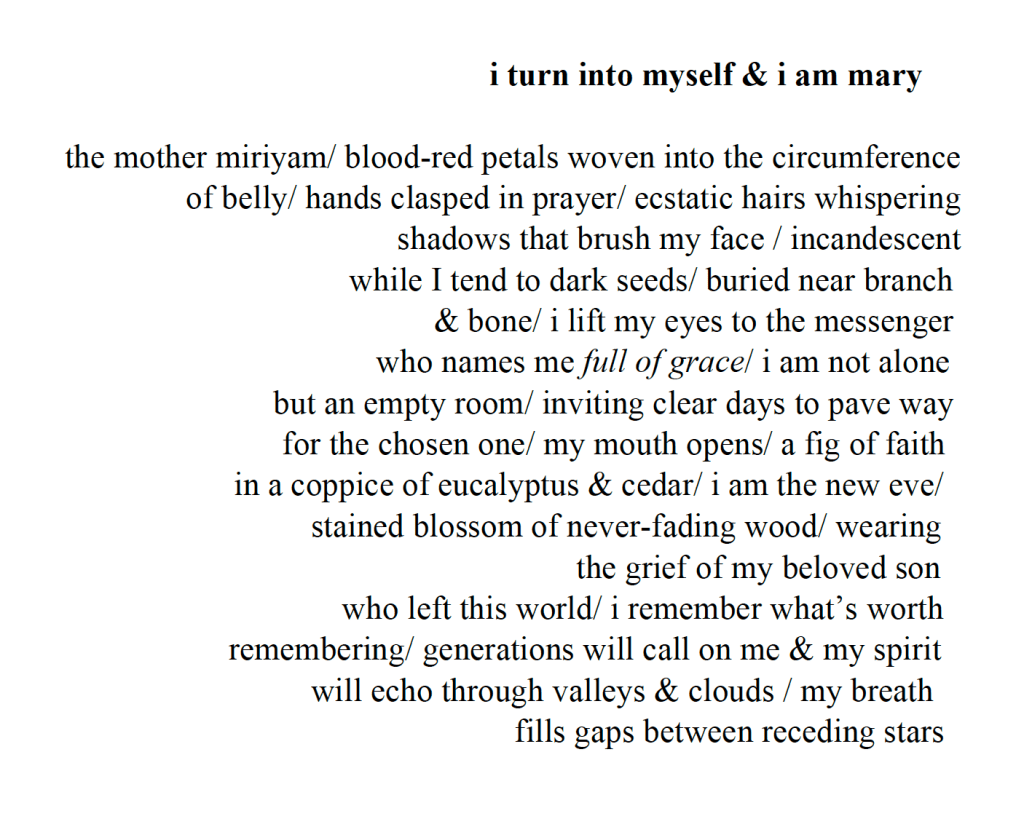
i turn into myself & i am Mary – a poem by Susan Michele Coronel

Susan Michele Coronel lives in New York City. Her poems appear in publications including Spillway 29, Gyroscope Review,  Redivider, and Anti-Heroin Chic. This year Susan won the First Poem Contest sponsored by the Massachusetts Poetry Festival. In 2021 one of her poems was runner-up for the Beacon Street Poetry Prize, and another was a finalist in the Millennium Writing Awards. She has received two Pushcart nominations. Her first full-length poetry manuscript was a finalist for Harbor Editions’ 2021 Laureate Prize. 

Decibels of Praise – a poem by J.S. Absher

Decibels of Praise

i. Now

The chorus of praise sung 
by creation drowns out ours— 
the white-throated sparrow
spilling its golden notes
on winter days; spring peepers
and katydids in their season.

In choosing to be human, 
we yielded to sorrows that pierce
through hearts to joy. We chose
the flinty grace of arrows,
the grinding of the hours
that sharpens the callow young.

And when we want to cry
we sing a lullaby. 


ii. Later

The first to rise will sing, Hallelujah!
and shake creation.
The sleeping will cry, What’s that brouhaha?
while Christ calls out, My dears, I know you! 
Such will be the exultation
when the first to rise sing, Hallelujah!
and shake creation. 


iii. At Last

Thorny bougainvillea,
cells that move by cilia, 

lichen and giraffe,
mother frog and bull calf,

the pampered and abused, 
well-loved and ill-used

will see in their stories
the makings of glory

and join their sweet words
in praise of the Lord.

J.S. Absher’s second full-length book of poetry, Skating Rough Ground, was published in 2022 by Kelsay Press. His first full-length book, Mouth Work (St. Andrews University Press) won the 2015 Lena Shull Book Contest from the NC Poetry Society. His poems have recently been published or accepted by the NC Literary Review, Triggerfish Review, and Tar River Review. His poems have been nominated four times for the Pushcart Prize. He lives in Raleigh, North Carolina, with his wife Patti. His webpage is js-absher-poetry.com