
Homing – a sonnet by Dan Campion

Homing

Life glides through us like seabirds through a mist
in search of land they’ve never seen before
but know each contour of and can’t resist
the urge that guides them through the corridor
of fog. To them, their island is a dream,
the sort of dream that draws a creature on,
though it may also be a mist. The scheme
is hidden in the flight, a pearl-gray swan.
The flock itself is made of mist, a skein
so vanishingly fine it’s hardly there,
not lilac, but a faint hint of vervain,
whose flower has the scent of empty air.
It leads the migrants, and the pilgrims too,
who take from it which north and south are true.

Dan Campion‘s poems have appeared previously in Amethyst Review and in Light, Poetry, Rolling Stone, and many other journals. He is the author of Peter De Vries and Surrealism (Bucknell University Press) and coeditor of Walt Whitman: The Measure of His Song (Holy Cow! Press). A selection of his poems was issued by the Ice Cube Press in July 2022: https://icecubepress.com/2021/10/01/a-playbill-for-sunset/
Don’t Rake the Leaves! – a poem by Janet Krauss

Don’t Rake the Leaves!

Let them lie on your front lawn.
They enrich the soil.
Butterflies can lay their eggs
on the crusty clusters outside
your window just as birds
feed and rest beneath
the wind-rustled cover
near the chipmunks and toads
sheltering under the same roof
in the woods all through
the rigor of winter.

And when it comes time for me
to leave, I will enter as a plant does,
growing roots into the earth
of the forest and join
the small, wide-eyed creatures
as I nurture them.


Janet Krauss, who has two books of poetry published, Borrowed Scenery, Yuganta Press, and Through the Trees of Autumn, Spartina Press, has recently retired from teaching English at Fairfield University. Her mission is to help and guide Bridgeport’s  young children through her teaching creative writing, leading book clubs and reading to and engaging a kindergarten class. As a poet, she co-directs the poetry program of the Black Rock Art Guild.

Sapphire – a poem by Valerie Maria Anthony

Sapphire


I have a treasure in my soul
given to me long ago
in words of bright, 
and literal blue

by a stranger who, 
told me that The Kingdom of God 
was a planet 
made of sapphire 
and that one day 
we would go there.

She said it, sharp and clear as fact,
directing her prophesy 
specifically at me. 

I remember -

though we only met briefly
how my friend pulled me away,
whispering, 
'Let's go.'

And so we turned our backs
and headed for the M3

And we stood thumbs up
hitchhiking for maybe forty years
and forgetting each other
and where we were going.

Everything about those days is hazy

But the sapphire planet still
shines
and I wonder 
if it is not in fact 
a star.

I know nothing about astronomy
but I have felt those azure rays
it seems, for an eternity.

And in my madness have bathed
in their light sometimes, 

wondering

fearful of gullibility
but lured back by beauty

So that I can now say
- sharp and clear as fact -
that something crystalline 
and true
now grows within me
reshaping 
with exquisite ordinances
the lost years
of my rebellion.

Valerie Maria Anthony is a London and Hampshire-based poet who has published In Oremus Magazine and Amethyst Review. She believes poetry can be an instrument of grace and takes joy seriously enough to look for it everywhere. She has many years of experience facilitating creative writing workshops in social care settings and is a trained visual artist.

Joy – a poem by Heather Swan

Joy


              It stalks me, knows
where I am, follows me now,
 
can see me, a wolf at the edge 
              of the pine forest watching as I run

through panes of light,
              against the air that whispers 

through the trees, that wants
              to lift me up like a sail. 

Nothing scares me more
              than being unhinged 

but when a dove lands before me
              I stop short, caught breathless,

breaking open, torn from the trough
              of despair I feel so safe in. No choice

but to rise, and I am stretched out,
              devoured, expanding into the trees, this bird,

no I, only we,  untethered to me 
              and inside of everything

              mortal and earthbound.

Heather Swan‘s poems have appeared in such journals as Terrain, Minding Nature, Poet Lore, Phoebe, The Raleigh Review, Midwestern Gothic and Cold Mountain. She is the author of the poetry collection A Kinship with Ash (Terrapin Books), a finalist for the ASLE Book Award, and the chapbook The Edge of Damage ( Parallel Press), which won the Wisconsin Chapbook Award. Her nonfiction has appeared in Aeon, Belt, Catapult, Edge Effects, Emergence, ISLE, Minding Nature, and  The Learned Pig. Her book Where Honeybees Thrive: Stories from the Field (Penn State Press) won the Sigurd F. Olson Nature Writing Award. She teaches environmental literature and writing in Madison at the University of Wisconsin-Madison.

Missionaries – a poem by Philip Kolin

Missionaries


They sail to places where their congregations
have never seen a map to plant churches
in jungles, deserts, in rainforests, in countries
not easily reached, and sometimes closed.

Watches or clocks are useless in many 
of these places; time is measured in dreams 
or when animals migrate. Ants or water buffalo
can be the timekeepers. Or molting alligators.

To communicate with their new flock
they must learn to make sounds their ears
have never heard or eyes seen. They teach
catechumens to recite God's name 

in different dialects without alphabets.
They sing in harmony with shafts
of sunlight; no high sopranos here;
toucans, hornbills, parrots make up the chorus.

They carry rainbows in their Bibles and build
ambries decorated with plantain leaves and
raise special praying bees for sanctuaries.
They use mists and moss to teach Gospel lessons.

The know God's gathering places and where
to hunker down when storms, earth slides, or
floods try to overcome their will to believe.
They inscribe epitaphs on bamboo tombstones.

Philip Kolin is the Distinguished Professor of English (Emeritus) and Editor Emeritus of the Southern Quarterly at the University of Southern Mississippi. He has published over 40 books, including twelve collections  of poetry and chapbooks. Among his most recent titles are Emmett Till in Different States (Third World Press, 2015), Reaching Forever (Poiema Series, Cascade Books, 2019), Delta Tears (Main Street Rag, 2020), Wholly God’s: Poems (Wind and Water Press, 2021), and Americorona: Poems about the Pandemic (Wipf and Stock, 2021).

Shelter – a poem by Paige Gilchrist

Shelter

All day, the rain has been plinking,
plunking, finally pelting down.
The whole time, latched to a slat
on the back of a bench outside
my kitchen window, a praying mantis.
Like a wooden clothespin with electric-green
limbs, not praying but splayed, tiny guy
wires that wrap and cling. Invertebrate
body looking like the offspring
of a pterodactyl tamped into the cast
of a clasped pocketknife. Still as a stick. If this
were me, I would fan my wings and flail
at the wet. Check and re-check the weather
on my phone. At the very least wail
about the lack of a cup of hot tea. But no.
Here’s a slim Zen priest, head bowed beneath
the lip of the rickety seat’s top rail. Just clearing
fat raindrops, poised to plop into the abyss.
Alert, as the sutras teach. At ease.

Paige Gilchrist lives in Asheville, NC, where she writes poetry and teaches yoga. Her poems have appeared in KakalakAutumn Sky Poetry Daily, and The Great Smokies Review.

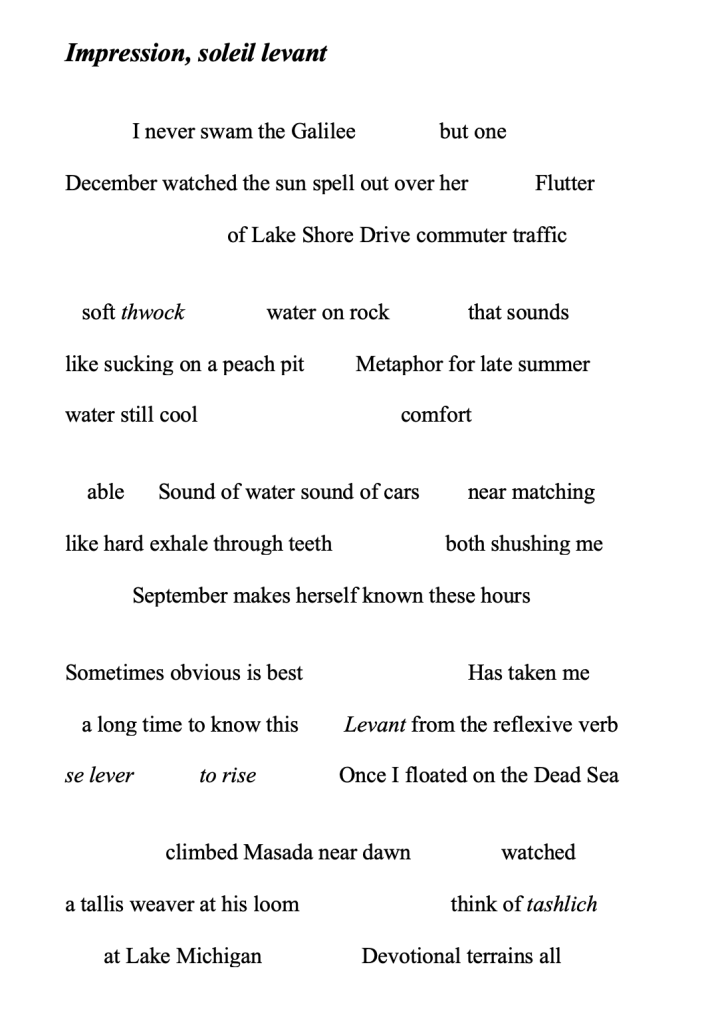
Impression, soleil levant – a poem by Annie Diamond

Annie Diamond is an Ashkenazi Jewish poet living and working in Chicago. She has been awarded fellowships by MacDowell, Luminarts Cultural Foundation, The Lighthouse Works, and Boston University, where she earned her MFA in 2017. Her poems appear and are forthcoming in No Tokens, Yemassee, Modern Language Studies, Western Humanities Review, and elsewhere.

Smart Water-Bottle Prayer – a poem by Helen Freeman

Smart Water-Bottle Prayer

Let clouds inspire me once again
as I slump here, empty and tangled 
in kelp. Make me raindrop pure. Lift 

me out of this seaweed sump, this 
toxic syrup where jellyfish spread nets
and no-one lays down a beach towel.

May clean hands re-energise me.
Deliver me from wrack of reef 
and rock and reek of fishbone tide. 

Lead me not into whale belly,
raw crack or wince of saline sting. 
Unfurl a banner over me, 

string balloons to wave and sing airs, 
spangle me in gold sand dollars. 
Replenish, re-use, re-muse me.

Helen Freeman started writing poetry whilst recovering from an accident in Oman and got hooked.  She now lives in Durham, England and has poems published on sites like Visual Verse, Ink, Sweat & Tears, Clear Poetry, Ground Poetry, Open Mouse, Algebra of Owls, Red River Review, Barren Magazine, The Drabble, Sukoon, Poems for Ephesians and Ekphrastic Review.  Instagram @chemchemi.hf 

Now, and at The Hour of Our Death – a poem by Lesley-Anne Evans

Now, and at The Hour of Our Death

a Marian prayer with ladybugs


Lady-birds—mothers of Christ—autumn seekers
of heat and quiet; you return to me in multitudes.

You gather for days in high corners of my room, 
black spots like tiny sins on your blood-red capes.

Then, O’ delight! You bless me in my shower stall!
Stigmata of my bathroom wall, please pray for us! 

When ghosts of steam condense, and holy water 
streams, consider me when you pause to drink.

Lesley-Anne Evans, an Irish-Canadian poet, writes from Feeny Wood, a contemplative woodland retreat in Kelowna, B.C., on the traditional unceded territory of the Syilx Okanagan Nation. Her work has appeared or is forthcoming in The Antigonish Review, Letters Journal, The Ekphrastic Review, Contemporary Verse 2, The Catholic Poetry Room, Soul Lit, and other periodicals. Lesley-Anne’s debut poetry collection, Mute Swan, Poems for Maria Queen of the World, was published by The St. Thomas Poetry Series (Toronto) in 2021. 

Rabbi Nehorai to Acher – a poem by Daniel Galef

Rabbi Nehorai to Acher
 
In Heaven, I have heard, there is no sitting
down, or telling jokes, or shedding tears—
one life’s allotment lasts one all his years,
then ducts run dry, mirth fades, prayer unremitting
serves for an eternity or so.
In Abram’s bosom, “Ha!” has been erased,
desire and hate—such joys!—from the soul effaced.
We must partake of these before we go.
I’ve always hoped there will be time for study,
that one might pass the long celestial season
among the learned dead, debate the twists
of the Law that, like blind pathways, seemed so muddy
to mortal eyes, to finally clear the mists,
and the final joy will rise from faith and reason.

Note: One of Rabbi Meir’s closest friends was the ostracized heretic Acher (“The Other”), with whom he would frequently debate scripture even as it risked his reputation to do so. Acher’s heresy may have sprung from a vision of a seated angel, contradicting the teaching that in Heaven there is no sitting down, as there is no weariness.

Daniel Galef‘s first book, Imaginary Sonnets (2023), is a collection of seventy persona poems, each a verse monologue exploring the point of view of a different historical figure, literary character, or inanimate object. Subjects include Saint Augustine, the moral philosopher John Taurek, and the woman who painted the fresco of Christ in Borja, Spain. The book is available now from Word Galaxy/Able Muse Press.