Driving in a Storm, She Practices – a poem by Karen Paul Holmes

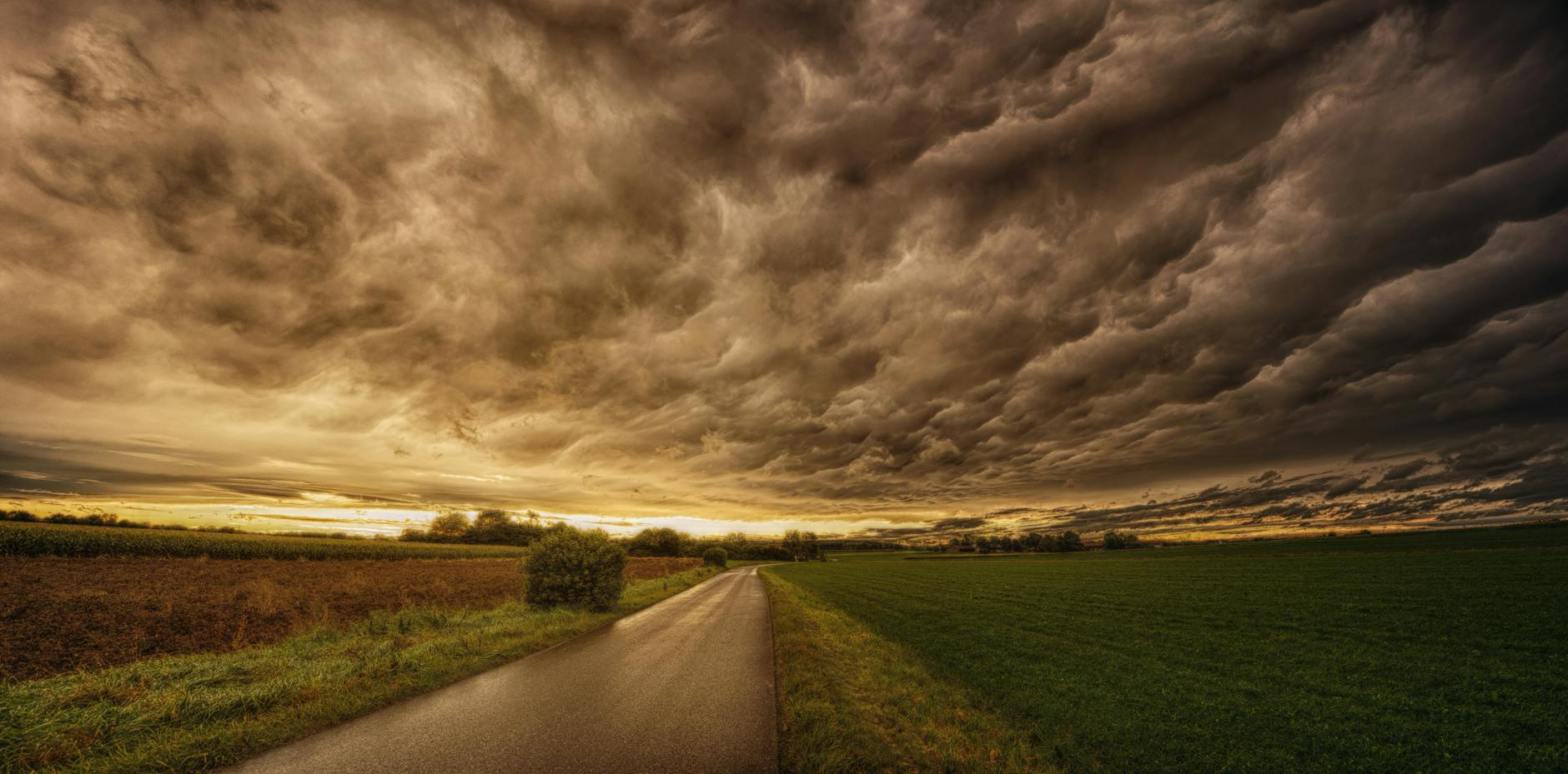
Driving in a Storm, She Practices  


She has given up predicting the weather
but has to catch herself now:
Will it be visibility zero 
going over the mountain like last time?
Icy rain hammers nails into the windshield, 
trucks rustle white mist from the road, 
her ninety-mile-an-hour 
wipers can’t keep up.

She’s learning to disappear time
by paying no attention to when 
she might arrive. 

Now sunshine, pavement barely damp. 
She breathes, Oh good.

But here’s another sleetstorm—
tires float, wanting to hydroplane.
She slows to twenty-five. 
Ungrips the wheel. It’s all good. 
Ahead, Wolfpen Ridge wears
a gray shawl fringed with hail.

She’s learning to stay present
by keeping her ear on the radio.
S-curves begin as La Bohème concludes:
Mimi is dying but dying beautifully. 
Violins and Rudolfo cry, 
and the little black car flies over
the mountain, tires singing on dry road. 
Clouds brighten to white. 

Karen Paul Holmes has two poetry books, No Such Thing as Distance (Terrapin) and Untying the Knot (Aldrich). Her poems have appeared on The Writer’s Almanac, The Slowdown, and Verse Daily. Publications include Diode, Plume, and Valparaiso Review. She has twice been a finalist for the Lascaux Review’s Poetry Prize. She lives in Atlanta, Georgia, USA and spends time in the Blue Ridge Mountains. 

Winter Solstice – a poem by Charles Lewis

Winter Solstice

I've always envied bears
who, fattened on fish, wild honey, and fruit,
hibernate in their dens all winter
oblivious to discomfort
and eruptions of feeling.

It would be nice not to be cold,
not to deal with the layered bondage of clothes,
the heaving of heavy snow,
and the bone-splintering,
abashing slips on ice.

But being human,
ever the natural antagonist,
I must live unnaturally awake
while the earth sleeps,
resting before the resurrection of spring.

So, in the dark I sit tonight
with a spark from the black sky of stars
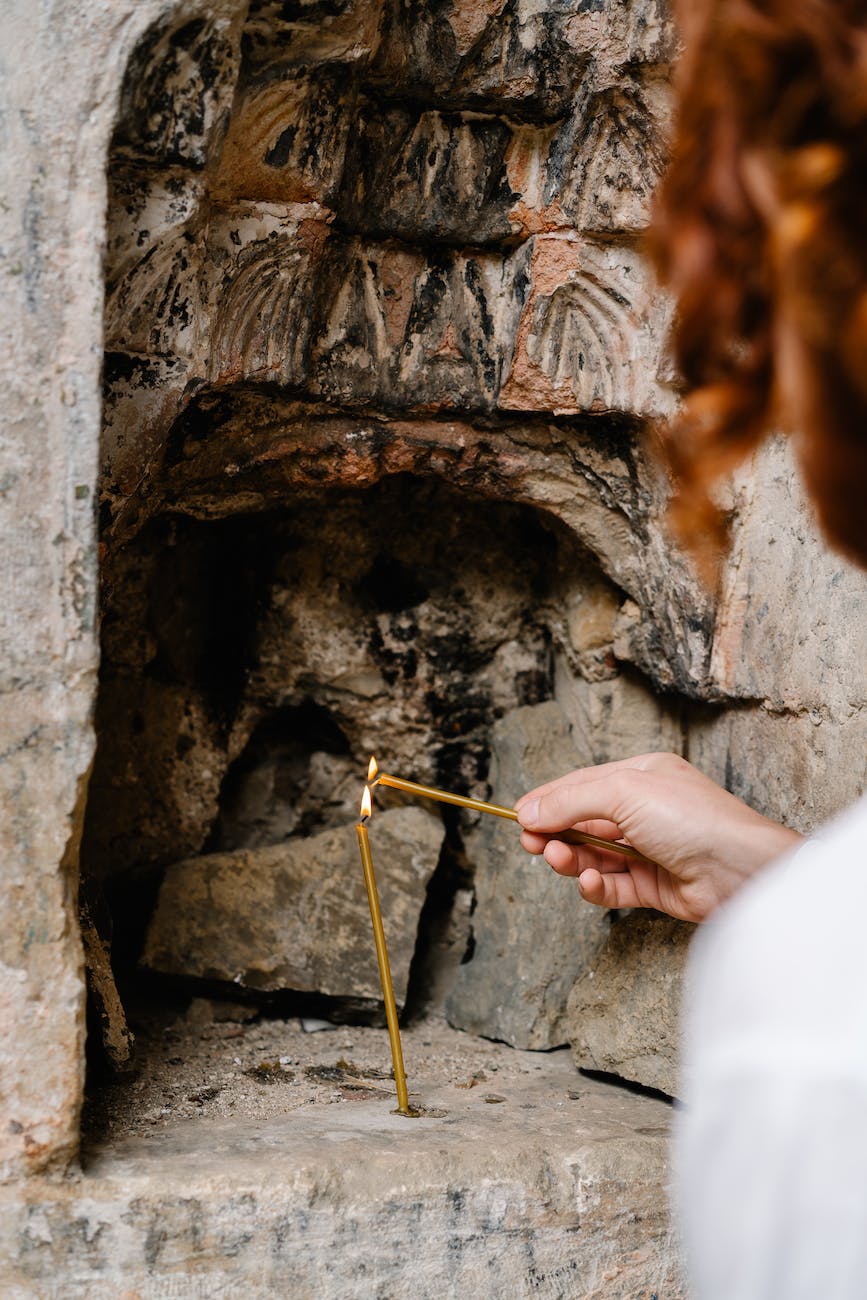
burning on a candle, exposed and golden-warm.
Not much against so much frozen night,
but enough so the darkness does not overcome it.

Charles Lewis writes poetry as a way of knowing and unknowing, as prayer and meditation, to share language and feeling, for fun, and because it’s necessary.

Crime Scene – an essay by Kresha Richman Warnock

Crime Scene

My husband, Jim, and I turn into the parking lot of the small Episcopal church. Full retirement wasn’t my husband’s chosen gig, so a couple of years ago, he became vicar of this church in the city where we retired. Here we are, about to lead the Wednesday morning Bible Study, bickering about something in the drive over as old married couples tend to do. He walks across the street to pick up the mail from the grey, rectangular-domed mailbox, unintentionally making me wait outside to enter the blue-green parish hall. I don’t have a key.

Larry, a member of the congregation who does, pulls his white mini-van into the parking space in an uncharacteristically reckless, speedy fashion. He ignores me and charges across the parking lot, as fast as a fit, 80-year old can, to talk to the man in the van marked “Joe’s Electrical Service.” I pretend to be mellow, as I stand in the sunshine under the blossoming cherry that is long past its spring bloom and wait for someone to open the door. Jim got there eventually.

We walk into a crime scene. I love mystery novels, but I’ll alert you: there is no body, no smeared blood, no mysterious gunshot residue. There is a tall ladder set up at the entrance. We turn the corner, and it takes a minute for our eyes to register what has happened.

Clumps of black dirt are scattered all over the slightly yellowed, linoleum floor. Looking up, I realize that it came from the holes in the popcorn ceiling, made by the heels of clumsy boots walking on the bare flooring of the semi-attic. Bits of shingles, broken lathe have fallen through from the space where the thieves used that first ladder to climb up and steal all the copper wiring from the attic. There is now no power in the little building – no heat, no refrigeration, no point in plugging in the thirty-cup coffee urn that one faithful congregant fires up every Sunday so we can socialize at the round, folding tables after the service. 

Even in its heyday, our little church was the runt of the litter of Episcopal churches in the Pacific Northwest. Instead of a brick-and-mortar social hall attached to the sanctuary, we got a reused, prefabricated, World War II-era mess hall which had outlived its purpose at nearby Ft. Lewis. 

No one living can describe how it got here in 1951, a 100-foot by 600-foot building on the bed of a truck, trundling up the ten miles from the Fort. There was no interstate in those days, so the truck must have waded its way through city streets, cleared of all parked cars, up Pacific Highway South, barely making the corner at Ninety-Sixth Street. What machinery moved the structure off the truck onto the prepared foundation and settled it there on the property where it sits until this day?

Back in the sixties and seventies, there were children and families that worshipped in the church’s sanctuary, across the parking lot from this little building, and ran around on its linoleum floors after church. The kids grew up, found different faiths or no faith and have grandchildren of their own who run around somewhere else now. We are a skeleton church, silently moving forward as one by one our members become less mobile, less alert, die. There are ghosts in the parish hall.

My husband took over in the midst of Covid. When we were able to unZoom our services, we started building friendships, getting to know the worshippers, complete with their foibles, histories, traumas, and relationships. Aging can be an inward-looking process, but with Jim’s encouragement, we added a deacon whose special ministry is to the homeless. The city opened a secure homeless encampment for veterans a mile from the church, everyone got involved, and we started delivering home-cooked meals. 

Positive movement, but when we walked in on Wednesday, the place was trashed. 

All the cupboards were torn open, napkins, plastic plates, miscellany tossed on the floor. The thieves took the carton of Swiss Miss Cocoa but left the big tub of Folgers Coffee. They took all the big garbage bags and the dish towels.

They also tore up Vivian’s artful décor. She had covered each of the tables in the main room with bright yellow fall plastic tablecloths. Fabric leaves, in yellow and green and reds fluttered down the middle as a centerpiece on each, and golden potted chrysanthemums adorned the serving table. She had gussied the place up for Gregg’s funeral. A week before, in a reception for that event, his family and friends sat together in this hall for a late lunch of little egg salad or cream cheese and turkey finger sandwiches that the church ladies had made.

I never met Gregg because he had suffered from advanced dementia since we moved here. His tiny wife, Rhonda, had been caring for him alone since before Covid. The reception was organized by Vivian and the ladies. There was a service in the church, but Rhonda had chosen to say goodbye to her husband at graveside, where the clods fell, by herself. I hoped the dirt and shingles that fell on the décor of his funeral would be cleaned up before she came in the door of the parish hall again.

At least they didn’t get Vivian’s silver. Only the week before, the ladies had been cleaning out the pantry. On the very top shelf, ten feet up, someone discovered a box of silver-plate cups and a tea service, blackened with tarnish. “That’s from my Janie’s first wedding,” Vivian said. “I’d wondered what happened to them.” Janie is now sixty-five. Myself, I’ve researched selling the silver plate I inherited, and it’s not worth anything, but I’m glad the thieves didn’t get Vivian’s.

A week earlier, thieves had stolen a smaller portion of the copper wire. That wiring was in the crawl space under the building, so the destruction wasn’t visible, but that’s why the electrician was there that morning. He was a sturdy working man in his forties, dressed to be able to spend hours in the dingy crawl space and replace the initial missing wires.

“If you find these people, just let me know who they are,” he said. “I grew up around here. I remember this church from when I was a kid. I would drive by and see barbecues and families playing on the lawn. It wasn’t my church, but it was part of my community. People would never have attacked a church then. But just let me handle those guys.”

We opted, instead, to call the police, knowing their response would be supportive but futile. Police staffing is low; there is no way to trace this kind of crime; even if they’re caught, there is little likelihood that the miscreant will go to jail, and the bad guys certainly aren’t in the position to pay restitution. 

The next morning, we had to phone the police again.  At 7:30 my husband had received another call. The side door to the church building itself was wide open.  He jumped in the car and drove the twenty minutes to the parking lot. I sat at home, pretending to write, imagining the same disaster zone in this space we call “sacred,” the altar at the front covered with its floral green frontal, the stained-glass windows memorializing the lives of members who had died, the rows of pews where the Vivians and Gregs and Rhondas and Larrys had sat in responsive worship every Sunday since the high-peaked building was built in the 1960’s. But the invaders had only crow-barred the door and trashed the Vicar’s office. They’d snagged an old laptop. And emptied papers, pulled the sixty years of detritus out of the closet, which I’d been nagging Jim to clean out anyway. The sanctuary was unmarred; the power still on.

How do we respond, as members of a church, as people of faith, as caring humans? Maybe we just let the electrician deal with them. He seems like a pretty tough guy. On Sunday, Jim will tell us that the center of our faith is reconciliation; we will pray for the miscreants. “Love your neighbor.” “If a man asks for your cloak, give him your tunic also”. “Pray for those who despitefully use you.” We will do what we can to non-violently protect our property. New security cameras will be in place, more lighting, more fencing. Maybe the police will drive by once a night. 

I’m thankful I’m one of the very few that walked in on the destruction. I’ve only been here two years; the ghosts in the parish hall don’t talk to me.  I didn’t eat and drink and laugh at Janie’s first wedding, forty-five years ago. The Sunday before the parish hall was trashed, Vivian had stood next to me and told me about how, when Janie’s son, her grandson, died in a car crash, Janie sat on Vivian’s couch for almost five years sunk in a depression. Vivian had been afraid her daughter would never recover. I didn’t cry when she told me, just gently said, “I’m so sorry.” The bone-thin, ramrod straight eighty-five- year-old woman, who only hears you when her hearing aids are working, just said, “I know” and went on to show me pictures of her great grandchildren. 

The Boy Scout troop that meets in the building once a week came in Wednesday night and cleaned up the Parish Hall. Vivian and all the others, living and dead, who sat around the round tables gossiping and planning bazaars and mourning lives long gone will see only pictures of the devastation. Eventually, the wiring will be replaced, the lights turned back on, the holes in the ceiling patched.

The cops tell us this was most likely the work of junkies, looking for money for their next fix. I don’t hate the miscreants, but I would be lying if I said I have the ability to love them or even pity them right now. I don’t have the wisdom to solve the problems of meth and fentanyl that are dehumanizing our community. In my younger days, I might have been self-righteous enough to think there were easy answers to poverty and homelessness and mental illness and crime. 

We can’t give up on solving these problems, but, as I age, I am drained of anger, drained of contempt. Instead, I have a reservoir of sorrow that does extend to Vivian and Rhonda and Janie and the ghosts in the parish hall. It extends to the tired veterans who are moving from a life in the streets and spending a few months in the homeless encampment up the road.  Even if I don’t hate the criminals, the sinners, who tore up our building, the boundaries of that reservoir are not broad enough yet to let me feel any sorrow, let alone love, for them. I know I am disobeying the commandment to love your neighbor. I’m working on it.

Kresha Richman Warnock and her husband, an Episcopal priest,  retired to the Pacific Northwest right before the pandemic hit. Since then she has filled her life writing a memoir and various essays. She has been published in The Brevity Blog, Persimmon Tree, Moss Piglet, Jewish Women of Words, Fahmiddan, Instant Noodles, and the anthologies Pure Slush and American Writer’s Review 2022. For a complete list of her works, please visit her website, http://www. https://kresharwarnock.com/.

Unto Us – a poem by Patrick T. Reardon

Unto us
 
 
Lord absolute.
Wonder counselor.
With us. Mighty.
 
(Bring war, bring peace, old age, jollity.)
 
     Do you know the laws of heaven?
     Order the clouds?  Send lightnings?
 
Lord, king. 
For ever and ever.
 
A given son, a burden carried. 
Everlasting.
 
(Bring magic, bring mystic.)
 
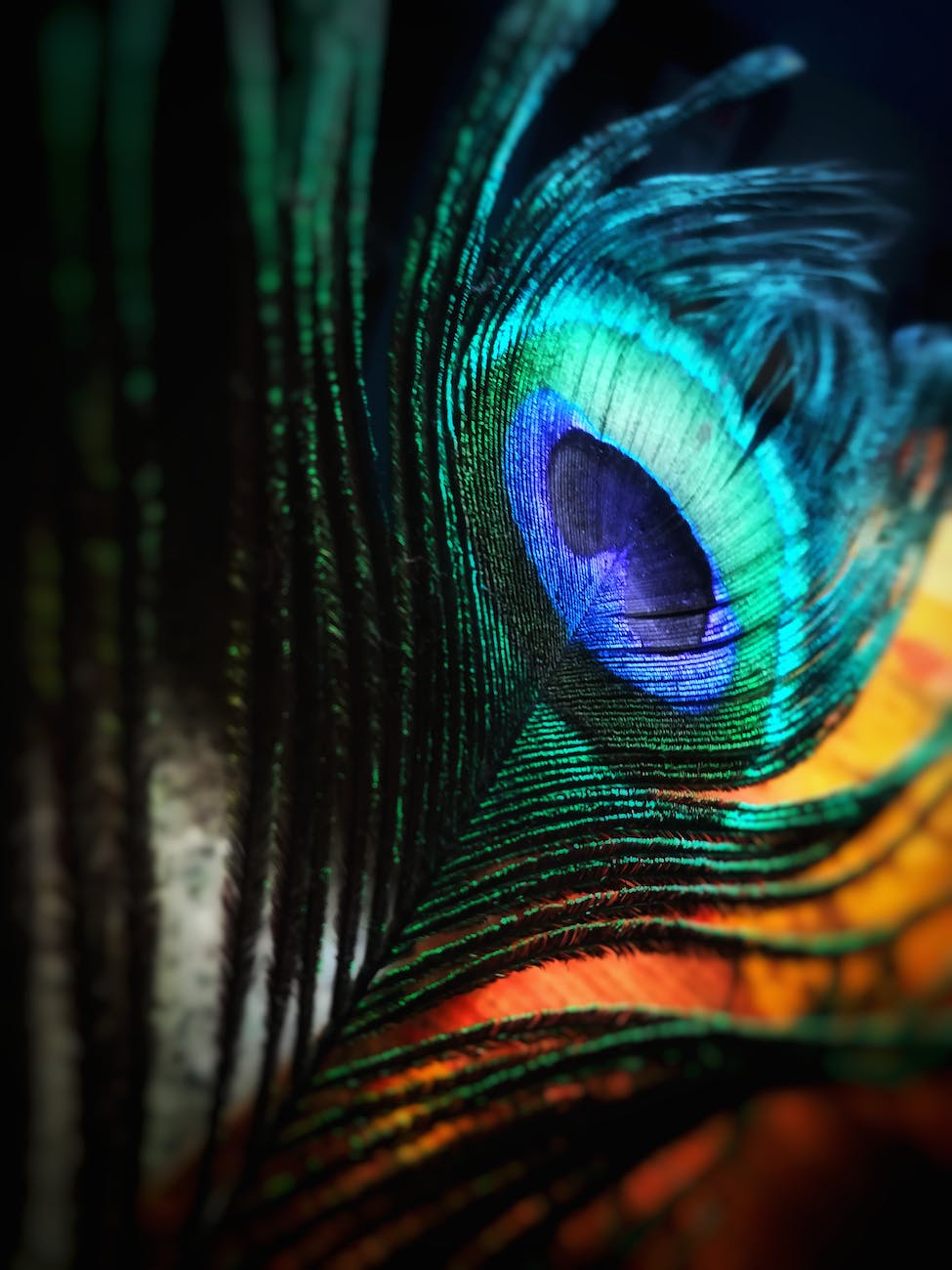
     Did you give wings to the peacock and the heron?
     Did you clothe in thunder the grizzly and the rhino?    
 
Rattle the heavens and the earth,
the sea and the dry land.
All nations.
 
(Bring message.)
 
Reign. 
 

Patrick T. Reardon is the author of twelve books, including the poetry collections Requiem for David, Darkness on the Face of the Deep and The Lost Tribes. His memoir in prose poems Puddin’: The Autobiography of a Baby was published by Third World Press with an introduction by Haki Madhubuti. It has been described by Mindbender Review of Books as “the most improbable and intriguing personal account by a writer published in 2022, but quite possibly the most ingeniously imagined memoir by any writer in any given year.” He has two new poetry collections: Salt of the Earth: Doubts and Faith from Kelsay Books and Let the Baby Sleep from the Australian publisher In Case of Emergency. 

Cresset Stone – a poem by Alice Stainer

Cresset Stone* 

There’s the stillness       and the flicker     
quivering    into the cowled dark.     It sparks   
in hollowed spaces     hallows them     over again.

There’s the meeting       and the passing.
It lights the liminal     the crossing places 
pilgrim pathways     communal     or lone.

There’s the waiting       and the pressing on.
Poignant as a kyrie     that rapiers to rafters
it strives to reach     beyond its deeps.   

There’s the holding       and the letting go
release     from steadying stone     to uncertainties     
of flame     tongues     that seek new speech.

There’s the lasting       and the fugitive.
Let it show you     how to feel your way with fire  	 
earthed hands     learning    to cup light.

*A block of stone scooped into hollows holding wick and tallow, used during the medieval period to illuminate monastic rites such as matins, as well as dark passageways and dormitories. The largest example in the British Isles, comprising thirty cups, is displayed in Brecon Cathedral in Wales.

Alice Stainer is a lecturer in English Literature and Creative Writing on a visiting student programme in Oxford, UK, and is also a musician and dancer. You can read her work in Black Nore Review, Atrium, Feral Poetry, After…, The Storms, and The Dawntreader, amongst other places. Recently nominated for Best of the Net, the Pushcart Prize and the Forward Prize, she is in the process of submitting her debut pamphlet. She tweets poetically @AliceStainer.

Advent – a poem by Lory Widmer Hess

Advent


Bare branch
pale sky
moon over scattered snow

The angel’s imprint 
on empty air 

I strain to catch the echo —
“Fear not!”

Can it be
all this life
is preparation …

For what?

For meeting fear
upright
as a tree
and waiting
to break
into leaf

Lory Widmer Hess is an American currently living with her family in Switzerland. She works with adults with developmental disabilities and is in training as spiritual director. Her writing has been published in ParabolaHeart of Flesh, Solum JournalEkstasisTime of Singing, and other print and online publications. She blogs at enterenchanted.com

fall & resurrection – a poem by Cordelia Hanemann

     fall & resurrection


i
the moon rises behind the tamarack
what rustle of trees the wind ruins
bruises me through the eye of the moon
ruthlessly slicing the world into grids
of shadow and rock : my chilly night.

ii
we have ransomed grief thrown creeds to the dogs
now oblivion stalks us weighty with curses
I stand on the rock nursing my bruises
words falling like water for tears / eyes
that no longer see : the dark complete.

iii
yet gentle the moth that kisses the candle
blue flame hisses--a curse and a ruin
its wings are flaming : it flies out and up
into the tamarack / creeds break open
red fire of the paraclete : dog now rises :
all eyes upon it : a cloud of unknowing.


Cordelia Hanemann, writer and artist, currently co-hosts Summer Poets, a poetry critique group in Raleigh, NC. Professor emerita retired English professor, she conducts occasional poetry workshops and is active with youth poetry in the North Carolina Poetry Society. She is also a botanical illustrator and lover of all things botanical. She has published in numerous journals including, Atlanta Review, Laurel Review, and California Review; in several anthologies including best-selling Poems for the Ukraine and her chapbook. Her poems have been performed by the Strand Project, featured in select journals, won awards and been nominated for Pushcarts. She is now working on a novel about her Cajun roots. 

Mont Sainte Victoire – poetry by Helen Steenhuis

Mont Sainte Victoire


1.
See the mountain as a mountain,
its angular shapes and shadows,
its brush and chiseled limestone
frozen, yet moving under the moving clouds.

I knew the walls, edges and cracks.
My fingers read the rock like brail
as I climbed higher than my fear —
those were the immortal years.


2.
Then see the mountain as something else, 
a white rose with streaks of grey 
or a timeworn face.
In the rain, it turns dark blue like a wet dog	
with oceans of wind that sweep a clean facade.

Once I lived in a hermit's cabin  
reading the Greek philosophers.
I washed outside in a field of thyme,
the towering presence behind, 
and felt closer to the gods.


3.
See the mountain as a mountain.
Anchored, monumental, firm.
When it hides behind a myriad of cloud,
an echo of its form,
one thinks of the age-old proverb —
'something boundless is happening, 
but few are aware'.

Originally from Atlanta, Georgia, Helen Steenhuis has been living near Aix-en-Provence since 1989 working as an English language teacher. Her poems have appeared in The French Literary ReviewEquinox: A Poetry Journal,The Poetry Library: Southbank Centre, London, and Cumberland River Review.

After Moving to Arizona – a poem by John Ziegler

After Moving to Arizona

In the west now, 
high in stone mountains,
among ponderosa pines,
their long needles glisten
when sunlight touches them,
tops sway in the wind,
down from the Canyon.

The crows begin at 5:00, 
in nasal voices,
to share their jokes,
their liminal dreams.

The light here,
is it brighter, cleaner?
The long slant at dusk?

Van Gogh beseeched Gauguin 
to come to the south of France
for the light. This light?

When Nakai plays his flute,
it comes as coyote night chirps from Wukoki.
from yellow mesas and red canyons.

This morning I am still,
a fresh book on my lap, 
the breeze across my bare feet,
I watch the weightless birds 
float on light. 

John Ziegler is a poet and painter, a gardener, a traveler, originally from Pennsylvania, recently migrated to a mountain village in Northern Arizona.

No Great Busyness – an essay by Susan Brice

Attend to what love requires of you which may not be great busyness

(Quaker Faith & Practice: Advices & Queries No 28).

A reflection by Susan Brice (June 2023)

When you are child, life is filled with potential. You can daydream through the hours imagining your world, creating castles in the air; you can knock them down and build others. You can be anything, the possibilities are endless and you know that time is infinite. A kindly aunt or a silly uncle might ask ‘And what do you want to be when you grow up?’ The reply doesn’t matter because at this stage you really can be anything from an astronaut to a ballerina, an engine driver to a hairdresser. 

For all but a fortunate few, aspirations take a tumble when ‘grown-up’ arrives. You have to put away all of those childish dreams, you are obliged to look reality in the face. Work is what you are now that you are an adult, it is the thing that will keep you afloat in life. You will be busy, sometimes life will be hum-drum, sometimes exciting, exacting, annoying but you will be busy. You will be of use to others and to yourself. But there is something else which comes alongside the wage packet and the busyness: it is identity. 

The childhood question changes: ‘What are you, what do you do?’ To which you may respond in many different ways depending on your chosen path but being able to give an answer enables the questioner to place you, simply because you are ‘Something’. 

Kipling writes of ‘the unforgiving minute’ in his poem ‘If’. As I grew up I learned that to be and to do are much the same thing, a salutary admonishment for idlers ‘You’re neither use nor ornament’ was drilled into me. I could never be busy doing nothing. Filling minutes, being of value to someone or something in a tangible way was proof that I was worth the air I breathed.  So in one way or another, I have spent my life being busy. But now, there is a change.

I have been officially ‘old’ for quite a while now, I have a state pension and a bus pass to prove this. Retirement meant a random attack of busyness, unplanned, unfocussed. Because I have had plenty of minutes to give away, I have been profligate with them, over-filling them with things that prove to me that I am needed and that because I am needed I am valued. This has been my privilege, to have time to spend for and with others. For some years now I have taken an active role in the management of a child centre. This has taken up a great deal of my time and has become what I am – ‘What are you, what do you do?’ ‘I work at the child centre… as a volunteer that is.’ I am a Volunteer, I am useful. Then, last October, I fell downstairs and broke my foot. I had no option but to stop and wait for it to heal.

The time of waiting, with the excuse of a broken foot, gave me much pause for thought. In the midst of my great busyness with the centre, I was certain that I could never give up, I was essential to its running. The truth dawned pretty quickly as the younger volunteers rallied round. Without me they were free to progress plans I might have blocked, they were free to talk about their ideas without deferring to me. They were free of me and, although they didn’t say so, it was clear to me that I was no longer needed. Further more, the centre grew in ways I could not foresee. As I waited and reflected on all of this, I knew that my time at the Centre was over and I planned my departure accordingly.

A few weeks ago, I went in for my final day. It was an ordinary day, no fireworks, but it was the end of being on the front line. I said my goodbyes and came home. It felt right. But now that I am home I wonder who I am now? I have been looking for clues, what shall I say now when asked ‘What are you, what do you do?’The space is a gift, it scares me. The space is a gift, dare I enter it? Perhaps it will be safer to look for the next thing to do so that I can be Something? 

When I look back over my life, it feels to me that the Creator has led me to the places I have needed to be. Sometimes this has made no sense, sometimes the reasons have been clear, this time I’m not sure. I have recenlty finished reading I Julian by Claire Gilbert. It is the fictional autobiography of the life of Mother Julian of Norwich. Gilbert’s novel is convincing, founded in facts about the life of an anchorite. Julian was called to a life of contemplation, a stark, startling calling – walled up in a cell for the rest of her life. She was called at one and the same time to wait on the Creator and to be busy in her prayer life. Julian was anchored to one place. I see the parallel with my own life, I have never remained long in one place but now, I believe that I am anchored here, almost certainly, for the rest of my life. Julian believed she was called for a specific purpose, if as I believe I am now anchored too, what is my purpose? What am I called to be now?

I don’t have an answer but the idea that Love may not require of me great busyness is beginning to feel like liberation. Already, I am beginning to appreciate unfilled minutes, I take long rambling walks with my dog. I can breathe the empty air and not wonder what there is to hurry back for, I don’t have to worry about what I ought to be doing. Julian discerned that ‘The light is love, which God in his wisdom measures out to us in the best way for us.’ I am beginning to understand that we are called to wait then, my dog and I: to listen and to learn what we are and what Love requires of us.

Quaker Faith & practice (5th Edition 2010-2013) Advices and Queries No:28. 

Published by The Yearly Meeting of the Religious Society of Friends (Quakers) in Britain.

Rudyard Kipling, The Complete Verse. Published by Kyle Cathie Ltd 1990

Claire Gilbert, I Julian. Published by Hodder & Stoughton 2023

Mother Julian of Norwich, Revelations of Divine Love (1997 impression). 

Published by Hodder & Stoughton

Susan Brice lives in Belper, Derbyshire with her husband and small dog, Sunny. She has meandered through life and has learned to be glad for Light and Joy. She also understands the blessings of Darkness and Sorrow. In 2022, Susan collaborated with two friends to produce an anthology of their poems, Daughters of Thyme (dotipress.com). They are currently working on a second anthology.