opening spaces in the ordinary divine voices from behind the painkillers vitamins razor deodorant all of those deniers of the human condition pale palliatives for what ails me and I stare at it on the other side of the swinging cabinet door opening it further unwilling to meet its gaze and I hear it a voice emanating from the emptiness behind the bandaids rusty and stained with the detritus of being human I am your medicine I am the promise of healing I am the cut that heals the pain dissipating I am who I am not your cure only the space behind reflections of who you were in years past empty out your cabinet and I am what remains hear my voice from the cavity no burning bush just the never exhausted memory of your tears come closer close your eyes I love you I am the never existing home the cushion you collapse against when you can’t contain yourself I am inside spaces the emptiness of which you only feel when you are sad I cannot fill them feel only the resonance of the empty walls singing you are enough and music to my ears fearful and wondrous.
I shut the swinging door silencing God’s voice and look out at the eyes that used to be mine again looking back at me my medicine.
David Banach is a philosopher and poet in New Hampshire, where he tends chickens, keeps bees, and watches the sky. He likes to think about Dostoevsky, Levinas, and Simone Weil and is fascinated by the way form emerges in nature and the way the human heart responds to it. You can read some of his most recent poetry in Isele Magazine, Neologism Poetry Journal, Passionfruit Review, Terse, and Amphibian Lit. He also does the Poetrycast podcast for Passengers Journal.
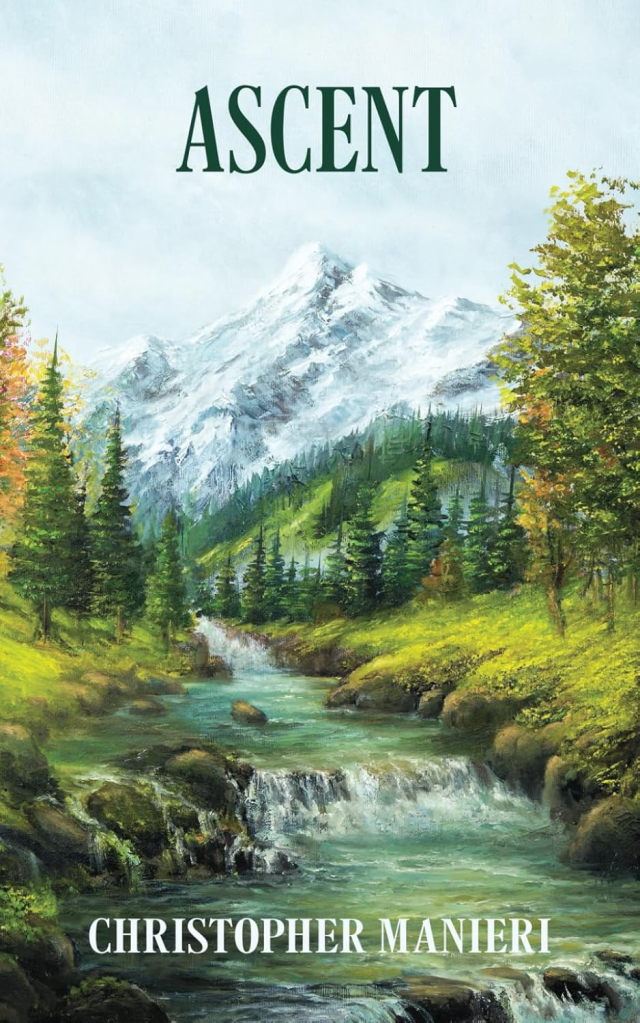
Review of The Ascent by Christopher Manieri, Careggi Press, 85pp (2024)
Those familiar with Christopher Manieri’s other collections such as The Voyage are familiar with his approach to philosophical poetry. What differs in this collection is its use of language. Far more modern yet refined, Ascent presents a resounding image of human nature. Written from the individual longing of the poet, the language bears philosophical reflection with colloquial brevity.
Manieri is deeply familiar with philosophical and religious traditions from across the world. This collection borrows thought from sources such as Plato, Plotinus, Zen Buddhism, Advaita Vendanta, mythological figures and the mystics who are seen as expressing a common vision. This vision is one of unity within plurality. It is not ironic that Manieri divides his thought among these traditions because they resolve in a common longing for ascent. Ascent is taken metaphorically as the realization that the cosmological order is composed of Consciousness (“matter derives from consciousness” he writes in “Consciousness”). This Ultimate Mind transcends the individual mind, its doubts and functions, yet resembles it. The Supreme Mind discovers itself through multitudinous creation. Ascent is the ascent to Mt. Sinai to discover God, realizing one’s true nature is identity with Brahmin; in this ascent, language fails us because awe overtakes us.
“In the Library of My Youth” has a certain resonance with poetry in A Boy’s Will by Robert Frost. Frost writes in “Waiting Afield at Dusk”: “And on the worn book of old-golden song / I brought not here to read, it seems, but hold / And freshen in this air of withering sweetness; / But on the memory of one absent most, / For whom these lines when they shall greet her eye.” Manieri personifies wisdom: “I may never see her glory again. / But how should I approach? […] She’s a modern Diotima. I should / be talking to her, not thinking / of death, always compelled again / towards more aching cogitations.” In both poems, wisdom is held somewhat distantly through longing. While Frost’s colloquialisms feel out-of-date now, Manieri revives the thought.
Ascent is rife with personalities. Aside from the philosophers and mystics who lived, Manieri’s use of allegorical dualism provides attitudinal contrasts between human archetypes. Take for example “The Conqueror and the Hermit,” a poem representing conquest in contrast to the contemplative life. The hermit tells the king, “Your empire is merely a tiny speck of sand,” that he should “detach from that wheel” and take his “voyage to freedom.” Manieri concludes the poem:
Your endless thirst can never be quenched
by the finite, but only by the Infinite
The poem illumines a question. The ‘wheel’ is the wheel of karma. If ambition signifies human frailty and sin, why do we have appetites? Does ambition not quench them? However, Manieri suggests that ambition is quelled living the vita contemplativa. Such a philosophical position reminds me of Aristotle’s expectation of a virtuous society: that it grants enough leisure for contemplation. Another expression of allegorical juxtaposing is “The Cosmos and the Child.” The dialectical conversation between the cosmos and the child offers, “How can you know / anything if you don’t first know the nature of the knower?” The essence of meaning itself is dialectical, “throwing stones into the water, / watching the circles radiating out.” Much of Manieri’s language, though derived from existential anguish, traverses a different realm than Existentialism.
Ascent is not just a poetry collection describing metaphysical ascent in the manner of so many spiritual poetries, it also clasps the heart of what it means to ascend—to live with purpose, to trust “the unfolding of the cosmic way,” as the final poem “Oneness” states. The final verse of the book is a wondrous answer to all its doubts:
Devoted to transcending the cavern,
I must heal my wings for the ascent,
ready to finally vanquish the void,
to triumph over grief, my deep longing
now intensifying as I keep striving
towards that unity, towards that oneness.
Dustin Pickering is founder of Transcendent Zero Press. He has contributed writing to Huffington Post, Los Angeles Review, The Statesman (India), Journal of Liberty and International Affairs, The Colorado Review, World Literature Today, and several other publications. He is author of numerous poetry collections and books including Salt and Sorrow. He placed in the top 100 for the erbacce prize in 2021 and 2023, and was a finalist in Adelaide Literary Journal’s first short fiction contest. He was longlisted for the Rahim Karim World Prize in 2022 and given the honor of Knight of World Peace by the World Institute for Peace that same year. He hosts the popular interview series World Inkers Network on YouTube and co-founded World Inkers Printing and Publishing.
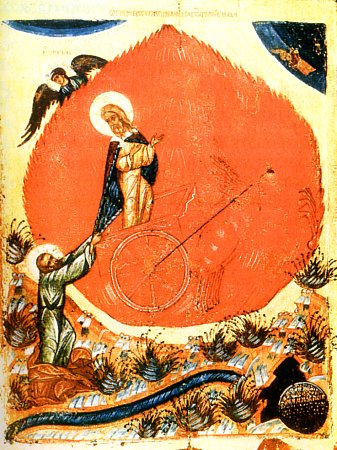
Reading the 16th century Russian icon, “The Fiery Assent of the Prophet Elijah,” also called “Elijah on the Fiery Chariot.”
Tishbite of Tishbe, bidden to the brook, Hidden to cherish Cherith, drying days— The raven read your drought and went without. He kept you, fed you, brought you bits of bread and meat. He crowned your ground with silhouette, wide wings, the markings of mendicant rook. Dried up, the brook cried out, “Arise and go.”
You left and found a widow and her son gathering sticks—like birds—to fix and mix fire for their final meal. You said, “Fear not. The meal shall not be spent, oil shall not fail.” They kept you, fed you, brought you bits of bread.
You heard the Word and left the widow bird, going as Gilead to bewilder Baal. Upon your twelve, your testifying stones, All was consumed in fire, fire of the Lord. Baal’s prophets taught, you took them to a brook That could not quench or counter with a cry. Down in the Kishon brook, you killed them all.
“Enough, it is enough,” you said. “I’m no Better than debtor drown, O Lord, please come And take my life.” And laying down you slept Beneath the broom, and soon, an angel came And kept you, fed you, gave you bits of bread.
Your icon—Fiery Ascent—is written Within these whirling winds of First and Second Kings, in the words of birds and pilgrim bread. So fed, you rise in elevated host, The burning and unfailing oil of orange, Drawn to the blessing arm of God, you go, Leaving Elisha cloaked with fiery dawn.
Maura H. Harrison is a writer, photographer, and fiber artist from Fredericksburg, VA. Her works have appeared or are forthcoming in Amethyst Review, Dappled Things, Ekstatis Magazine, Solum Journal, Windhover, and others.
Fog creeps in from the sea. Seven pelicans sail overhead; silhouettes in the mist. I find a stone with a keyhole.
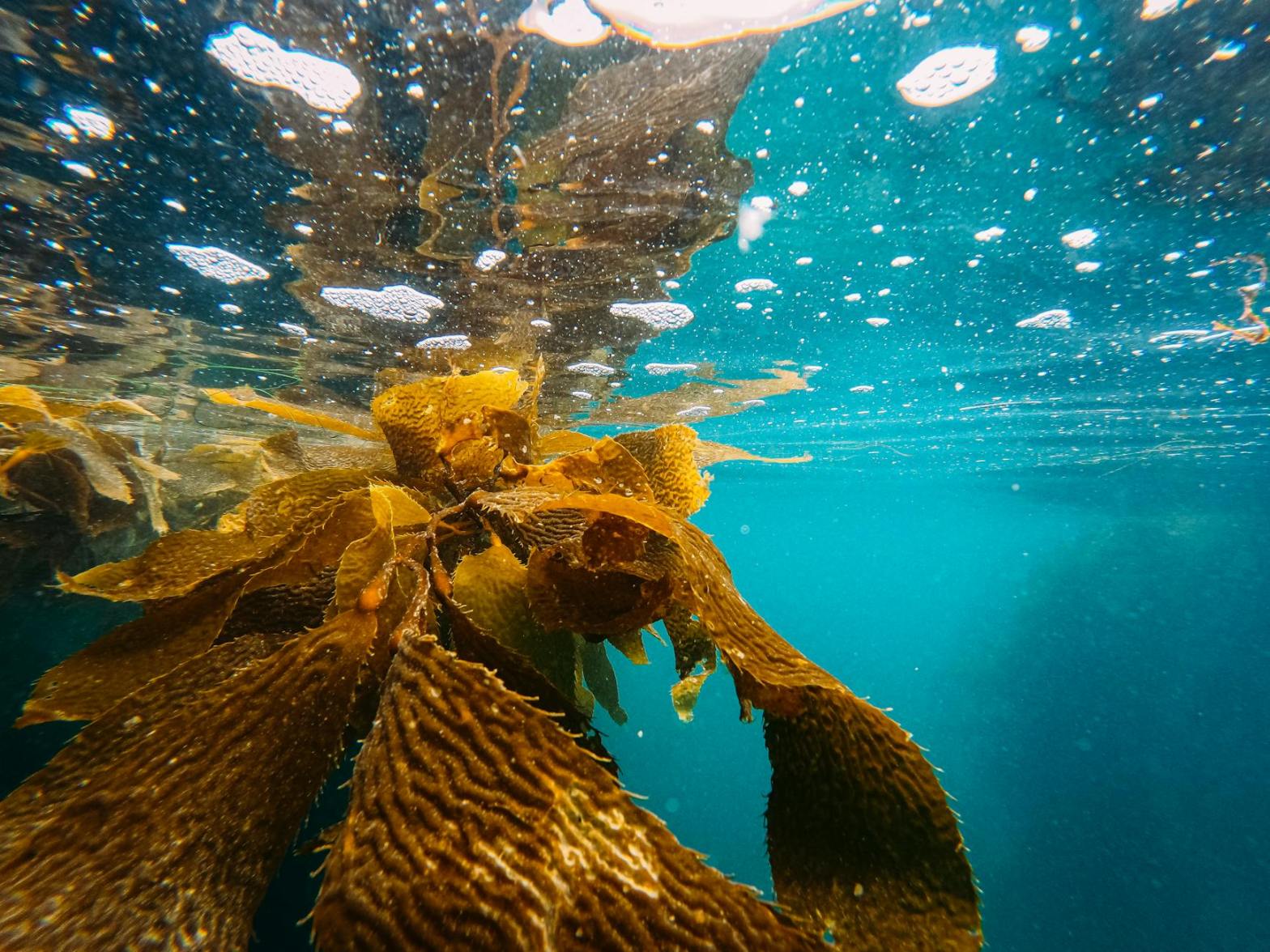
The beach is littered with kelp. Translucent blades, criss-crossed with ridges. Firm airbladders. The holdfast grips a rock with many fingers.
The kelp whispers questions: What lifts you up? What do you cling to? How do you find balance between holding on and floating away?
Agnes Vojta grew up in Germany and now lives in Rolla, Missouri where she teaches physics at Missouri S&T and hikes the Ozarks. She is the author of Porous Land, The Eden of Perhaps, and A Coracle for Dreams (Spartan Press) and of a chapter in Wild Muse: Ozarks Nature Poetry (Cornerpost Press, 2022.) Her poems have appeared in a variety of magazines; you can read some of them on her website agnesvojta.com.
Pollen is dripping steadily like rain under the white crepe myrtle – sweetness falling off bees that swarm the blossoms: bundles of lace forming at the end of branches. Opening its veins, the tree is offering a feast. Tipsy on pollen, bees are spreading their wealth among the flowers. Arbutus, green guardians, forming a wall along the garden’s edge: privacy for the spider’s web between two branches growing to the sky. Fragrances spinning through the air, seduce the hummingbird, cause mockingbirds to sing with gusto from atop cypress trees while sparrows are building a nest next to the downspout that feeds olive shrubs. Along the walkway, paddle plants are blushing under the sun’s attention, while manzanita stretches over the ground: a covering for the neighbor’s cat to tread when night falls. A low hum is settling over the garden as sap moves through branches and leaves, as blood courses through veins – bringing life to cells that allow eyes to see leaves forming on the azalea, feed lungs inhaling the sweetness of pollen before it becomes honey on my tongue.
Margaret Anne Kean received her BA in British/American Literature from Scripps College and her MFA from Antioch University/Los Angeles. Her chapbook collection, Cleaving the Clouds, was published by Kelsay Books in 2023. She is a Pushcart Prize nominee and her work has appeared in various journals including Eunoia Review, San Antonio Review, EcoTheoReview, and Tupelo Quarterly.
I watch a mass of red-winged black birds in the high distance flock against the turning leaves, watch them rise, tar wings cutting the sky, cresting the hazy red dusted tree tops surfacing beneath them. The sadness inside me sears blue, & I feed it my skin, my bones; still it begs, batting at my tendons like a cat. On the edge of deliverance, the fondness of solitude, the sadness curls up, purring in my chest. I think about the way it presses to my forehead like a kiss, chewing into my skull, burning my breath. They tell me to count to ten, name five things I can see, four I can hear, to breathe in a box, but still I slip into collapse— a ghost born naked, scraps of flesh, snippets of voice, face of my fear, hostage of my bones. I’m trying to make sense of what came before, before they rose, lifted their razor-sharp wings, & I call out across a cloudscape torn with black gales never having fully understood the bounty of birds, forgiveness of sins, wipe my brow of the wet, muted, worn, warm hunger calling my body home to rooms more haunted than me, knowing now better than to betray the spirit, for it speaks the language of God.
Ariana D. Den Bleyker is a Pittsburgh native currently residing in New York’s Hudson Valley where she is a wife and mother of two. When she’s not writing, she’s spending time with her family and every once in a while sleeps. She is the author of four collections and twenty-one chapbooks, among others. She is founder and publisher of ELJ Editions, Ltd., a 501(c)3 literary nonprofit. She hopes you’ll fall in love with her words.
1. Love has tinctured the soles of my feet the hue of the One Who Springs From Tongues. When I sang the range of notes in the mountains, it was only scales and arpeggios. Hearing Her tonic, I toss as melody in the wind. Let those whose Beloved is mute clamor at doors. Mine hums in the smallest cells, as stars within eyes.
2. If we could reach Her through a diet of krill, I would have asked to be born a blue whale in this life. If we could reach Her through the statuesque hunt for a lizard among the bird of paradise plant, then surely the saints would have been egrets when they descended. If reading oak with our hands could show us the way, I would have transcribed the ravines of its bark in both rainfall and drought. Only tears and sweat fallen into the well of peace will bring you to Her.
3. With the heel of Her palm She presses into me mango that I am to feel if ripe then cuts to my pit undresses my peel holds me to Her mouth like an ocarina and plays
4. I smoldered and at last have burst as trapped sap freed from firewood o brief ember dispelled into sky
Bradley Samore has worked as an editor, writing consultant, English teacher, creative writing teacher, basketball coach, and family support facilitator. His writing has appeared in The Florida Review, Carve, The Dewdrop, and other publications. He is a winner of the Creative Writing Ink Poetry Prize. Website: www.BradleySamore.com
For those who sleep beneath their stones: Grip tight, hold deep their naked bones.
For those who live and toil above: Turn still, forgive our lack of love.
For those not yet but soon to be: Annul our debt and leave them free.
And when this race of pests is gone Wipe clean your face and carry on.
Simon MacCulloch lives in London. His poems live in Reach Poetry, The Dawntreader, Spectral Realms, Aphelion, Black Petals, Grim and Gilded, Ekstasis, Pulsebeat Poetry Journal, Ephemeral Elegies, Lothlorien Poetry Journal, Emberr, View from Atlantis, Altered Reality, The Sirens Call, The Chamber Magazine, I Become the Beast, Lovecraftiana, Awen and elsewhere.
I see you from a distance, a figure from another age, under a sweltering sky.
I weigh up your watering cans, your coat of loden green, your waistcoat, double-breasted, every button different, straw hat wide-brimmed, shadowing your face.
Why place yourself so picturesquely here? I approve your presence, you perfect a perfect view, foreground to abbey walls, their slabs of shadow dark on flawless lawns.
A travelling gardener you say you are. You’ll spend a few months here, and then move on. You used to play the tuba in an orchestra. You no longer have a wife.
Turned vagabond, your old life grown too small or worn too thin, are you searching for a new persona, embodying a pastoral ideal?
Or perhaps an honest journeyman, your waistcoat marks your status, craft and task? Or is the Benedictine cross pinned to your hat a sign of pilgrimage, your search for grace?
The darkened patch you watered is full of the sweetness of geraniums and roses, and the smell of wet earth.
Pam Stocker has facilitated local poetry and writing groups for many years, performs at open mikes and leads creative retreats. She loves collaboration and community, and gets pleasure from facilitating the writing of others, whether they consider themselves creative or not. She worked as an English teacher and retrained as a Gestalt counsellor. Now she has more time, she is writing and arting, sailing, cycling, walking and doing ballet. Faith, for her in a Christian tradition, brings with it the potential for growth and depth, making way always for both ambiguity and trust.
Hollowed by the smallest loss in a forest upturned by hooves,
borrowed shine will blink beeswax light into your body.
This is how it happens— a votive that doesn’t know
it’s a prayer will ache its way into your throat.
Where fawns hide, your eyes will blossom. Your bones will branch.
You will be sweet sponge moss, the click of silver beetles.
Ellen Devlin is the author of chapbooks Rita and Heavenly Bodies at the MET, both published by Cervena Barva Press. Her recent journal publications include: Beyond Words, 2023, Muleskinner Journal, 2023, Rock Paper, Poem, 2023, Westchester Review, 2023 She lives in Irvington, New York





 Amethyst Review