

From the Upanishads – a poem by John Claiborne Isbell

From the Upanishads

“Lead me from the unreal to the real.”
The web of dream and waking fills my mind
as daylight fills a glass. My weary path
does not fork but leads back to where I’m from.
A lamp, a chair, a window – now my old
familiar room is speaking. It is not
speaking English. In the woods outside,
behold the trees I climbed. How tall they were!

As the mountaineer reaches the summit,
the mountain disappears from under him.
The stopped clock tells the time; the blue
ocean parts neatly, like a loaf of bread.
This is not the journey never made;
this is not the futility of achievement.
This is the painted crab scuttling off the wall,
the long years unwinding and the glory they reveal.

To know the light, we learn to know the dark.
To smile, we learn the many ways to weep.
We hear the nightingale to hear the lark,
and only wake when we have been asleep.

John Claiborne Isbell is a writer and now-retired professor currently living in Paris with his wife Margarita. Their son Aibek lives in California with his wife Stephanie. John’s first book of poetry was Allegro (2018); he also publishes literary criticism, for instance An Outline of Romanticism in the West (2022) and Destins de femmes: Thirty French Writers, 1750-1850 (2023), both available free online. John spent thirty-five years playing Ultimate Frisbee and finds it difficult not to dive for catches any more.

The Desert Fathers – a poem by Jeffrey Essmann

The Desert Fathers

We have their sayings, strange and wise,
With just enough of sandy grit
To take the soul quite by surprise
(A horse that of a sudden shies…)
At what at first can only seem
A Christian life lived so extreme
One knows not what to make of it.
And yet there is the strange allure
To leaving everything behind
And staking out a place that’s pure,
Uncomplicated, insecure;
A place where all you have to do
Is every day surrender to
A Word you simply can’t define.

Jeffrey Essmann is an essayist and poet living in New York. His poetry has appeared in numerous magazines and literary journals, among them Dappled ThingsAmethyst Review, the St. Austin Review, The Society of Classical PoetsThe Road Not TakenEdge of Faith, Pensive, and various venues of the Benedictine monastery with which he is an oblate. He is editor of the Catholic Poetry Room page on the Integrated Catholic Life website.

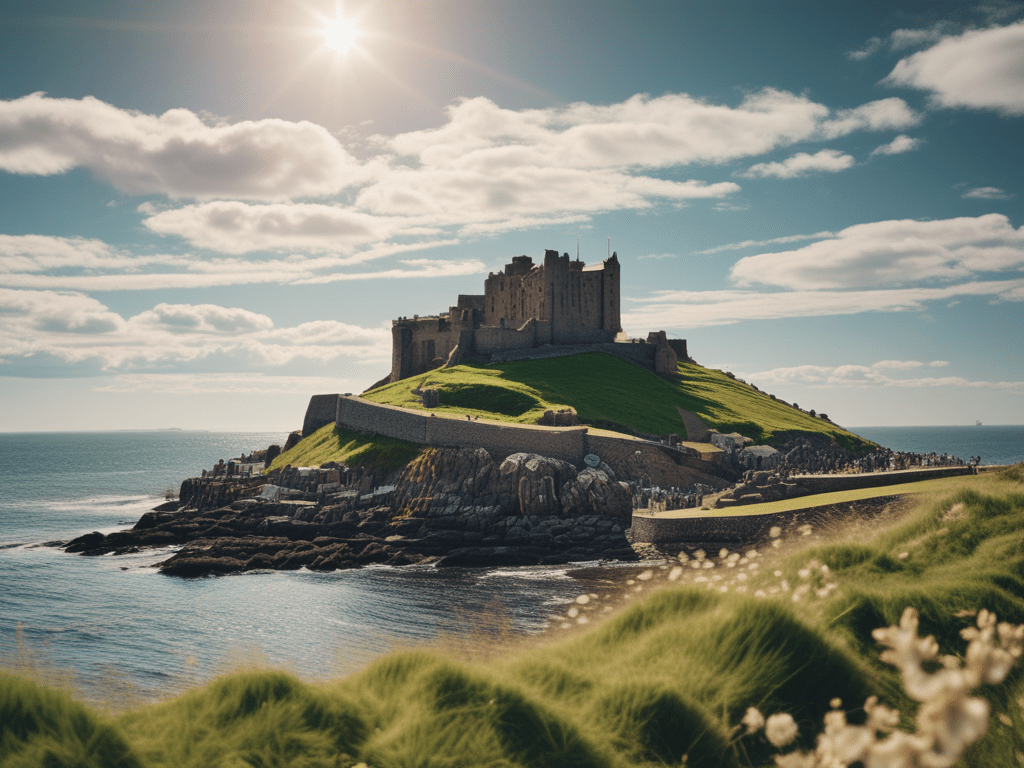
Saint Cuthbert’s Isle – a poem by Helen Jones

Saint Cuthbert's Isle

By day he watches
Gulls swooping overhead, looping and turning,
Twist in impossible intricacies of flight,
Sun touching films of gold on waves’ white tips,
The seals, grey otherness undulating over water,
Their heads a punctuation on a darkened sea,
The eider-sergeants marshalling straight lines
Draw spaces for the writing of the world.
Herons, stark capitals standing on the shore,
And in the margins of his eyes, black oystercatchers
Are tiny illustrations in the book of life.
By night he hears
The seal-song slicing through his ageing bones
As knife cuts paper.
He watches stars
Swirling their silver on a velvet sky
And feels the motion of the world around.
He does not know
Eadfrith will make a book from all these things.
Here he can read the book of all the world
And know all things are one.


Helen Jones was born in Chester, U.K. in 1954. She gained a degree in English, many years ago from University College London and later an M.Ed. from the University of Liverpool. She is now happily retired and spend a lot of her time writing and making a new garden. Her poetry has been published in several journals in the U.K.

The Coaxing – a poem by Vikki C.

The Coaxing

Because I was young and left searching,
a dress never to fit, but to fill its journey,
windblown therapy on hard red roads.

Like an open book, its strangers shifting dust
so that each day may begin simply—
the mare’s smooth head raised to morning,
a ruby on each horizon, worth a child’s devotion.

To pause and play and waste a little light—
in corners of my own blooming,
your body returning an ancestral gift.

Because the horse lowers its head at dusk,
water spreads wide with moonlight.
There is pleasure in the sound of drinking
as some measure of death, stripped of clothes
— or lovers by a river trying not to drown.

I miss how hands comfort through a war,
I miss the depth of snow’s indiscrimination.

Because I am old and left searching,
a foal in June leaves what must be left—
its coat a flaxen vision I had not witnessed,
nor thought of chasing on my way through.

Vikki C. is a British-born, award-nominated writer, poet and musician whose work explores the intersections of ecology, myth, existentialism and the human condition. She is the author of the chapbook The Art of Glass Houses (Alien Buddha Press, 2022) and the full collection Where Sands Run Finest (DarkWinter Press, 2024).

Vikki’s poetry and fiction are internationally published/forthcoming in Stone Circle Review, EcoTheo Review, Psaltery & Lyre, ONE ART Poetry, The Inflectionist Review, Ballast Journal, Dust Poetry Magazine, Ice Floe Press, Black Bough Poetry, DarkWinter Lit, Acropolis Journal, The Belfast Review, The Winged Moon, Sontag Mag, Boats Against The Current, Nightingale & Sparrow, Origami Poems, Jerry Jazz Musician, Lazuli Literary Group and various other venues. 

Psalm – a poem by Skinner Matthews


*To Virginia Woolf. Her boulders and chains, her sojourn into the river Ouse.
What have we to measure
the distance we are
from ocean or albatross?
The pieces of offshore reef
breaking on barrier islands
a dead white alabaster
adrift of their environment.
Chrysalides of thoughts
and beliefs and each
dies easily. The truth never
lasting as long as it should
so we follow what? Maps
their lines, their geographies
the sciences, the furrowed fields
we farm, the chasms and crevices
of each mountain, canyon
and valley. Is nature so simple
and complicated in its sophistication?
The hummingbird, the bee, flower
the pupa, so small yet carrying
the weight of the world. So simple
so pure yet how do we avoid
the bottom of the river Ouse?*
find inner sanctum where we belong?
if we are not free of all but the ties
that bind us—to the sorrow, the joy
the thrum of opening and closing
and opening and closing
and opening.

Skinner Matthews is a poet living and writing in Bluffton SC. He writes for spiritual enlightenment of, and with an informed knowledge of the working class. He hopes his poetry brings light to the many dark places that exist like landmines in the streets, neighborhoods, and family households of the working class. His work is published or forthcoming in Autumn Sky Poetry Daily, Livina Press, Ekstasis, As Surely as the Sun, Rising Phoenix Review, Stray Branch Literary Journal, and Sea Change Anthology [8th Edition]

Sunrise – a poem by Rita Moe

Sunrise
Wheatstack

Grainstack, Sun in the Mist, 1891
Claude Monet


“Only Monet could make a cathedral out of a grainstack.”
—Bruce Dayton


Dazzled at being chosen,
each bead of dew
flashes fire,
dances into vapor,
and ascends.

Rita Moe is a poet, knitter, & gardener.  She is the author of two poetry chapbooks: Sins & Disciplines and Findley Place; A Street, a Ballpark, a Neighborhood.  Now retired from a Minneapolis investment firm, she is the mother of two grown sons and lives with her husband in Roseville, MN.  

Hollow – a poem by Timothy Geiger

Hollow 


In the meadow there is this green undoing,
this diastolic thumping,
this deference to cloud-light,
milkweed floss,
and the torn, red-tipped wing of blackbird
rendered by hawk-strike;
all becoming equal parts
suffering into resignation,
maybe faith.
I have nowhere else
to go with my shovel
but out here, into the past
making holes.
Sanctuary
is not what I would call it—
the goldenrod has gone
to umber dry stems, bones fill the earth,
it bends and swallows—
but a single startled sunray
shimmers the back of the rabbit
darting from a swale
of orchard grass, follows it into the ground.


Timothy Geiger is the author of the poetry collections Weatherbox, (winner of the 2019 Vern Rutsala Poetry Prize from Cloudbank Books), The Curse of Pheromones, and Blue Light Factory. His newest collection is In a Field of Hallowed Be, (September 2024, Terrapin Books). He lives on a small farmstead in Northwest Ohio and teaches Creative Writing, Poetry, and Book Arts at the University of Toledo.

Offering – a poem by Jeff Burt

Offering

Look at my psalms, he misspoke,
holding his upturned hands
like blossoms toward my eyes,
and flashes of his work with wood
appeared, honey gold of the finish,
the plane smoothing the grain,
the sandpaper that softened
both a corner and his fingers
and removed a portion of his identity
and gave it like a gift to the wood,
thumbs crippled, his palms
extended in lament, worship,
beseeching, triumph.

Jeff Burt lives in Santa Cruz Country, California. He has a digital chapbook available, Little Popple River , from Red Wolf Editions, and print chapbook from A Filament Drawn so Thin from Red Bird Chapbooks. He has previously contributed to Amethyst Review.

The First Real Line – a poem by Aaron Brown

The First Real Line

Each poem an opening,
an image held and praised:
your son at play in rain,
wet yet unaware that time
asks in. Each poem opens
overwrought, so often,
your broken runner’s stride
never warm and gliding.
Await the first real line.
You will know it,
you, looking over
a draft, will realize
the sacred has come
calling, you who’d
rather muscle your way in.
Give yourself
to the language that knocks,
follow it to the next door.

Aaron Brown is the author most recently of the poetry collection Call Me Exile (Stephen F. Austin State University Press, 2022) and memoir Less Than What You Once Were (Unsolicited Press, 2022). His debut poetry collection, Acacia Road, won the 2016 Gerald Cable Book Award and was published by Silverfish Review Press. Brown grew up in Chad and now lives in Texas, where he is an associate professor of English and directs the writing center at LeTourneau University. He holds an MFA from the University of Maryland.

The Bringer of Fire – a poem by Edward Alport

The Bringer of Fire

Tell me, old man, I said to the figure
hunched in the doorway,
why are you waiting here
for the odd thrown coin?
There is a world you must have seen.
Didn’t it glitter? Didn’t it
beckon you with its soft sigh?
What are you waiting for
half in darkness, half in light, as the world passes by?

He had a bloody bandage wound around,
and an ancient bowl, rough with years, smoking at his feet.
I saw the world, he said.
Saw it from a distance, you could say .
From a mountain top.
I gestured with distain.
A safe distance?
Not very safe, he grunted, shifting in his pain.

He caught the coin I threw,
before it hit the bowl,
but some low-life swooped
and seized the bowl, dropped it,
howling, and ran with hands smoking, red raw.
The old man looked at me. I came all this way,
he said, to give you this glow.
Take it.
Use it wisely.
And don’t burn the place down as you go.

Edward Alport is a retired teacher and proud Essex Boy. He occupies his time as a poet, gardener and writer for children. He has had poetry, articles and stories published in various webzines and magazines and performed on BBC Radio and Edinburgh Fringe. He sometimes posts snarky micropoems on Twitter as @cross_mouse.