Sandbar
… everything floats on the brink,
suspended
above the long tunnel of disappearance.
—Mark Doty
Lift the hand. One sweep . . .

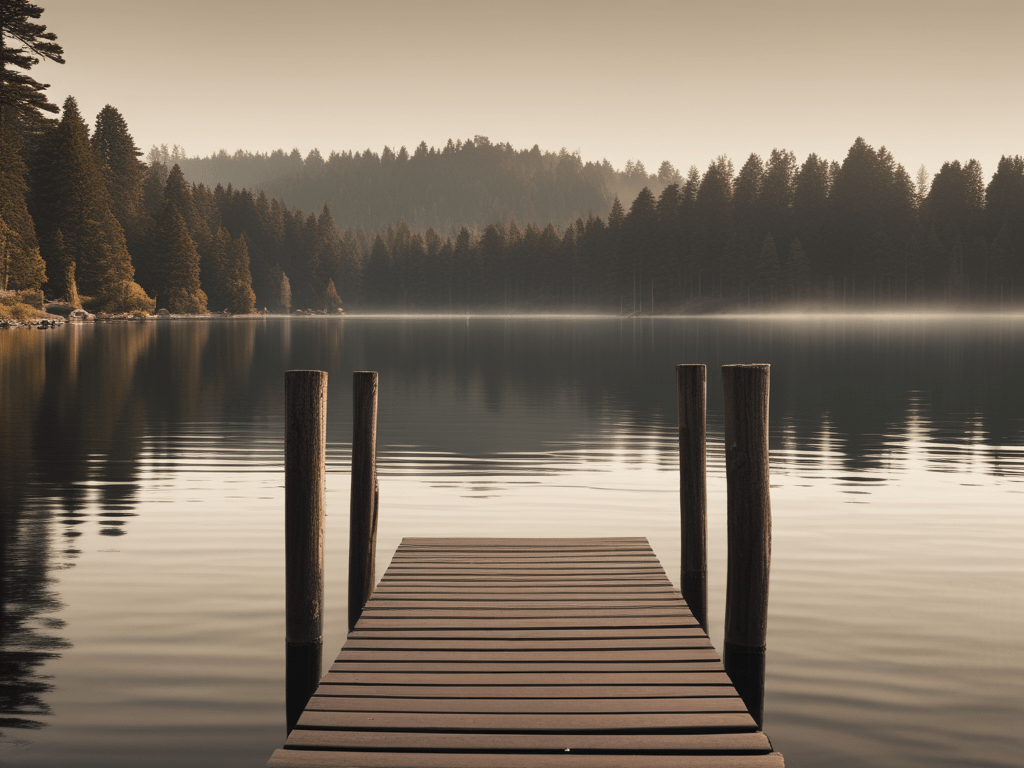
. . . and here is the redwood dock
jutting into Fowler Lake,
the silt-green scent of July
in the ‘60s—that ashy,
granular drift rising
from Daddy’s cigar.
“Lifejacket,” he calls, holding it out.
I adore him but loathe wearing the thing. It smells of sweat and dismay and forgotten bait, left to wilt in the dented coffee can.
Galvanized pipes anchor memory’s walkway. The air flutes across them, a breathy moan like a mourning dove. Once upon a dock my little kid-self hurried from one to the next. Someone tiny was trapped down there—she needed our help! Dad would chuckle and ruffle my hair. Then he explained acoustics.
Over here is our rowboat, the color of dirty nickels. And here is childhood’s sunburned face and throat framed in a horseshoe of orange kapok. Dad doublechecks the lifejacket clasp, then snugs the canvas straps. He steadies the boat while I clamber onto the seat. I’ve never soloed at dusk before—but the sandbar calls.
“Stay close to shore,” he says, and “the current never sleeps.”
⚬
The way Dad tells it, every so often a swamp gets handed a new life. City fathers meet with developers. Permits change hands. Realtors weigh in. Workers bulldoze a channel, then drain the mire. Loggers fell trees. Dredgers arrive.
Soon an entire town, dreaming of boats, will pray for rain.
Meanwhile, until the crater fills, ragged stumps litter the foot-sucking goo. Seepage eddies around debris, as if water forgets where it’s going.
I reenter memories like rooms and leave them, emptyhanded, only to retrace my steps. What was it I wanted?
⚬
Sunglasses, beer cans, a tennis shoe—the sandbar offered a grainy canvas for small-town jetsam dropped off by the current.
Weedy depths rife with invasive milfoil surrounded the shoal, absorbing sediment thick as regret, washing down from the river. Rowing in close, a girl could ship oars, watch the silt as it mushroomed around a carp, and one time, a menacing garfish. When the gar started nosing around our pier, Dad bought a gaff, wickedly barbed. Weeknights after work he patrolled our dock, that wooden shaft with its hungry hook riding his shoulder: man + plus weapon vs. a fish like a lead pipe.
Raise the gaff. One hurl . . .

. . . Mean as a shadow
or baby crocodile,
that armored carcass
filled Mama’s washtub.
Wanted: one hero. One manmade lake. One last summer, exuding magic.
⚬
Looking back now feels akin to wearing a swim mask, alternating marvel and blur. My father worked longer hours, sometimes arriving home to stoop over my bed and murmur goodnight.
“Dad,” I’d say, “You should’ve been here! I nailed the Jump Stumps—all four.”
Submerged a few yards beyond the dock, they resembled elevated stepping stones, bone-jarringly slick with fish eggs. The game? Leap from one to the next without plunging into the muck below. He’d chuckle over tales of missed footing and billowing clouds of sludge. Then he’d tiptoe away and close the door.
⚬
Builder of Docks, Boat Meister, Garfish Slayer—behold the Saturday dad in waders as he savors his stogie, rakes out the newest layer of trucked-in gravel. He means to keep those weeds at bay. Ankle snares, he calls them. Parasite hotbeds. No summer rash will threaten his girl.
Maybe he’ll hammer together a raft, lash the platform to oil drums, anchor it deep. Any time she wants she can leave the shore, butterfly-stroke to her own private island.
⚬
He’s watching me now, spreading my oars, pulling away from the pier and into the gathering gloom.
“Keep an eye on that sky,” I hear him call. The hand with the lit cigar waves. A reddish wink stutters beneath the trees.
Down-lake, church lights on timers switch on. Their long beams span the water, slatted like blinds opened halfway: wavering bars of brightness and shadow. Who knows what cruises beneath the rippling surface?
Shivering a little, I hear milfoil sliding beneath the hull. So creepy. And the vesper bats are rising. I could turn back. Should.
Don’t.
⚬
Decades later, I’m stalking specters. Or irretrievable magic.
Have you ever watched an aquatic weed cutter mow a lake? Imagine water wheels churning, the scre-e-e, ka-chank, clank of machinery—massive, grinding—the tilted conveyor belt moving the heaped vegetation up, up, up its ramp till the whole wet snarl drops from view, into the rear cargo bed. Run aground on the sandbar . . . and then what?
Noonday heat. Humidity. Stink.
O how insistent, the un-laid ghost. Even the biome carries its echo.
Do I want revenge? Temptation, you spread like milfoil. Sly. Noxious. Self-fragmenting.
Eventually, even Daddy succumbed. I imagine his secretary tilting her head, alert to something strangling his joy. Close, then closer, she moved in, desire churning.
A year later he left us for her. Left the house, the boat, the redwood dock. Swamped in anger and grief, I skipped the wedding. Call it angrief, that ache cinching a girl’s windpipe, snaking around the lungs. Last shot at happiness, my eye. I’d show them. No gift, not even a card. Acknowledge his new life? Why would I?
They bought a house, three blocks from ours.
⚬
If only they’d tangled more, like those shorn weeds clogging the lake: burgeoning chaos that finally succumbs to the blade and barge; one more unwanted entity dropping out of sight.
Nope. They embodied sappily-ever-after.
⚬
Rowboat-me lucks out, locating the sandbar as dusk falls. I am alone with a freshening breeze chasing its tail, a few early stars. Below me, five or six murky shapes rest on shifty ground. What are they? Too cold now to go wading. Plus, Daddy wants me home before dark.
Another day, then. The lifejacket chafes as I push/pull the oars, reversing direction for home. It takes practice to master the hard turn.
Catch, drive, recovery: these are the names of the strokes.
⚬
“It is the hour of the pearl,” Steinbeck wrote, “the interval between day and night when time stops and examines itself.”
These days I feel suspended between two eras—now, and before—the sandbar somehow present, yet gone, along with the redwood dock and oars dripping water like unstrung pearls. The lake itself is reportedly shrinking amid encroaching weeds.
Over the years, time and therapy have mostly dredged the angst of betrayal, layer by layer. But there are questions I’d ask my father today if I could.
Sometimes, what remains unanswered chafes.
⚬
Do you remember? Once upon a tree, when time shed its yellowing gloves, like leaves, maybe you curled them into funnels, stitched them closed with a twig: little houses for fireflies.
Now, leaning into lightless times, you start feeling around for the old contours. Shelter. Mostly the twinkling.
⚬
He dies young, younger than I am now. His wife hoards his ashes, creates a shrine in the living room. What wouldn’t I give for a share of his cremains? A spoonful. A smear.
I cradle these aging hands once callused from gripping oars, and, in the space of a wish, time eddies, then slips sideways.
And I’m back, back in the tomorrow after my trip to the sandbar.
My best friend and I toss lifejackets into the boat. So uncool. Daddy’s at work, so he can’t insist. I row past the Jump Stumps, intent today on locating the queen of them all: Hydra, the sandbar’s guardian monster. Amid floating mats of weed, a length of trunk slues sideways, crowned with roots that taper to spikes. With my oar I tap the point nearest the surface for luck, and onward we go.
When we finally locate the rising ground, I heave out the anchor. The stern swings around. My friend looks up in surprise.
“There’s something here,” I say. “Maybe clams. I saw them last night.”
Leaning over the gunwale, we peer through the amber shallows. At the far end, sunshine highlights a scatter of mottled shells, lumpy and possibly hinged. We stare at each other. Clams mean pearls, right? Which also means cash.
“Daddy says pearls fall from the sky when dragons fight.”
My friend nods. “Cuz they’re made of moonlight, trapped inside dew.”
Laughing, we clamber overboard to gather shells we believe to be priceless. What, oh what, will I buy first?
⚬
“Sorry, kiddo,” Dad says. “Not clams.”
Nor were they oysters. Those dead, freshwater mussels utterly failed my innocent hopes.
⚬
You can read this in a book. Sandbars come in three types: permanent, seasonal, or evanescent. Some rise above the water’s surface; others lurk beneath it, hazards to passing boats.
Imagine waves and currents interacting, day and night, relentlessly bearing suspended silt and gravel, sloughing it off at the same place.
In my day, the sandbar in Fowler Lake was a moving target. Locating it meant courting luck as well as visualizing two perpendicular lines, like crosshairs: one running straight from the willow shading the bay, the other extending from the end of the neighbor’s pier. The imagined meetup more or less marked the sandbar’s heart. And sometimes, its wavering hem.
I always believed it would hold me. But a sandbar can collapse beneath the weight of a man in waders. Or a barefoot girl in her first two-piece swimsuit.
Ask the lake. What appears stable later upends assumptions.
⚬
A decade later and two thousand miles from the lake, I marry. My father declines to attend the celebration. No gift. No card. Nor will he ever visit my home in the arid West.
Payback?
Sporadic mail barely sustains our tenuous bond. His wife probably picks out the cards and nags him to sign them. Every few years, I take my children to see him.
⚬
One day my mother sends me her mother’s pearls. Their quiet gleam suggests mystery and risk and disappointment. Pearls aren’t my style, so into a box at the back of the drawer they go. No one tells me frequent contact with human skin keeps them burnished, glowing. Turns out ongoing touch is vital.
I finally reach for them while dressing for a funeral: the classic finishing touch. But the clasp breaks and pearls scatter across the hardwood floor. One by one, I drop them into my palm: dulled, inherited spheres. I should have worn them long before this, kept them close, maintained connection.
Something niggles, then shifts—like entering a room on an errand, then going blank. What was it I wanted? Perhaps to think about boats again, reliving mercurial summers. To pick out the luminous bits, string them together. To whisper, “I’m sorry.”
Two words . . .
And here is my father,
the ashen drift of cigar,
a man like a sandbar:
appearing, vanishing . . .
Nature and daydream and death collide. It feels like forgiveness. A small opalescence, ghosting within.
⚬ ⚬ ⚬ ⚬ ⚬ ⚬ ⚬ ⚬ ⚬ ⚬ ⚬ ⚬ ⚬ ⚬ ⚬
Laurie Klein is the author of two poetry collections, House of 49 Doors: Entries in a Life and Where the Sky Opens (Poeima/Cascade). A multiple Pushcart nominee and winner of the Thomas Merton Prize for Poetry of the Sacred, her prose has appeared in Brevity, Beautiful Things at riverteethjournal.com, Tiferet, New Letters, The Windhover, Cold Mountain Review, and others. She blogs, monthly, at www.lauriekleinscribe.com

 Amethyst Review