Cellular Theology
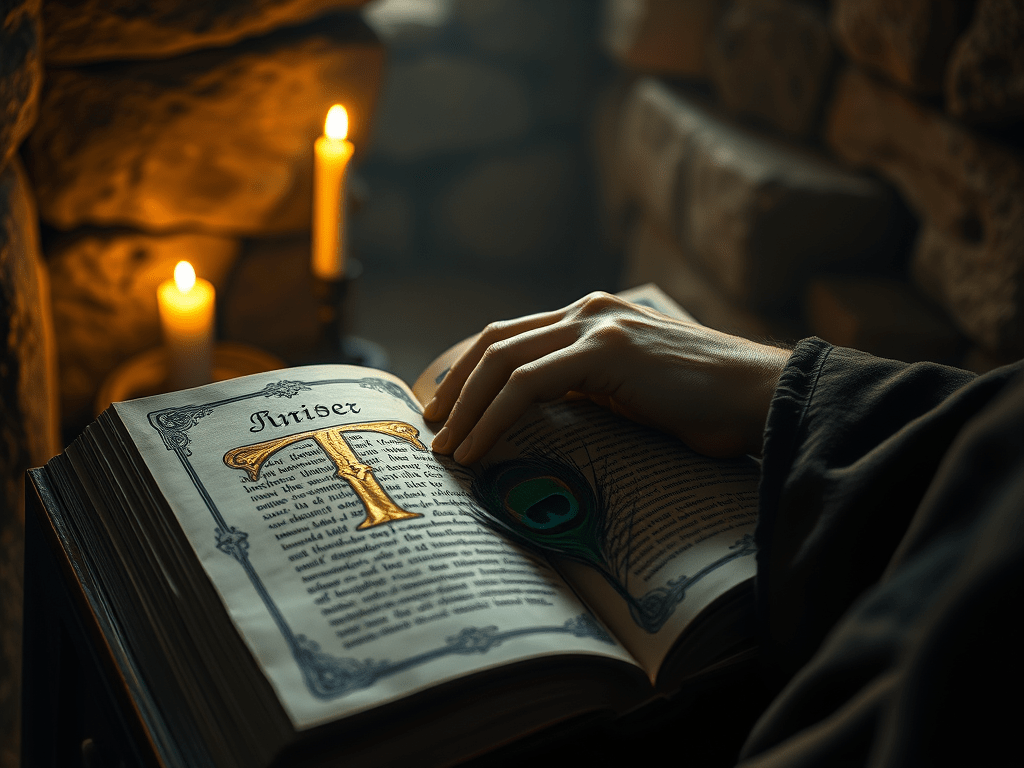
It is late. He should sleep, but tonight the monk feels a restless pull from the manuscript before him. Under the frail, flickering candle, the illuminated capital letter (the T of Tau) shimmers with gold filigree. It is a beacon—but the apostle’s words that follow are dull, mere shadows. Whenever this mood descends, everything becomes leaden—all that is real is the sullen flesh. His hand rests heavy on the vellum: calf skin. His quill is nothing but a bird feather: a dead thing plucked from a dead thing.
His gaze drifts to the whimsy added by a previous brother in Christ: a single peacock feather decorating the margin. Inexplicable. Indulgent. Why does it rivet him now?
His mind fixates on a vast peacock strutting before drab peahens, and regards his own drab robe—his solitary cell. He curses himself. Why does everything distract? Even in this cold, dark stone room—or because it is so plain?—so many serpentine streams flow underground into indulgent fantasy. Self-regard. A species of sloth. Why do feeble minds twist away, perverse, from the sacred source: the refreshing lake of God’s presence?
His mind fans out at the vague threat of Viking invasion. He fantasizes about killing marauders—engaging in the righteous slaughter of heathens. Protecting The Word. Him! Hero martyr monk! The banality of pride…
It is not all my fault, he defends himself feebly. His imagination is vivid from all the visualization techniques the Abbot taught him as a boy, training him to recollect all manner of catechism. To this day, each sin and virtue has a geometric shape and a color for him. And if his mind drifts, it may be because he hasn’t eaten a full meal in days—partially out of devotions, but mostly by circumstance. The oat stores grow thin, and weevils wriggle in the porridge, putting him off his repast.
The abbey cat purrs in the corner. Is she enjoying infused meditation? Bright dreams of bloody murder? He remembers her asleep outside in the summer, her head resting in a halo of feathers. What is it like to hunt? To pounce and—
No! An error! A cursed error! A repeated letter. Has he ruined the page?
He can’t lift his hand. His skin is fused with the calfskin vellum—one continuous medium. Something burns. He slides up his sleeve. Script swirls under the skin of his forearm—not Greek, Latin, Aramaic… The letters blaze. It hurts to look directly at it. He screws his eyes shut.
***
The peacock pattern unfurls in every direction. Within the details of each feather the monk spies interlocking figures: every martyr and persecutor, every sinner and saint, every angel and demon that has ever been or may ever be, all emerging from each other—dazzling symmetries! Consistent as syllogism! The Unsayable Form behind all forms!
Peering closer, the monk spies infinite monks with infinite concentration encoding the manuscript of manuscripts. They work in tiny cells—it is cells all the way down! Great cities emerge, and from them the City of Cities, its noise become choruses of perfection, its stink become perfume. Infinite city, and script, and scribes are one, are many. Sublime glory.
Now the feathers part: a gate. He is the gate, the opening, the way.
***
The abbey cat wakes with a start. She mews, then pads off, preying near the stone crevices where pests cower and twitch between frantic dashes into the light. The cat is oblivious to the new image on the vellum: peacock feathers perfectly rendered, profuse, swallowing all text, all errors, all sin. Beautiful, but unreadable. As the stern Abbot would say: what human eye could draw sense from such a wayward sign?
Colm O’Shea is a Clinical Associate Professor of essay writing at New York University.







 Amethyst Review