The Light She Kindles
The sun bleeds its final light over Seville, staining the sky in crimson and molten gold. Ana stands at the window, her breath fogging the glass as the winter chill seeps through the stone walls of the estate, uninvited.
It is time.
Her fingers trace the edge of the scarlet brocade draped across the table, its threads glimmering in the fading amber light. Two places set with gilded cutlery, two crystal goblets polished to flawless clarity, two chairs pulled close enough to speak in hushed tones. A picture of marital harmony, staged for an audience of one.
The short winter Fridays are a mercy. Antonio’s trading offices bustle until long after dusk, his return delayed by ledgers and the clink of reales counted behind locked doors. The servants—fewer here than in the mansions along the Guadalquivir—have been dismissed at noon, leaving Ana with only the company of her thoughts.
She lights the fire, watching as flame touches wick, and the candlesticks—small, unadorned, camouflaged amongst peonies and pomegranate centerpieces—awaken with a tremulous light. Shadows pool in the crevices of the wood-paneled walls, softening the room’s sharp edges.
L’hadlik ner shel Shabbat. The words slide from her lips, a blessing she has recited a thousand times, rising from some wellspring in her heart, half-forgotten, half-remembered.
This fire is not the pyre’s devouring roar, nor the Inquisition’s hungry blaze. It is the radiance of divinity and hope. The light that she can bring into her home. Even here, where shadows gather, this small flame is hers.
A tear pricks at the corner of Ana’s eye, but she forces it back, unwilling to let it fall.
Is it enough?
Is the light she kindles each week enough, when her soul shudders beneath the weight of all she hides? When the man of the house—the other half of her—crosses himself devoutly in the privacy of their bedroom? When she raises her children, innocent and pure, to call her ancestors’ faith heresy? When the life she has so carefully woven together rests precariously upon falsehoods too fragile to carry it?
Once, they had promised—young and idealistic, brimming with love—that they would preserve their faith, their heritage. That it would survive, undiluted and unbroken. They had reasoned that a drop of baptismal water could never wash away the essence of what they were.
But time, like water, wears down stone. Not with a single torrent, but like the relentless trickle upon rock—drop after drop, until the stone begins to yield. Even the Tagus changes course.
Some nights, Ana stands at the window, watching shadows pool in the street like spilled ink. She imagines vanishing into them: bundling the children into a cart, bribing a ship’s captain, fleeing to some alley in Fez or Salonika where she might finally breathe. But then little Tomás murmurs in his sleep, his curls matted to his forehead, and her resolve dissipates. To run means being marked a heretic in two worlds. It means not receiving a divorce. A widowhood without end.
Where to go in a life where choice has long since evaporated? How to pray when her dreams have crumbled into dust?
She takes another breath, but the ache inside her tightens, clawing at her chest. It is a wound she cannot name. Outside, the bells of Santa María toll, their iron call smothering the silence. Ana closes her eyes and lets the sound wash over her, a tide of shadows. And in that moment, she wonders: if the lie, at least, is beautiful, should it matter how it feels?
***
Dawn spills pale gold over Seville, washing the city in quiet luminescence. The scent of damp stone drifts through the open lattice. Somewhere in the distance, a vendor calls out the morning’s wares—figs, almonds, saffron fresh from the ports.
Ana lies motionless. The linen sheets are warm where she has pressed into them. The room is still and dim, save for the faint traces of Antonio’s absence. He has already gone. He always rises before the first light, his footsteps careful as he dresses in the hush of their chamber.
Lately, he does not wake her.
Ana exhales and forces herself upright. The tide does not wait for readiness. It simply pulls, steady and relentless—and she follows, because what else is there to do?
Sunlight filters in slanted beams, catching the dust motes turning slow, aimless circles. Her world is bathed in gold, yet she moves through it as one who has forgotten how to see color. She should rise. Slide into her house slippers. Smooth down her linen shift. Begin the motions of the day. Instead, she lingers at the threshold of waking, her pulse a quiet thrum beneath the weight of morning.
She knows, somewhere deep in the recesses of her mind, that it is God who has placed her here. (Has He? Or is this her own doing?) She tries to see the design He is threading, to follow the invisible pattern that ties her life together, but when she reaches for it, her hands tremble.
She sees only the underside of the tapestry: knotted threads, frayed edges, places where the weave pulls too tight, a string that could snap if she dares to pull too hard. She wonders—what is she becoming?
Is this disorder part of something beautiful, something greater? Or is she unraveling, thread by thread, into nothing at all?
Ana sighs, reaching for the dressing gown draped over the chair. The fabric is cool against her skin, solid in a way that she no longer feels. It is hard to fight for someone she does not yet know. The woman she is meant to become—is but a ghost, flickering on the edges of her vision, and yet Ana must endure for her. Must turn the days into steppingstones, fragile as they are, that will lead to her.
She has the will to survive. That much, at least, is instinct. But shaping survival into something more—that requires strength she is not sure she has.
The air in the room thickens. The soft hum of the morning seems distant now, a far-off murmur against the whirlpool of her thoughts. She closes her eyes for a moment, feeling the heaviness inside her, the emptiness where certainty should live.
It’s in that moment, when time itself feels uncertain, that she hears it. A presence, warm and secure, calling her attention without a sound.
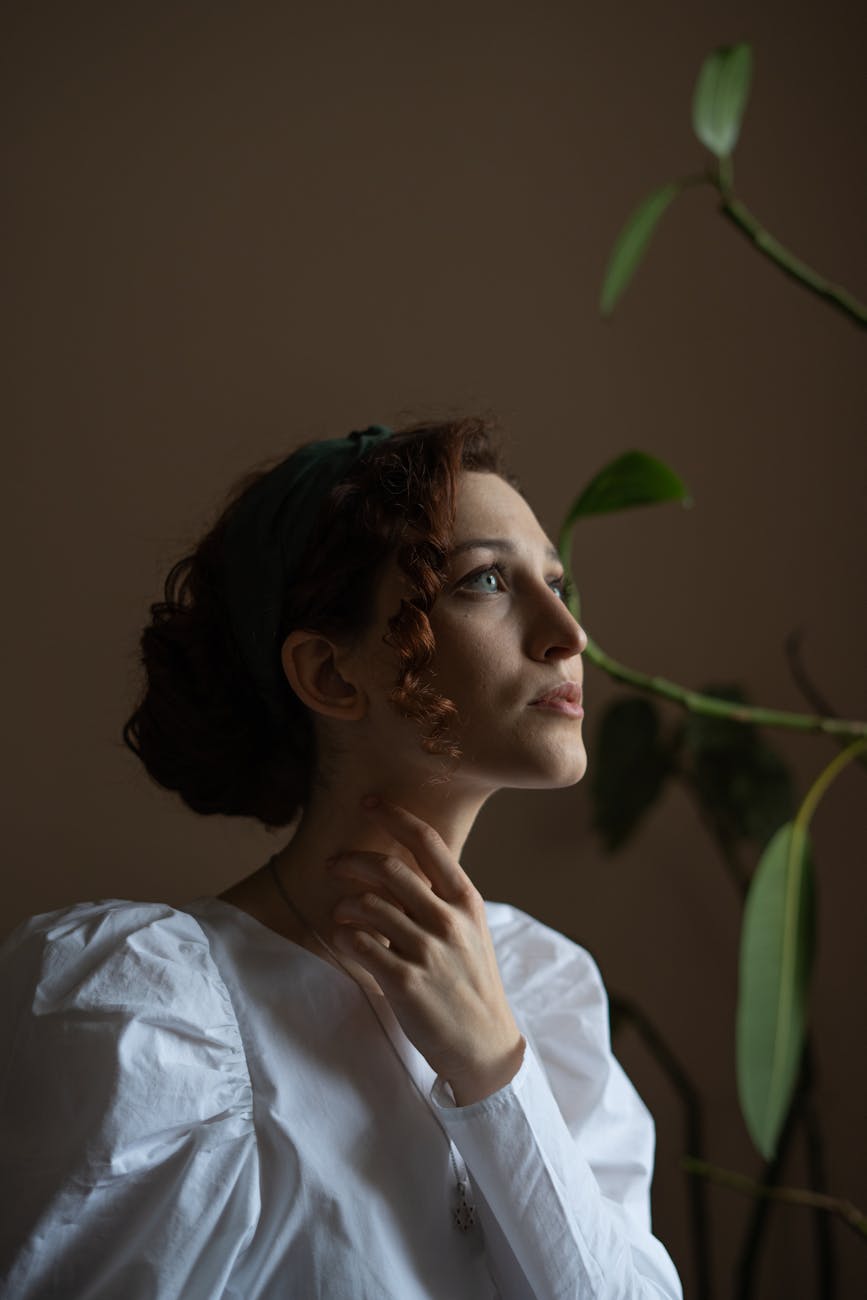
When she opens her eyes again, the room has shifted. A woman stands before her. She is taller than Ana, though she knows they are the same height. Straighter, though Ana has never thought of herself as bowed. Her hair is unbound, dark waves falling over her shoulders. The light that burns beneath her skin is not blinding but steady, as if it has known both darkness and endurance. She is whole, even in her brokenness.
She is at peace.
Ana stares, breath caught in her throat. Strange, to know that she has endured.
Then, the woman speaks. “Ana,” she says, her voice soft, resonating deep within Ana’s chest. “I am here.”
Ana’s heart tightens. She had not expected this—not the warmth, not the familiarity, not the way her name sounds like a benediction on the woman’s lips.
“I know the weight you carry,” the woman continues, her voice steady but weighted, as though it holds years of sorrow in its echo. “You are a part of me I have never let go of. The fear that coils in your chest, the prayers that stick in your throat, the falsehood that tastes like ash on your tongue. The way you carry so much yet find yourself hollow. The space between who you are and what the world demands of you… I know.”
Ana’s hands clench at her sides. “Then tell me why.” Her voice cracks, each word a plea too heavy for her to bear. “Had I foreseen even a fraction of what was to come, I would have yielded before I began.”
The words come in a rush, raw, aching, as though the very act of speaking might tear her apart.
“She was purer, that girl,” Ana whispers. “But she did not understand. She did not know fear, nor silence, nor the weight of a life built upon trembling ground. She thought herself strong.” She exhales sharply. “Can one grow wiser and yet become more lost?
“And if that is so—then what was the purpose? Why suffering if it only drives us from who we long to be? Why cling to a path so treacherous—why risk all—when what remains is so little? When all that lies ahead seems to lead to ruin?”
The words fall into the silence, a question too vast for any simple answer.
Then the woman steps forward, closing the distance between them, and pulls Ana into her arms.
The embrace is gentle, but it carries a strength that Ana cannot resist. She melts into it, surrendering her tension, her grief, her fear. It is like the pulse of a heartbeat she had forgotten she could trust.
Ana’s chest tightens. The floodgates open. She is shaking now, but she does not pull away. She presses her face into the warmth of her future self’s shoulder, letting the tears come. She doesn’t speak, doesn’t need to. For the first time, there is nothing she needs to explain. She is simply held.
When the sobs begin to quiet and Ana’s breath comes in shuddering gasps, her future self pulls back just enough to cradle her face in her hands, delicate fingers brushing the tears away gently.
“I bear your sorrow,” she says softly, her voice a quiet anchor. “I see it. I feel it. Every wound, every crack.”
Ana meets her gaze, red-rimmed and wet with tears. She looks at the woman, seeing now not just her, but something else in her gaze—a strength Ana has never felt within herself.
“But I need you to know something.” The woman holds her gaze with an intensity that reaches deep into Ana’s soul. “You are of value worth enduring for.
“Day by day. Breath by breath.” Her voice carries a quiet certainty. “And you need not see it now. You need not believe me yet.”
She pauses, brushing Ana’s cheek in a gesture that is both gentle and knowing, as if it is a promise she is offering in the space between the words.
“You just have to believe that I am possible.”
Ana’s breath catches, a tremor of something like hope stirring in her chest. The woman’s voice is barely a whisper now. “Keep my image in your mind. Even when the light seems distant. Even when you can’t see it. Just trust that I am waiting for you.”
The words settle into Ana’s skin, like their weight is making a space for something to grow inside her. The path ahead is still shrouded, but there is a new presence in her chest—a small flicker, barely visible but undeniable.
Ana looks at the woman before her, strong and steady, forged from fire, and something shifts in her gaze. For the first time, she doesn’t turn away. She doesn’t close herself off. She meets the woman’s eyes, the wavering light of a future she’s not sure she believes in—but now, she’s willing to reach for it.
Sarah Rietti is a writer who draws inspiration from Jewish traditions and spirituality. Her work explores the intersection of ancient wisdom and contemporary life. When not writing, she teaches high school English and takes nature walks. She lives in Jerusalem.



 Amethyst Review