
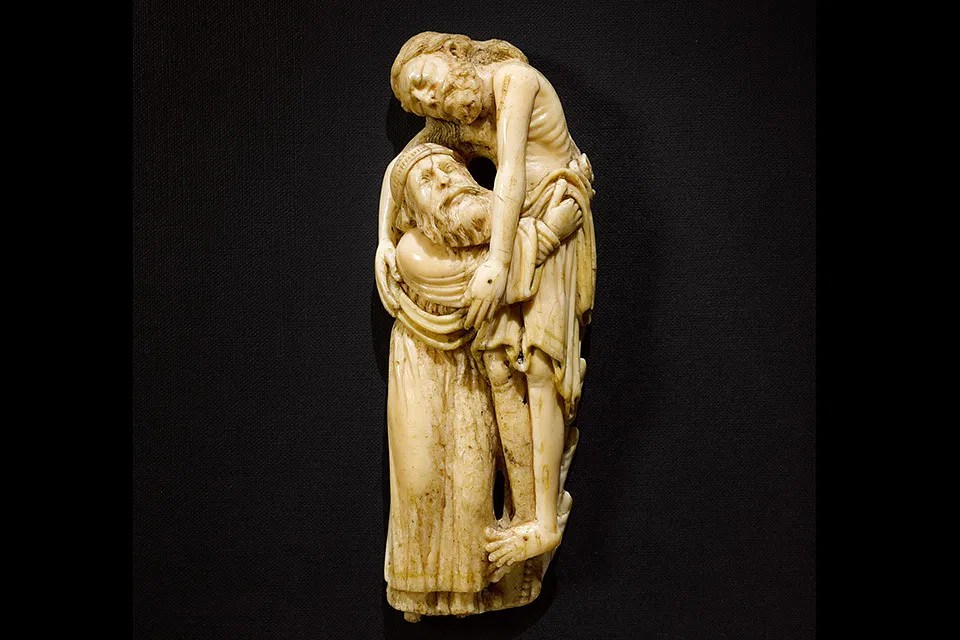
Deposition from the Cross, (c. 1190-1200), Ivory, 18.3cm, England (probably York), Victoria and Albert Museum, London.


Bright Circle

After this, Joseph of Arimathea, who was a disciple of Jesus—though a secret one because he was afraid of the Jews—asked Pilate to let him remove the body of Jesus (Jn. 19:38).

I.
The nightmare sky is always blood-red.  My desire:
to end his infamy, all foul and bloodied, try to take
him down from the cross and lay him in my tomb.
But it’s a nightmare and I cannot move.

Impossibly, he’s coming down, his feet swing: slow,
relentless.  Distance bays and barks with wolves,
the sound surrounds me.  I attempt to move my arms
and pull and strain and pant but nothing gives. I wake,

bleating, like a sheep.

II.
A shy child, I would pace the quickening marketplace,
listening for a voice I’d never heard, chasing a face
I’d never seen.  A man now, wealthy enough for ease
and influence, I still paced, stealthy, searching. Enough

was not enough. One day, that Nazarene was there—
Jesus, healing Lazar, poor old blind man we all knew,
and Jesus closed his eyes at first as though in prayer,
absorbing Lazar and his blindness. Then he groaned

and with long hands enveloped Lazar’s  face.  He spoke
some words I could not hear but soon Lazar was smiling,
blinking, crying out, his face raised to a gentle rain
that bathed his eyes while Jesus quietly withdrew.

Jesus: his uncanny self-containment. Jesus: whose gaze
outreached the furthest star.  Jesus: with those twelve
young men.  Jesus: with that little group of women
who supported him.  I knew his voice. I’d sought

this face.

III.
My skin is hot with rage—the nightmare’s back again—
I’m in the house of Caiaphas—the whole Sanhedrin’s
there—the liars! They collude in savage jealousy—
they mean to kill. A stinking little hill of raw meat

lies all sour on the floor and crawls with maggots.
Dogs are wary, snuff but turn and whine. And I?
I try to hide for I am naked—while they abuse
the living truth by tales they spin. I should stand


next to him, disempower them, expose their lies
but I’m exposed instead.  The floor turns into mud,
sucking at my feet.  There’s no escape, the dream
repeats, repeats my sin again, again.  I wake.

Coward.  Coward!

IV.
Oh, I was important—once I knew that he was dead!
Pilate I quite bullied.  I had courage then!   I asked
and got his leave to take ‘the dead man’ (as I said
to Pilate).  But I kid no one: Pilate wanted to forget.

He dreaded the return of Jews who’d fled the scene.
He tasked the soldiers with the routine breaking
of the legs. They would have followed orders but
Jesus was dead already. So they broke, they broke

instead his broken body by a lance-thrust to his side
and as his blood and water flowed, they wrenched him
down with ill-bred jokes about ‘the stench of god,’
his head, his head falling in the darkening day.

But in the nightmare no one’s there, not John,
not Nicodemus, not the woman Mary Magdalene,
not even his exquisite mother (all of whom seemed,
on the day, to pity me). I am alone beneath the cross.

The sky is always blood-red.

V.
Last night, the dream, the dream was changed.  The sky
is softly green, like olive oil.  And lo: I stand beneath
the cross.  His feet come down again, but now one foot’s
a child’s foot and sweet.  I kiss the wound’s bright circle.

In this new dream, his body’s clean; a fragrance fresh
as bread arises from the flesh as he is given, slowly,
into my arms.  And now I reach—I move as easily
as when, a boy, I’d reach up to my father and he’d

lift me high. Now Jesus is as light, and I, I close
my eyes, afraid to look at him at first, but then I open
wide to see not crucifixion’s ravages but on his face
a smile curves his lips—just barely, but enough.

His arms curve round my head, my shoulders. He
becomes so small and somehow changes into bread
and in my hands I cradle him and slowly eat the tender
loaf that tastes of honey.  It is enough.  Look:

the sky’s become a bright circle.
Johanna Caton, O.S.B, is a Benedictine nun of Minster Abbey, in Kent, England. Her poems have appeared in The Christian Century, St Austin Review, Ekphrastic Review, Amethyst Review, One Art, Today’s American Catholic, Fathom, Fare Forward, Windhover, The Catholic Poetry Room, and other publications. She is a Pushcart Prize nominee.
 Amethyst Review
This is so moving, Sr Johanna. Thanks to you and Sarah for posting this meditative poem.
LikeLiked by 1 person
Thank you so much for your kind comment, Lizzie!
God bless you.
Sr Johanna
LikeLike