
Recovering Words, Language, and Stories – A review of Break Bow Burn & Make: A Writer’s thoughts on Creation by E. Lily Yu
Review by Jessica Walters
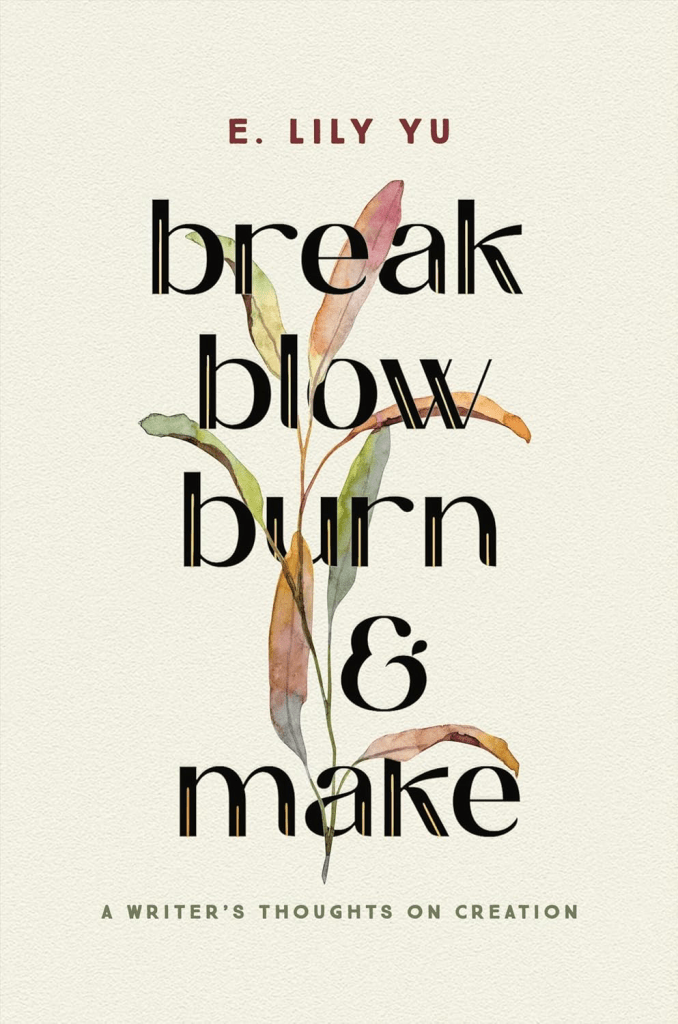
Each year before the star of a new, academic semester, I read Marilyn McEntyre’s timely book Caring for Words in a Culture of Lies because it reminds me why words matter. Indeed, her book prompts the reader to love and steward words because they “are entrusted to us as equipment for our life together, to help us survive, guide, and nourish one another” (2).
McEntyre draws on several sources, notably George Orwell and George Steiner who both “lamented the way that language, co-opted and twisted to serve corporate, commercial, and political agendas, could lose its resiliency, utility, and beauty” (3).
And so it happened that the week I went to the library to find Steiner’s Language and Silence (upon which McEntyre draws) I began reading E. Lily Yu’s Break Blow Burn & Make. She, along with the three previously mentioned authors, encourages her reader to take seriously the gift of language and warns of the dangers of misuse.
Yu offers a variation on theme. She writes, because has noticed that stories no longer have love, intertwined throughout and she longs for incandescent writing, which she describes as such:
The writer begins with light, which is sometimes a steady white flame, sometimes no more than an ember that must be blown to brightness, and the dust and ashes left by living one’s life. Within and through the writer, this dust and the light combine to create the drafts of a book, one after another, each exhibiting an increasing internal order, like the instars of a dragonfly. If the process is carried to its final and most perfect point, a whole world emerges richly complicated, well-ordered, and entire. The book blazes forth for as long as it has a chance of finding a reader (5).
Yu rightly believes there is a kind of holy mystery, perhaps even a chemistry to the writing life, one that combines diligence, sustained attention, care for language, and deep and abiding love in a writer’s work and life. I tend to agree. And having just read Leif Enger’s Peace Like a River, I know just what Yu is referring to. But the problem, according to Yu, is that this kind of writing has nearly vanished and “a light [has] gone out of new books. . . They [are] sometimes entertaining, witty, competent, and comforting, and sometimes they were not, but they [strike] me as missing that vital flame” (6).
Is this a surprise? It shouldn’t be, not if Orwell and Steiner’s prophetic warnings about the co-opting and twisting of language are to be taken seriously. To make matters worse, the flippancy and misuse of language can be ruinous to ourselves and souls.
Wendell Berry (as quoted by McEntyre) says that there are two epidemic illnesses of our time, “the disintegration of communities and the disintegration of the person. . . My impression is that we have seen for perhaps a hundred and fifty years, a gradual increase in language that is either meaningless or destructive of meaning” (7). McEntyre adds that the disintegration of communities and persons is ever so closely related to the disintegration (and degradation) of language. It is then no surprise that disintegrated language has cheapened our capacity for storytelling.
While Yu nods to the above, her concern is with the degradation of recent works of literature. She points to several concrete explanations for this degradation. It’s an interesting and insightful list and I’ll summarize a few of her points.
- Online mobs have hounded writers because of bad-faith interpretation of a work and this has led to a break down between reader and writer (10).
- Readers have lost the ability to read closely and to understand the book’s relationship to reality (11).
- Readers approach books like a mirror, desiring not transformation but “reinforcement of preexisting belief” (11).
- When professional book critics retired, underpaid graduate students and freelancers took their place and “the latter group, under the klieg lights of social media, are often anxious to be liked” (13). This has not fostered robust literary conversation but its opposite.
- Five-star ratings are a poor way to evaluate books and place “tubs of grout, air filters, and novels of breathtaking brilliance . . . on the same [rating] scale” (13).
It’s a dire list. And the reader wonders, is there any hope of a remedy. Indeed, reading Break Blow Burn & Make is in itself a remedy awakening the reader to exquisite sentences and carefully created images while also proposing several acts of healing (courage and solitude to name a few). It’s a worthwhile read, but reader be warned, it may just change your reading habits and your life!
Yu, E. Lily. Break Bow Burn & Make: A Writer’s thoughts on Creation. Worthy Publishing, New York, 2024
Jessica Walters was a hobby farmer in the Fraser Valley, Canada where she raised chickens, foraged for turkey tail mushrooms, and pruned apple trees. Her work has been published in The British Columbia Review, The Brussels Review, Scintilla, Solum, and Foreshadow, and her short story “Glass Jars” was shortlisted for the Mitchell Prize for Faith and Writing. She is the review and fiction editor at Radix Magazine.
 Amethyst Review
Jessica, Yu’s book sounds interesting. It’s going straight to my TBR!
LikeLike