
A Map to Mercy by Elizabeth Jarrett Andrew (Orison, 2025)
Reviewed by Lory Widmer Hess
Finding a way into prayer has not been easy for me. I find myself questioning whether I’m doing it right, what it’s really for, whether it’s worth the time, what I’m getting out of it. Of course, all this questioning gets in the way of prayer … or does it? Maybe, if I would sit honestly with my questions, I might be shown a different kind of answer than the one I’m pressing for, a way to sidestep my spinning thoughts and see things in another light. Maybe the desire to pray, even a thwarted desire, is itself enough of a prayer, to start with.
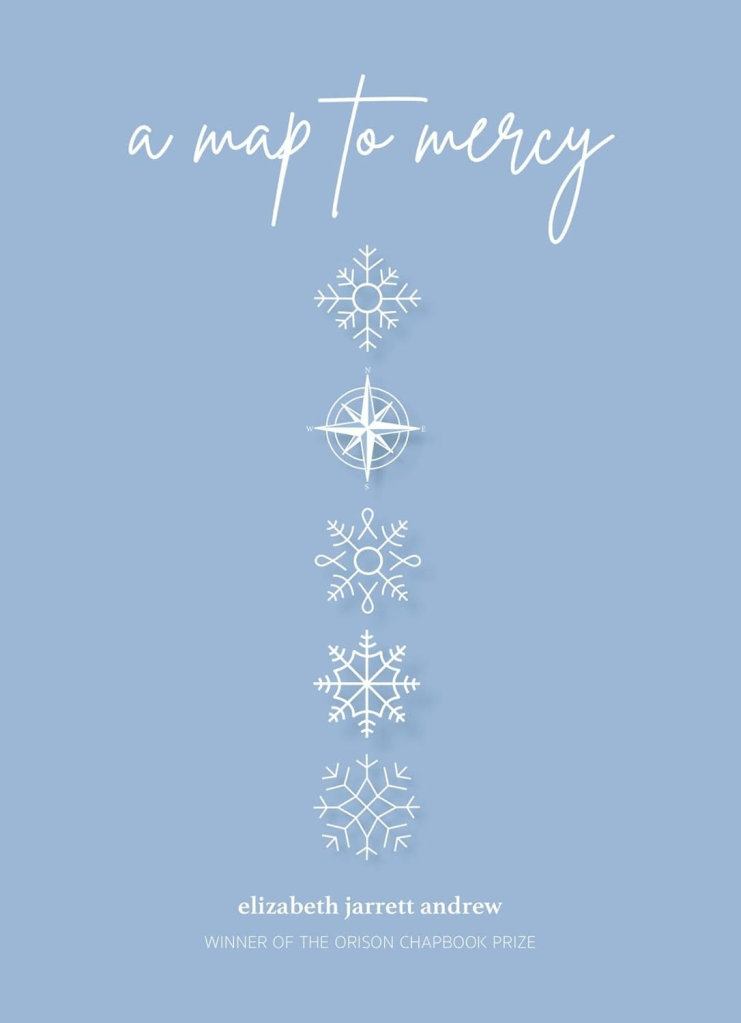
That kind of desire is beautifully described by the writer Elizabeth Jarrett Andrew in her newly published A Map to Mercy, winner of the Orison Chapbook Prize. It starts with the memory of a dream, in which she experienced an indescribable sensation of sinking into peace, along with a solemn announcement of death. Seeking to experience that peace again, and wrestling with the necessary sacrifice, led her along a twisting path, full of questions and thwartings and obstacles and revelations. It led her to explore ancient forms of prayer, while stubbornly asserting her right to be who she is in the postmodern world. And as we walk with her along this path, we may find our very own individual way to be both ourselves and part of a greater whole, to connect ourselves with sacred realms without losing the value of our particular personhood, in the spirit of freedom and joy.
Jarrett Andrew candidly shares her struggle, her questions and doubts and frustrations, in a way that removes all the preciousness and bleached-out piety from her discussion of prayer. The title refers to her choice of a word to return to in contemplative practice, symbolizing her intention to allow the presence and action of the divine within, setting aside other thoughts for the time being. She didn’t at first want to use a word at all, nor did she like the one that kept whispering to her. “Mercy” smacked to her of helplessness, of grovelling and condescension. It sounded like the “sorry remnant of a theology I’d discarded ages ago,” a patriarchial power structure that had done nothing but harm to our planet, and that continued to oppress anyone who fell outside the categories of dominance. Letting “mercy” in seemed an admission of defeat.
But grappling with the word leads her, and the reader, toward a valuable insight: prayer might be less about demanding what we want, and more about how we deal with the realities we don’t want. “In prayer I see my habitual grasping after significance, anything, and know this to be the least of my flaws…All my relentless thoughts present the perfect opportunity to choose, again and again. I choose quiet. I choose patience and deliberation and receptivity. I choose life.”
To what shall we choose to surrender? We can all think of times when we submitted to something out of convenience or fear or inattention, and found ourselves diminished and frustrated, dropped into a hole where further struggle only seemed to push us deeper. How and when can surrender actually enlarge us and set us free? As she moves back and forth between considerations of ancient practices and ordinary, everyday experience, between the wise words of sages and monks and the messy lessons of life lived with her wife and daughter, Jarrett Andrew admits she still loses the way. But then, she comes back to the essence: “And while I get confused about it, endlessly confused, love—that searing silence which is love—is my God. Prayer is how I remember. Mercy is how I bow down.”
I find it consoling to know that such an articulate writer and teacher of spiritual memoir admits to getting confused, and needs constant reorientation. After reading A Map to Mercy I was left wondering what my own map would look like, where it would take me, what I would find. I was newly inspired to take up the path of prayer without pre-existing assumptions, simply trusting that the divine world wants me to be my fullest self, and will show me how if I allow it.
In the end, the word “mercy” opens up new meaning for Jarrett Andrew; the mysterious tug of something unwanted can indeed turn out to be a pointer toward our deepest desire. And this word, or any word, can be both of the greatest significance and of no significance at all. What matters, she concludes, are the bonds with one another that are also our union with ultimate mystery.
Each of us has our way of walking toward that knowledge. Here is one writer’s way, one very human and relatable way, which could open up new and different perspectives for each reader. This small book has huge vistas inside it, much like contemplative practice itself. Why not open it, and see what you find there?
Lory Widmer Hess grew up near Seattle and now lives in Switzerland, where she works with adults with developmental challenges. Trained as a spiritual director, she companions individuals in their spiritual journey and leads online groups in the practice of Sacred Reading. Her writing has been published in Amethyst Review and other magazines and journals, including Parabola, Vita Poetica, Anglican Theological Review, Pensive, and Motherwell. She is the author of When Fragments Make a Whole: A Personal Journey Through Healing Stories in the Bible (Floris Books, 2024). Find her online at enterenchanted.com.

 Amethyst Review