
Solstice Hymn – a poem by D.W. Baker

Solstice Hymn

Glory to the troposphere,
precious ring of loving air—
Glory to the thunderstorm,
greening winter into spring —
Glory to the stratosphere,
shielding ultraviolet glare—
Glory to the water’s course,
cycled through each living thing—

May the shortest day
show that our time is full
May the longest life
share every beauty known

Glory to the mesosphere,
burning errant meteors—
Glory to the rocket’s flare,
subatomic fairy ring—
Glory to the thermosphere,
buffering ionic force—
Glory to the colored air,
borealis glimmering—

May the longest day
stretch possibility
May the shortest life
stimulate urgency

D.W. Baker is a poet, father, and teacher from St. Petersburg, Florida. His work appears in Sundog Lit, ballast, Overtly Lit, and Green Ink Poetry, among others, and has been nominated for Best of the Net. He reads for several mastheads, including Variant Lit and Cosmic Daffodil. See more of his work at http://www.dwbakerpoetry.com

Common Ground – a poem by K. L. Johnston

Common Ground
(An Atheist, a Presbyterian, and a Catholic Take Out Their Garbage)

I can hear my neighbor singing,
the one whose house I can’t see
for the golden leaves of the old
maple, singing soft to herself
as she carries out her weeks’ worth
of things to be reduced, reused.

Across the street the tech guy who
works from home, another neighbor,
the one with the big heart, foster
father of cats, raises his hand
in greeting, grins, and looks skyward.
We three stand silent, gazing up.

Above us the heavy velvet sky
presses out its saturated
crimsons, oranges, while the moon
rises early above the pines
and problems. We sometimes – amid
the garbage, the recycling –
forget the bigness of the sky

(as big as her song) shaking out
(as big as his heart) into this
new season’s slow wheeling around
the depth of cobalt horizon,
pushing forward into the night
and toward the coming equinox.

K.L. Johnston is an award-winning author, photographer, and poet best known for works centered in spiritual experience, nature, and trauma survival. Author of three books of poetry, In Every Season, The Nature of These Gifts, and Grace Period, her works can be found in literary magazines and anthologies. A retired antiques and art dealer she currently lives near the Savannah River. Visit her online gallery at 1-kathleen-johnston.pixels.com.

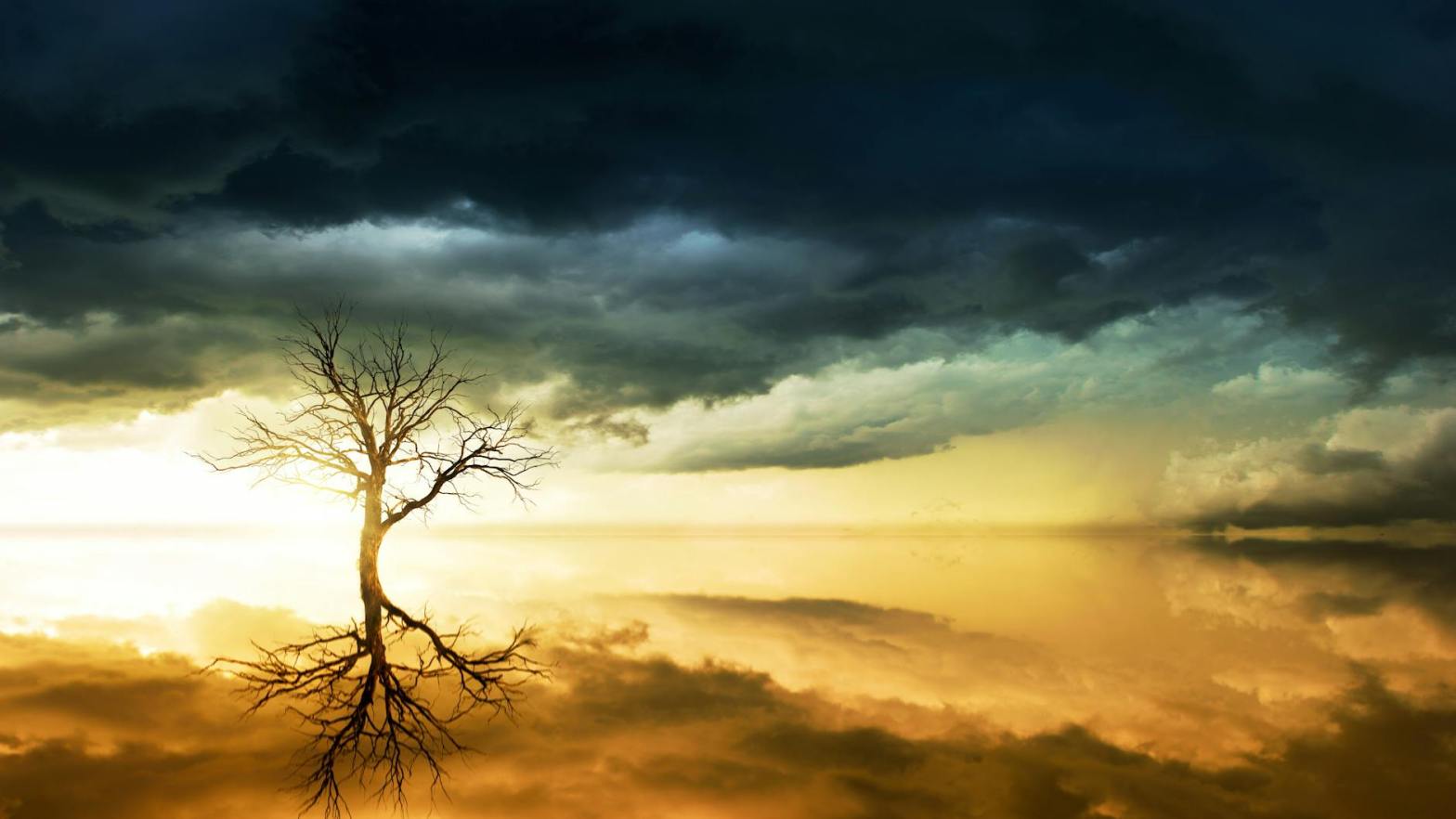
The skeleton tree – a poem by Wendy Westley

The skeleton tree

Leaning silently to the right
It was as if the skeleton tree
Was weighted down with winter weariness.
Fragile branches reached out
As if there was some help and
Gentle succour to be had.
Phalanxes brittle and desperate,
Spoke of remembered leaves and
Luscious red berries
Aflame with life and joy.
Even the bark looked withered,
Bleakly forlorn.
As I walked in quiet dawn,
I paused to breathe and inhale the frosty air.
Small buds whispered of resilience
And promised resurrection.
It was not a skeleton tree after all.

Wendy Westley was a successful nurse and midwife for many years in the National Health Service in the UK, and now writes short stories and poetry in retirement. She belongs to a creative writing group and has had her poetry published in poetry journals and magazines- Amethyst Review, Pulsar Poetry webzine, Seventh Quarry Press, and Spirit Fire Review. Her first book Sun hats & staying home was launched on 1st March 2025 in the West Midlands

The Shofar’s Call – a poem by Janet Krauss

The Shofar's Call

gathers us up
with the sheep and the cows
to huddle together
in barn, temple or home,
bleats the sustained distress
of all who need help,
releases the broken spirit
within its bent form,
soars like a gull taking flight,
leaves the echo of yearning
roaming across the sky.

Janet Krauss, who has two books of poetry published, Borrowed Scenery, Yuganta Press, and Through the Trees of Autumn, Spartina Press, has recently retired from teaching English at Fairfield University. Her mission is to help and guide Bridgeport’s  young children through her teaching creative writing, leading book clubs and reading to and engaging a kindergarten class. As a poet, she co-directs the poetry program of the Black Rock Art Guild.

Civil Society – a poem by Maryanne Hannan

Civil Society


Unto you therefore, O kings, do I speak, that ye may learn wisdom, and not fall - Wisdom 6:9


When you say you are king,
I laugh. And ask, of what?
But there’s your retinue,
Your messengers, specks
Against my moon’s horizon,
My brilliant sun and stars,
Here, demanding I listen.

A frequent book reviewer, Maryanne Hannan has published poetry in THE WINDHOVER, PRESENCE: A JOURNAL OF CATHOLIC POETRY, CHRISTIAN CENTURY, and elsewhere. She is the author of ROCKING LIKE IT’S ALL INTERMEZZO; 21ST CENTURY RESPONSORIALS.

Soaked – a poem by Baskin Cooper

Soaked

caught without an umbrella
the sky opening above me
each drop a cold hand
pressed to my skin

at first I hurry
shoulders tight
thinking of dry rooms
clothes drenched against skin

then I stop
let it fall over me
soak the seams
weigh my hair

what blessing is this
to be washed without asking
claimed again
by the open sky

I wonder
what else have I turned from
thinking it hardship
when it was gift

Baskin Cooper is a poet, visual artist, and multidisciplinary creator based in Chatham County, North Carolina. His work spans poetry, songwriting, sculpture, screenwriting, and voice acting, weaving together visual, narrative, and musical elements. He holds a PhD in psychology and previously lived in Cork, Ireland, experiences that shape his explorations of folklore, lyricism, and personal history. His poems have appeared in Rattle, The Avocet, Ink & Oak, Smols Poetry Journal, Verse-Virtual, and ONE ART, with new work forthcoming in The Khaotic Good, The Woodside Review, and others. His debut collection, The Space Between Branches, is seeking publication.

Herring – a poem by Morrow Dowdle

Herring 


Sometimes when a door closes, God doesn’t
open a window. Then you sledgehammer
through all the drywall, and still, you may break
through into total darkness. I thought God
was laughing when my mother said, I won’t
be your mother
. I couldn’t hear God say,
I’ll mother you instead. God is rarely
the evidence and often the obverse.
Remember this: Do not let anyone
tell you what God is or how to find it.
I informed the therapist I couldn’t
leave my lover because I’d never meet
someone better. She smiled, and there was God,
and swimming behind, a school of bright fish.

Morrow Dowdle is the author of the chapbook Hardly (Bottlecap Press, 2024). Their poems have been featured in Rattle, ONE ART, Pedestal Magazine, The Baltimore Review, and other literary journals. They have been nominated for the Pushcart Prize, Best of the Net, and were a finalist for the 2024 Red Wheelbarrow Poetry Prize. They run a performance series which features historically marginalized voices. A creative writing MFA candidate at Spalding University, they live with their family in Durham, NC.

Revenant – a poem by Linda Conroy

Revenant     						

Am I like Alice, gazing, stepping,
tumbling through the looking glass?

I try to find you, your new form.
Who are you now, a bird of paradise?

Or a sparrow, thriving on borrowed charm,
dancing with Mad Hatter,

a Red Queen rising to that magic place
where I wait for your image to appear?

A fairy child with gold spun hair, reaching
both hands to the sky, talking to yourself

of being left behind, when those of us
less whimsical stride into the world.

Did I dream you from a hundred hopeful
incantations, carve you from the earth?

Are you real? Can I still reach you here,
touch the ragged edges of your shirt?

Linda Conroy, a retired social worker, enjoys writing about the complexities of human nature and our connection to the natural world. Her poems have appeared in many journals and anthologies. She is the author of poetry collections Ordinary Signs and Familiar Sky.

Guru Days – creative nonfiction by Shanti Ariker

Guru Days

The Indian family welcomed us in to their home for the first time. I was around ten years old. By now, I knew there were many different religions, yet I hadn’t heard of a guru before or how that tied into worship. 

As we took off our shoes, I could see pictures of an old man with white hair, sitting cross legged in a black and white framed picture and inside the picture was an ashy substance. There were also pictures in color of a man with a big Afro of curly black hair, wearing an orange straight robe down to the ground, smiling and wearing flower garlands with his hands outstretched in front of him.  

We sat on pillows on the ground as they started to sing songs that were like prayers of praise to Sai Baba. We sang, “Om Bagavan, Om Bagavan, Satya Sai Bagavan.” 

People passed around a bowl of ash and smeared it into the creases in their hair, while others placed it as a dot on their forehead above their eyes. Harriet, my stepmom, leaned over and put a dot on my forehead and one on hers. She told me to take a little ash onto the tip of my tongue and taste it. I did and it tasted sweet, not like ash from a fire.

“That is ash from Sai Baba,” she said. “The pictures are the original older Sai Baba and his reincarnation.”

“What is that?” I asked.

“When you come back in another form, but you are the same person.” I immediately wondered how they would know it was him, but I knew better than to ask a lot of questions in the house. 

She continued, “When we sing really hard and with feeling, Sai Baba hears us and ash is produced in the pictures, like you see in some of the frames. It’s a healing substance and some people have been cured of diseases from taking the ash.” 

I think she wanted to believe it was true, that this guru had a special connection to God and could produce ash as a sign of his divinity. I watched, trying not to blink, to see if I could catch any ash materializing while we were singing, but I never saw it happen. I closed my eyes and prayed hard, trying to see if it would release spigots of ash. I opened my eyes. Nothing looked any different.

*

My parents started out as hippies, then divorced and recoupled with new partners. Dad and Harriet were ‘spiritual’ at first but then embraced their Jewish heritage – I would say they went in ‘whole hog’ if it wasn’t so contradictory to Judaism but that is how they did it.

Even though we had been going to temple and practicing Judaism for a few years, Harriet still longed for something else. She had convinced Dad that we should check a guru called Sai Baba, a spiritual man who performed miracles. On Sunday afternoons, we began going to bhajans, a service where we sang songs in Hindi at the house of a local Indian family.

My parents didn’t see any conflict with being practicing Jews and having a guru. I had read that we should not have idols but I knew better than to ask if Sai Baba would be considered an idol. I kept my mouth shut so I could avoid my stepmom’s wrath and punishments. I could always tell God that I wasn’t seriously worshipping Sai Baba, I figured.

Over the year, as I grew up, we continued to go to bhajans every Sunday afternoon at an Indian family’s house, and Harriet also dragged Dad and me to see other gurus over the years. I never believed in Sai Baba or the other gurus, but I did enjoy the singing, the spicy Indian food and the colorful clothing. Just like I had to choose between my parents, I had to choose between Judaism and worshiping a guru. I chose Judaism – it was tied to my ancestors and made more sense to me on a visceral level. 

That first day, after the prayer songs were over, the family invited us to go with the rest of the group to their restaurant down the street. The meal started with samosas, full of a spicy mixture of potatoes and peas, dipped into a mint chutney, then vegetable pakoras, bundles of zucchini and other vegetables fried in batter. I had never eaten Indian food before and the curry was spicy, with hints of tomato, cumin and sometimes coconut. I loved it.  

A man came over. “Welcome family! We are happy to have you here with us in worship and to celebrate with a meal.”

Dad and Harriet smiled and nodded. 

“How do you like the food?” he asked me.

“It’s great, not what I am used to but I like it a lot.”

“And how did you like the bhajans?”

“I love to sing, but I am Jewish. I go to temple and I am learning Hebrew,” I said.

He smiled and nodded his head.

Harriet frowned at me and said he didn’t need to know all that and I was insulting his religion.

But he just laughed and moved his head in waves like Indian people sometimes do.

                                                             ####

Shanti Ariker is a writer by night and a lawyer by day. The start of her memoir appears in How We Change, the 2024 San Francisco Writer’s Foundation Writing Contest Anthology. Her work has been published in The Thieving Magpie, On Being Jewish Now substack, OfTheBook Press and Simpsonistas Vol. 3. She can be found at shantiariker.com.

Holy the Firm – a poem by Gene Hyde

Holy the Firm

- for Annie Dillard

Falling like saffron flakes at my feet,
the glue that holds the cover of
Annie Dillard's Holy the Firm comes
undone, the cover slipping free as I
sit in the car dealership, my brakes being
repaired and my safety, at least in this regard,
assured for a while. I gaze at the Blue Ridge
out the window thinking of Dillard's
Countenance Divine as it shone forth
on the clouded Olympic Range,
while the same God goes riding here,
oblivious to tourists and traffic and human
foibles, of which we are legion. God sits
at my feet, in the dust of bookish glue,
and washes across this waiting room filled
with unwitting pilgrims, infusing even
indifferent souls with sparks of silent prayer.


Gene Hyde‘s poetry, essays, and photography have appeared in such publications as Appalachian Journal, San Antonio Review, The Banyan Review, Raven’s Perch, Valley Voices, Tiny Seed Literary Journal, and Mountains Piled Upon Mountains: Appalachian Nature Writing in the Anthropocene. He lives in the Blue Ridge Mountains of North Carolina with his partner and a scruffy little dog. You can find his website at https://www.banteringbibliocrat.com/