
Philip C. Kolin. A Centenary Garland: Poems about St. Thérèse of Lisieux. Oxford, UK: Teresian Press., Dec. 2025
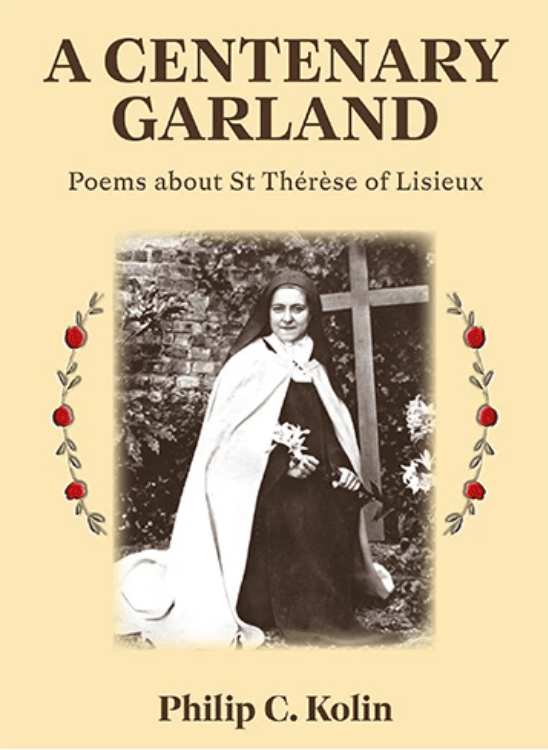
Philip Kolin is one of the most prolific and respected poets whose vocation is to write about the sacred. His latest book, the Centenary Garland, celebrates the 100th anniversary of St. Thérèse’s canonization in 1925. Though she lived a short life of just 24 years (1873-1897), nine in a Discalced Carmelite cloister, the impact of her spirituality has reached across the globe, resulting in being made a Doctor of the Church in 1997.
Thérèse was one of the most popular saints in Christianity. Her prayers and struggles resonated with so many. I, too, was her devotee. I prayed to her to intercede for me as I struggled with deciding between a priestly or lay vocation. Her words were familiar and consoling. They revealed a compassionate Jesus whom she saw as her spouse. Kolin’s iconic poem “In the Sacristy Garden” underscores this: “Christ is her Divine Spouse and she welcomes / every cross that comes to her.”
Kolin’s poems explore St. Thérèse’s life and legacy. Key poems focus on her parents, Zélie and Louis Martin, both canonized, and her three sisters who also became Carmelite nuns—Pauline, “the Pearl of Lisieux,” and Celine, “the photographer of Carmel.” Kolin includes several of Celine’s photos enriching our experience. St. Thérèse’s home nurtured her faith and her theology.
St. Thérèse’s life in the convent was short, but during that time she lived a full spiritual life. She developed and documented a rich spirituality of great intimacy with God to the desperation of the dark night of the soul. Kolin captures these in his poems that are carefully crafted and informed by St. Thérèse’s autobiography The Story of a Soul. His poems look at the different roles and activities she had in convent life—novice, sacristan, artist, caregiver, and active at “The Great Laundry Day,” an “allegory of body and soul.” The key to St. Thérèse’s theology was her “Little Way”—“This little sister asked big questions about God / from her desk in her cell behind / grille and gate . . . Her pen had eyes like Eziekiel’s angels” and in “Thérèse the Artist” Kolin echoes the saint’s emphasis on her own smallness—“I am the little brush which Jesus has chosen to paint” Kolin evokes Thérèse’s own littleness again in “L’oiseau du Jesus, God’s Lark”:
Though vowed to a cloistered life,
Thérèse often envisioned herself
Ascending into the skies

as a weak little bird,
a light lark
who gladdened others

by bringing them the good news
about Christ. Thérèse prayed
to soar toward the Divine Sun.
A major reason why devotion to St. Thérèse spread around the world was the simplicity of her message. Rather than pursue great accomplishments, she wanted to score many small gains. As Kolin’s poems show, she frequently emphasized the need to be uncluttered and unpretentious but clear and simple in focus. That simplicity won for her epithet and fame of “The Little Flower.” Kolin’s poems, tender and insightful, reveal why. She earned this title because from early childhood she attended her father’s garden, cultivating and sharing his flowers. Kolin surmises, “She loved red roses the best.” She continued gardening in the convent and earned the reputation for handing out roses to those who came to the convent for prayer or a visit.
In addition to flowers, Thérèse was an observer of much of nature’s beauty in creation. Here in “Chestnut Alley” within the monastery’s walls, we hear Kolin’s eloquent voice:
Every holy place has trees –
Palms, oaks, cedars, pomegranates.

At Carmel chestnuts line the alley
And the garden near the cemetery.

Seeing them from the recreation room or
walking their paths has enlightened the sisters.

Rooted in such a holy place, these trees
bloomed rich in symbolism.

Fruit-ladened with lush, leafy canopies,
God’s gifts to Carmel.

But at autumn pruning time, bare
trees found their leaves in bundles

on the ground teaching lessons in humility
and poverty.
Kolin’s poems repeatedly stress that Thérèse loved the face of Jesus. Her official religious name was St. Thérèse of the Child Jesus and the Holy Face. To look upon his face was to be united with Him, joined in suffering with Him and comforted by His love. Though His face is broken and buffeted with abuse, for Thérèse it is beautiful and saving. Kolin pens a prayer inspired by St. Thérèse’s veneration of the Holy Face and asks us to see in Christ’s wounds in those suffering today.
When we pray before your Sacred Face,
may we see the woes and wounds
of our brothers and sisters.
May your Holy Face comfort
and console them in their misery.
For your face has seen the Father of all mercies.
Kolin’s poems also concentrate on Thérèse’s worship of Jesus’s Holy Blood.
At fourteen, gazing at a painting
of the crucifixion with Christ’s wounds pouring
out water and blood, she called it
“divine dew,” and vowed to invoke
His blood through prayer and work
to cleanse and save sinners.
There are poems that also honor St. Thérèse as a martyr and the patron of missionaries. She wanted to be a missionary herself, but since she had chosen a cloistered life, she accepted to pray enthusiastically for the missionaries she encouraged through her letters and prayers. Kolin writes:
Though planted in Lisieux, Thérèse became
the patron of missionaries, writing to two
of them, a spiritual sister. One went to Indochina,
and she hung a map of Su-Tchuen where he lived.

In her cell, Remember, she encouraged him,
That the cross flourishes in mission fields.
“When you put on Chinese clothes,” she declared,
“think of Christ putting on human flesh.”
And in a later poem Kolin invokes St. Thérèse to help those suffering in the world today.
Though planted in Lisieux, Thérèse became
the patron of missionaries, writing to two
of them, a spiritual sister. One went to Indochina,
and she hung a map of Su-Tchuen where he lived.

In her cell, Remember, she encouraged him,
That the cross flourishes in mission fields.
“When you put on Chinese clothes,” she declared,
“think of Christ putting on human flesh.”
Kolin’s Centenary Garland is an important collection helping us to understand St. Thérèse’s “Little Way” within Carmelite spirituality of friendship with others and with God. It is a tribute to Kolin’s poetic skills that the poems have been published by the Teresian Press established by the Carmelite Fathers of England and Ireland at the Priory at Boars Hill, Oxford. One of those friars, Father Clement Obiorah, OCD, insightfully wrote in his Foreword that Thérèse was “a saint whose entire life was a poem written to God.” Recognizing this, Kolin’s poems were written to Thérèse on her special anniversary.
Charles W. Dahm, O.P.
Charles W. Dahm, O.P. is a Dominican priest in Chicago and chairperson of Domestic Violence Outreach which promotes religion’s resistance to domestic violence. www.domesticviolenceoutreach.org
 Amethyst Review
As a Catholic schoolgirl, the Little Flower loomed large in my life!
LikeLike
I want to read this. I especially like the second poem with the trees.
LikeLike