Praise for the American Dipper
After five miles of mostly uphill hiking, I stood on an exposed ridge over ten thousand feet above sea level, catching my breath and staring at rows of pine trees twisted so tightly by the wind that they looked like braided rope. The prevailing winds are extreme, and everything—everything—bends or breaks. Adapt or die. Those are the only choices. I ran my fingers across the bark of a large, limber pine that had finally surrendered and whispered, “We are more alike than you realize.”
As much as you can have a “destination” on a trail like this, mine was Lake Ouzel—a mostly frozen glacial lake just ahead. The scene could not be more picturesque: a small, almost perfectly round, crystal clear lake with a single slab of ice floating in the center. Completely calm and unassuming, set against jagged cliffs that rose hundreds of feet into the bluest sky. Snow draped the smaller pines. Taller ones poked through like witnesses. Behind me, the morning sun illuminated everything, casting long shadows at my back.
Where the edges of the lake had thawed, small shards of ice drifted, kissing the shoreline before gliding back toward the center, as if to tell the larger piece what it was missing. If I were a lake, I thought, I’d want to be this one—nestled in what surely must be the neighborhood where God lives.
I expected that familiar mix of elation and achievement—the grounding effect that comes when you finally reach your destination. I have been on dozens, maybe hundreds, of hikes, all ethereal in their own way. I expected calmness to wash over me.
What rose in my spirit was not calmness or achievement, but anxiety—and strangely, embarrassment. I felt my cheeks go hot.
So, I ran.
I ran to the water’s edge like someone trying to catch an elevator door before it closes. I ran like I was late to a meeting scheduled thirty-nine years ago, the one where they would evaluate my life so far and present the deadlines and productivity expectations for the years ahead. I nearly ran straight into the lake, stopping only when my boots sank unexpectedly deep into the soggy bank. Cold water seeped into my socks. I stepped back and nervously looked up at the jagged mountains surrounding me, straightened my shirt and cleared my throat.
“I’m so sorry I’m late,” I wanted to say. “You wouldn’t believe the traffic.”
“Take a seat,” said the tallest mountain in the middle. “She’ll be with you shortly.”
Oh.
I assumed he was in charge.
I lowered my head and looked behind me. There, positioned with uncanny precision, was a rock exactly the right height and width for sitting. A custom fit. So I sat. I waited. I chewed my fingernails until one bled – my least favorite nervous habit.
Then something moved. A straight, clean ripple shot away from the shoreline as something swam beneath the surface, pointing my attention to the verdant life below. Fish? Something else? For a moment, I imagined myself fly-fishing here.
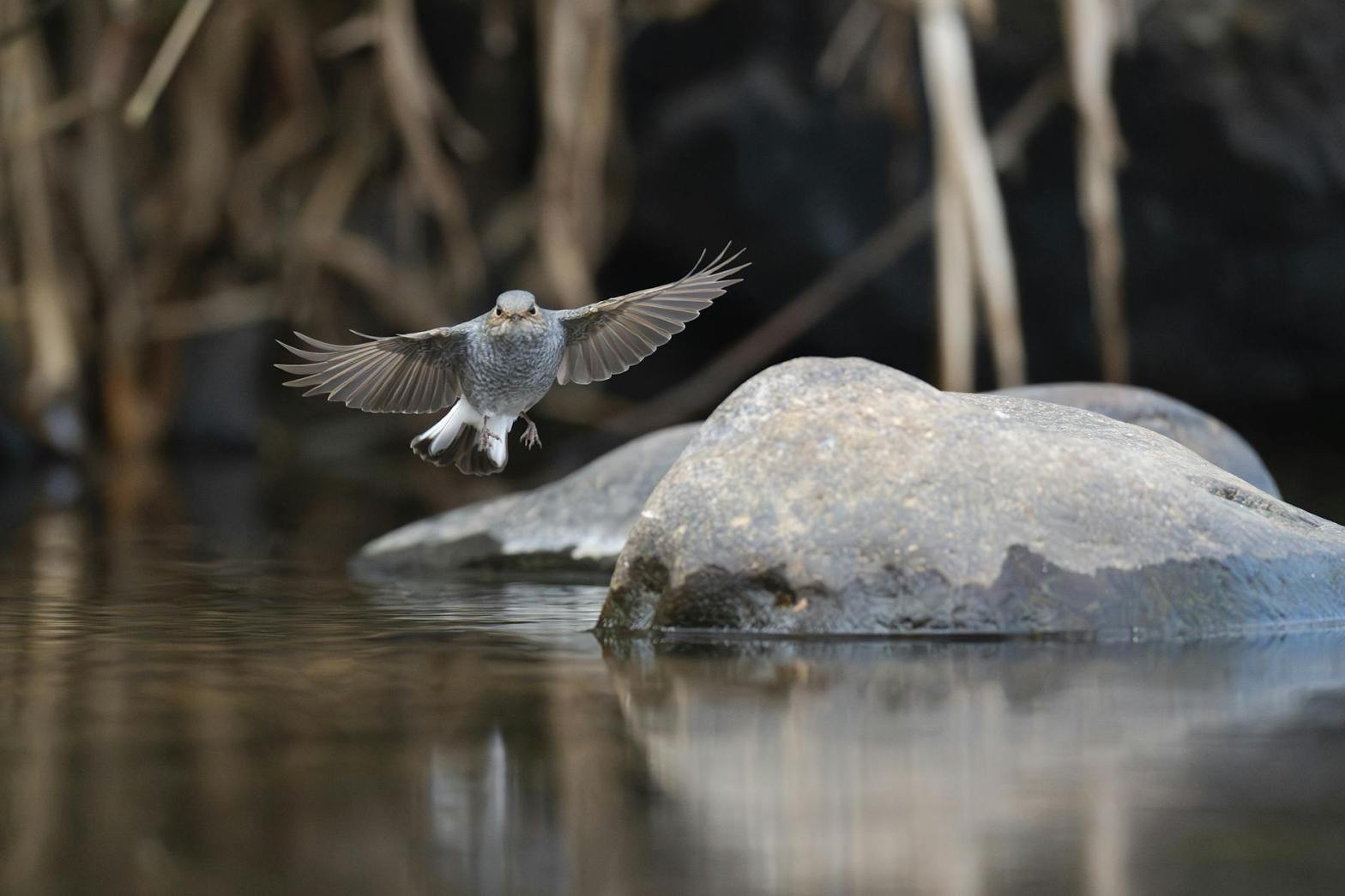
But the daydream snapped when a small black bird appeared on the ice. She looked at me. I looked at her.
Is this her?
Surely not.
She didn’t look aquatic. She looked like a songbird. Then she cleared her throat and released a melody—a songbird indeed! She began bouncing, dancing, wiggling her tail feathers, bobbing her head. She bobbed her head so many times, I lost count. She. Was. Vibing.
I laughed out loud.
And then – without hesitation – she leapt off the ice and disappeared under the water.
Gone.
That little feathered phantom.
There was no way a tiny songbird could have just dove headfirst into a mostly frozen lake that surely housed fish big enough to swallow her whole. Songbirds don’t – can’t – shouldn’t do that.
But she did. And she didn’t give two flaps about my opinion on the matter.
Shocked, I pulled out my phone and filmed her. She resurfaced, empty-beaked, danced again, dove again, repeating the whole sequence for several minutes. Then she vanished.
I didn’t know whether to cry, applaud, or ask for forgiveness for assuming to know so much about the habits of birds. So I did all three.
Clouds gathered quickly over Lake Ouzel, and we half ran down the mountain to avoid a storm.
Back home, I searched: small songbird that dives underwater. There is only one aquatic songbird in all of North America. The water ouzel, also known as the American Dipper. And she met me at the one and only Ouzel Lake to encourage, inspire, and convict.
I think she suggested it might be time I learned how to dance.
I’ll have to sleep on that one, little dipper.
My favorite theology book has always been a trail map.
My favorite faith community swims in Mother Earth’s waters, sleeps in her dens, scrambles up her trees, and soars through her skies.
The greatest sermons I’ve ever heard were delivered from the most surprising pulpits by the gentlest creatures.
Josh Stone is a poet, percussionist, and assistant principal from Owensboro, Kentucky. He holds a BA in Education with an emphasis in English and an MA in School Administration from Western Kentucky University. Josh enjoys spending time on the marching band field and hiking with his family. His poems have appeared or are forthcoming in the Harrow House Journal, The Pensieve, Half and One, Made from Midnight: A Poets in the Pines Anthology, Wingless Dreamer, Mad Persona Magazine, and elsewhere. He is currently working on his first poetry manuscript. You can connect with Josh on Instagram & Bluesky @joshstonepoetry.