That Sunday
The air is still as the morning light pours down,
covering the little village in hazy gold.
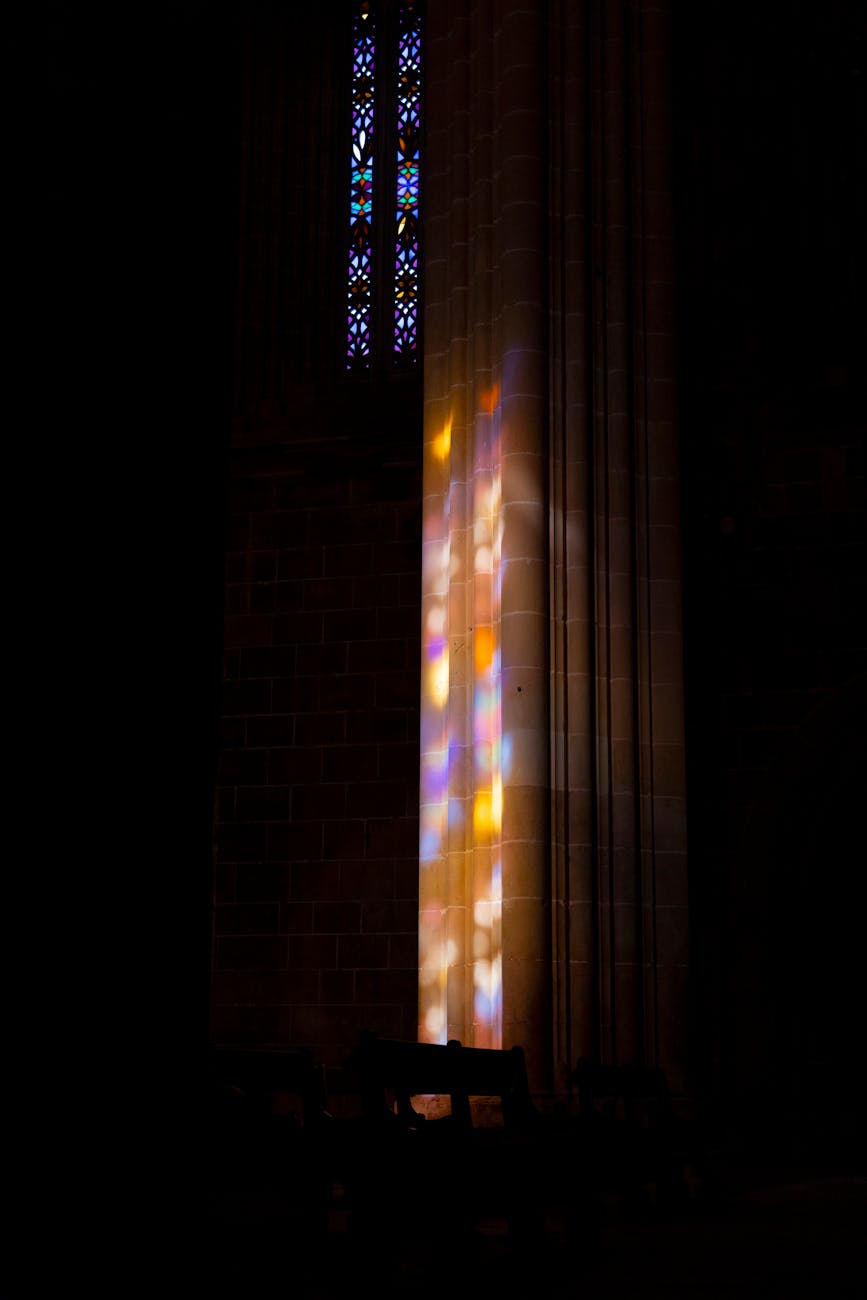
The church is poised against the olive green hills
and the tiny steeple points toward God.
A dozen souls crowd the ancient brownstone
and pray their prayers of timeless longing,
their voices echoing in the narrow brick streets.
The universe pauses, enfolds, and incorporates.
Some prayers will be answered, and some will wind on
through the labyrinth of centuries.
Joan E. Cashin writes from the Midwest, and she has published in many journals including Soft Cartel, Down in the Dirt, Riggwelter, Mono, and Months to Years.
Trimming
I’ve pruned the lilac, privet, and the rose,
the cedar and the maple and the oak.
All will survive next winter thanks to those
spring cuts. You’ve done such work too, I suppose.
You heard the frozen limbs crack as they broke,
and, since, have kept your orchard trimmed. The ice
will have to find its victims elsewhere, freeze
somebody else’s trees, who’ll pay the price
for negligence. Neglect’s a nasty vice,
on that rule each good husbandman agrees.
Our family’s year of sickness, oranges froze,
the garden went to seed, woodlot to smoke.
A still hand sows disorder’s paradise.
The knowing spend June weeding on their knees.
Dan Campion‘s poems have appeared previously in Amethyst Review and in Light, Poetry, Rolling Stone, and many other journals. He is the author of Peter De Vries and Surrealism (Bucknell University Press) and coeditor of Walt Whitman: The Measure of His Song (Holy Cow! Press). A selection of his poems was issued by the Ice Cube Press in July 2022: https://icecubepress.com/2021/10/01/a-playbill-for-sunset/
Still Life
The view from a window changes
while that of a painting next to it doesn’t
‘what comes to us has chosen us’
she says setting down her coffee cup.
Bruegel’s returning hunters lean into each snowy step
or just the step we see assuming others
ankle-deep in snow’s deceptions
masking known to unknown ground as the hill drops away.
Leaning into steps aids balance with caution
of slicks, trips, errant falls
their long-pole spears hung with rabbits
over shoulders, in front probing for the next step
a pack of dogs following nose to ground
the hunter’s faces turned away from us
in a scene with dozens of people none face us
only the next step’s hidden offerings
some walking iced-over ponds and streams
some skating, some fishing through holes in the ice
we are the scene’s only witness
a face seeing itself.
Slowly we begin to feel chosen
by a frozen moment outside ordinary time
yet within it not as contrast
but as what is there naked
saved for us caught up in a moment’s motions
not seeing its stillness.
Outside the window seductions of movement,
its singularity masking our duplicity, our multiplicity
tasks us. We are only a white van racing a grey road
for a few seconds. An erratic scattering
of bright yellow-orange leaves falling like impulses,
each a glance of sunlight at just this angle
missing some branches, fenceposts
favoring others.
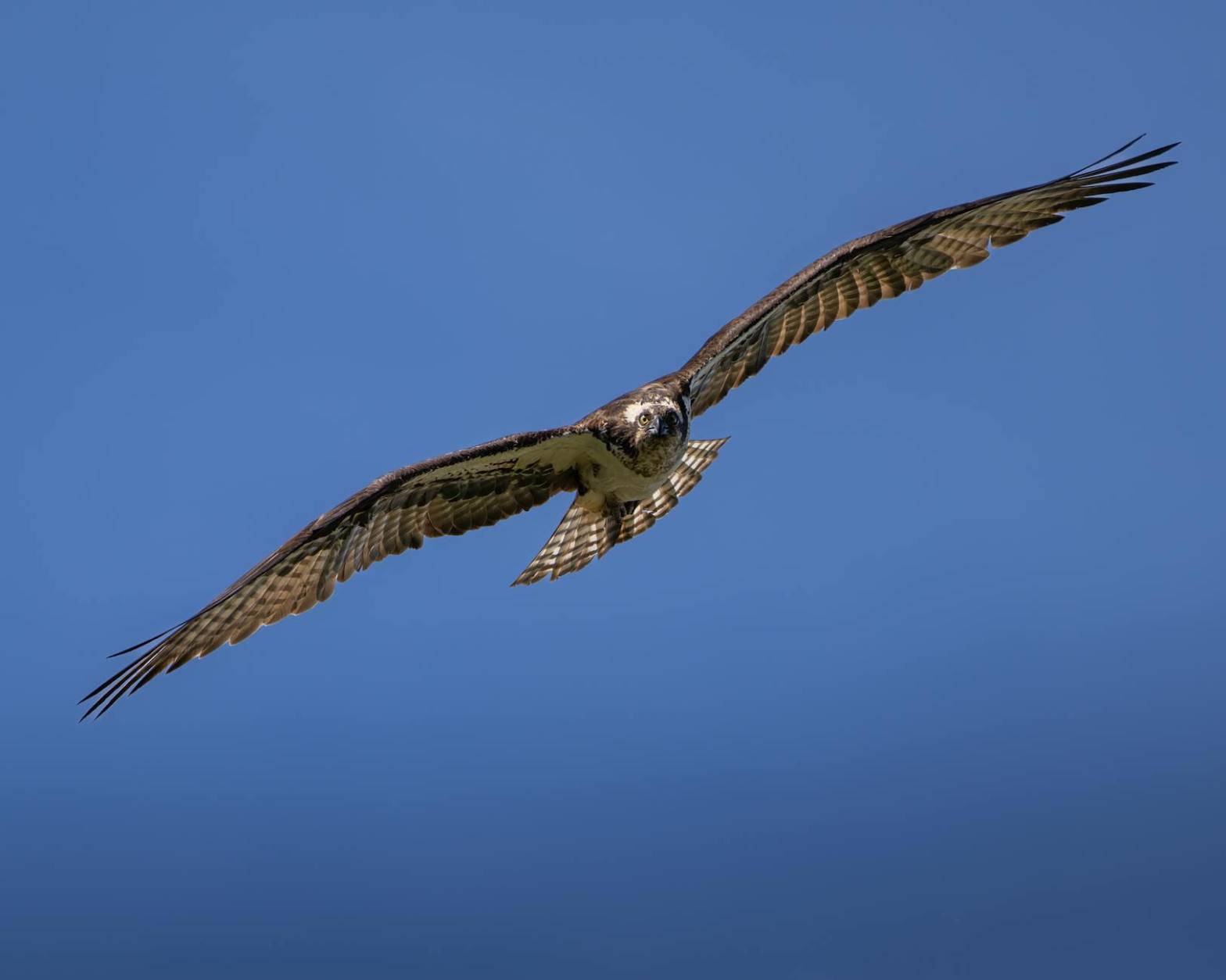
Overhead is a sizeable hawk, wings outstretched
in a turn: we see both wings at once one above
one below its body neither flying nor falling.
Don Brandis lives quietly outside Seattle writing poems. He has a degree in philosophy and a long fascination with Zen. Some of his poems have been published by Black Moon Magazine, Amethyst Review, Blue Unicorn, Leaping Clear, and others. A book of his poems is out – Paper Birds (Unsolicited Press, 2021).
Renaissance
Listen / you hear fine ribs of stone / that vault and arch and fan to stars / soldering a cage of sound / that holds you not against your will / but from a hope of resonance / so lose yourself in these mazy lines / catch hold of a thread / then let it go / for there are many and which will lead you / deliver you to reasons why / basses grounding / tenors the touchstones / holding firm / countered by alto false relations / asking the questions you dare not / trebles probing the highest bounds / you cannot think that angels sing like this / they do not seek / but annunciate that one concerted purpose / yet fearlessly these voices twine / untwine entwine and intertwine / their figments of eternity / until in a flourish of infinite fullness / the singing is done / and you are undone / and at that crux of perfection / and dissolution / you are reborn / in the twist of a Tudor rose //
Alice Stainer is a lecturer in English Literature and Creative Writing on a visiting student programme in Oxford, UK, and is also a musician and dancer. You can read her work in Black Nore Review, Atrium, Feral Poetry, After…, The Storms, and The Dawntreader, amongst other places. Recently nominated for Best of the Net, the Pushcart Prize and the Forward Prize, she is in the process of submitting her debut pamphlet. She tweets poetically @AliceStainer.
In this dream, are we the seer or the seen
the rider or the driven,
the seizer or the seized?
In this dream, are we the stillness
or the motion,
do we offer or partake?
In this dream or in this waking,
do we hear the sound or make it,
make our vow or break it?
Are we one or two or more,
are we movie or projector,
writer or director,
do we look to the sun or turn away?
Are we the water or the thirst?
Karen Paul Holmes has two poetry books, No Such Thing as Distance (Terrapin)and Untying the Knot (Aldrich). Her poems have appeared on The Writer’s Almanac, The Slowdown, and Verse Daily. Publications include Diode, Plume, and Valparaiso Review. She has twice been a finalist for the Lascaux Review’s Poetry Prize. She lives in Atlanta, Georgia, USA and spends time in the Blue Ridge Mountains.
Study of Falling Water
In the village when the sun
has passed over my house,
I go to a place where women
once washed clothes, and listen
to the sounds of falling water.
The day hot on my skin,
the stone smooth and worn,
I imagine them meeting
with woven baskets
a hundred years ago.
Water flows through the village
into a marble basin.
It falls in a heavy irregular stream —
water from the fountain endlessly falling.
I take in its random pulse until
I am the fountain and the sound,
no longer battling against hard edges,
making my way gracefully,
around and beyond.
Originally from Atlanta, Georgia, Helen Steenhuis has been living near Aix-en-Provence since 1989 working as an English language teacher. Her poems have appeared in The French Literary Review, Equinox: A Poetry Journal,The Poetry Library: Southbank Centre, London, and Cumberland River Review.
Spring Rain
There will come a day
when this winter rain will change
to spring rain
though you can't imagine it now,
here, where you are living
deep in January.
There will come a day when the air
will soften
like soil thawing
and your skin will soften, too,
expanding,
the way roots tendril outward
sensing they will find welcome.
And you will tilt your face to the sky
and whisper: oh, here you are!
Here I am.
Jennifer Skogen is the author of the young adult series, The Haunting of Grey Hills, and her work has recently been featured in Lady Churchill’s Rosebud Wristlet and Green Ink Poetry. Jennifer lives near Seattle, Washington, and goes hiking in beautiful places whenever it isn’t raining (and often when it is).
Echolocation
1.
Under a streetlight
a rabbit splashes
across a puddle
surrounded by
melting snow.
2.
Pigeons spring into the sky
blowing a circle of skittering leaves.
3.
Muffled thuds of rocks
knocked off a cliff
pause over a lake
to disclose
the white dots
of mountain goats.
4.
Grasshoppers crackling above
the wheatgrass and needle and thread
camouflage the slower rattle,
the quieter rattle that is the humming
of the unhidden machine
that runs everything.
Jeffrey Thompson was raised in Fargo, North Dakota, before it became a watchword for cool, and educated at the University of Iowa and Cornell Law School. He lives in Phoenix, Arizona, where he practices public interest law. His work has appeared or will appear in journals including North Dakota Quarterly, The Main Street Rag, Hole in the Head Review, The Tusculum Review, ONE ART, Maudlin House, Trampoline, Funicular, New World Writing Quarterly, and The Dodge His hobbies include reading, hiking, photography, listening to Leonard Cohen, and doom-scrolling the ruins of Twitter.
Dive Down
“. . . it is a bird that likes books and even
brings them in its beak to saints if the saints
have dropped their holy books in water and
they need retrieving. . .”
-Ali Smith in Companion Piece
How far down would you go
for wisdom, words wet but still
clinging to page, to priest,
to Author of All descending
to the watery depths?
Three days: not flames
but the cool, dark grave
of suffocation, lungs filling up
with river, ocean, all the seas
of imagination, where fear
keeps ebbing each side of shore,
up and over the organs, the teeth,
the tongue, every puddle of breath.
Gulp even that. The jot
and tittle of inhale/
exhale, the prayer
of pulp and paper,
savior script, the sunlit
single stroke that rises to letter,
then letters, word and Word,
ascending, breaking the surface
of world with one quick gasp of awe,
one drenched syllable of rescued hallelujah.
-after the composite photograph Prayer of Pulp and Paper by Karen Elias
Intercession
Pollen becomes
honey through the
intercession
of one bold bee.
My prayers for you
fluttering throne-
ward like the dove
sacrificed, rise
translated and
presentable
only by the breath
of the Spirit, holy.
My part in this
miracle is
no greater than
buzzing among
blossoms and seeds,
obedient.
K.L. Johnston is an author, poet, and photographer whose work has appeared in numerous literary magazines, anthologies, and travel journals as well as a photo illustrated book of meditations. She holds a degree in English and Communications from the University of South Carolina and her wide-ranging interests contribute to her writing and art. Her work explores the connections of humanity with the physical, spiritual, and liminal places she has stumbled into in her travels and in her own back yard. She devotes her unscheduled time to writing and satisfying her curiosity about people and this planet. You can find out more by visiting her Facebook page “A Written World”.