
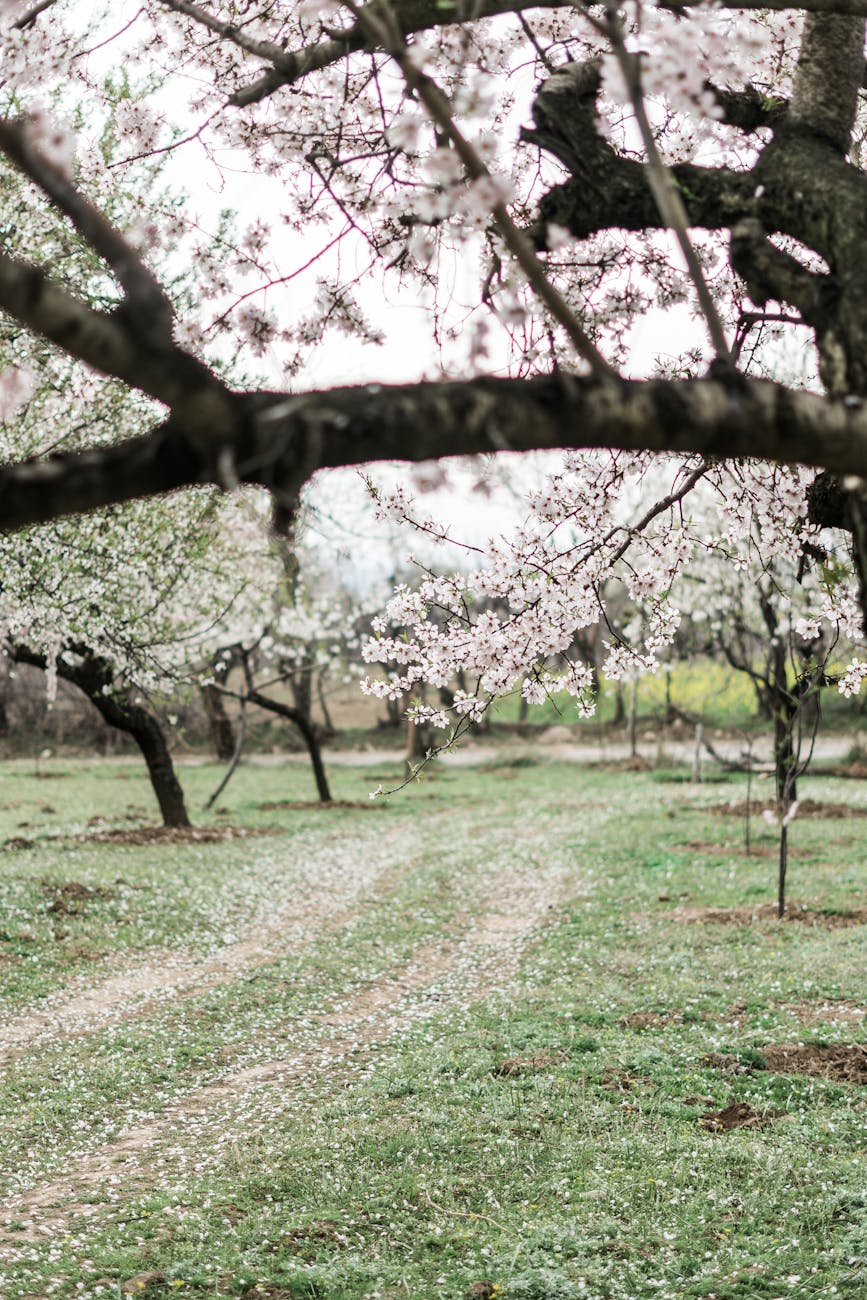
Orchard
Before I began to live in a borrowed house with its back to the ocean, I lived in the middle of another country, underneath the country of the borrowed house. “Underneath” as in the southern side of the border, so that visually it appears to be under the other country, at least on a two-dimensional surface such as a map.
At first there was no orchard where I lived in the middle of the other country, but we planted one, tree by tree. I call my husband Tree because he’s tall and not overly fond of hugging—you can run up and hug him and he’ll stand there, tall and strong with his arms at his sides, so you might feel like you’re hugging a tree. Everyone who knows how much life-force courses through a tree (sometimes you can hear it, with your ear pressed close to the bark) knows that this is not to suggest coldness or disinterest on the part of my tall, strong husband in the middle of the other country.
When we moved into the house nowhere near an ocean in the other country, the eleven acres were fallow. Of course that word reminds me of “hollow,” but the land is not hollow, although we later learned of an underground river running deep beneath it. The house sits right on the highway and has only seven windows and one bedroom. Because of the south-facing slope way behind the house and over a hill, we knew we could plant fruit trees. It’s basically a secret orchard because you can’t see it from the highway or even from the backyard.
My husband and I snuck up on the fallow, not hollow, land before we began to live there. After we first looked at the house and overgrown fields and pasture in the daytime, we drove back after midnight and parked on another road, one that borders the opposite end of the field. We made our way through the ditch and brambles alongside the dirt road, wary of being seen, which was most unlikely with no houses nearby and the roads empty. We crouched low, bent toward the earth as we climbed and stepped from the tree line to the edge of the field to see how it felt to stand there at night.
Was it because we were moving gingerly, low to the ground, that a charge came through it? Not into the soles of our feet since we weren’t barefoot, but more generally around us, gently pin-pricking into our lightly clad arms and legs? That is what happened that night in April as we walked and stood still by turns, and also at times lay down. You’d think we’d have lain on our backs to look up at the night sky, but instead we lay on our stomachs. When we had something to say, we propped ourselves up on our elbows and our words went into the ground and into the air. The witchgrass and foxtail were high.
Even from the highest point in the field, the house was hidden from view. Only the barn was visible. It was years later, when the well pump broke, that the person who came to fix it told us of a river running deep underground. I wondered if the water coursing below us had to do with what Tree and I felt as we lay on the ground that night.
When I had a miscarriage, that information, too, came up from the ground we were crawling on, and maybe also from the river underneath. By then, we had lived in the house for five years and were growing almost an acre of strawberries, the most sought-after in the area. We grew several varieties, all with their own names such as Earliglow, Jewel, and Sparkle. But they all have their general name, “strawberry,” because of the age-old necessity of having to be covered with straw until the nights are warm enough to let them be uncovered. The timing is tricky: you want them to get the full benefit of spring sunlight, but you don’t want to risk doing so while they’re still vulnerable to late frosts.
It was spring when I was about four weeks pregnant. We had taken the straw off the strawberry plants a week or two before the night of the late frost. But when the frost came, the only chance of saving the berries was to go out and cover them back up. We must have been hoping until the last possible moment for the weather to change, because by the time we went out to do it, it was pitch dark, windy and getting cold. As my husband drove the tractor, I stood on the trailer bed and used a pitchfork to toss bales of straw throughout the rows. We rode up and down the rows like that until all the bales were dispersed. Then the process of spreading straw over the plants began. Each time we cut the twine binding the bales, we used our pitchforks to take apart the bales and shake the straw loosely into piles beside the rows. It seems we could have stayed standing, using our pitchforks to scatter straw, and maybe that’s how my husband kept doing it, or maybe he joined me on the ground from the opposite end of the row or in the adjacent one. Either way, my own method was to crawl on all fours, using my hands to gather straw from between the rows and pile it in mounds on top of the berries. Of course, there are no berries at this point, but that’s how you refer to strawberry plants as soon as they’re planted.
At that early stage of fetal gestation, there is no detectable movement. One moment I was crawling along on my hands and knees, blanketing the berries with straw, and one moment I felt the slightest sense, infinitesimal really, of a current (of energy? of information?) coming up from the ground and into my body. What I discerned, without in a million years being able to explain how, was the absence of a separate life in my body. I suddenly knew I was no longer pregnant. Equally and at the same time, aliveness in the earth was palpable. The wind was blowing around us and it was getting colder, but we kept piling straw on the strawberry plants in the hope of saving them. There was no need to speak about what I knew to be the case at that moment. The next morning we made an appointment for an ultrasound.
Logistical details that followed are less vivid to me than the instant of knowing, while crawling around in the night sky (the earth and sky being all together, in the dark), the fact of the change that had happened at some point in the previous three weeks: the cessation of the pregnancy, although nothing had been expelled from my uterus yet. That is a clunky sentence for an enigma I haven’t articulated until now, twenty-three years later. The ultrasound confirmed it: “There is no baby in here,” said the technician or doctor holding a kind of wand and looking at the screen, which resembled a static-beset, black-and-white television documentary of undersea waves. He told us about the frequency, even the normalcy, of early miscarriage: one in four pregnancies ends in the first four to six weeks, I think he said, often without the woman ever knowing she was pregnant.
From the beginning, which is never really a beginning in itself, I had not intended to stay in the borrowed house with its back to the ocean without receiving any visitors at all. People would periodically join me, I had thought—my sister, husband, friends—and I’d take them to the giant boulder I climb every few days in the shallow harbour. From the top of the boulder, I throw stones back into the ocean, stones I’ve picked up and carried into the house to live with for a while. Once a seal watched me stretching on top of the boulder, and I watched it back.
However, the year before I arrived, the border between the two countries closed for the first time in history. I was able to cross freely as a “dual citizen,” but no one else in my family was allowed except my sister, who stayed home, and our dad, who had died. Naturally, everyone thought the border would re-open by the following winter, but it did not. I am writing in the past tense now because it has already happened. I did not think I could not write in the past tense before, because the orchard is still there and a river may still be coursing, flowing, swirling, running, or perhaps just holding still beneath it.
Lisa Fishman is the author of eight books of poetry, a collection of short stories, and a forthcoming novel. Her most recent book is One Big Time (Wave Books, 2025); her debut novel, Write Back Now!, will be released on 1366 Books by Guernica Editions (Toronto) this May. Her book of stories, World Naked Bike Ride, was published in Nova Scotia by Gaspereau Press (2022) and shortlisted for a ReLit Award in Canada. Her work has appeared in Granta, Fairy Tale Review, jubliat, A Public Space and elsewhere. A dual US/Canadian, she divides her time between Eastern Canada and Wisconsin.
 Amethyst Review