Three Women – a short story by Sarah Das Gupta

Sarah Das Gupta

Three Women    

(The Green Christ   –     Gauguin)

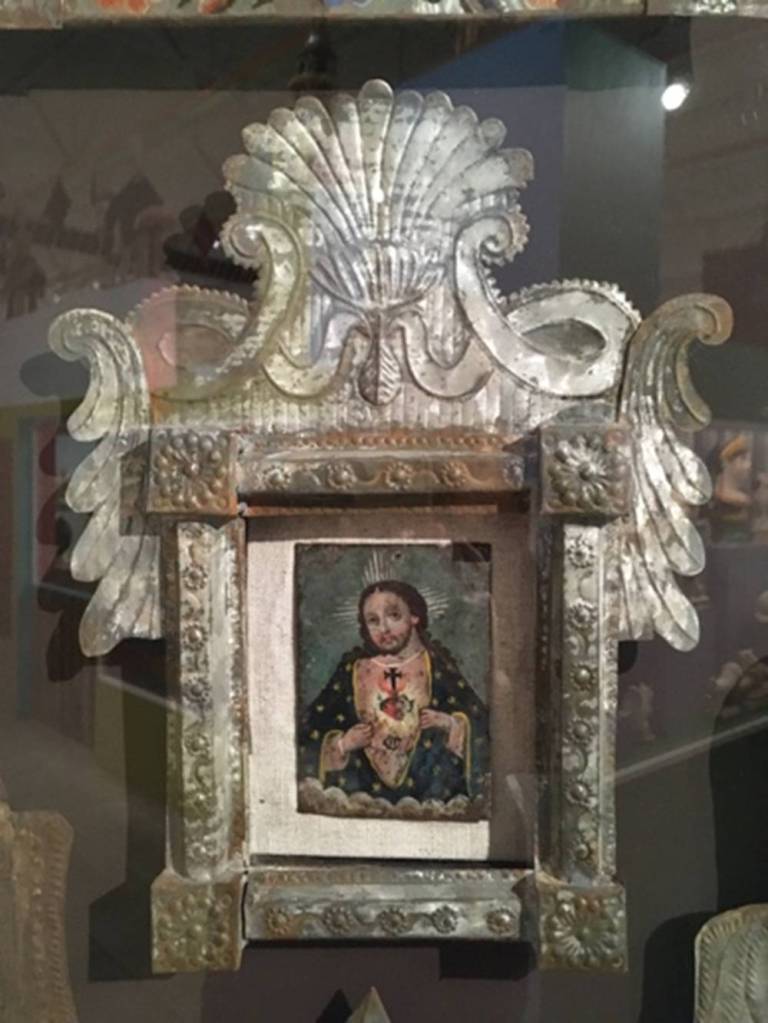
Jeanne- Marie could simply not forget what she had seen the night before. It might be 1890 but in the Brittany hamlet of Yaudet things took decades, even centuries, to change; she thought ruefully. She herself knew that better than most. She stood pressed close to the dark granite rocks which had been carved years before, to shelter the wooden image of the crucified Christ. She had rushed out in such a panic, that she had forgotten to bring the bright bunch of pansies she had picked to lay at the pierced feet. Quickly she gathered a bunch of golden buttercups and laid them on the wood, smoothed by centuries of village mothers, many of them probably in a similar state.

She whispered a few prayers, then peered round the edge of the rock. Stone steps, carved from the granite, led between the cliffs to the beach. The sea was lapping over the bottom step, leaving a strip of white lace as the wave retreated. Jeanne guessed the tide was on the turn. A young woman with black hair, as dark and shiny as the cormorants flying overhead, was sitting looking down to the sea. The fishing boats will soon be back, that’s why the gulls are gathering. Jeanne stepped into the shadow of the rocks. She didn’t want Veronique to see her. 

The view down the steps had disturbed her more than she had expected. How often she had sat there waiting for Luc to run up those stairs two at a time, carrying the creels full of wriggling fish. He’d balance the baskets on the rocky path before holding her tightly in his arms. Then they’d walk to the cottage together. She pushed back her hair which had once been as black as Veronique’s, but now it was impossible to hide the streaks of grey.

As she stood looking at the crucifix, the old wooden carving began to fade. Three women appeared holding the body of Christ taken down from the cross. Between them they held the dead figure. They looked with sadness but also with a strange sort of joy. Jeanne found it difficult to read the emotions of the three mourners. In the shadow of the rocks the images took on a green shade – the colour of the fields round Yaudet in spring when the lambs were born.

Like most of the village girls, Jeanne had had to attend catechism classes but she had found the priest’s lugubrious voice sent her off to sleep or into a daydream. This was so different. The love of the three women for this broken body they held was palpable, as they carried Him somewhere beyond death. Jeanne remembered the day Luc and the rest of the crew were lost in a freak storm when the waves had come right up the steps and the coast guard had carried his body to her as she waited. Apart from a cut on his hand, Luc looked peacefully asleep. She had stared up at the crucifix as the men carried his body into the village. You don’t care a damn. Perfect and unreachable stuck up above everyone.

She looked back down the steps. A young man ran up two at a time and Veronique disappeared in his arms, her dark hair falling over his shoulders. 

Jeanne looked back at the wooden image. The three women had gone but the sense of their love remained. She turned back to Yaudet.  It wasn’t going to be easy. The young man, as she had suspected, was a Guillou, the outcasts of the village, but Jeanne knew her love for her daughter was stronger than any village feud.

Sarah Das Gupta is an 83 year old, retired English teacher from Cambridge who has taught in UK, India and Tanzania. She lived in Kolkata for some years. Her interests include, Art, the countryside, Medieval History, parish churches, early music and ghosts. She has had work published in journals and magazines online and in print, in countries, from New Zealand to Kazakhstan. She has recently been nominated for Best of the Net and a Dwarf Star Award.

Online Workshops with Amethyst Review from October 21st

New! Online Workshops from Amethyst Review.

On TUESDAYS 6-7PM UK TIME, Editor Sarah will be leading a generative writing workshop online (Zoom), with poems, extracts, and prompts that engage with spirituality and the sacred.

Each session will have a theme with a connection to writing and the sacred. We will look at poems, extracts from fiction and creative nonfiction (usually 2 examples per session), and there will be time for writing in response to prompts given by Sarah. 

Theme for October 21st: LIGHT

There will be the opportunity to read from your own writing, if wished. We will not be critiquing but listening supportively.

Please spread the word and join me! Very affordable, pay as you go, and only an hour per week. Sign up via Eventbrite

Reaching – a poem by Cordelia Hanemann

	Reaching
reading Charles Wright

In the beauty you wish to create
there lies something you cannot know

In the brush suspended over the canvas
the stroke that would finish the painting or begin it
In the synapse between the words of the poem
the word written and the word sought
In the sequence of notes / the missing phrase
that one chord that would complete the sonata

What but the search : that last leap
the release from certainties into risk
What you have struggled to discover
what you have reached for
what would save you

Out past the unsure edge : fledging :
that wing / that reaching
that necessity : a kind of Faith.

Cordelia Hanemann, writer and botanical artist, currently co-hosts Summer Poets, a poetry critique group in Raleigh, NC. Retired English professor emerita, she conducts occasional poetry workshops and is active with youth poetry in the NCPS. She has published in numerous journals including Atlanta Review, Connecticut River Review, California Quarterly and others; in several anthologies including best-selling Poems for the Ukraine and her chapbook. Her poems have been performed by the Strand Project, featured in select journals, won awards and been nominated for Pushcarts. She is now working on a novel about her Cajun roots.

The Names of the Queen – a Poem by Richard West


The Names of the Queen

Time and a river run through the ancient realm, in rhythmic
waves that flow through desert land and dynasty alike.
And so, a thousand years and more before Cleopatra ruled,
another queen, Tausret, sat on ancient Egypt’s throne – as king.
The names she took hint life and death, flowing, river-like,
between genders, relationships, and roles, with ostentation and
yet with charm:

Strong Bull, Beloved of Truth,
Lord beautiful of appearance, like the god Atum,
Founder of Egypt, who subdues foreign lands,
Daughter of the god Ra, beloved of the god Amun,
Mighty Lady, chosen of the goddess Mut.

Calling herself Lady of the Two Lands of Egypt as well as
Lord of the Two Lands, Tausret knew the intricate web of
life’s ongoing game of thrones, and the ironies within our
lives – we who live by time and the river’s flow, and then
are washed away by them. Her names, her dreams, were
stone-carved in temple and in tomb – but in an eternal land,
even stone is weak and all too soon is overthrown.
As dynasties rose and fell, her monuments of forever were
torn apart to be reused – a legacy impugned, covered and
at last destroyed. And yet her names live on in hieroglyphs
that breathe in books, real, yet surreal; there, but not; then
there again – like the river’s ebb and flow, like the
capriciousness of gods, like shadows on the sand.


Richard West” was Regents’ Professor of Classics in a large public university and has published numerous books, as well as many articles and poems, under his own name or various pen names. His poems have appeared in more than twenty literary journals. He now lives in the American Desert Southwest, where he enjoys learning to cook and attempting to add flavor to his poems. He is the excavator of the Temple of Queen-King Tausert – the subject of this poem.

C A L E N D A R – a poem by Marlene Tartaglione

Marlene M. Tartaglione is an artist whose creativity manifests poetry, children’s literature, visual arts. Her work has appeared in presses nationally & abroad. Ms. Tartaglione has won 4 poetry prizes, her work presented at venues such as the Brooklyn Museum, M.O.M.A, New York Book Fair. Her poem, S C A R E B, has recently been nominated for a 2025 Pushcart Prize. Ms. Tartaglione’s M.B.A. studies were conducted at NYU; Ms. Tartaglione also holds a B.F. A. from the Cooper Union, where she studied with poet/ educator/ scholar, Dr. Brian Swann.

Scratch Messiah – a poem by Lara Dolphin

Scratch Messiah

And who are my neighbors?
An assemblage of the enthusiastic unrehearsed
the kind who would trudge through a snowstorm
for fellowship and musical uplift.
The seating is scrambled, not by part,
and I discover that I am seated near
as many tenors and bass-baritones as female voices.
Blend.
Don’t breathe when the person next to me breathes.

The chancel choir takes its place
while the orchestra begins to tune.
Then silence except for the thrum of anticipation.
The soloists emerge.
Next the guest conductor enters all to joyful applause.
I open my Schirmer score to follow and be ready.
The symphony plays.
Then at last song breaks forth–
Comfort ye, comfort ye my people, saith your God.

A native of Pennsylvania, Lara Dolphin is an attorney, nurse, wife, and mother of four. Her chapbooks include In Search Of The Wondrous Whole (Alien Buddha Press), Chronicle Of Lost Moments (Dancing Girl Press), and At Last a Valley (Blue Jade Press).

Unexpected – a poem by Olivia Oster

Unexpected

Though too old to
Crawl rocks
Avoid briers
Limbo rotting trees,
Call of mountain water
Overcomes.
Come! It calls
See where I flow
Over where all
Living water must go!
To the green valley,
The beauty below.

I follow
Until it falls frolicking.
New perspective
Bows me to the wind
Teaches me to breathe
On the moss, in the spray.
Like the pine and laurel
I cling to the Rock.

Olivia Oster is a writer living on Lookout Mountain, GA, whose writing is about common everyday life as well as chronic pain, parenting, gardening, cooking, and homemaking. Olivia’s poetry has been accepted in The Reformed Journal, Spirit Fire Review, and others. She has a grammar book and a poetry chapbook called Poetic Faith. Olivia is a teacher, wife, and mother of five.

Paper Birds – a poem by Claudia Wysocky

Paper Birds

I was a bird once, made of paper and thin air
flying over the arid landscape of my soul.
My wings were strong, but brittle
and I knew that I could fall at any moment.
The sky above me was a deep blue,
as if the world had chosen to color itself in reverence
for my freedom. The sun warmed my feathers,
but I knew that it was only temporary.
Soon, the sun would set and the cold night would come,
bringing with it an unrelenting chill that would test my resolve.

But still I flew, soaring high above the lonesome earth
where there are no trees to call home,
where there is only dry grass and cracked dirt.
With each beat of my wings, I felt myself grow stronger,
more resilient. I was not meant for this world,
bound by gravity and time. No, I was meant for something greater.
Something beyond the confines of this fragile existence.

And so I flew on, chasing after dreams that only birds can dream.
Drunk on the wind and dizzy with possibility,
I forgot about everything else –
the weight of responsibility, the burden of reality.
For a brief moment in time, I was free from all constraints
and nothing could bring me down.

But as all creatures do,
I eventually tired and began to descend
back to the unforgiving earth below.
As my wings gave out and I fell towards oblivion,
I couldn’t help but wonder –
was it worth it?
To be a paper bird flying high in an endless sky?

Yes. Yes, it was.


Claudia Wysocky, a Polish writer and poet based in New York, is known for her diverse literary creations, including fiction and poetry. Her poems, such as “Stargazing Love” and “Heaven and Hell,” reflect her ability to capture the beauty of life through rich descriptions. Besides poetry, she authored All Up in Smoke, published by Anxiety Press.”

Peter returns to his nets – a poem by Herman Sutter

Peter returns to his nets

Before the sea was solid
it was safe for me

to sink beneath the waves
and rise upon each crest.

My only destiny:
nets and hooks and fingers from

fashioning a day
out of sweat and sun,

scales and blood, and the salt breath
of an evening breeze

thick as my lungs.
But I was free

always`

to find my way and sink
beneath the same
waves

I now have walked
upon.

Herman Sutter is the author of the chapbooks Stations (Wiseblood Books), and The World Before Grace (Wings Press). His work appears in: Saint Anthony Messenger, The Ekphrastic Review, tejascovido, The Langdon Review, The Porch, Benedict XVI Institute, The English Review, The Merton Journal as well as the anthologies: Texas Poetry Calendar (2021) & By the Light of a Neon Moon (Madville Press, 2019). His narrative poem Constance, received the Innisfree prize for Poetry. His latest manuscript, A Theology of Need was long listed for the Sexton prize in poetry.

Prodigal – a poem by Jean Biegun

Prodigal


And so to them I gave a foolish son
the couple with scientific bent

and that woman lit by poetry
a daughter who was starch

The more forward of archangels
asked why …

That they come to inhabit
my labyrinthine heart of course

sample batches of earthy alchemies
stirring dust to sweat to ecstatic dance

mine tunnels through ice mountains
and then melt those same mountains

Thus to see me and sip
my honeyed air


Jean Biegun is retired in California after a lifetime in the Midwest USA. Her poems have appeared in numerous journals and anthologies. She has received two Pushcart nominations and written two poetry collections, Hitchhikers to Eden and Edge Effects (2022 and 2024, Kelsay Books). Recent work is in Third Wednesday, The Scarred Tree: Poetry on Moral Injury, Ekstasis, Unbroken, and Thin Places and Sacred Spaces: A Poetry Anthology (Amethyst Press).