
On Hatred of the Enlightenment – a poem by Brian Glaser

On Hatred of the Enlightenment

from Five Cantos on Enlightenment

My first word as a child was light.
My mother brought me into dark rooms
And spoke the word as she flipped the switch

And one day at around twelve months
I said the word before she did.
I had a concept and its sound: marked by history.

And months before that I had been taken
Away from her and put through
A spinal tap as a neonate

Because I had spinal meningitis.
Twenty hours separated as a newborn
And subjected to excruciating pain alone.

So when I talk to you, when I pose a question
To you, I have come to understand why
I do not wholly expect that you will answer.

During the Second World War it became
Thinkable to hate the Enlightenment,
As Horkheimer and Adorno did.

What do I have left if I join them—
If I try to return to the dark room
And instead of choosing the concept—

Discovering it again as we may perpetually do—
I sit in silence, rejecting the shared word,
The half-credible evidence of a bond restored?


Brian Glaser teaches at Chapman University in Orange, California. His first book of poetry, The Sacred Heart, is forthcoming at the end of 2018 from Aldrich Press.
Speaking to the Unknown – a poem by Richard Green

Speaking to the Unknown

I speak to the unknown
having asked
puis-je vous tutoyer?

I don’t expect an answer
in any voice I could comprehend,
but maybe some form of communication

will pass between us, familiar,
maybe not knowing at the time,
beyond thought,

ideas, structure,
released from definitions
into something like the dream.


Richard Green lives in southern New Mexico in the Rio Grande Valley. He writes about natural phenomena mostly. His poetry can be seen in The Almagre Review, Penwood Review, Sin Fronteras/Writers Without Borders, The Avocet, The Anglican Theological Review, and Twitterization Nation. His website is www.anewmexicanpoet.com.

Trinity – a poem by Cynthia Pitman

Trinity

i. Immersion

Water breaks,
pulls me down
to a cold, murky world
hidden beneath the sunlit foam.
I open my eyes.
Yellow, green, black:
sinuous forms
undulating,
ominous forms
dancing their slow-motion death-dance.
They reach for me.
(I reach for them?)

Someone from above
pulls me up.
(No! Wait! Not yet!)
I cough,
suck the air,
close my eyes
and begin to cry.

ii.Conversion

white
white robe
flowing white around me
white
washed white
washed white in the blood
white
washed white
in the blood of The Father
white
washed white
in the blood of The Ghost
Holy blood.
Baptismal blood.

iii. Resurrection

Water breaks,
splits me apart,
twists me inside out,
bends Me into Two.
Blood, water, flesh
flow together:
a distorted image
in the mirrored orb.
My son
(ghost of my father)
My son
(born again)
My son
(washed in the blood)
Coughs,
sucks the air,
opens his eyes,
and begins to cry.

Cynthia Pitman has had poetry published in Literary Yard and Right Hand Pointing. The title of the RHP issue, The White Room, was from her poem, and the artwork was designed around it. She has poetry forthcoming in Postcard Poems and Prose, and a short story forthcoming in Saw Palm: Florida Literature and Art.


Vespers – a poem by David Chorlton

Vespers

A gilded moment passes
tree to tree along
the street before
light folds its wings
to roost. Behind the house
hummingbirds
sip the final glow
before an eyelid closes
on the mountain’s rim.
All the world is undergrowth
to the rodents waking
in the woodpile as
a chill rolls across
the grass and sparkles
on the tip of every blade.
The clock displays
coyote time as
the traffic sings its last
work chorus of the day.
It’s the devil’s cocktail
hour: he’s dropping
olives into a glass of fear
and sitting back
to see what night will bring.
And a prayer
against him runs its course
from lamp to lamp
where moths display
the old and secret texts
of ultimate deliverance
upon their wings.


David Chorlton is a transplanted European, who has lived in Phoenix since 1978. His poems often reflect his affection for the natural world, as well as occasional bewilderment at aspects of human behavior. The Bitter Oleander Press published Shatter the Bell in my Ear, his translations of poems by Austrian poet Christine Lavant. A new book, Reading T. S. Eliot to a Bird, is out from Hoot ‘n Waddle, based in Phoenix.

Lauren Downington’s Doubts – a poem by Megan McDermott

Lauren Downington’s Doubts 

Over coffee, the seminarians
ask each other questions undisclosed
to ordination committees.
Is it worth it if this is just a myth?
Lauren says, Sometimes it just
feels like I’ve picked my favorite
story and decided to live in it
.
She stares down at the Bible on
the table and adds, And even then,
it’s a story I hate half the time
.
But the other replies: Has anything
else ever produced the same wonder
?
Lauren shrugs and admits nothing has.
We’re wired for it, the second says.
Even if it’s false, it’s ours. And that
is enough to put a stopper on streaming
questions – for them to pick up
their readings again and try to make
sense of the senseless.


Megan McDermott is a poet and Episcopal minister based in Massachusetts. She recently graduated from Yale Divinity School and Yale’s Institute of Sacred Music, an interdisciplinary program dedicated to religion and the arts. Her poetry has been published in The Windhover, Rock & Sling, The Cresset, Letters, Saint Katherine Review, and Episcopal Café.

Plain and Simple – a poem by M.J. Iuppa

Plain and Simple

Standing on our weather-beaten porch, I
close my eyes, for just a minute, before

I take another step that will set me in a direction
that’s plain and simple, going forward until I

find myself back here in this very spot, stopping
in this velvet dark & autumn chill to listen

to the sound of scattering leaves that is
the sound of hands clapping, clapping for

my close calls, for my death-defying
escapes—for me— still here.


M.J. Iuppa ‘s fourth poetry collection is This Thirst (Kelsay Books, 2017). For the past  29 years, she has lived on a small farm near the shores of Lake Ontario. Check out her blog: mjiuppa.blogspot.com for her musings on writing, sustainability & life’s stew.

After the Crescendo – a poem by Corren Hampson

After the Crescendo

“I’m really getting bigger,” Lena says, scrambling through the
woods to the creek. Her four-year-old voice affirms the pride of
accumulation, of chubby hands
tying shoes, of climbing trees
like a monkey,
of saying the ”R” in “water.”

In glory we are born,
climb through green change
to a golden crescendo
of confounding growth.
Lost in the jungle there,
we hear voices call from all directions where loss disguises as bright
birds.

I say she will be Lena, queen of the jungle, some day.
She says, “I don’t want to be
queen of the jungle.
I just want to be the jungle.”
“I’ll go with you,” I say.
“I’m really getting smaller.”


Corren Hampson lives in Grants Pass, OR.  She is a gardener and poet. Her first book of poetry, Growing Smaller, has recently been accepted by Flowstone Press.

from POND – poetry by John L. Stanizzi

11.14.2018
7.32 a.m.
31 degrees

Paired with nothing, I witnessed the
Occasion of its nearly inaudible thwack
Nearing the pond’s outlet; a single brown maple leaf
Dropped onto the surface and rippled the signal of its arrival.

***

11.18.2018
9.21 a.m.
34 degrees

Plowed perfect, snow mound reflected in the black mirror of the pond.
Oak leaves, blown from the southwest end of the water into the northeast cul-de-sac.
Note of the muddy bottom so low I cannot hear it,
dwindling, darker each day. Perhaps it is the B-flat of the universe.

***

11.20.18
11.33 a.m.
34 degrees

Pluvial night, the rain hangs on as mist.
Opiate ripples when a branch releases its gems of rain,
normal and lonely an act as releasing its leaves,
downward in silence, all around me the sound of rushing water.

***
11.24.18
8.33 a.m.
24 degrees

Peabody, Peabody, Peabody, Old Sam Peabody!
Oblique geometry here, mirror-smooth there, thick battered hem, gray
nuances of ice seal it all – those on the bottom – those in the bottom.
Determined white-throated sparrow searching for Sam, though I’m the only one here.


John L. Stanizzi’s full-length collections are Ecstasy Among Ghosts, Sleepwalking, Dance Against the Wall, After the Bell, Hallalujah Time!, and High Tide-Ebb Tide.  His new books – Chants, Four Bits – Fifty 50-Word Pieces, and Sundowning will be out before the end of this year.  His work is widely published and has appeared in Prairie Schooner, Rattle, New York Quarterly, American Life in Poetry, The Cortland Review, Tar River, and many others.

THE ONLY KNOWN PHOTOGRAPH OF GOD – a poem by Rupert Loydell

THE ONLY KNOWN PHOTOGRAPH OF GOD

‘When you get a clearer picture you can understand
why so many want to stand in the dust cloud,
where there is comfort in confusion.’
– Thomas Merton

The only known photograph of God
turns out to be a silhouetted skyhook
slung from a wire, holding nothing
and not moving at all. It is not
uplifting or impressive, the sky
is grey, the image black and white.

What did the monk who took the photo
mean? Was it a surrealist joke or a way
to make an oblique comment about
expectations or absence, the unknown?
He took up meditation, talked in zen
and went to meet the Dalai Lama,

then his maker. Left us notebooks
and a damaged small black painting,
photos and calligraphies, a mystery
shaped hole in the centre of his work.
It is totally absurd to expect answers
that might help explain our world.

© Rupert M Loydell


Rupert Loydell is a writer, editor and abstract artist. His many books of poetry include Dear Mary (Shearsman, 2017) and The Return of the Man Who Has Everything (Shearsman 2015); and he has edited anthologies such as Yesterday’s Music Today (co-edited with Mike Ferguson, Knives Forks and Spoons Press 2014), and Troubles Swapped for Something Fresh: manifestos and unmanifestos (Salt, 2010).

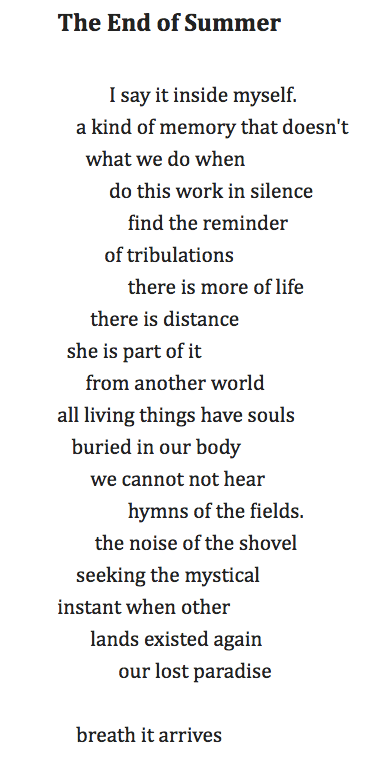
The End of Summer – a poem by Serena Mayer


Screen Shot 2018-10-15 at 22.55.54


Serena Mayer studied anthropology and social geography, and is interested in hidden texts and forgotten or discarded language. Her writing has previously appeared in Nutshell, Electric Zone, Here to Stay, I Am Not A Silent Poet, X-Peri, Amethyst Review, Odd Moments, Reflections, A Restricted View From Under the Hedge, Poetry WTF, Storm Warning, and International Times. Her first book, Theoretical Complexities, was published by Broken Sleep Books.