Given a Life to Spend – a poem by M.J. Iuppa

Given a Life to Spend

Not holy. Not holy, yet wholly
snow spins like a swarm of bees,
like a gauzy cloud snagged in
the crab apple tree where red &
green birds feather dust branch
to branch to feeder, swinging
tenderly, like the priest’s censer
leaking pearl-gray smoke over
heads bowed in thoughts few
say in prayers, in lent’s ashes
that can be read as sad petitions
for one’s life centered on things
incidental & idle that fail to be
transmuted in a veil of incense.


M.J. Iuppa ‘s fourth poetry collection is This Thirst (Kelsay Books, 2017).For the past 30 years, she has lived on a small farm near the shores of Lake Ontario. Check out her blog: mjiuppa.blogspot.com for her musings on writing, sustainability & life’s stew.

First Exit – a poem by L.B. Stringfellow

First Exit

The day I would lay down
to face the sun. In the darkest
hour, they told me not to fear
what, in my mind, I had already
repeated. Because to think is to do.
And since I thought of my death,
I had died already.

I watched those around me
in their slim tombs, the length
of their bodies thick, horizontal.

They were to prepare my body, remove
all but the essential heart
so that I could stare into
the eye for eternity.
They wrote falcons on my coffin
so that my son could become god.
I was meant to keep forever
locked within the walls of Osiris.
But, like a god, I passed
back through life
as through a dark pupil.

It has been miles since.
I return every hundred years or so
through strange doors.
The vulture of heaven is no more
than the stomach through which one passes
at times. I am no more
cemented in eternity
than the crumbled offerings
presented at my first death.

Like the mortals, I keep
repeating this dying
and rising from the dead.


L.B. Stringfellow writes both verse and prose poetry, often exploring themes of transformation, woundedness, and interdependence in her poetry.  She grew up in the Southern US, has worked as a university instructor and as a professional tutor, and holds an MA in English and an MFA in Creative Writing.

Hidden – a poem by Sam Norman

Hidden

I have lost my boy
in a perpetual game
of hide and go seek.

I have looked
everywhere.

Is he in heaven?
He’s certainly not
in the other place.

Will he be found
only in my heart,
my memories?

Is he simply buried,
a star above his head,
waiting for the rapture,
or for the rest of us to join him
and become stardust.


Sam Norman has been teaching high school for 16 years at Bacon Academy in Colchester, CT. Until now, most of what Sam has written has been shared only with family and a few friends, though he has been published in Bacon Academy’s literary journal, The Salmon River Review. Most of Sam’s recent poetry focuses on a terrible tragedy. Sam’s son, Ben, just 20 years old, lost his life in a weather-related traffic accident on New Year’s Eve, December 31, 2018. Sam lives in Coventry, Connecticut with his wife Teri, their children, Becca and Daniel, a bunch of chickens, and their beloved dogs, Cloudy and Ripple.

Unicorns in The Hood Part 26 – a poem by Israel Francisco Haros Lopez

Unicorns in The Hood Part 26

i walked along the smoking mirrors
of tescatlipocatl and the day keepers
the ones that swallow keys and skeletons
walked
until i found
the mouth of queztalcoatl
feathered serpent
stretching into
the womb of water
where water births stars
i tried to walk
into the mouth of quetzalcoatl
and found myself
back inside smoking mirrors
of tescatlipocatl and the night keepers
the ones that swallow dreams and visions
walked away
again
until i found
the mouth of queztalcoatl
feathered serpent
stretching into the water
of my eyes
queztalcoatl
swallowed my hope
and gave me
feather serpent
wings
to place
in my tongue
to remember
to fly when
i speak


Israel Francisco Haros Lopez was born in East Los Angeles to immigrant parents of Mexican descent. Israel graduated from U.C. Berkeley and received a degree in English Literature and Chicano Studies followed by an M.F.A in Creative Writing. At formal and informal visual art spaces, Israel creates and collaborates in many interdisciplinary ways including poetry, performance, music, visual art, and video making and curriculum creation. His work addresses a multitude of historical and spiritual layered realities of border politics, identity politics, and the re-interpretation of histories.

Israel has been published online and in print poetry journals and magazines, including, Rise Up, Across The Margin, La Bloga, The anthology ‘Poetry of Resistance: Voices for Social Justice’. He has two collections of poetry ‘Waterhummingbirdhouse: A Poetry Codex’ and ‘Mexican Jazz Vol. 1’.

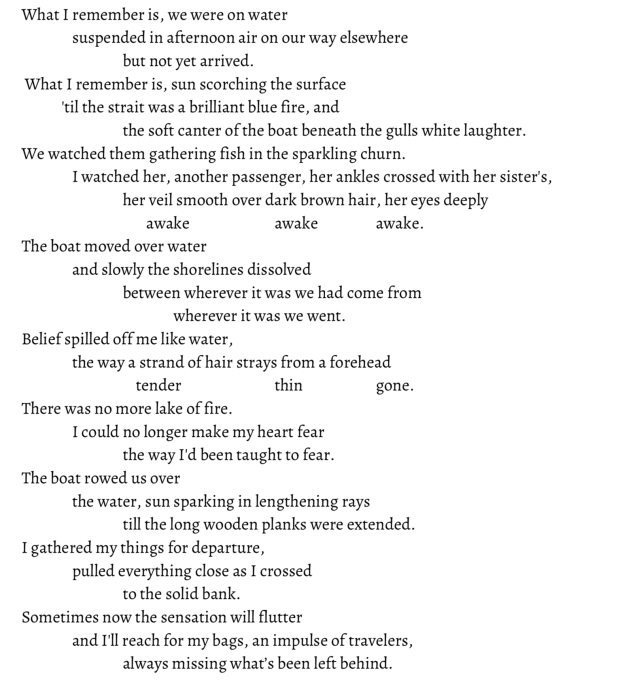
On the Ferry – a poem by Jen Stewart Fueston

On the Ferry

Screenshot 2019-03-05 at 08.17.15


Jen Stewart Fueston lives in Longmont, Colorado. Her work has appeared in a wide variety of journals, most recently Ruminate, Rock & Sling, and The St. Katherine Review. Her poems have twice been finalists for the McCabe poetry prize, and been nominated for a Pushcart Prize. Her first chapbook, “Visitations,” was published in 2015, and her second, “Latch,” will be released in early 2019. She has taught writing at the University of Colorado, Boulder, as well as internationally in Hungary, Turkey, and Lithuania.

Allow – a poem by Ali Grimshaw

Allow

How different it is
to force
instead of allow.
To let it come to you.
Unfurl.
Without your touch.
Inside a flower bloom
without a worry
if the petals overlap.
To relinquish. Your plan
might not be the one.
Unfold another way,
yet considered
inside magic
that you desire.


Ali Grimshaw is the author of Flashlight Batteries, https://flashlightbatteries.blog/ a poetry blog for those struggling in darkness and tough times. Her poems have been published in Vita Brevis, Poetry Breakfast and Ghost City Review.

Prayer flags – a poem by Carol Alena Aronoff

Prayer flags

When I exhale,
the Tibetan flags
suspended from a shelf
above my desk flutter–
sending prayers
into the world.

Now when breezes
move through leaves
of the golden shower
tree and neighboring
coconut palms, I see
them as prayer.

When wind ripples
river, it sets small
stones afloat, carries
twigs and koa branches
toward the ocean
as offerings.

Is movement arising
out of stillness
prayer?
And is stillness
the sacred ground?


Carol Alena Aronoff, Ph.D. is a psychologist, teacher, poet. Her work has appeared in numerous journals and anthologies and won several prizes. She was twice nominated for a Pushcart.  She published a chapbook and five books of poetry: The Nature of Music, Cornsilk, Her Soup Made the Moon Weep, Blessings From an Unseen World and Dreaming Earth’s Body (with Betsie Miller-Kusz).


A Day of Peace – a poem by Merril D. Smith

A Day of Peace

Red sky at morning, sailors take warning

White gull soars into the blushing sky,
drops a clam shell on the beach,

leaving it
for the boy to find.

He’s never seen the sea before
but he’s seen fragmented beauty

in his shattered city,
of broken statues.

.

Dark clouds roll in from the horizon,
the boy picks up the broken shell,

puts it in his pocket,
a token of hope.

Mackerel sky, mackerel sky, never long wet and never long dry.

One raindrop falls,
then another

landing on the woman’s greying hair,
dripping down her sun-weathered face.

She sniffs the air, smiles
at the scent of damp earth

imagines the corn that will rise
from the thirsty ground,

smiles, as the raindrops fall faster,
drumbeats upon the earth,

waking it,
quenching it

with more than her blood–
both sated and alive.

Once in a blue moon

the sky clears,
the moon silvered-full hovers

over sea and land,
rising—

the woman stands on her porch and watches it,
listening

to the sounds of the night,
thinking she can hear the corn grow,

or the moon
humming a lullaby for the fitful world.

In his new bedroom,
the boy takes the shell from his pocket,

gazes up to the sky,
he hears no thuds,

no sniper rat-tat-tat-tats,
only the wind sighing, blowing

him dreams of flying like a gull
over a moonlit sea.


Merril D. Smith is an independent scholar with a Ph.D. in American History and numerous books on history and gender issues. Her poetry and stories have appeared recently in Rhythm & Bones, Vita Brevis, Streetlight Press, Ghost City, Twist in Time, and Mojave Heart Review. Her blog is at merrildsmith.com.

With and Without – a poem by M.J. Iuppa

With and Without

                for Meghan Rose

Shimmering shells dry
on the kitchen table—
fragile like one’s heart
Yet, able to hold the sea
like love— un-
quenchable—lives en-
twined.

Overwhelming jungle
rhapsody of stars
needle-sharp, unblinking
the steady gaze of
my daughter’s eyes.


M.J. Iuppa  is the Director of the Visual and Performing Arts Minor Program and Lecturer in Creative Writing at St. John Fisher College; and since 2000 to present, is a part time lecturer in Creative Writing at The College at Brockport. Since 1986, she has been a teaching artist, working with students, K-12, in Rochester, NY, and surrounding area. Most recently, she was awarded the New York State Chancellor’s Award for Excellence in Adjunct Teaching, 2017. She has four full length poetry collections, This Thirst (Kelsay Books, 2017), Small Worlds Floating (2016) as well as Within Reach (2010) both from Cherry Grove Collections; Night Traveler (Foothills Publishing, 2003); and 5 chapbooks. She lives on a small farm in Hamlin NY.

The Bag without any Bottom – part 3 of a story by Wayne-Daniel Berard

The Bag without any Bottom 3/3

Wayne-Daniel Berard

To her, the icon resembled Eve, the mother of all and the mother of sorrows. She, too, poured out her heart to the image. She spoke of a parting with her first love, the death of her husband, the departing of her son to find his fortune, a son who had never returned. She wept, and for the first time, Ket’her wept with the penitent.

“What prayer do you say?” asked Ket’her asked her through his tears.

“I have no prayer,” she answered, “but I have a song.” And slowly she began to hum a tune; it had no words, but it seemed to Ket’her that there was a tiny flame in the melody, a flame which glowed like a lamp before an icon of the Virgin.

Gently the woman took the icon from Ket’her’s hands and held it before his gaze. He kissed it tenderly, and she did the same. They then exchanged the kiss of peace upon the forehead, he to hers and she to his. It was at that moment that the Abbot returned to his cell.

The look on his face changed quickly from one of disbelief to one of rage. He opened his mouth to roar and raised his hand as if to strike, but the woman calmly stood and placed herself between the master and his novice. Slowly, the Abbot’s hand dropped; the woman glided from the cell and was gone.

For a moment there was stillness. Then the Abbot came to himself, hmphed and blustered as if he were going to explode, and strode from the cell. A few seconds later, Ket’her heard the Abbey bell tolling furiously, calling all the monks to chapel.

Ket’her dreaded this assembly. He was the last to enter; as he did, a brother pointed toward an empty chair in the center of the nave. Opposite it, before the high altar, sat the Abbot in full vestments.

“You!” he thundered from his wooden throne. “You who are unworthy to bear the name brother — hear the charges against you! We saved your life as you lay dying in the forest. We tended to you and accepted you as one of our order. And how have you repaid our kindness?

“In your vanity, you have taken upon yourself the office of confessor, which one must labor years to obtain, deceiving yourself that it was pity and not pride which motivated you. What is worse, you have desecrated these holy grounds with pagan rites and rituals of the infidels!

“And then — crime of crimes! – you have permitted a woman into our Abbey, into the very cell of the Abbot, where she was witnessed kissing you, a monk consecrated to the life of chastity.

“For any one of these crimes alone you could be banished from this place; for all of them you will be fortunate to escape a fiery death at the stake.

“Speak, then, spawn of ingratitude! Our order’s blessed rule guarantees a defense, even for the likes of you. What have you to say?”

Ket’her at first stood speechless. Then, haltingly, he began,

“Reverend Abbot, brothers of the Abbey, all my life I have sought only one thing: that which is inexhaustible, that pursuit or person or passion which knows no end, and to which one could give his entire life — a bag without any bottom. Many times I thought I had found it . . . in race and culture, in commerce and riches, even in love. But each time the bag, although deep, turned out to be finite. I soon reached the bottom of each experience, the disappointing end of all that it could teach me.

“When you found me and brought me here, I thought that at long last I had found my heart’s desire. But it seems that the faith you practice also has boundaries, limits. Although we speak of compassion, we will only extend it to those of our faith; though we declare that all are children of God, only men as seen as truly worthy.

“I thank you, dear brothers, for saving my life. I thank you for the kindnesses you have showered on me, and for the learning I have gained here. But I cannot repent of the compassion that I, unworthy as I am, have shown to those who came to me uninvited. If there is a god, he alone brought them here, and to him alone will I answer.”

“If?” bellowed the Abbot, rising up enraged. “If there is a God? How dare you blaspheme in this sacred place! By your own words, you show yourself unworthy of God, and of this” — the Abbot pulled Ket’her’s icon from beneath his vestment — “his holy mother, whose image you will never be permitted to desecrate again . . .!”

At this he turned and smashed the icon into splinters on the stone altar behind him. All the assembly gasped.

“Now go, before your life is forfeited! With nothing you entered this place, with nothing shall you depart!”

Ket’her stood up. For a second, he meant sheepishly to withdraw. But then, in his mind’s eye, faces began to appear. He saw the men who had refused him a fair price for his home and his sheep. He saw those in the Great City who had snubbed him in his poverty. He saw the face of Zod, who had pretended to value him, but had stolen his only love from his side. Finally, he saw the face of Abbot Dominus, who had destroyed Ket’her’s only link to his mother.

Lit by a fire within, Ket’her raised dark, smoldering eyes toward the Abbot. Purposefully he strode slowly toward the high altar. The face of the Abbot began to change; Ket’her saw fear twitching at corners of his mouth, and dread fill his eyes like tears. The Abbot began to tremble; every monk was frozen in his place.
Ket’her raised his hand as if to strike the Abbot, but held it in the air. The Abbot, shaking with fright, leaned back in his throne, which toppled sideways down the great steps, leaving the Abbot cringing beneath it, his arm shielding his face as he whimpered.

Ket’her threw off his monk’s habit and walked from the chapel in silence. At the Abbey gatehouse, he exchanged his sandals for a pair of boots, donned a woodsman’s tunic over his breeches and set out once again into the world alone.
He wished to avoid the town, neither did he want to plunge into the forest. He decided to follow the creek that fed the Abbey’s well, to see where it might lead him.

For many days he followed the stream, which soon became a river. Ket’her followed on through flat, muddy bottom land, until at last, forty days later, he and the river reached the sea.

Ket’her had never before seen the sea. To him, it was like the surface of the clouds he had seen when he’d herded his sheep in the high mountains, only the sea was even more vast. It seemed to have no end.

As he walked along the seaside, in the distance he saw figures sitting beside a weathered cabin on a bluff. Ket’her, very tired and hungry, turned toward the cabin.

At the top of the bluff sat a woman, and at her feet a circle of children. She did not seem to notice Ket’her; she was engrossed in a story she was telling.
“Children,” she said in a voice like light, “have you ever heard the story of Solomon and the Demon of a Thousand Names?”

Ket’her stopped short. On her right hand, the woman wore a puppet, made of an upside-down bag. On it she had painted eyes, a nose and a mouth, and around its head she had wrapped red cloth in the shape of a turban . . .

The woman began to tell the tale in a strange voice, a voice that Ket’her recognized as his own. Indeed, she told the story exactly as Ket’her had so often done, with the same inflections and pauses. At first, Ket’her thought that he was being made a fool of, but there was no mockery in the woman’s voice, and the children loved it.

When she had finished, the children applauded, then filed off down the bluff. Only then did the woman turn her face to Ket’her, who knew her immediately. She was the penitent who had come to the door of the Abbot, it seemed a very long time before.

“What is your name?” whispered Ket’her.

“Ket’hera,” answered the woman.

“What is that on your hand, Ket’hera?” asked Ket’her, barely speaking.

“It is the bag without any bottom,” she replied. “Come and see.”

She handed the bag-puppet to Ket’her. He reached in his hand. Inside, he thought he could feel the soft wool of the sheep, just as he had when he was a boy . . .

He dug deeper, and thought that the scent of his mother’s cooking rose from the bag, and that he could feel her long, silky hair brush across his fingertips . . .

He placed both hands into the marvelous bag; his muscles ached as from exertion and work and the making of profit . . .

The bag rose to his shoulders; Ket’her swore he could hear the ancient songs of his people rising from its depths . . .

Finally, he climbed into the sack as into a sleeping bag, for he was very weary. As he held the bag closely to himself, he thought that he could feel Fatyma’s heart beating softly against his own . . .

And still his feet felt no bottom to the bag.

“Life, life itself?” Ket’her murmured sleepily. “Is this the bag I have sought?”
Ket’hera’s quiet laugh was the opposite of disparaging.

“No, life is merely its holder,” she replied. “You, yourself are the bag without any bottom. For your own endlessness was this all created.”

She slid easily into the bag beside him, kissed his forehead and both his sleepy eyes, and rested her head gently upon his chest.

“Tomorrow is another day, Brother Found,” Ket’hera whispered.


Wayne-Daniel Berard teaches English and Humanities at Nichols College in Dudley, MA. Wayne-Daniel is a Peace Chaplain, an interfaith clergy person, and a member of B’nai Or of Boston. He has published widely in both poetry and prose, and is the co-founding editor of Soul-Lit, an online journal of spiritual poetry. His latest chapbook is Christine Day, Love Poems. He lives in Mansfield, MA with his wife, The Lovely Christine.