Spring Tea – a poem by Anita Pinatti

Spring Tea

slowly
the pond woke
to spring

Midori knelt
in her flowered kimono
with its tight, white obi
and measured
the value of silence
from a bamboo dipper
over powdered green.

Tell me more.

enough enough


Anita Pinatti is a native New Englander, amateur photographer, and a late-bloomer who began writing poetry in her late-fifties along with a meditation practice. Her poetry has appeared in a variety of journals including Earth’s Daughters, Evening Street Review, Glimpse, SALT, and Vallum.  

Transit – a poem by Stan Sanvel Rubin

Transit

Love tells you you are everything,
as the mystic says,

but the universe says you are nothing.
How can you persist this way,

a stalled cloud?
How can you know

if anything too large to measure
deserves to be called real?

That goes equally
for the very small,

not just the quanta,
but whatever keeps us going,

the spark we keep seeking
not knowing

if it’s large or small
and what we can use it for,

in love or pain.

Stan Sanvel Rubin’s poems have appeared in many US journals including Agni, Poetry Northwest, Georgia Review, One, and in Canada, China, Ireland, and Belgium as well as several anthologies. He has published four full length collections including There. Here. (Lost Horse Press) and Hidden Sequel (Barrow Street Book Prize). Born in Philadelphia, he lives on the north Olympic Peninsula of Washington state.

A Mere Crumb – a poem by Margaret Taylor-Ulizio

A Mere Crumb

The host presents itself but once a month
full and round
a complete image
and then on other days
it is but a fragment,
but we have always known and were always taught
that in the fragment
we find there the whole
in its entirety complete
the mere sliver notwithstanding.

Margaret Taylor-Ulizio is a canon lawyer, part-time Religious Studies instructor, and novice writer. 

Wholly Spirit – a poem by James B. Nicola

Wholly Spirit

One tale from so-called Scripture daunted me
as deeply as a passage from the Tao
until I learned that Myths, like poetry,
use metaphor to help a mind grasp how

one God, or The Divine Soul, from some Higher
Realm, or Heaven, thought of as above,
descends, from time to time. One Way is Fire.
Another, paradoxically: The Dove.

A forest burned makes fertile soil, however,
as does volcanic ash when cooled at last.
And after World War One, the world said never
again, as some, after The Holocaust.

Some, not all. Is The Dove returning, then?
Or will The Flame be visiting again?

James B. Nicola is the author of eight collections of poetry, the latest three being Fires of Heaven: Poems of Faith and Sense, Turns & Twists, and Natural Tendencies. His nonfiction book Playing the Audience: The Practical Actor’s Guide to Live Performance won a Choice magazine award. He has received a Dana Literary Award, two Willow Review awards, Storyteller’s People’s Choice award, one Best of Net, one Rhysling, and eleven Pushcart nominations—for which he feels stunned and grateful. A graduate of Yale, James hosts the Writers’ Roundtable at his library branch in Manhattan: walk-ins are always welcome.

To Scatter Where – a poem by Rob McClure

To Scatter Where


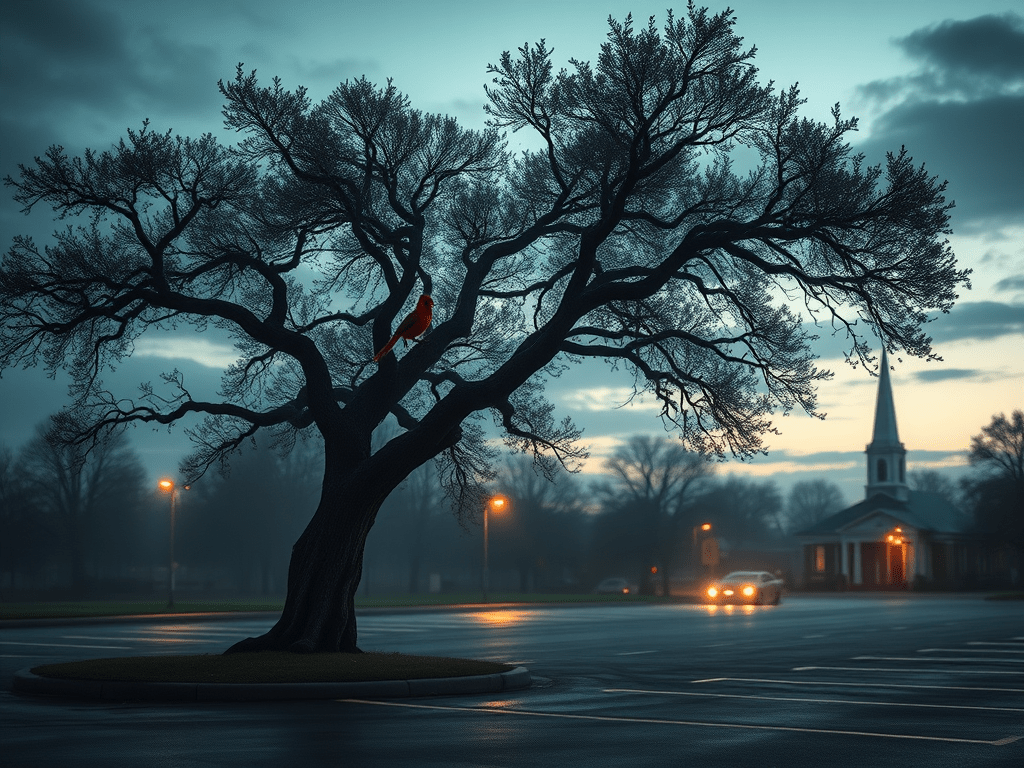
across the car park carrying the ashes,
the trees bereft
the birds have left
only the heft
of recorded church bells
unnatural chiming

to scatter where?

Does it matter?

a galaxy away the star whorls
in the vortex of a black hole
& light is no more
& time buckles
in the event
horizon
& what matter disappears
from the universe

when a cosmos collapses,
it overwhelms.

Roll away the stone,

the writhing things found beneath
think of me not
but I of them
make something

the universe breathes

on a cold oak bough
by a crematorium chimney,
that lone cardinal cheers,
his two-parted whistle chirped

to scatter where?

Here

black tarmac glistens
where the puddle ice cracks
I carried in these arms
& upon this back this black
pouch
heavy,
something remains
still
with death comes grief,
guilt-edged relief
perhaps belief.


Rob McClure‘s poetry has appeared most recently in Poetry Scotland, New Writing Scotland, Lallans, Anthropocene, Neologism Poetry Journal and Light. He is the author of The Violence (Queen’s Ferry Press, 2018) and The Scotsman (Black Springs Press,2024). Originally from Scotland, he teaches at Knox College in Galesburg, Illinois.

Meditation Instruction – a poem by Laurinda Lind

Meditation Instruction


The friend who phoned and fumed
couldn’t right himself to center so

I said how it might mend him if
he found his larger life, breathed

his longer breath, slipped inside
what was down inside, made his

way to his quiet mind. He said no
that would never work, but called

later in the week and asked how
long I’d done it. Sixteen years,

I said. Do you sit in the lotus
position, he asked, do your fingers

form a circle? No I don’t, I said,
no they don’t. Well, he said,

I checked out this library book
and I hate to rain on your parade

but without the pose, it was all
for nothing. I thought how hard

it had been not to think thoughts
so I’d get to a space of no space.

I smiled at the phone and said,
Oh, Eddie, you are exactly right.


Laurinda Lind lives in the U.S. in New York’s North Country, close to Canada. Some of her poems are in Blue Earth Review, Stand, and Spillway. Her first chapbook, Trials by Water, was released in summer 2024 (Orchard Street Press). She has won four international poetry competitions.

Ajanta Caves: Leaves from a Photo Album – a poem by Deepa Onkar


Ajanta Caves: Leaves from a Photo Album

From the window
of the bus, the caves –
black pits in the vast
stretch of craggy rock

*

Sun and wind and rain
of centuries: a bodhisattva stands
up close with impermanence.
The swarms of tourists
soon vanish

*

Buddhas spring
like lotuses
from the depths
of dank nothingness

*

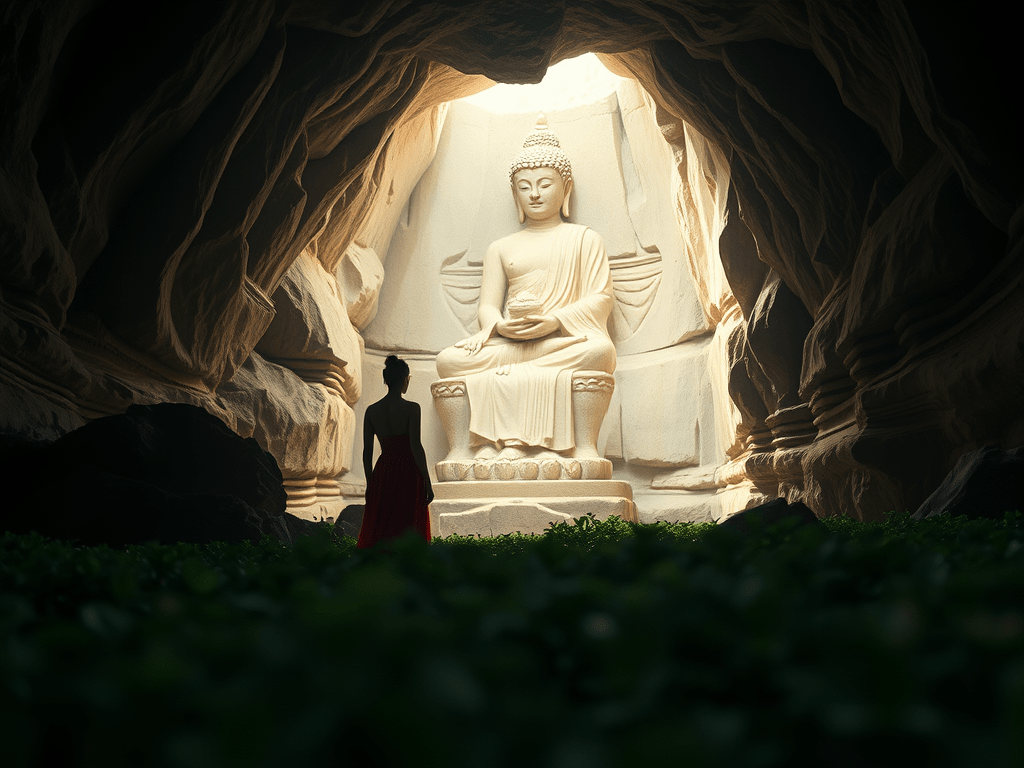
I stand frowning in my red dress
in a field of wild mint: the peace
of the sculpted past is perhaps
already a memory

*

Light floods stone, smoothens it.
The Buddha lies, head cradled
in his arm. I listen – his words
still reverberate: be a lamp unto
yourself, be your own refuge


Note: bodhisattva: In Buddhism, a being who strives for Buddhahood and helps others to do the same.


Deepa Onkar is a poet from Chennai, India. She was a teacher at Krishnamurti schools, and a feature writer and literary editor with The Hindu, an Indian national newspaper. Her recent poems have been published at The Lothlorien, Mollusk Literary Magazine, and Sparks of Calliope. She currently divides her time between Chennai and Bangkok, Thailand.

the braid – a poem by Amrita Skye Blaine

the braid 

Taking happiness and suffering as the path requires the noblest aspiration, a kind and courageous heart, and skillfully developed endurance. —Chakung Jigme Wangdrak

but happiness and suffering
are the path
whether realized or not
the third, peace of mind—
three cords I live with
plaiting and twining
the braid of each day
into equanimity’s strand
offering strength
and securing the rest,
I weave gilded thread
as reminder—
steadiness, the gold
constancy, the way

Amrita Skye Blaine develops themes of aging, disability, and spiritual awakening. She received an MFA in Creative Writing from Antioch University in 2003. She has published a memoir and a three-novel trilogy. Blaine has been writing poetry steadily since she turned seventy. Her poems have been accepted by Braided Way Magazine, The Penwood Review, Delta Poetry Review, the New English Review, Soul Forte, and Chiron Review. Her first book of poetry, every riven thing, has been accepted for publication by Finishing Line Press and will come out mid-2025.

The Cynic and the Friar – a poem by Bruce E. Whitacre

The Cynic and the Friar

In memory of Mychal Judge

The Friar was an old family friend who took it upon himself
To check in on my boyfriend, the black sheep of a pious family.
He had introduced us to a gay strip club and we were eager
To show off our new place: garden views and a miraculous,

Five by five kitchen. Of course, there were cocktails and wine
Before the pasta. Even a discalced Franciscan has to live.
He had just returned from Medugorje, in Bosnia,
Where the Virgin appeared daily to six young people.

We knew of it. Back in Yugoslav days we had crossed
From Bari to Dubrovnik on a boat bursting with pilgrims,
Annoying, so many, so many loud Americans. We left
Them at the dock for sladoled along Medieval lanes,

The rocky beaches of “our” Yugoslavia, secular, polyglot paradise—
To think what was to follow.
Now, the Friar was back, with us, attention-getter, do-gooder,
Holding forth about his pilgrimage with a wheel chair-bound

Ex-cop wounded in the line of duty, searching for a miracle
They had failed to find at Lourdes or Knock.
“I can’t wrap my head around it,” the Friar said, serious and misty-eyed
As he sometimes got between jokes and laughs at himself.

“I was in the church, praying, with all these people,
And out of nowhere I suddenly smelled flowers, roses.”
He paused. “Yes? And?” I leaned in for more.
“Well, you know the scent of flowers is a sign the Blessed Mother is…”

His voice trailed off. “Hell, I don’t know.” He laughed.
I had this. I pressed the table for emphasis.
“It’s obvious. You’ve been conditioned. You expected to smell flowers,
So, of course, you did. It’s all in your mind. Not to worry.”

“Ah, yes. I see,” he mildly thanked me for denying his miracle.
We cut the cake and moved on, the decades since…
To think what was to follow.
I often smell roses in his words.

Bruce E. Whitacre: Good Housekeeping, 2024 from Poets Wear Prada, is a BookLife Reviews Editors Pick. The Elk in the Glade: The World of Pioneer and Painter Jennie Hicks, Crown Rock Media, was also a BookLife Reviews Editors Pick. Both books received awards from The BookFest.Richard Thomas has narrated the audiobook, to be released in late 2024. His poems have appeared in many anthologies and over thirty five journals. He has been nominated for Pushcart and Best of the Net. He lives with his husband in Queens, NY. More info at http://www.brucewhitacre.com.


Surely, the Lord is in this place – a poem by Michelle Stephens

Surely, the Lord is in this place  


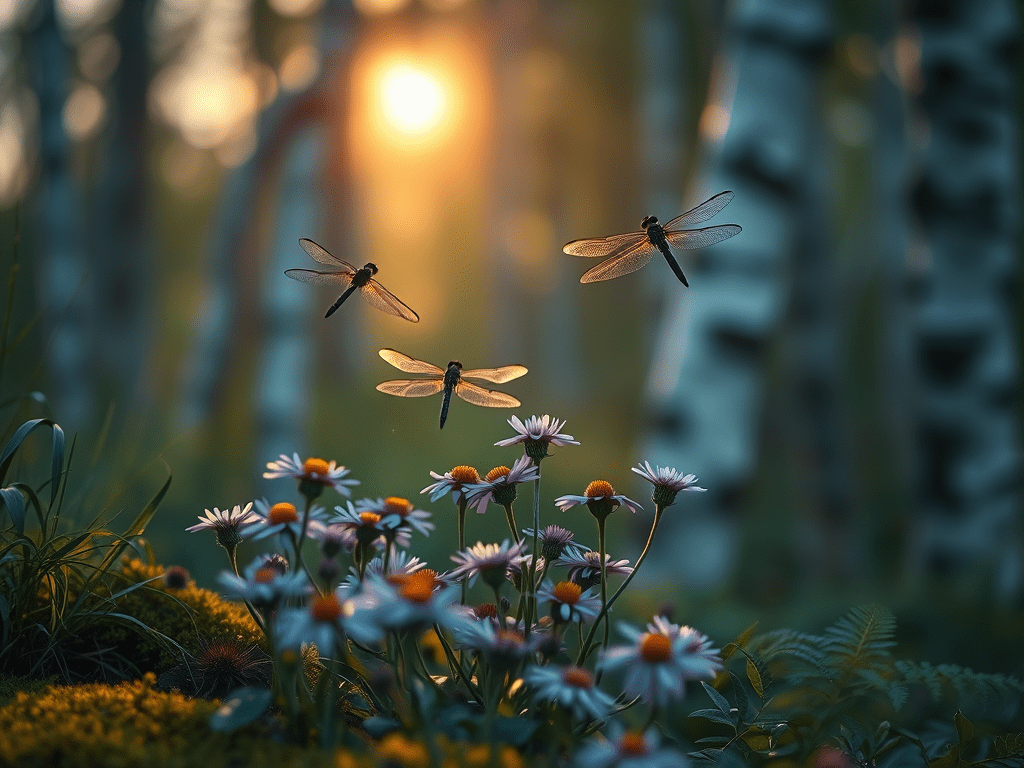
Even a dragonfly's wing

silvery miracle
quivering on asters

in their moonlit vigil
silent

My cares vanish
over birches

too far from my reach
the anxieties, micro calamities

of self

Here, only my heart
which blooms in rhythm

to an earthen hymn
thrummed deep

beneath the moss
ardent flush

of fern

and my hands
open

—Some truths lean
towards skin

waiting, like plush
petals

like icy fire
of wings

or hem
of fulgent garment,

to be touched


Michelle Stephens is an alumna of Fresno State University, where she majored in English Literature with a minor in Classical Studies. Her poems have been published in HAIS: a literary journal and are forthcoming in Ekstasis and Orchards Poetry Journal. She makes her home in the San Joaquin Valley of California with her husband and their son.