Offering – a poem by Jeff Burt

Offering

Look at my psalms, he misspoke,
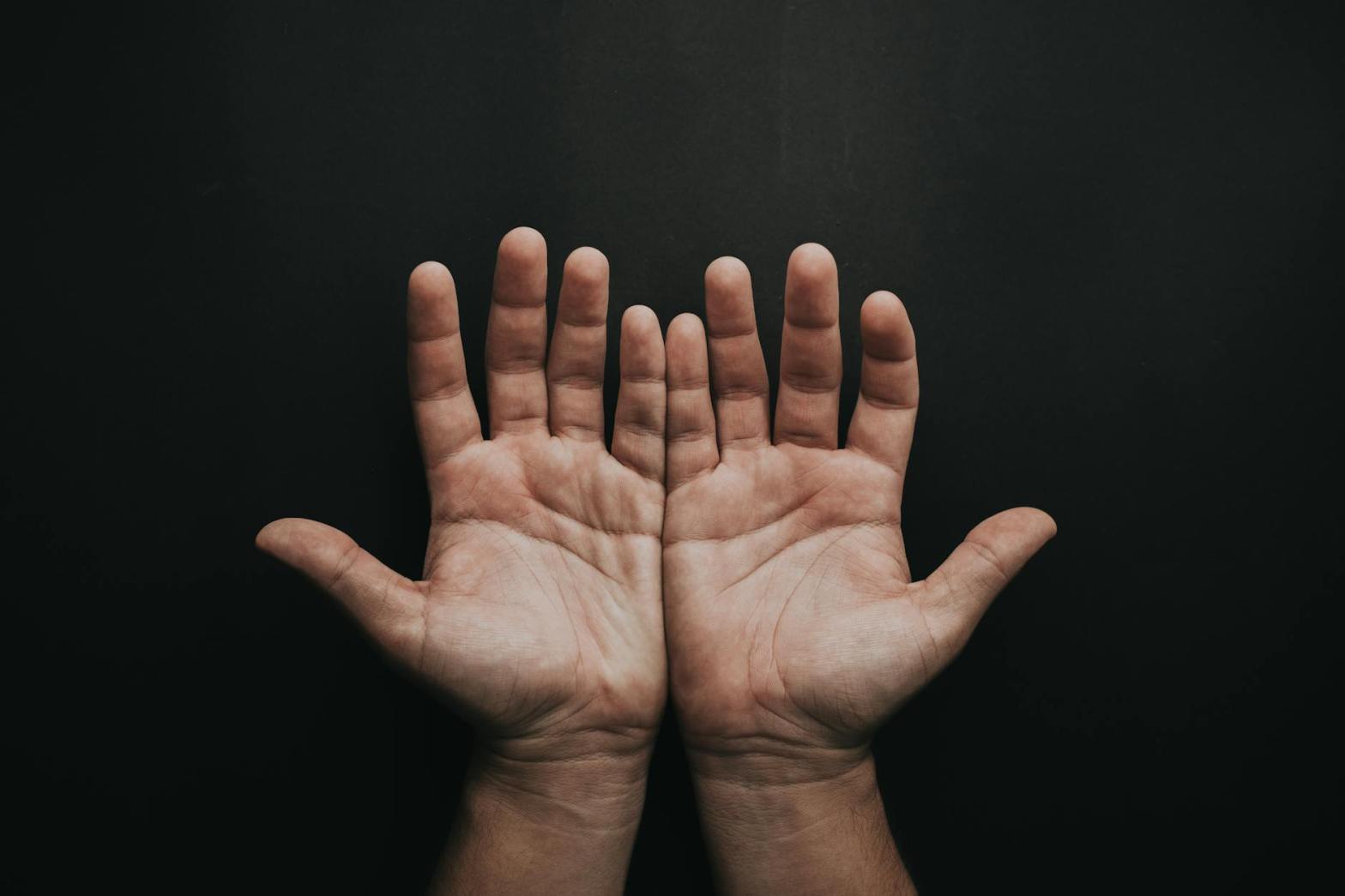
holding his upturned hands
like blossoms toward my eyes,
and flashes of his work with wood
appeared, honey gold of the finish,
the plane smoothing the grain,
the sandpaper that softened
both a corner and his fingers
and removed a portion of his identity
and gave it like a gift to the wood,
thumbs crippled, his palms
extended in lament, worship,
beseeching, triumph.

Jeff Burt lives in Santa Cruz Country, California. He has a digital chapbook available, Little Popple River , from Red Wolf Editions, and print chapbook from A Filament Drawn so Thin from Red Bird Chapbooks. He has previously contributed to Amethyst Review.


The First Real Line – a poem by Aaron Brown

The First Real Line

Each poem an opening,
an image held and praised:
your son at play in rain,
wet yet unaware that time
asks in. Each poem opens
overwrought, so often,
your broken runner’s stride
never warm and gliding.
Await the first real line.
You will know it,
you, looking over
a draft, will realize
the sacred has come
calling, you who’d
rather muscle your way in.
Give yourself
to the language that knocks,
follow it to the next door.

Aaron Brown is the author most recently of the poetry collection Call Me Exile (Stephen F. Austin State University Press, 2022) and memoir Less Than What You Once Were (Unsolicited Press, 2022). His debut poetry collection, Acacia Road, won the 2016 Gerald Cable Book Award and was published by Silverfish Review Press. Brown grew up in Chad and now lives in Texas, where he is an associate professor of English and directs the writing center at LeTourneau University. He holds an MFA from the University of Maryland.

The Bringer of Fire – a poem by Edward Alport

The Bringer of Fire

Tell me, old man, I said to the figure
hunched in the doorway,
why are you waiting here
for the odd thrown coin?
There is a world you must have seen.
Didn’t it glitter? Didn’t it
beckon you with its soft sigh?
What are you waiting for
half in darkness, half in light, as the world passes by?

He had a bloody bandage wound around,
and an ancient bowl, rough with years, smoking at his feet.
I saw the world, he said.
Saw it from a distance, you could say .
From a mountain top.
I gestured with distain.
A safe distance?
Not very safe, he grunted, shifting in his pain.

He caught the coin I threw,
before it hit the bowl,
but some low-life swooped
and seized the bowl, dropped it,
howling, and ran with hands smoking, red raw.
The old man looked at me. I came all this way,
he said, to give you this glow.
Take it.
Use it wisely.
And don’t burn the place down as you go.

Edward Alport is a retired teacher and proud Essex Boy. He occupies his time as a poet, gardener and writer for children. He has had poetry, articles and stories published in various webzines and magazines and performed on BBC Radio and Edinburgh Fringe. He sometimes posts snarky micropoems on Twitter as @cross_mouse.

Yo, heave ho! – a poem by Maggie Mackay

Yo, heave ho!

Dad cranks up the gramophone
like a conductor lifts his baton.
He gently drops the stylus
onto the shellac 78rpm.

Bass voices of Volga burlaks
arise from the disc,
from a deep echo
in a vault or mountain pass.

Their sacred shanty melody
transforms
our dwelling place
into a cathedral.

I’m silenced by its power,
this strange, hypnotic wall of sound,
powering the heaving of barges on straps,
not by horses, and before steamships,

a choir of metronomes,
of full fathoms,
ticking pendulums.
Yo, heave ho!


Maggie Mackay’s poem ‘How to Distil a Guid Scotch Malt’ is in the Poetry Archive’s WordView permanent collection. Her second collection The Babel of Human Travel (Impspired.com  ) was published in 2022. She reviews poetry collections at The Friday Poem (https://thefridaypoem.com).  Her best downtime moments  are spent with her greyhound and a malt whisky. Twitter handle is @Bonniedreamer.

Still Point – a poem by Richard Schiffman

Still Point

The half of the earth in night
the other half in day

a black fish and a white
dash through the dark of space

and we, who are neither dark
nor wholly bright,

in sleep and also waking,
our days both clear and cloudy,

our nights both calm and stormy—
these lives of ours revolve

around a sane and sacred place
a hidden still point

at the heart of space, where time
forgets where it was headed,

and what is here
is all there ever was

Richard Schiffman is an environmental reporter, poet and author of two biographies. His poems have appeared on the BBC, in Rattle, the New Ohio Review, the Christian Science Monitor, the New York Times, Writer’s Almanac, This American Life in Poetry, Verse Daily and other publications. His first poetry collection What the Dust Doesn’t Know was published in 2017 by Salmon Poetry.

Worship of Light – a poem by Clive Donovan

Worship of Light

On a high plateau far away,
lived a race of people who enslaved light.
No Zoroastrians, these, for they had usurped the sun:
Their technology encompassed fluorescence,
lasers, mirrors, globes and gigantic lens.
Originally harmless in their faith,
they worshipped bio-luminescence, keeping fish and worms
in temple tanks where devotees would rub and click
on rosaries of beaded quartz for mystic sparks.
But priests were now advanced to inner rings
of atoms and their photons—pressuring
with heat and forced velocity,
splitting the very finest grains of paradise.
They persecuted unbelievers—named them heretics—
who lived in cellars now and bunkers underground,
for world had gone insane with zealots and religious wars,
as wayward balls of fire ripped through ether.
And they all went blind in that realm of captured light,
for their god, in emergence from dark ruptured elements,
revealed just a fraction of his bright transcendent glow,
exploded to engorged illumination
like the stars of Van Gogh...

Clive Donovan is the author of two poetry collections, The Taste of Glass [Cinnamon Press 2021] and Wound Up With Love [Lapwing 2022] and is published in a wide variety of magazines including Acumen, Agenda, Amethyst Review, Crannog, Popshot, Prole and Stand. He lives in Totnes, Devon, UK. He was a Pushcart and Forward Prize nominee for 2022’s best individual poems.

No Hurry – a poem by Garret Keizer

No Hurry


Someday we may reach a level of love
so high it will seem foolish to compose
a poem, impossible even to whisper of
the meaning behind the obsolescent rose.
We aren’t there yet, of course, but only skim
the meadow tops until we roost in church,
not gone to heaven but crying our hymn
skyward from our consummated perch.
I’m in no hurry for transcendence, dear.
An astral body scares me, no matter how
sublime, how infinite, emancipating, and clear
the unstrained light; I want the stained light now.
Enough for me to glimpse us heading to
an us beyond ourselves, yet still with you.

Garret Keizer is the author of The World Pushes Back, winner of the 2018 X. J. Kennedy Poetry Prize, and seven books of nonfiction, including Privacy and The Unwanted Sound of Everything We Want.  He is also a contributing editor of Harper’s Magazine and Virginia Quarterly Review. His website is here:  https://garretkeizer.com.

A mild panic attack at the end of the day – a poem by Liz Kendall


A mild panic attack at the end of the day

Behind my heart is fluttering a fear that stills my feet;
a spreading heat, a weight, a clenched arrhythmic pulsing beat.
I tell myself what I’m observing, feeling into pain;
accepting everything that’s there and softening the strain.
All suffering, emotional or taut electric nerves,
is calling out for company; to be held and observed.
With hands warm on my heart I let the comfort spread until
the panicked immobility retreats; I know it will.
In trying to be helpful, function in this racing world,
I blunder: missing out the quiet pause that makes the pearl.
Just give your wisdom time to form, solidify, and let
the final insights take their place; don’t do it now, not yet.
That rush to have it over with, to move on to the next
self-fabricated duty is what’s put you in this mess.

Liz Kendall works as a Shiatsu and massage practitioner and Tai Chi Qigong teacher. Her poetry has been published by Candlestick Press, The Hedgehog Poetry Press, and Mslexia. Liz’s book Meet Us and Eat Us: Food plants from around the world is co-authored with an artist and ethnobotanist. It explores biodiversity through poetry, prose, and fine art photography. Her website is https://theedgeofthewoods.uk and she is on Twitter/X and Facebook @rowansarered, and on Instagram @meetusandeatus.

Uma – a poem by Steven Knepper

Uma

Soft gusts, the windows down, I’m reading the
Upanishads.

The parking lot is overfull.
It’s STEM night at my daughter’s elementary
school: programmable robotic arms,
volcanoes, mirror tricks,
prismed light and laser beams,
the fecund hollowness within the seed,
the crowding furrowed brows, delighted eyes,
the ancient wonder veiled,
but also intimated.

I close the book and think,
“What we can never comprehend
is that by which we comprehend the world.”

A toddler waiting with her mother near
the door grips spring’s first meadow garlic shoots,
lifts chubby fingers to her nose, leans back
her head, and laughs into a flaming sky.

Too easily, too easily,
we all word-wrap the mystery.
Sophia, Uma,
wisdom,
take my hand.

Steven Knepper teaches in the Department of English, Rhetoric, and Humanistic Studies at Virginia Military Institute.  His poems have appeared in The Alabama Literary Review, The William and Mary ReviewFirst ThingsPresencePembroke MagazineSeminary Ridge ReviewSLANT, The American Journal of Poetry, and other journals.

Along the Shaded Woods – a poem by Lydia Falls

Along the Shaded Woods


i talk in frenetics at the midnight hour
before time slips beyond the skyline

from my star-flecked room, as a meditative darkness
falls in circles. caught between the passage

of concentric navigation, i memorize
the lost in found with space carved out

for emptiness, reframe my light upon
the nurtured grace of suffering.

now the lilac dust speckles the garden.
the metaphors litter the yard.

this vessel is a temple and i have risen
here before: tilting on the middle path

towards waking. along the shaded woods
thrives a whirlwind of devotion, yet

the flower feels its ache as it still opens.


Lydia Falls resides in the woods of New York after living abroad in South Korea and Taiwan. Her poetry collection, Beneath the Heavy, was published under Merigold Independent (2021). Lydia’s poems have appeared or are forthcoming in Connecticut River ReviewMidway JournalWashington Square ReviewHere: a poetry journal, and elsewhere. www.lydiafalls.com