Sol, the sire of life, makes butter run. We’re on the terrace. Shaded. Breakfast. Fruit and pastries. Coffee creamed with Baileys. Decadent. The street beneath, still sleepy, muses why last night we stopped mid-road to gawp a moonless heavens splotched down its middle with a billion melded suns.
A primal call to confront infinity? Elements intuiting whence they came? Or inculcation that the distant, vast and barely comprehended demands our awe?
It could, of course, be glitz - the straining flame before us on the table, oil oozing iridescence after rain, a dusty shaft of sunlight through a crevice – that lures the eye and later we take home and, granting our perceptions import, flesh with meaning.
Daniel P. Stokes has published poetry widely in literary magazines in Ireland, Britain, the U.S.A. and Canada, and has won several poetry prizes. He has written three stage plays which have been professionally produced in Dublin, London and at the Edinburgh Festival.
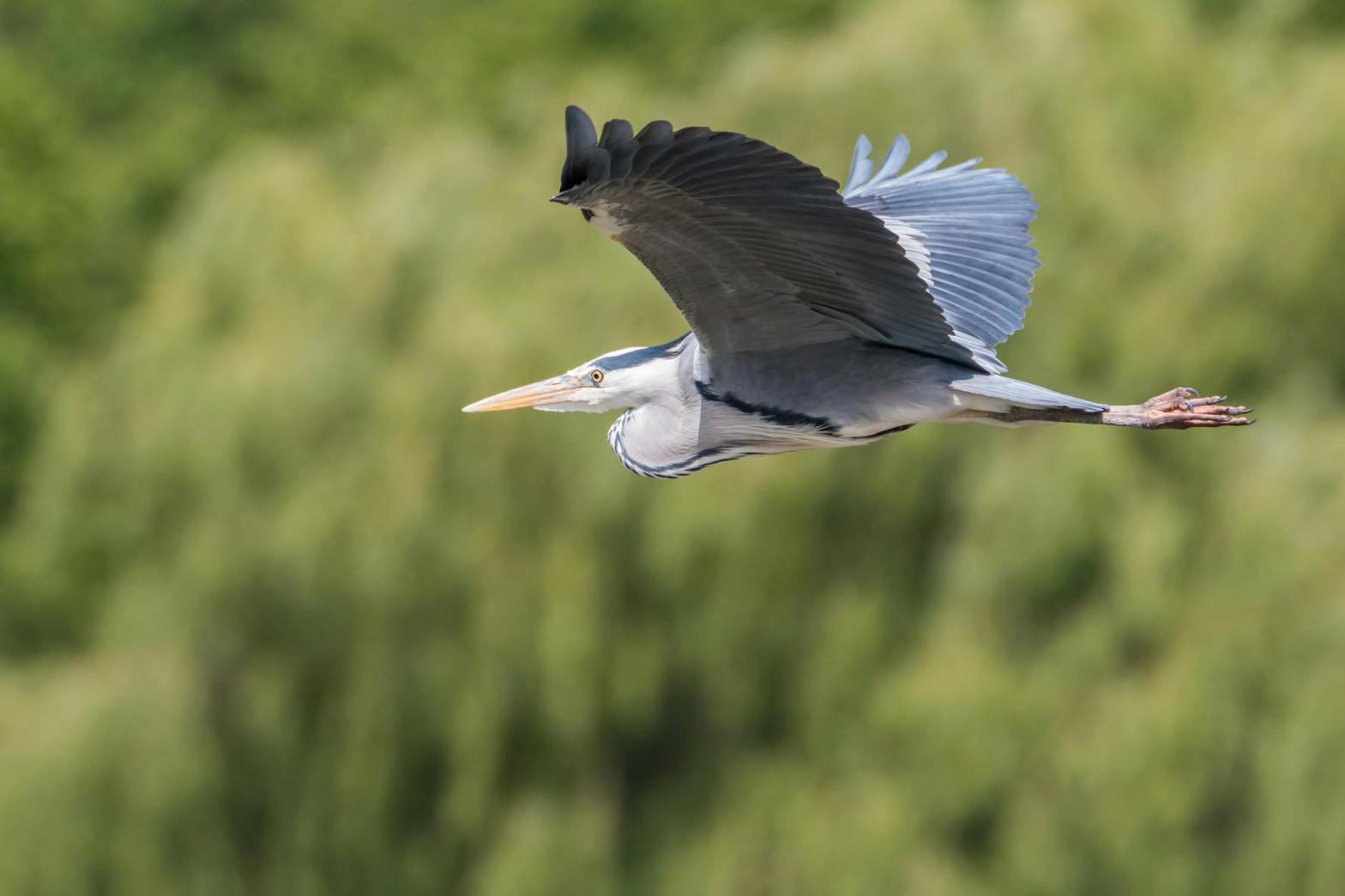
I reach for my camera in the bow of the kayak as living driftwood of exquisite thinness senses me from shore with that great, watchful eye keen for spying fish and frog, lifts, stays low skimming the silver gloss, neck tucked, legs dangling, curved wings silently rowing.
I’ve heard it said that the bird in any poem, in fact, represents the poet. Oh, were I that heron! How I covet the instinct, the grace, the speed, the effortless transcendence— one with sky and lake.
Katherine Edgren has two books of poetry: Keeping Out the Noise, by Kelsay Books and The Grain Beneath the Gloss, by Finishing Line Press, plus two chapbooks: Long Division and Transports. Her work has appeared in journals including: Coe Review, Birmingham Poetry Review, Light, Orchards Poetry Journal, and Third Wednesday. Katherine is a former Ann Arbor City Council member. Her past work includes heading up the Health Promotion and Community Relations Department at University Health Service and serving as a Project Manager for Community Action Against Asthma a community-based, participatory and intervention research project through the School of Public Health, University of Michigan. She has a Masters Degree in Social Work from the University of Michigan.
Deep breathing is a challenge right now. The virus has yet to seize me by the lungs, but when I do breathe, the smooth swoop of air scratches my throat, and the coughing clutches me again. I do my best, though, tilting my head back against the recliner, letting fatigue flood my eyes shut as the guided meditation begins.
Half of me wants to ask the narrator, “Why me? And why now? How long will I have to live with the craving to sleep all day? And could my boyfriend please be spared so he never receives what I never wanted to give him?” But the other half of me knows these worries are futile. So I listen as the narrator’s voice vibrates through the soles of my feet, as he reminds me to relax, as he reminds me not to think, as he asks me to do what is effortless (close your eyes) and what is not (breathe deeply). Then he asks me to imagine my root chakra as a sphere of red light at the base of my spine—
and suddenly I see it, a tiny planet like Mars, spinning on its axis as it centers me, and that’s when I find the solar system I hold inside— all seven energy centers, tiny globes rotating on fixed points along my back, neck, and head, each one shimmering in a color from the rainbow—
and only then do I notice how I breathe with a river’s ease, how I remain in my recliner yet have floated into a galaxy where illness, questions, and fear don’t exist, where the expanse that grows within blurs with the boundaries of skin until the space I contain is limitless, until all traces of disease seem to fall away, until this lying back and listening is all I do for hours because it allows me to feel well again.
The Meaning of Life

In the struggle between the stone and water,
in time, the water wins.   —Japanese proverb

A formula came to me in a dream
when I was desperate
		a dream drifted
clear as an algaed pond
	in which mottled koi
	swim their scaley dance
meaning: fog-sighted,
self-contained,
meaning: this belongs inside
	my thought’s clay banks

	the dream sign stood clear
to me
letters and numerals
moving verso to recto
like a koi ballet
or the garnet veins
of a coral-bell leaf

I wrote it down in a notebook
I no longer carry it with me

because to stamp meaning
on one equation of life
makes an imperious whim
an emperor of argument

yet the finch goes on
just being finch
creating its sounds
we soothe ourselves
by calling song
instead of edict

our words become rock or water
rhetoric is a boulder
a tool to build
laws or confidence
power or fear

poetry flows as human song
heart in throat—
evolved from ancient
circles of fire, circles
of stones, small tribes
farflung under a shining dome
of alien galaxies—
hope with many feathers
truths free of greed’s chains

may our words, our acts, be a river
polishing smooth the stones
Susan Swartwout’s books are Odd Beauty, Strange Fruit: Poems, 2 poetry chapbooks, 12 anthologies, and a publishing textbook. Her work has been awarded a Rona Jaffe Foundation Award, St. Louis Poetry Centre’s Hanks Award, and nominated for seven Pushcart Prizes. She taught creative writing and small-press publishing, and founded a university press. “Retired,” she copyedits as a freelancer and currently serves as editor of Delta Poetry Review.
A fly joins me at the three-legged table. She appears to be divining, her miniscule forearms bent in supplication, her head steadied millimeters from where our dinner is served. Many years ago, when anxiety raged in my chest like a lion, I went to study meditation with a Buddhist monk. Every Monday, I’d sit in that stiff metal chair and listen to his high voice recount the inevitability of death, the humanity of suffering and the constancy of meditation. I’d close my eyes and try to hear the silence. When I opened them again, this man’s eyes met mine, and I saw, in that moment, his burning sanctity like the center of the sun. Now, as I gaze at the fly, I see that same fiery core, and I want to love her before she flies away.
Sonya Schneider is a playwright and poet living in Seattle, WA. Her poetry can be found or is forthcoming in 3Elements, ONE ART,Naugatuck River Review, Catamaran, SWWIM, West Trestle Review, Eunoia Review and MER VOX, among others. She was a finalist for the 2022 New Letters Patricia Cleary Miller Award for Poetry and her micro chapbook, Hunger, was shortlisted for Harbor Review’s 2023 Jewish Women’s Prize. She is a graduate of Stanford University and Pacific University’s MFA in Poetry.
Pearl Knotting

“The Latin word “bede” means to pray.  And as we stitch our beads one at a time, I hope we can find solace in this simple and loving repetition that somehow adds goodness to the cosmic soup.”  Beadwork Magazine

Put on your favorite music,
Pachelbel or Vivaldi recommended.
Prepare your space,
placing cloth on table that will hold all your
vials of pearls, beads and tools.

Pierce the barely visible hole
of a pale pearl with fine wire
trailing gray silk thread,
snuggly place a precise knot
with sharply pointed tweezers,
close behind the pearl.

Thread a faceted crystal,
a knot,
a smaller pink pearl,
a knot.
back to the milky pearl.
repeat the mantra again.

At the center
place a large tear drop pearl,
return to pattern.
At the end join
female and male parts of clasp.

Gems of water world,
clear crystals of earth
knotted together into
a rosary,
no matter the order of the beads,
a universe of rose petal prayers.
Eva McGinnis has written three books of poetry Strands of Luminescence: Poetry of the Spirit’s Quest; Wings to my Breath and At the Edge of the Earth and has had her work published in a number of literary books and magazines, including Tall and True Tales of the Olympic Peninsula, In the Words of Olympic Peninsula Authors Vol 2 in 2018, Vol 3 in 2019 and Prevail in 2020; Tidepools 2016, 2017, 2020, 2021, 2023; Rainshadow Poetry Anthology 2016; Wild Willow Women’s Anthology Project; Seattle Poems by Seattle Poets Anthology; Woman as Hero Anthology; A Mother’s Touch book; Spindrift ’93,’94 &’95. Her poems and photographs were displayed at the PA Public Library in 2018 & 2019 and in Fluidity (online) Art Show in 2020. She has had Ekphrastic poetry displayed alongside artwork (or read from) at the Port Angeles Fine Arts Center, Blue Whole Gallery, Northwind Gallery and Studio Bob’s. Her poetry has been part of the FAC’s Poetry in the Park for three years. She facilitates a writing group in her neighborhood in Port Angeles. Eva holds degrees from Michigan State (in English) and Iowa State (in Adult Education) and a certificate in Poetry from University of Washington.
“The true capacity of poetry comes in finding strength and grace in everything life presents us.”
There’s a meadow beyond the back pasture of my grandpa’s old farm, and when I was a city kid, it scared me—that vast openness brimming with nothing but wildflowers, insects, and birds.
Grandpa often took me there to read and think. The reading I didn’t mind, but I had no idea what to think. “Relax your mind, Jenny Bell,” he’d say.
And so we’d lie there on his red-checkered blanket, staring at the endless expanse of sky, making shapes out of the cottony clouds, pieces of grass between
our teeth. The hum of insects would make me drowsy, but I’d stay awake. Grandpa would eventually tell me his thoughts, mostly about how to invent new tractors
or what to name the new calves that were nearly born. One time, I surprised myself by telling him about middle school and how I didn’t like Harvey Winters because he
stuck gum on people’s seats and made fun of the freckles on my nose. “Why do you suppose he does that?” Grandpa asked. That’s where all the thinking came in—"I suppose
it’s because his mama is dead, and he doesn’t have a good daddy,” I said. Grandpa made an umm hmm noise, but didn’t add anything. He let me think some more. Over the years,
Grandpa and I shared lots of thinking time, and nearly every one ended with—why do you suppose. Grandpa died when I was twenty-three, right after I graduated with a psychology
degree. But every now and then, I leave my office and return to the farm. I lie down in that back meadow, a blade of grass between my teeth, and I talk to Grandpa just like I used to.
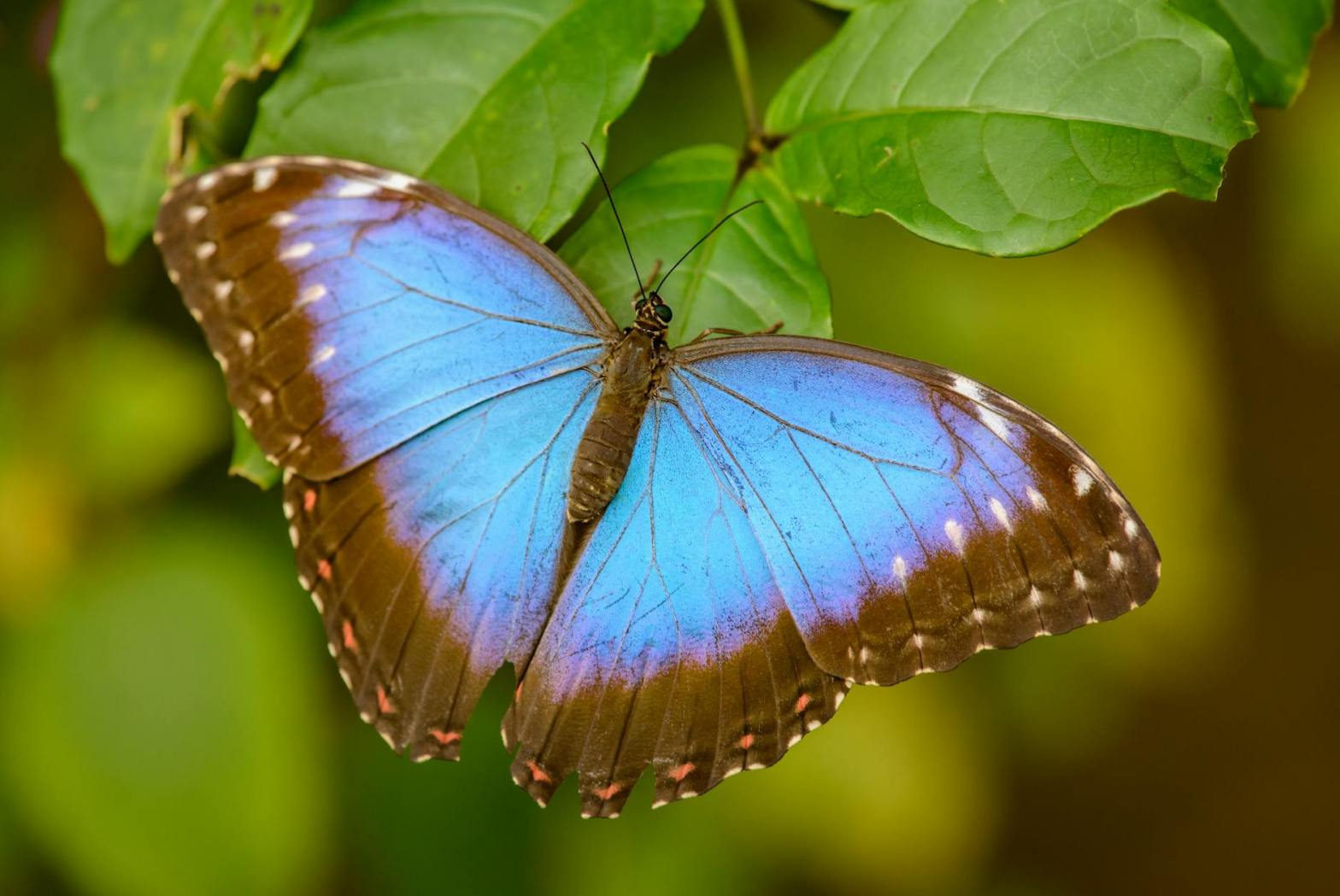
When I’m puzzling things out in life, I hear his voice, Why do you suppose? And I find my answers floating among clouds shaped like lions while a butterfly rests on my chest.
Arvilla Fee teaches English Composition for Clark State College and is the managing editor for the San Antonio Review. She has published poetry, photography, and short stories in numerous presses, including Contemporary Haibun Online, Calliope, North of Oxford, Rat’s Ass Review, Mudlark, and many others. Her poetry books, The Human Side and This is Life, are available on Amazon. For Arvilla, writing produces the greatest joy when it connects us to each other. To learn more about her work, you can visit her website: https://soulpoetry7.com/
By the hard rocks where the well was, they’d gathered; the morning sun, rising boisterous, ecclesiastic,
over the tortured mountain rock. It would be hot today. Mathew & Judas stood there, beside her, robed, sandaled.
She said, “I’ve been with the Master; he is well.” Then: “The wickedness of each day is sufficient; it’s what marks us
with the candid will to survive, until we thrive …and we’ll thrive in that light that has no diocese to it – except that it is
beyond these garments.” The men stood silent, listened. And then she said: “Workers deserve their food. We who work
against the ignorance that binds and ties us to ourselves – to that greed that will not let us pass the door of light in us –
will earn, and be fulfilled in that other food that has no false apostolicity to it. And it is earned only by that careful choosing
that disrobes one’s self from enormity. The work is small: it passes us through only the smallest place: and it has no trust
of enormity, which is the struggle of the falsified eyes, always: and it always blocks the beginning of the way. Mathew & Judas
sipped water from cups, sat quietly on the red side of the well, listened further. Mary then said: “Disciples resemble their
teachers: they learn from their wisdom, and also their folly, and then they must find their own way home, through the
ignoble false light that blocks even the teacher, and then the light pours down. And when the truth-light pours down
(upon us) we are disassembled but emerge victorious, and it will take standing in that place of reach, when we strip
ourselves of garments, that Spirit is disclosed. And then she said, “The Master has told us just this: One who does not stand
in the darkness cannot see the light. And those who come after us will dwell in that unwashed riddle and many
will die. It is best that we try to drink from that well that has no water in it, but just vision. And if we can
just drink the vision, we will see the birth of a new soul into the world. And then we will have done our work.”
Ken Meisel is a poet and psychotherapist from the Detroit area. He is a 2012 Kresge Arts Literary Fellow, Pushcart Prize nominee, best of the net nominee, winner of the Liakoura Prize and the author of nine poetry collections. His new book, The Light Most Glad of All, was published in 2023 by Kelsay Press. It was reviewed by Tipton Poetry Journal and Trampoline Magazine. Other collections include: Studies Inside the Consent of a Distance (Kelsay Books: 2022) and Our Common Souls: New & Selected Poems of Detroit (Blue Horse Press: 2020). He has work in Crab Creek Review, Concho River Review, San Pedro River Review, Panapoly, Sheila-Na-Gig and The MacGuffin.
opening spaces in the ordinary divine voices from behind the painkillers vitamins razor deodorant all of those deniers of the human condition pale palliatives for what ails me and I stare at it on the other side of the swinging cabinet door opening it further unwilling to meet its gaze and I hear it a voice emanating from the emptiness behind the bandaids rusty and stained with the detritus of being human I am your medicine I am the promise of healing I am the cut that heals the pain dissipating I am who I am not your cure only the space behind reflections of who you were in years past empty out your cabinet and I am what remains hear my voice from the cavity no burning bush just the never exhausted memory of your tears come closer close your eyes I love you I am the never existing home the cushion you collapse against when you can’t contain yourself I am inside spaces the emptiness of which you only feel when you are sad I cannot fill them feel only the resonance of the empty walls singing you are enough and music to my ears fearful and wondrous.
I shut the swinging door silencing God’s voice and look out at the eyes that used to be mine again looking back at me my medicine.
David Banach is a philosopher and poet in New Hampshire, where he tends chickens, keeps bees, and watches the sky. He likes to think about Dostoevsky, Levinas, and Simone Weil and is fascinated by the way form emerges in nature and the way the human heart responds to it. You can read some of his most recent poetry in Isele Magazine, Neologism Poetry Journal, Passionfruit Review, Terse, and Amphibian Lit. He also does the Poetrycast podcast for Passengers Journal.
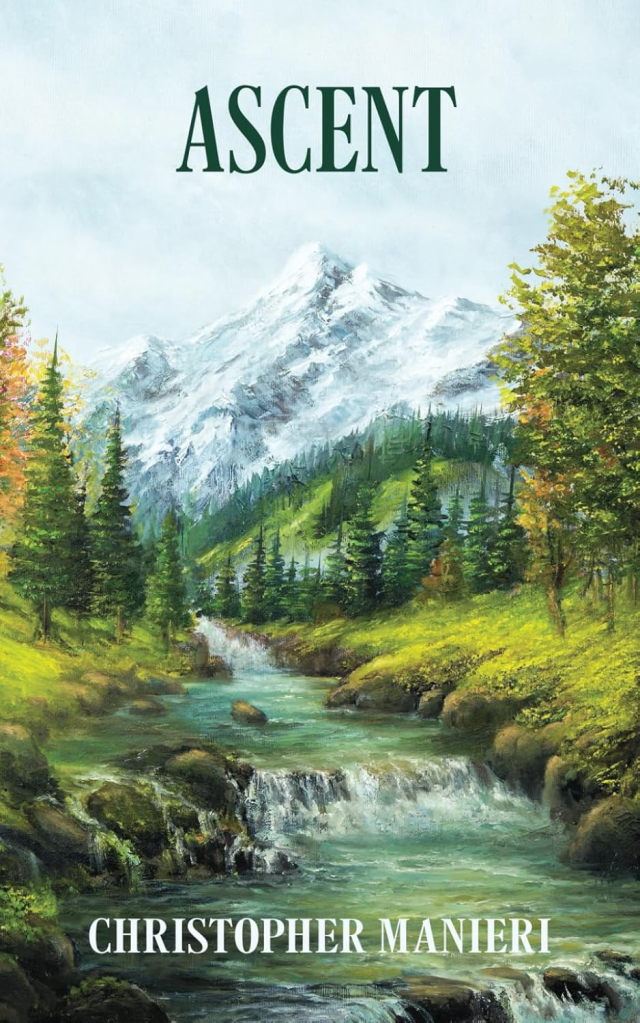
Review of The Ascent by Christopher Manieri, Careggi Press, 85pp (2024)
Those familiar with Christopher Manieri’s other collections such as The Voyage are familiar with his approach to philosophical poetry. What differs in this collection is its use of language. Far more modern yet refined, Ascent presents a resounding image of human nature. Written from the individual longing of the poet, the language bears philosophical reflection with colloquial brevity.
Manieri is deeply familiar with philosophical and religious traditions from across the world. This collection borrows thought from sources such as Plato, Plotinus, Zen Buddhism, Advaita Vendanta, mythological figures and the mystics who are seen as expressing a common vision. This vision is one of unity within plurality. It is not ironic that Manieri divides his thought among these traditions because they resolve in a common longing for ascent. Ascent is taken metaphorically as the realization that the cosmological order is composed of Consciousness (“matter derives from consciousness” he writes in “Consciousness”). This Ultimate Mind transcends the individual mind, its doubts and functions, yet resembles it. The Supreme Mind discovers itself through multitudinous creation. Ascent is the ascent to Mt. Sinai to discover God, realizing one’s true nature is identity with Brahmin; in this ascent, language fails us because awe overtakes us.
“In the Library of My Youth” has a certain resonance with poetry in A Boy’s Will by Robert Frost. Frost writes in “Waiting Afield at Dusk”: “And on the worn book of old-golden song / I brought not here to read, it seems, but hold / And freshen in this air of withering sweetness; / But on the memory of one absent most, / For whom these lines when they shall greet her eye.” Manieri personifies wisdom: “I may never see her glory again. / But how should I approach? […] She’s a modern Diotima. I should / be talking to her, not thinking / of death, always compelled again / towards more aching cogitations.” In both poems, wisdom is held somewhat distantly through longing. While Frost’s colloquialisms feel out-of-date now, Manieri revives the thought.
Ascent is rife with personalities. Aside from the philosophers and mystics who lived, Manieri’s use of allegorical dualism provides attitudinal contrasts between human archetypes. Take for example “The Conqueror and the Hermit,” a poem representing conquest in contrast to the contemplative life. The hermit tells the king, “Your empire is merely a tiny speck of sand,” that he should “detach from that wheel” and take his “voyage to freedom.” Manieri concludes the poem:
Your endless thirst can never be quenched
by the finite, but only by the Infinite
The poem illumines a question. The ‘wheel’ is the wheel of karma. If ambition signifies human frailty and sin, why do we have appetites? Does ambition not quench them? However, Manieri suggests that ambition is quelled living the vita contemplativa. Such a philosophical position reminds me of Aristotle’s expectation of a virtuous society: that it grants enough leisure for contemplation. Another expression of allegorical juxtaposing is “The Cosmos and the Child.” The dialectical conversation between the cosmos and the child offers, “How can you know / anything if you don’t first know the nature of the knower?” The essence of meaning itself is dialectical, “throwing stones into the water, / watching the circles radiating out.” Much of Manieri’s language, though derived from existential anguish, traverses a different realm than Existentialism.
Ascent is not just a poetry collection describing metaphysical ascent in the manner of so many spiritual poetries, it also clasps the heart of what it means to ascend—to live with purpose, to trust “the unfolding of the cosmic way,” as the final poem “Oneness” states. The final verse of the book is a wondrous answer to all its doubts:
Devoted to transcending the cavern,
I must heal my wings for the ascent,
ready to finally vanquish the void,
to triumph over grief, my deep longing
now intensifying as I keep striving
towards that unity, towards that oneness.
Dustin Pickering is founder of Transcendent Zero Press. He has contributed writing to Huffington Post, Los Angeles Review, The Statesman (India), Journal of Liberty and International Affairs, The Colorado Review, World Literature Today, and several other publications. He is author of numerous poetry collections and books including Salt and Sorrow. He placed in the top 100 for the erbacce prize in 2021 and 2023, and was a finalist in Adelaide Literary Journal’s first short fiction contest. He was longlisted for the Rahim Karim World Prize in 2022 and given the honor of Knight of World Peace by the World Institute for Peace that same year. He hosts the popular interview series World Inkers Network on YouTube and co-founded World Inkers Printing and Publishing.








 Amethyst Review