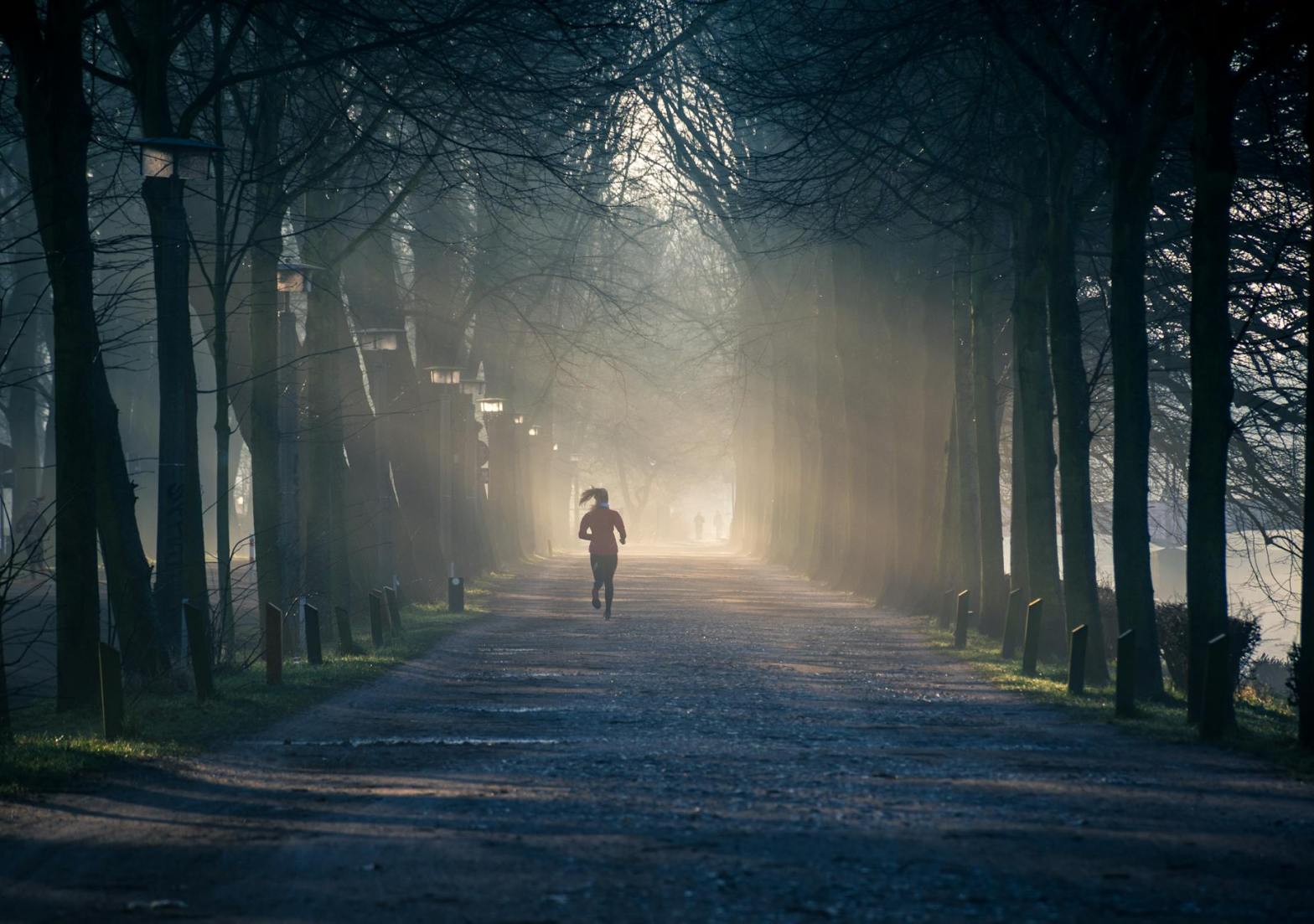
Cristo Redentor – a poem by Ken Gierke

Cristo Redentor
jazz by Donald Byrd

A haunting chorale
laced with sonorous chords
leads me through winding hills
to deliver me
into the narrow valley
that holds Westphalia,
where a church spire high on a hill
rises from surrounding trees to be seen
by all who pass on the highway
below, both wayward and devout.

As I leave that steeple behind,
Donald Byrd’s trumpet,
slow, and almost sultry, moves in,
dances with those voices,
and Duke Pearson’s piano teases,
seems to offer a revelation.

Rich Fountain lies just down the road,
waits to follow suit, its church
again totally obscured above me,
save the lines of its spire
rising above the trees.

When the road from there
opens to a wide valley,
I almost expect to see
Sugarloaf Mountain on the horizon
with the arms of Christ the Redeemer
opened wide, expecting me to come home.

Once baptized,
that boat long since capsized,
I still know all the rituals,
mouth the words at weddings
and funerals, though I know
they’ll never be uttered at mine.

As if knowing that ship has sailed,
trumpet, piano, and chorale
fade into the distance
as I head down the road to Belle.


Ken Gierke writes primarily in free verse and haiku. His poetry has been published or is forthcoming both in print and online in such places as Amethyst Review, As It Ought to Be Magazine, Ekphrastic Review, Poetry Breakfast, and Silver Birch Press. Glass Awash, his first collection of poetry, was published by Spartan Press in 2022. His poetry collection, Heron Spirit, was published in April 2024. His website: https://rivrvlogr.com/


almond blossoms – a poem by Isabel Chenot

almond blossoms

After the cold's unblunted knife,
a tenuous gracility
resembling a linen coif
is tangled on the almond tree.

Help me to stand as nude of line
where the sky nailed my summering,
as starkly witnessed as this sign
the year hammered on nothing --

as mute a token as this maimed,
unapprehending winter tree.
A dark menorah, till enflamed
with white-intense fragility.

Isabel Chenot has loved and practiced poetry for as long as she can remember. Her poetry has appeared or is forthcoming in various places — most lately Ekstasis, Shotglass Journal, Vita Poetica. She writes regularly for Story Warren. Some of her poems are collected in The Joseph Tree, available from Wiseblood books.

Eddie’s Knees – a poem by Jeffrey Essmann

Eddie's Knees

I always forget about Eddie’s knees.
I pray for peace, of course, I always pray
For peace, and always for the sorry souls
I see along the street whose lives unroll
And more and more impact me by degrees;
For friends as well, their joys and their regrets,
And Eddie, too, but somehow still forget
To say a little something for his knees.

Jeffrey Essmann is an essayist and poet living in New York. His poetry has appeared in numerous magazines and literary journals, among them Dappled ThingsAmethyst Review, the St. Austin ReviewU.S. CatholicAmerica Magazine, The Society of Classical Poets, and various venues of the Benedictine monastery with which he is an oblate. He was the 2nd Place winner in the Catholic Literary Arts 2022 Assumption of Mary poetry contest and 1st Place winner in its Advent: Mary Mother of Hope contest later that year. He is editor of the Catholic Poetry Room page on the Integrated Catholic Life website.

When You Don’t Know What Else to Do – a poem by Liza Halley

When You Don’t Know What Else to Do 

Shhhh. Look.

Left eye, soul eye
secret eye looks down
to the white and black
of the Sphinx moth
nestled in the primrose leaves,
to the moss-covered rock
aglow in morning dew,
to the hole between tree roots
hiding a cluster of fungi.

Right eye,
turns up
to the towering sunflowers
filling the field,
to that October parade of maple leaves
lighting up the river road,
the trembling of finches
cutting a dark swath
across the cloudless sky.

Sometimes you must pack
everything you need
in one bag. Board a plane
to a land an ocean away,
sit on the edge of a canyon
watch the sun change the sky.

Sometimes you need to
gently pick the grass
stuck between the hot pink
dianthus blades in your garden bed.

Sometimes only your embrace
of midnight’s pitch, eyes wide
everyone else asleep or gone
searching the internal darkness,
sometimes only then
can you see.

Liza Halley works as an elementary school Library Teacher. Liza helped establish the Poet Laureate position in her hometown of Arlington, MA. She is the co-founder of Write Around Portland, a nonprofit based in Portland, OR that amplifies voices and builds community through our writing workshops, literary programming, books, and readings.She loves to build community through the written word, be it through poetry, zines, or comics. She has a poem that was recently published in Braided Way Magazine: Faces and Voices of Spiritual Practice. 

Ordinary Miracle – a poem by Sheila Wellehan

Ordinary Miracle 

The columbine that self-seeded,
squeezing into a crack of shallow dirt
in my home’s concrete foundation

has flourished. Dozens of red
and yellow bell-shaped flowers
dangle above my dog’s water bowl,

feeding hungry hummingbirds.
The same plant, Aquilegia canadensis,
that I carefully planted five feet away,

in rich soil with optimum conditions,
has petered out, returning as a diminished
version of itself each year.

I’m sure there’s a lesson here,
but instead of trying to figure it out,
I relish this ordinary miracle.

Sheila Wellehan’s poetry is featured in On the SeawallRust & MothThimble Literary MagazineTinderbox Poetry JournalWhale Road Review, and many other publications. She’s an assistant poetry editor for The Night Heron Barks and anassociate editor for Ran Off With the Star Bassoon. Sheila lives in Cape Elizabeth, Maine. You can read her work atwww.sheilawellehan.com .

Light – a prose poem by Grant Shimmin

Light

“What’s that light?” she had asked of the faint glow that persisted when the hanging torch doubling as tent reading light was off. “Is it a car?” That had quickly been ruled out. When the airbed was found to be slowly deflating three hours later, we discovered the real, glorious cause. We had been reading under canvas while the sky finally shed the last flickers of day, but the replacement that  now confronted us was so big and breathtaking, it felt like God himself had let our airbed down so we would see it. They were all there, the formations faintly visible from home, the plough, the Southern Cross, bold and bright, and all the unheralded stars too, flickering with varying intensity in the spaces between, accompanied by the sense of billions more in the distant beyond. And right over us, the Milky Way spanned the curve of the heavens like a celestial archway. After that, my heart was light against the hard ground.

Grant Shimmin is a South African-born poet resident in New Zealand, who counts humanity, nature, and their relationship as poetic passions. He has work published/forthcoming at Roi Faineant Press, Does it Have Pockets?, The Hooghly Review, underscore_magazine, Amethyst Review, Blue Bottle Journal, Epistemic Lit and elsewhere.

Hearth-Song – a poem by Anna Eastland

                          Hearth-Song

“Then Wisdom unlocked her word-hoard again,
sang her own truths and spoke thus.”*


How I long for the joy of fellowship
In the halls of my heart—
To hear the poets sing,
Filling my hearth with sweet dream-craft,
To bask between the other bench-sitters,
Warm and safe

As the storm howls outside the door.
For in the dark forests of my brain,
Monsters roam and ravage my thoughts,
Twisting them ‘til they become
Monsters themselves—
Doomed to be lone-walkers,
Disconnected from wisdom
And wandering in woe.

Flee not from me, friends,
In the halls of my heart.
Nestle nearer the fire
And see its warmth gleaming
On the golden rings you wear—
Tokens of friendship,
Tales of glory taken together.

For sad is the man who sings alone
As one sailing on dark waters;
The bitter blast of wind may o’erturn
His little life-raft, leaving him
Ship-wrecked and wretched.

So let us feast together,
Heart-friends, and hearth-companions,
Makers of music and tellers of tales.

As the years since my birth fly by
Like birds before nightfall,
You brighten my spirit
With sparks of heaven-fire.


* From “The Metres of Boethius,” Metre 6, II. 1-2, translated from Latin to Old English c. 890 AD.

Old English Word-guide:
Dream-craft: music
Bench-sitter: a fellow companion in the hall
Lone-walker: loner, one exiled


Mom of ten Anna Eastland is the author of unexpected blossoming a journey of grief and hope, and has contributed to various anthologies including Love Rebel: Reclaiming Motherhood, Canadian Converts II, Never-ending Love: Sharing Stories, Prayers and Comfort for Miscarriage and Infant Loss, Composed, and Habitations Vol.II. She was chosen as a librettist for The Lament’s Project by soprano Ai Horton, who transformed Anna’s babyloss poem “Carry Me” into a song of lament accompanied by harp.

Tai Chi Woman – a pom by Carol Stanton

Tai Chi Woman                                                                                 

At first, she just
watched
the slow,
dance-like
movements
of people
practicing tai chi
in Golden Gate Park,

wave cloud hands,
strum the lute,
push the mountain,

watching them
gave her a peaceful,
contented feeling,

when she began to
practice tai chi,
she loved
how calm
she felt afterwards,

her breathing
began to change,

slow
deep
breaths,

soon she found
her life
began
to change,

no longer
fearful,
unhappy,
lost,

she became
cloud waver,
lute strummer,

mountain pusher.


Carol Stanton lives in Pittsburgh PA. She is a member of the Mad Women in the Attic program at Carlow University.  Her poems have been published in Voices from the Attic, Paterson Literary Review, and other journals. She is a retired psychotherapist and taught writing and spiritually oriented courses at the University of San Francisco for many years.

Bhutan—Notes from a Journey – poetry by Melissa Huff

Bhutan—Notes from a Journey

5th day, 4th temple

We slip off shoes leave them on stone steps
pull aside the fiercely colored cloth curtaining the doorway
step over not on the 7th century threshold
onto burnished wood worn polished
a patina from thousands of bare feet.
Color bursts from exuberant textiles
incense strong but not sweet
the smell of butter from the butter lamps.

6th day, 11th temple
Our daughter and the two monks traveling with us
make their prostrations. Offering of money in hand
we touch it to our foreheads lay it on an altar filled
with flowers fruits food flanked by two elephant tusks.
The caretaker monk lifts an elegant vessel
the thinnest of spouts peacock feather adorning its lid
pours a small puddle of sacred water into my cupped hand.
I take a small sip spread the rest on my head.
One of the monks begins to explain the stacked images
of gods painted on every inch of wall.

Deities myriad reincarnations of deities a multitude
of manifestations some benevolent some angry
multiple gurus arhats [what are arhats?]
the Bodhisattvas [spelling?]
countless forms of Padmasambhava,
more variations than the arms of Chenresig—
that deity sometimes seen with eleven heads
a thousand arms an eye in every palm.
Our guide called him Avalokiteshvara.
I finally learned how to say that—and it rolls off the tongue
rather nicely, doesn’t it? A-va-lo-ki-tesh-va-ra.
And I figured out that Padmasambhava—
the one who brought Buddhism to Bhutan—
is the one they’re calling Guru Rinpoché “precious teacher”
and I remember that Milarepa is a poet
but I’ve lost track—who is Pema Lingpa?


7th day, 17th temple
Always move clockwise
always behind each altar golden statues
always three important ones different in every temple
sometimes Sakyamuni the Buddha
Bhutan—Notes from a Journey, p.2
and I know he’s here I see the coiled hair.
I’ve learned to recognize the next one, too
founder of Bhutan Zhabdrung Ngawang Namgyal
the third one? I’ve no idea.
Surrounding them a semi-circle of more statues
every detail significant how each body is positioned
their garments what they’re sitting on
their mudra or hand gesture. Once again
walls packed with paintings the storytelling begins.

Gods more gods demigods demons
depictions of local protective deities, too—
trying to make sense I sink in this lake of—

It’s all too much for me this complex pantheon.

8th day, 18th temple
Punakha every surface coated in gold. Today our monks—
by now our friends—are wearing their finest
sweeping red robes generous drape of orange scarf
and on their chests bright sparks of the royal yellow
signify their high ranking.

The stories continue miracles bigger than life
stories that require putting aside doubt suspending disbelief.

8th day, 21st temple
—the weight of it all—
still I bend my head to his quiet voice
try to listen to follow pull something out
something to grasp perhaps words that form stepping stones
so I can make my way to temple after temple
without drowning in the detail.

Then as he speaks from the heart
of Buddhist thought three pillars rise
the first one gratitude to all who help along the way
and then loving-kindness
to those whose paths intersect with mine
the third compassion the eyes to see another’s pain.

As I step outside of yet one more temple
I slip one foot into the shoe of gratitude.

Melissa Huff feeds her poetry from the power and mystery of the natural world and the ways in which body, nature and spirit intertwine.  An advocate of the power of poetry presented out loud, she twice won awards in the BlackBerry Peach Prizes for Poetry: Spoken and Heard, sponsored by the (U.S.) National Federation of State Poetry Societies.  Recent publishing credits include Gyroscope Review, Snapdragon: A Journal of Art and Healing, Persimmon Tree, Blue Heron Review, andAmethyst Review.  Melissa has been frequently sighted making her way between Illinois and Colorado.