
The Door – a poem by Alfred Fournier

The Door

I’ve spent too many days
curled away from God,
squeezing my pillow tight.

Why are we most afraid
of the one road that can save us?
Carry us beyond hope of returning.

I guess that’s a question
that answers itself. One day
I will be filed away as ashes.

We cannot live beyond our time.
When that deep horn wails for us from afar,
there’s no refusing its call.

Why not lay my questions,
self-doubt and grudges to rest?
Why not wake to the soft miracle
of the everyday?

Soon I will realize that love
has caught me in a corner.
There is a bright white door.
I see myself
reaching for the handle.
 

Alfred Fournier is a writer and community volunteer in Phoenix, Arizona. His first poetry collection, A Summons on the Wind (2023, Kelsay Books), was nominated for the Eric Hoffer Book Award. His poems have appeared in Amethyst Review, Orchards Poetry Journal, Gyroscope Review, The Sunlight Press and elsewhere. Twitter (X): @AlfredFournier4, alfredfournier.com.

The Vanity of Faith – a poem by Ulrica Hume

The Vanity of Faith

The vanity of faith
in a universe measured
by light years
black holes
by infinite, shapeshifting views.

Easy to lose oneself in such a place.

Sing, if you must,
a song of sweet fears
your hallelujahs dissolving
as snowflakes on tongue.
Sing of broken cathedrals.
My hand on the sleeve of
your coat hiding the rift
in our gratitude.

Beware the distances yet crossed.
The stuttered flight,
path petered out.
Fix on stars in their sapphire wake.
The snake, bright and
sinless in the grass.

Ulrica Hume is the author of An Uncertain Age, a spiritual mystery novel, and House of Miracles, a collection of stories, one of which was selected by PEN and broadcast on NPR. Her work appears online (EcoTheo, RIC Journal, Short Édition, etc.), in literary journals (Firmament), and in anthologies. She is a labyrinth guide.

Rumination – a poem by Wally Swist

Rumination


The shadows of the roadside trees
broaden in the late September morning,

cloud shapes lingering over
Monument Mountain disappear,

light wind stirs the hedge
that borders the rail of the veranda

to further deepen the quiet.
Cloud-watching, you say, “Look,

how they move apart ever so slowly,”
gesticulating with a hand

to the bands of cirrus that
only drift farther across the light blue sky,

resembling ocean waves
imprinted upon a shore

of imagination. Things evolve
in constant disappearance:

the contrail above the mountain,
the small plane’s engine droning

into far distance, your memory now
from one moment to the next,

like silence filling the descending scale
of our lives where music was once heard

Wally Swist’s books include Huang Po and the Dimensions of Love (Southern Illinois University Press, 2012), selected by Yusef Komunyakaa for the 2011 Crab Orchard Open Poetry Competition, and A Bird Who Seems to Know Me: Poems Regarding Birds and Nature, winner of the 2018 Ex Ophidia Poetry Prize. Recent essays, poems, and translations have appeared in Asymptote (Taiwan), Chicago Quarterly Review, Commonweal, The Comstock Review, Healing Muse: Center for Bioethics & Humanities La Piccioletta Barca (U.K.), Pensive: A Journal of Global Spirituality & the Arts, Tipton Poetry Review, Poetry London, and Your Impossible Voice. Shanti Arts published his translation of L’Allegria, Giuseppe Ungaretti’s first iconic book, in August 2023. He will be featured writer in the Spring 2025 issue of Ezra: An Online Journal of Translation that will highlight several of his translations from the Spanish of Roberto Juarroz.

Finishing Line Press will be publishing his book, If You’re the Dreamer, I’m the Dream: Selected Translations from The Book of Hours, in 2025.

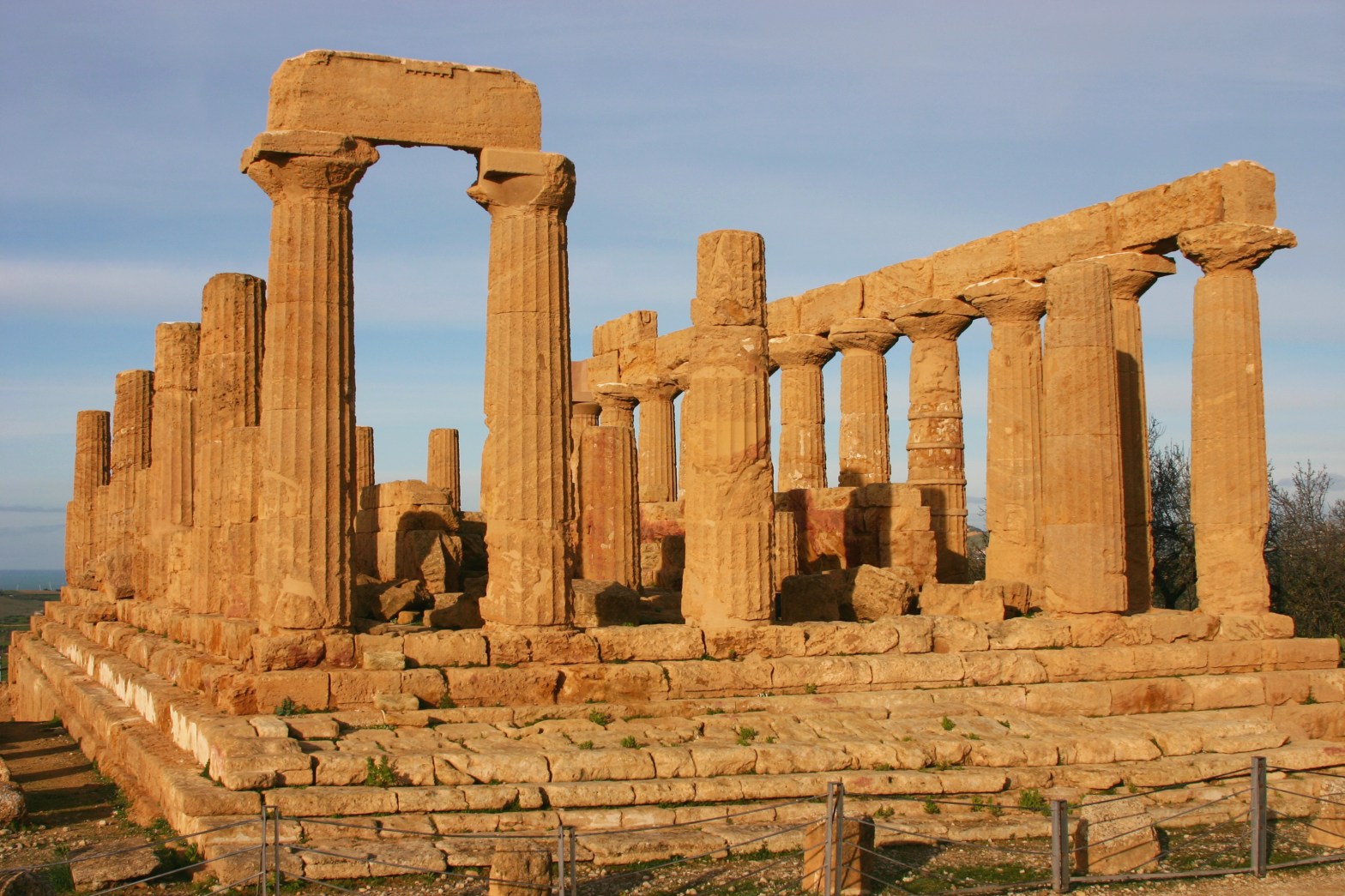
The Temple of Hera – a poem by Royal Rhodes

The Temple of Hera
~ at Agrigento

The temple does not stand,
but seems to float,
pressing lightly down.

And we, like those gone,
are thinking of the sheer
mathematics of it all --
the almost invisible curves
to fool the quick eye
at a distance or near.

Illusion is in service
to a pure, godly reason --
sacredness in paraphrase --
lets us see what is real.

And here we merge with
the polyglot tourists
stumbling over rock
polished by myriad feet
to gaze on her absence.
But I can feel sharply
the peacock talons pierce
my irregularly beating
heart.

Royal Rhodes is a poet and retired educator who was trained in the Classics. His poems have appeared in numerous journals in the U.S., Canada, and the U.K.  He lives in a small village in rural Ohio, surrounded by Amish farms and sheep pastures.

Sometimes I fall – a poem by Jenna Wysong Filbrun

Sometimes I fall

through
the notes
of a song

like light
through
a window

at this
bright peace
and thirst

this
alive
and fragile

cruel
and
deep

beauty
so good
I believe

in a place
I can’t quite
get to

somewhere
I already
am


Jenna Wysong Filbrun is the author of the poetry collection, Away (Finishing Line Press, 2023).  Her poems have been nominated for the Pushcart Prize and Best of the Net and have appeared in publications such as Blue Heron Review, EcoTheo Review, Wild Roof Journal, and others.  Find her on Instagram @jwfilbrun or visit her website: https://jennawysongfilbrun.wixsite.com/poetry.

Askesis in the Wild – a poem by Steven Knepper

Askesis in the Wild

Luke 1

At first, it seemed the Seraph’s punishment:
tongue turned to silt, to sand, to drought-dry bed,
once living words etched in a fossil stream,
seeming extinction in this wilderness
where winds licked joints of bone with neither whine
nor throaty groan.
The incense turned to ash.

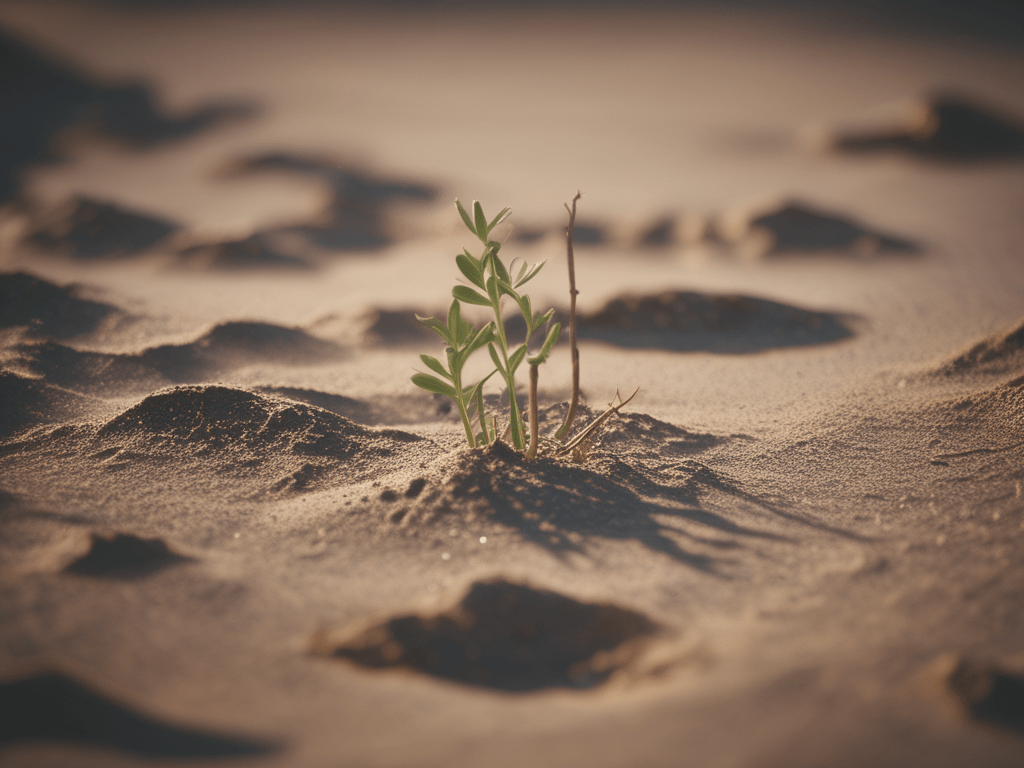
But wallowing in ash he had a dream
of green shoots in cracked dirt, reminding sign
this silence nourished voice, that it was sent
to teach him not to question but to bless,
askesis through long desert months, then flash
and flooding flow:
“His name is John,” he said.
 

Steven Knepper teaches in the Department of English, Rhetoric, and Humanistic Studies at Virginia Military Institute.  His poems have appeared in The Alabama Literary Review, The William and Mary Review, First Things, Presence, Pembroke Magazine, Seminary Ridge Review, SLANT, The American Journal of Poetry, and other journals.

In Santo Niño de Atocha Chapel, Chimayo, New Mexico – a poem by Lisa Zimmerman

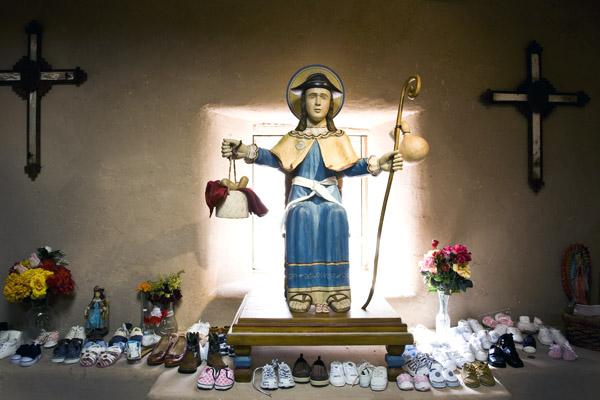
Featured photograph: Bulto of Santo Nino de Atocha by Felix Lopez – Richard L. Rieckenberg

In Santo Niño de Atocha Chapel, Chimayo, New Mexico

I don’t know what to think
of the hundreds of pairs of tiny shoes
attached to the chapel walls. I wonder
if they might have belonged to babies
who were sick or who had died, left there
by bereaved parents and other family members.
Later I learn that people offer shoes to Santo Niño,
who walks everywhere on foot to help the suffering.
Often it’s the people’s own children who need healing.
The air in the chapel is soft and full of silence
that follows prayer, or weeping. Sunlight leans
bright against the stained glass windows, listening.

Lisa Zimmerman’s poetry collections include How the Garden Looks from Here (Violet Reed Haas Poetry Award winner) The Light at the Edge of Everything (Anhinga Press) and Sainted (Main Street Rag). Her poetry and fiction have appeared inRedbook, The Sun, SWWIM Every Day, Cave Wall, Poet Lore, Vox Populi, Cultural Daily, and many other journals. Her poems have been nominated for Best of the Net, five times for the Pushcart Prize, and included in the 2020 Best Small Fictions anthology. She teaches creative writing and literature at the University of Northern Colorado.

Second Wind – a poem by Russell Rowland

Second Wind

I tried my nemesis trail today.

After scaling its three successive scrambles,
pulse pounding against my eardrums,
I sat down for a rest in the scrub.

A hawk circled, overseer of outcomes.

One small unassuming man
stopped to talk on his way down. He looked
like someone who had been to the End

numerous times already.

He said, “The less you dread it, the easier it is.”
“Are you happy?” I asked him. “Content.”
“There are so many mountains.” “Only one.”

I wondered when I would come to it.

A smile: “Sometime.” How would I know
when I was ready? “The mountain
itself will tell you.” He stood, saying,

“Till we meet again.” We parted. He
continued downward over the scrambles. I
ascended, in the strength of my second wind.


In retirement, Russell Rowland continues his work as a trail volunteer for the Lakes Region (NH) Conservation Trust.  His poetry has appeared in over a hundred small journals. His most recent books, Wooden Nutmegs and Magnificat, are available from Encircle Publications.

Small Sutra – a poem by Mark J. Mitchell

Small Sutra

The path of water is not known by water.
—Dogen Zenji
Mountains and Water Sutra


You fall
light as water.

Water falls
lightly on you.

You look down
a long hill.

The long hill
calls to water.

You sing
like water on trees.

Trees accept
a gift of falling water.

You don’t know
water or trees.

Trees and water
don’t see you.

But you, water
and trees make a river.

Mark J. Mitchell  has been a working poet for 50 years. He’s the author of five full-length collections, and six chapbooks. His latest collection is Something To Be from Pski’s Porch Publishing. A novel that includes some poetry, A Book of Lost Songs is due out next spring. He’s fond of baseball, Louis Aragon, Dante, and his wife, activist Joan Juster. He lives in San Francisco where he points out pretty things https://www.facebook.com/MarkJMitchellwriter/

https://www.mark-j-mitchell.square.site/

@Mark J Mitchell.Writer

Aliferous – a poem by Ann Power

Aliferous

And the likeness of a hand was put forth and took me by a lock of my head, and the spirit lifted me up between the earth and the heaven…. And behold the glory of the God of Israel was there…. New Catholic Bible. Ezekiel 8:3 & 4.

Whoops! There he goes again!
No Zulu Flight Plan filed….
the moment, the moment.
It could be the name of Jesus, the sound of a
bell, the unfolding of numinous flower petals,
all could elicit ecstasy.
In infant opportunities,
salmon-flash,
a salting,
Radiance.

And suddenly Joseph is at an altitude…
2 meters …
soaring toward the high altar, or toward an
olive tree.
No fuselage, no flaps, no throttle.
Magnetized to the beauty of the
sacred,
seized by the celestial talons
of rapture,
he levitates.
Unconscious of everything except the
Divine, he is oblivious to pain,
called back only
by the ending of
meditation or the voice of his
superior.

As a child he had been called
“Bocca Aperta,” because of his gaping mouth,
and later the Franciscans
labelled him “remarkably unclever.”
He suffered the slights of tongues whispering
“witchcraft” and “wizardry.”
Enduring frequent transfers between
communities, he
was isolated for 35 years;
not allowed to attend choir, refectory, or
say Mass.
Confined to his cell, he was cloistered,
a prisoner

Born in a stable, apprenticed to a cobbler,
he never learned to make shoes…
as if he needed any for his journey.

Ann Power is a retired faculty member from The University of Alabama.  She enjoys writing historical sketches as well as poems based in the kingdoms of magical realism. Her work has appeared in: Spillway, Gargoyle Magazine, The Birmingham Poetry Review, Dappled Things, The Copperfield Review, The Ekphrastic Review, The Loch Raven Review, Halfway Down the Stairs, Amethyst Review, and other publications.  She was nominated for Best of the Net in Poetry for her poem, “Ice Palace.”