divine lepidopterology – a poem by a a khaliq

divine lepidopterology


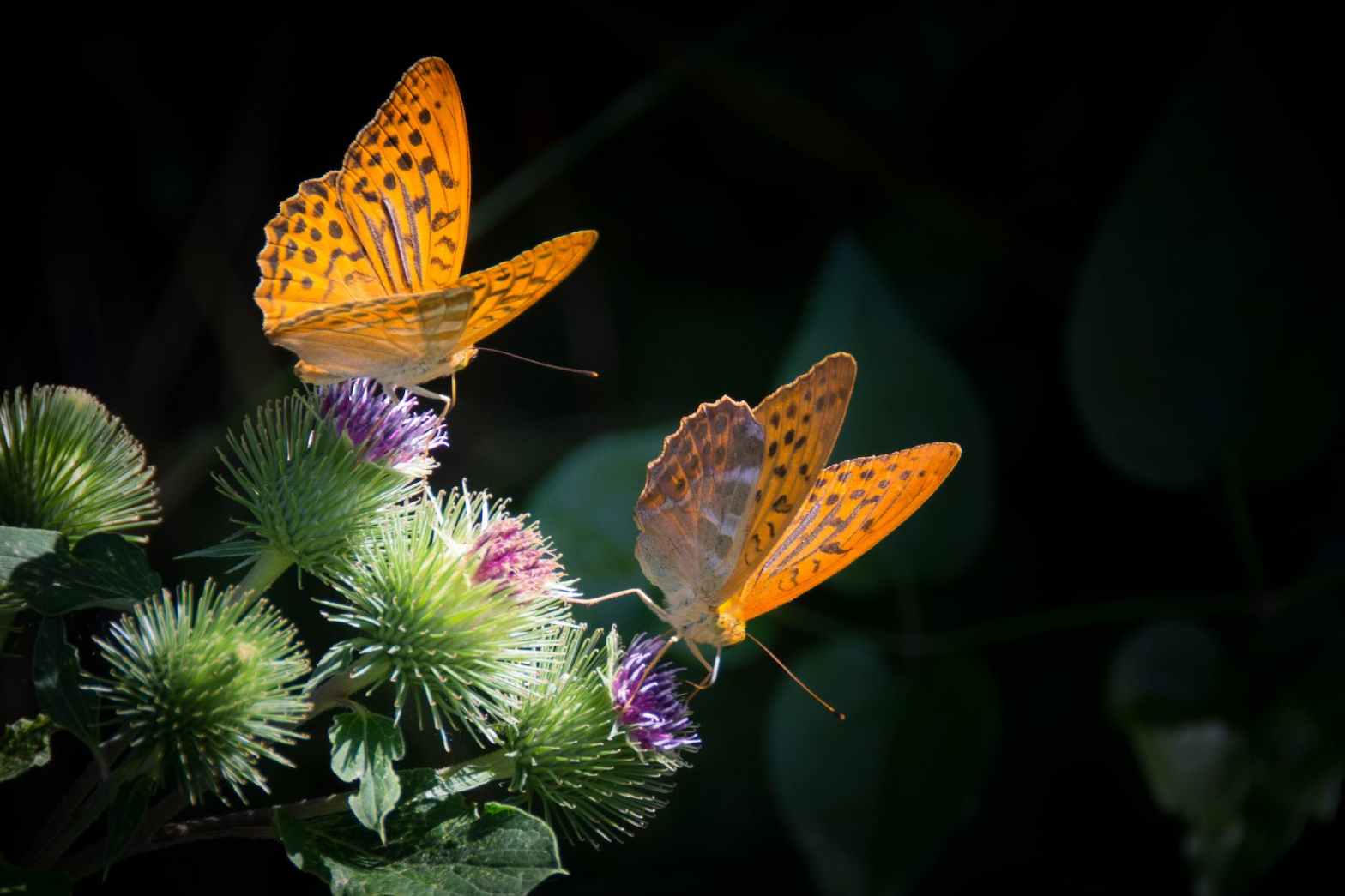
to God the lepidopterologist i could ascribe
99 qualities or 99 to its power, but instead i
get stuck marveling at the quality of His sight.
you look upon me as i crawl across my life,
scuttling and striding in alternations, desperate
to keep my butterfly heart beating jauntily.
so soon will your tweezers come and pinch
and your needle thrust through me in one fell
swoop until i am in twain: vessel and that being
that was once your breath. i don’t need to beg
you, handle me gently. i know that you are being
so tender it would bring me to tears, that what
feels like you rocking me from side to bitter side
of my life is really the barest kiss. where does
one begin in questioning the expert? all i can
wonder is, how does my weeping seem to you?
from your vantage, is it an attempt to waterboard,
or a drop teetering, teetering on top of a penny?
 

a a khaliq is a poet and medical student from the midwest. she writes, in the tradition of kafka, to close her eyes. 

[The day my gods died] – a poem by Jason Gabbert

[The day my gods died]

The day my gods died I was afraid
they would take me with them.
I turned from prophets to poets,
and my church became 
a coffee shop named after a saint.
I went from right to wrong,
and all the wrongs became
questions, not sentences.
There’s a ball of ants at my feet,
pulling some leftovers toward a hole
too small to permit it entrance
but they’ll keep at it until dusk.
And I’ll keep pushing these things
until the lights go out or a bird shows up.

Jason Gabbert participates with words (those things that stir and explore the vast range of what it is to “be”) with simple sentences.

A Bit of What I’ve Learned – a poem by Angela Hoffman

A Bit of What I’ve Learned

There will be detours, side trips in your journey. 
You will deviate from the path that is trodden. 
You can’t stay unconscious when you are lost. 
Pay attention. 
You’ll learn to be resourceful, to depend on the stranger. 
You’ll get stronger, softer at the center when moving on the edges. 
It’s there you’ll learn about radical acceptance. 

Then find your church even if its in a large box, a tree, 
in the pine sap, the mud, the tender green.
Love, make bread, feed someone kindness. 
Walk, take a nap, remember the Sabbath. 
Attend to your work. The doing will teach you. 
Garden, hang laundry, dig, chop the onion. 
Subtract from your life but take every offering:
the tears, the laughter, the good, bad, the ugly. 
Look the other in the eye, look anywhere, 
and see humanity all mingled together with divinity. 

Angela Hoffman’s poetry collections include Resurrection Lily and Olly Olly Oxen Free (Kelsay Books). She placed third in the WFOP Kay Saunders Memorial Emerging Poet in 2022. Her poems have been published internationally. She has written a poem a day since the start of the pandemic. Angela lives in rural Wisconsin.  

What Every Rose-Grower Should Know – poetry by Colin Jeffrey Morris

What Every Rose-Grower Should Know 
publ. The American Rose Society, Harrisburg, Pa., 1931 				       								  	

A Book of Rose-Progress for All 

In these pages are helps 
to carry a rose-friend 

forward. To strengthen the 
faith of rose-lovers, all history, 

all observations unrelated 
to propagation 

have been omitted.  


Bury in the Autumn, Plant in the Spring 

Spring planting is safe, 
if done early.  

Earliness is relative.


American Rose-Needs

There are, so far, no true yellow 
Hybrid Perpetuals.  Hope 

was high a few years ago 
when Peter Lambert announced 

Yellow Druschki, but it was yellow 
only in the bud. 


Protecting Roses from Enemies

Hybrid Multiflora provide 
many shades of red, pink, and 

white, but no good yellow, 
although several whitish varieties 

are flattered by the names Yellow 
Rambler, Sunny Gold, etc. 

Rosa Lucieae (the Memorial Rose)

Breeding yellow tones 
into this group 

seems to injure the form 
of the plant as well as 

the flower’s color.  It is 
hoped that this 

can be overcome.


The Elusive Recurring Climber

Recurrent blooming may 
be impending. Blaze, grown 

on new wood, has come 
again. New Dawn, a sport of 

Dr. G. Van Fleet, is reported 
twice returned.


Time to Order Your Roses 

Roses are grown for only 
one purpose – production 

of flowers. Their value 
lies in their ability 

to endure neglect. 


The Severer Zones 

Harison’s Yellow is required
for thin and difficult places. 

It is the only dependable yellow 
in the colder North.     


The Much-Desired Yellow Color 

There is a climbing Austrian 
Brier, known as Le Rêve, 

which is yet the deepest 
yellow in existence.


What to Make of a Diminished Thing  

The dotted line shows 
how to cut a rose.	


Colin Jeffrey Morris lives and writes in Berkshire County, Massachusetts. His poems have appeared or are forthcoming in The Ekphrastic Review, Delmarva Review, Lily Poetry Review and descant.

Early Buddhism – a poem by Mark J. Mitchell

Early Buddhism


Polly Cannon set off all by herself
to find un-named trees and lose her wrong self
like a basket or a love note. She looked
at leaves, branches, sky. She refused to chant.
The sounds that god-names made scared her infant
soul. She ignored birds. Learned no holy books
while scratching words in dust. She asked for no
meaning. She sat still. She breathed. She let go.

Mark J. Mitchell has worked in hospital kitchens, fast food, retail wine and spirits, conventions, tourism, and warehouses.He has also been a working poet for almost 50 years.An award-winning poet, he is the author of five full-length poetry collections, and six chapbooks. His latest collection is Something To Be from Pski’s Porch Publishing. He is very fond of baseball, Louis Aragon, Miles Davis, Kafka, Dante, and his wife, activist and documentarian Joan Juster. He lives in San Francisco, where he makes his marginal living pointing out pretty things. He can be found reading his poetry here: https://www.youtube.com/@markj.mitchell4351A meager online presence can be found at https://www.facebook.com/MarkJMitchellwriter/A primitive web site now exists: https://www.mark-j-mitchell.square.site/ He sometimes tweets @Mark J Mitchell_Writer

What the Light Can Conjure – a poem by Sarah Rehfeldt

What the Light Can Conjure
 
If you find it
(and it may
find you unexpectedly),
hold on to it with your eyes
for a very long time.
Stretch it out against the evening
before it disappears.
If you’re lucky,
you can watch it go
back to where it came from.
 

Sarah Rehfeldt lives with her family in western Washington where she is a writer, artist, and photographer.  Her poems have appeared in Blueline; Appalachia; Presence: An International Journal of Spiritual Direction; and Weber – The Contemporary West.  She finds inspiration in the close-up world of macro nature photography.  Favorite subjects include her garden; the forest; cloudscapes; and the ever-plentiful raindrops of western Washington.  You can view her photography web pages at:  www.pbase.com/candanceski

Evensong – a poem by Rachel Matters Clark

Evensong


To you before the close of day

            Drifting down like ashes or snow
Creator of all things, we pray

            chest rises and falls
That in your constant clemency

            breath descends to the belly 
Our guard and keeper you would be
            shoulders drop, arms open
Save us from troubled, restless sleep
            hands hit the lap, empty,
From all ill dreams your children keep

            defenseless under the mantle of night.
So, calm our minds that fears may cease

            Banish the dark thoughts.
And rested bodies wake in peace.

            Shed everything.


Words in italics are from a 6th century Latin hymn.

Rachel Matters Clark received a BA in Drama from Bennington College, and an MDiv from San Francisco Theological Seminary. While raising her children, she directed educational programs in several churches and worked as an actor and acting teacher. She and her husband live in Falls Church, Virginia, where she teaches ESOL students and leads a small poetry salon on Zoom.

Hey, Climb a Tree – a poem by Russell Rowland

Hey, Climb a Tree

Grey squirrel hunches up and up
the corrugated oak,
wee claws clinging tight as burrs.

A nuthatch does it upside-down
and backward.  Even

the twenty-pound porcupine
can get its bulk and ordnance
into the foliage,

where it stoically outwaits
grounded predators.  Even a bear,

when you and I are near.

Jesus, beneath a mustard tree,
branches harboring hatchling nests,
told still another parable—

of a sanctuary citadel
for the littlest, the lost, the least—
vast as that overspreading tree.

He held out one of the very sort
of seed from which it grew,

so tiny the myopic couldn’t see.

Seven-time Pushcart Prize nominee Russell Rowland writes from New Hampshire’s Lakes Region, where he has judged high-school Poetry Out Loud competitions.  His work appears in Except for Love: New England Poets Inspired by Donald Hall (Encircle Publications), and Covid Spring, Vol. 2 (Hobblebush Books). His latest poetry book, Magnificat, is available from Encircle Publications.

People of the Holloways -The Seer – a poem by Martin Towers

People of the Holloways -
The Seer

I was a Seer, Touched. I inhabited shadows 
and hospital wards, in league with darkness, 
able at any time to drop beneath, besides or under. 
My eyes had it, I know – my eyes had the ache
of skies over fields empty late in the afternoon. 

I listened to the whispers not the shouts.
I could See what was not there.
I could hear the hum at the back of things.

Martin Towers is a support worker in Aberystwyth, Wales. His poems have been published in Crannog, Banshee and The Galway Review.

My Spiritual Practice – a poem by Cecil Morris

My Spiritual Practice


It is practice, the going again and again
through the heavy double doors and along
the polished wooden pews, the week’s program 
in my hand, the list of hymns and verses ready
for the faithful and the struggling, the ones like me
who repeat the prayers silently but with my lips 
in motion.  It is practice, the discipline 
of repetition, the dumb fingers climbing the scale,
rehearsing the tricky cross over, making time 
to serve the melody, making the body serve 
the will, and training the spirit when the spirit 
no longer feels the flame of faith.  It is practice,
the familiar, the regular, the repeated 
that will keep the spirit afloat assures the priest,
agrees the therapist, the bright orange vest you wear
to sustain you through the rapids and buoy you 
in the deepest waters, the keel of the life boat 
where you cling even after belief has capsized. 
It is practice, not perfection, not mastery,
that winches me out of my despair following 
her loss, the winding rope of dailiness, the meals 
with awkward friends, the re-filling of bird feeders
each morning, the dogged breaking up of concrete 
and hauling of debris, the work down on my knees
to level flagstones, the Wednesday morning doughnut 
rendezvous, the Sundays inside the heavy doors,
under high ceilings, arches, and the rhythmic words 
that I heard again and again that hold me here.

Cecil Morris retired after 37 years of teaching high school English, and now he tries writing himself what he spent so many years teaching others to understand and (maybe) enjoy. He has had a handful of poems published in Cimarron Review, English JournalThe Ekphrastic ReviewHole in the Head ReviewThe Midwest QuarterlyPoem, and other literary magazines.