The day my dad died it didn’t rain. There was no flooding, no trees toppled over, no violent hurricane, no water lashing the earth. There was just a vast void in my life, a chasm too difficult to cross. I didn’t leave the house.
Late in the afternoon, it arrived unexpectedly—a large, square, flat package, there, on the porch, from Rebecca, one of my dearest friends I’d not seen for seven years.
When I opened it, I discovered the portrait I’d seen her working on all those years ago, the painting I had asked if I could buy.
It’s not finished yet, she said.
So I returned to my life on the opposite coast, writing letters to cross the distance between us. I forgot about the painting.
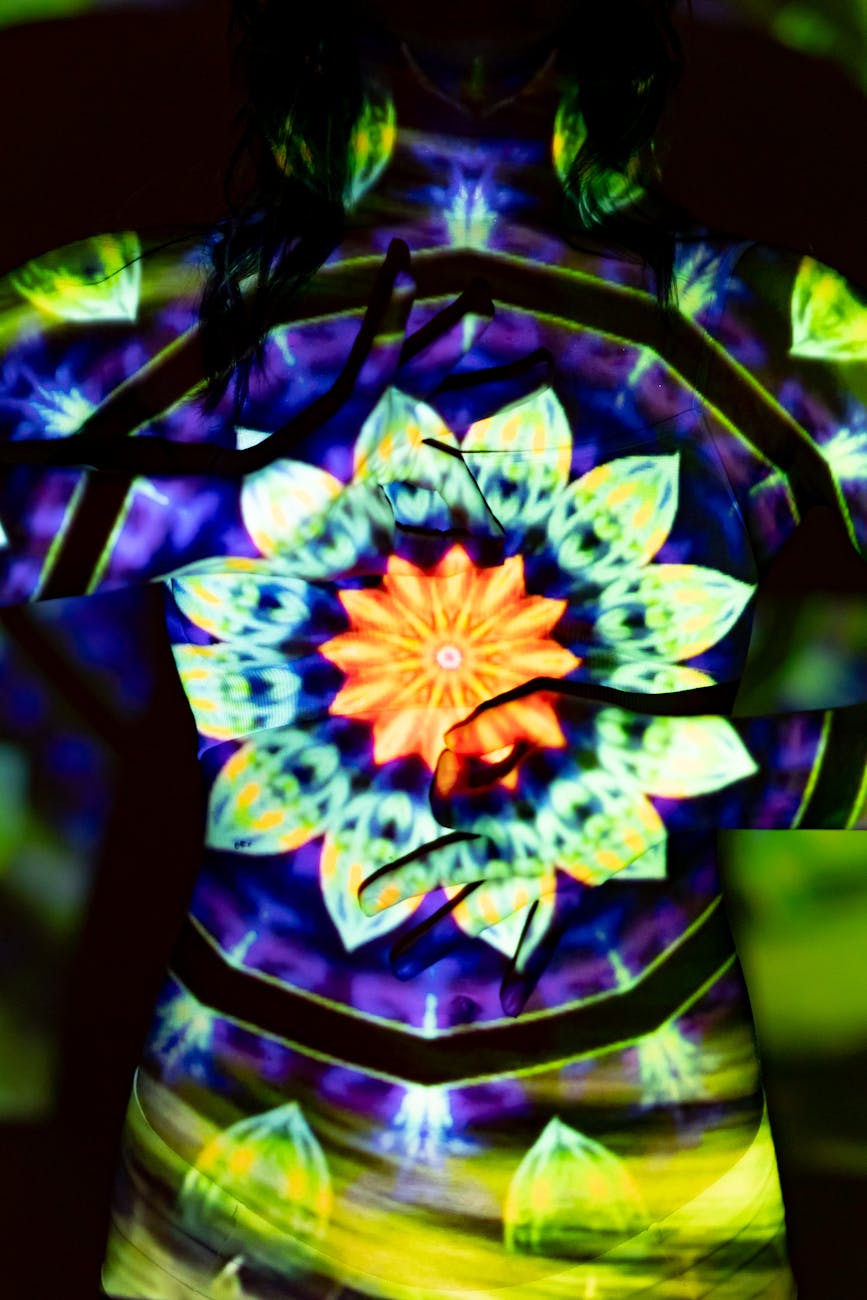
Now, on the day my father died, October 18, 2022, it came without expectation, without fanfare, the painting I dearly loved: A woman’s serious face surrounded by flowers, alive with color, the colors strange and vibrant.
And I knew it was meant for me, on this day, that in the divine order of the universe I was remembered and cherished. This was a sign from God. Now the work is finished.
Anderson O’Brien lives in Winston-Salem, NC with her devoted husband and two terribly spoiled cats. She has published in Iodine Poetry Journal, The Kentucky Review, Blue Fifth Review, Red River Review and Heavy Bear.
There’s no going back to summer, to that spring. The past is fading and it’s beautiful, beautiful... The world is always healing,
always shedding old weight, riding the current for Now... Now a decision must be made:
Will you lie and squander in the briars of your sorrow?
Or push up, out—
into the new life?
Ahrend Torrey is the author of This Moment (Pinyon Publishing, 2024). His work has appeared in Denver Quarterly, storySouth, Panorama: The Journal of Travel, Place, and Nature, The Greensboro Review, The Westchester Review, Welter, and West Trade Review, among others. He lives in Chicago with his husband, Jonathan; their two rat terriers, Dichter and Dova; and Purl, their cat.
Theodora, I know so little about your life, and you haven’t heard of mine, lodged in this unthinkable future.
You sleep on a coarse mat with sheepskin for cover, own two clay jars for water and oil, a lamp casting shadowy light.
My soft-cushioned life is the kind you escaped from. Brightness in my home is dimmed at a touch. While you wash
your own clothes, I have a metal box that performs that task. Entertainment winds around my days, noise grips them firmly.
Discarding linens finely beaded, you wear a rough tunic, dress as a man to avoid unwanted attention.
I’m comfortable lounging in jeans, nevertheless own more than one dress and coat.
You’re tired of men who wield power, live to excess. That world is also familiar to me, so I vote, sign petitions.
Yet I know large gestures are not the answer, it’s cutting my own excesses— a new jumper, endless cups of coffee,
hoarding books — that will change how I view the world, allow me to walk gently on our fragile planet.
This is why, sometimes, I feel the need to meet with you in your desert-solitude, sink into layers of silence
where we circle our deepest hopes, then face our reality— you weaving mats, me mopping the kitchen floor.
In about the fourth century, groups of men and women moved out into the desert to live a different kind of life. The desert fathers are remembered, the desert mothers mostly forgotten.
Yvonne Baker’s debut poetry pamphlet, Tree Light, was a winner in the Cinnamon Pamphlet Prize 2022 and her debut collection, Love Haunts in Shades of Blue, won the Cinnamon Literature Prize and The Rubery Book Award for best poetry collection 2025. Her other collections with Cinnamon Press are Light Still, Light Turning and Backwards forwards across the sea. Her pamphlet Becoming Wetland will be published in 2026.
It’s time to watch now for the smallest things: How quick the little baby up the block Has grown and now begun to walk; How early in the day the robin sings; How even just a passing stranger’s smile brings The sense we’re still somehow quite interlocked One to the other, still can feel, can talk, Can whistle in the dark, can even sing. For big things, so it seems. have all gone bad: Decayed, collapsed, betrayed our deepest trust. They totter strangely, just about to fall. And yet we must not let ourselves be sad; Must hold to faith and not become nonplussed: The Greatest Thing is hiding in the small.
Jeffrey Essmann is an essayist and poet living in New York. His poetry has appeared in numerous magazines and literary journals, among them Dappled Things, the St. Austin Review, Amethyst Review, Pensive Journal, Forma Journal, and The Society of Classical Poets. He is a certified catechist with the Archdiocese of New York, a Benedictine oblate of St. Mary’s Abbey in Morriston, NJ, and editor of The Catholic Poetry Room page on the Integrated Catholic Life website.
As soon as her fingertip touches the purple crystals, her face absorbs their luminous light. She is ready to enter-- the crystals part, a moss carpet appears. A balloon, feeling like warm soft skin, wanting to be held, drifts towards her. She reaches for its string, the balloon her partner as she twirls, circles and leaps in her gauze skirt. Someone calls her name, the moss carpet disappears. She stops dancing, the balloon floats away. In a corner of her desk, she places the amethyst, its promises to her glowing forever.
Janet Krauss, after retirement from teaching 39 years of English at Fairfield University, continues to mentor students, lead a poetry discussion at the Wilton Library, participate in a CT. Poetry Society Workshop, and one other plus two poetry groups. She co-leads the Poetry Program of the Black Rock Art Guild. She has two books of poetry: Borrowed Scenery (Yuganta Press) and Through the Trees of Autumn (Spartina Press). Many of her poems have been published in Amethyst Review, and her haiku in Cold Moon Journal.
I lower my mouth like a prayer to this steaming cup of tea. My spine tingles as the warmth spreads through my chest, makes my body a furnace in this freezing autumn room. I sip again and again, this is my communion wine this is my sacred place— God, make me still make my heart fill to all its depths let no part of me be untouched by the warmth of this tea and the stinging chill of the air outside on my cheeks.
God, I am holy God, I am rising above the places I felt I deserved to stay and reaching past the limits my history imposed on me.
God, I am meeting you, our hearts like vapor melding together until we are one. You are breathing me, filling your lungs with my desires I am shaping you and you are shaping me and like the roots of an old oak we grow together twisting around each other in ecstasy.
Moriah Brown is a poet, novelist, and full-time student at Syracuse University working towards a degree in creative writing. Her poetry has been published in Creation Magazine, The Woolf, and The Passionfruit Review, among others, and has also been featured in Alchemy and Miracles Anthology and Bimbo Feminist Anthology. She is from Fort Worth, Texas, and loves writing, birds, and her cat Nala.
Elizabeth Shanaz is a New York based writer. Her work has been featured in Playboy, Human/Kind, Sorjo, Defunkt, PREE Lit, Zhagaram Literary, BRAWL Literary, wildscape Literary Journal, The Literary Times, and the Blue Minaret, among other journals and magazines. She studied writing and literature at CUNY City College before earning her law degree from NYU School of Law. She is the proud child of Guyanese immigrants.
such an intricate simplicity, these rules, these ideas
every book on the subject sends one to next week, head reeling, high as a kite
the closest we’ll ever get to our greatest potential: we can taste it it’s right there
and yet so far away
the chemical signature of caffeine petals of a dandelion meditation Islamic art
the Absolute starts to show up everywhere
awe and fear paralyzes me
Kendra C. Duke is a poet and independent scholar based in London, Ontario. Her work explores the intersection of ethics, spiritual inquiry, and social responsibility. She holds a Master’s in Philosophy from Queen’s University and writes across genres, including essays, poetry, and public philosophy. She is the author of “Subspace Log”, an interdisciplinary newsletter, and is currently preparing several long-form projects that bridge philosophical reflection with poetic insight.
Can you not see the seagulls rolling in the cool rumpled sheets of air over the lake, pressing their case for spiritual freedom?
Do the robins, plump and puffed as priests, plundering the green grass, not witness dutifully to their unwavering faith in abundance?
Even the wise man of Bethlehem recognized in this their mastery.
And if the shy wren, plumed in brown in a brown bush, lifts his bright voice— lifts his radiant voice-- does it not seem as if the bush is singing? As if the bush were on fire with the crackling blaze of his gratitude?
Oh, take off your shoes, my Soul, when the wren comes hallowing!
Is this not God? The God of my ancestors? The God of Israel, who speaks by wind and flame, whale and ass?
Penny Freedwing writes poetry and creative non-fiction along the shore of Lake Michigan north of Chicago. Her work has appeared or is forthcoming in Dunes Review and Deep Wild Journal.
Deposition from the Cross, (c. 1190-1200), Ivory, 18.3cm, England (probably York), Victoria and Albert Museum, London.
Bright Circle
After this, Joseph of Arimathea, who was a disciple of Jesus—though a secret one because he was afraid of the Jews—asked Pilate to let him remove the body of Jesus (Jn. 19:38).
I. The nightmare sky is always blood-red. My desire: to end his infamy, all foul and bloodied, try to take him down from the cross and lay him in my tomb. But it’s a nightmare and I cannot move.
Impossibly, he’s coming down, his feet swing: slow, relentless. Distance bays and barks with wolves, the sound surrounds me. I attempt to move my arms and pull and strain and pant but nothing gives. I wake,
bleating, like a sheep.
II. A shy child, I would pace the quickening marketplace, listening for a voice I’d never heard, chasing a face I’d never seen. A man now, wealthy enough for ease and influence, I still paced, stealthy, searching. Enough
was not enough. One day, that Nazarene was there— Jesus, healing Lazar, poor old blind man we all knew, and Jesus closed his eyes at first as though in prayer, absorbing Lazar and his blindness. Then he groaned
and with long hands enveloped Lazar’s face. He spoke some words I could not hear but soon Lazar was smiling, blinking, crying out, his face raised to a gentle rain that bathed his eyes while Jesus quietly withdrew.
Jesus: his uncanny self-containment. Jesus: whose gaze outreached the furthest star. Jesus: with those twelve young men. Jesus: with that little group of women who supported him. I knew his voice. I’d sought
this face.
III. My skin is hot with rage—the nightmare’s back again— I’m in the house of Caiaphas—the whole Sanhedrin’s there—the liars! They collude in savage jealousy— they mean to kill. A stinking little hill of raw meat
lies all sour on the floor and crawls with maggots. Dogs are wary, snuff but turn and whine. And I? I try to hide for I am naked—while they abuse the living truth by tales they spin. I should stand
next to him, disempower them, expose their lies but I’m exposed instead. The floor turns into mud, sucking at my feet. There’s no escape, the dream repeats, repeats my sin again, again. I wake.
Coward. Coward!
IV. Oh, I was important—once I knew that he was dead! Pilate I quite bullied. I had courage then! I asked and got his leave to take ‘the dead man’ (as I said to Pilate). But I kid no one: Pilate wanted to forget.
He dreaded the return of Jews who’d fled the scene. He tasked the soldiers with the routine breaking of the legs. They would have followed orders but Jesus was dead already. So they broke, they broke
instead his broken body by a lance-thrust to his side and as his blood and water flowed, they wrenched him down with ill-bred jokes about ‘the stench of god,’ his head, his head falling in the darkening day.
But in the nightmare no one’s there, not John, not Nicodemus, not the woman Mary Magdalene, not even his exquisite mother (all of whom seemed, on the day, to pity me). I am alone beneath the cross.
The sky is always blood-red.
V. Last night, the dream, the dream was changed. The sky is softly green, like olive oil. And lo: I stand beneath the cross. His feet come down again, but now one foot’s a child’s foot and sweet. I kiss the wound’s bright circle.
In this new dream, his body’s clean; a fragrance fresh as bread arises from the flesh as he is given, slowly, into my arms. And now I reach—I move as easily as when, a boy, I’d reach up to my father and he’d
lift me high. Now Jesus is as light, and I, I close my eyes, afraid to look at him at first, but then I open wide to see not crucifixion’s ravages but on his face a smile curves his lips—just barely, but enough.
His arms curve round my head, my shoulders. He becomes so small and somehow changes into bread and in my hands I cradle him and slowly eat the tender loaf that tastes of honey. It is enough. Look:
the sky’s become a bright circle.
Johanna Caton, O.S.B, is a Benedictine nun of Minster Abbey, in Kent, England. Her poems have appeared in The Christian Century, St Austin Review, Ekphrastic Review, Amethyst Review, One Art, Today’s American Catholic, Fathom, Fare Forward, Windhover, The Catholic Poetry Room, and other publications. She is a Pushcart Prize nominee.