Of  Pomegranate  Seeds


“Death is the mother of Beauty,”
a poet wrote.  Death is also the husband
of beauty, Persephone. He forces her
 to eat the seeds of a  pomegranate
so she will always return to him
sulking amidst smoldering vapors.
Each time  she  emerges  from the underground
alive she wears  the damp chill of death.
When she lifts her arms the scent of flowers
washes away the dank odor, and her mother
rouses the earth to flourish again.

Perhaps, in the Renaissance painting
baby Jesus is urging his mother
to eat a pomegranate seed from his bowl
to comfort her, assure her he will be reborn
years later. She turns away, face locked
in the grief of knowing her son’s fate.
She refuses his offer. She ignores
the persistent blue of the sky.

On Rosh Hashanah, if one eats of this
fruit of the earth, the pomegranate,
any of its  613 seeds, the number of days
in a Jewish year, one will dance with Persephone
 among the wildflowers, and long after she has to  leave,
will continue in a meadow of one’s own making.
Janet Krauss, who has two books of poetry published, “Borrowed Scenery,” Yuganta Press, and “Through the Trees of Autumn,” Spartina Press, has recently retired from teaching English at Fairfield University. Her mission is to help and guide Bridgeport’s young children through her teaching creative writing, leading book clubs and reading to and engaging a kindergarten class. As a poet, she co-directs the poetry program of the Black Rock Art Guild.
Two poems from Pelican

1.
I recite my hours
rather too soon than too late
matins by night in winter
prime in winter early

spent hours in his company
I was taught to curl my tongue
paster noster
time not wasted

I have control
he gifts it to me
seals words in my throat
with bent wick and candlewax


2.
pater noster ave maria
arms around each hour
my faith taut strong
tightening my sockets

before matins after prime
after compline

my hiding place and my shield
I am yours save me
I have sought your precepts

after lights out silence


Kieran Wyatt lives on the Fylde Coast. He is co-chair of GenSex (@GenSexResearch), an interdisciplinary research group, asking probing questions about gender and sexuality. His work has been published in Eunoia Review, The Art of Everyone, and Small Leaf Press. He graduated from Edge Hill University with a degree in Creative Writing in 2018.
Blank Look #271


all the birds
in the locust tree


shrug off their names
when they begin to sing
Carl Mayfield has recent work in Miramar, Wales Haiku Journal and Slipstream. His most recent chapbook is I Would Also Like To Mention Biscuits & Gravy
Sabbath

Today I sit under a torrent of silence
outrageous and deep, as though
all the space between all the words I ever wrote
are come back to visit me. It is not a haunting
but a blessing. The spaces, like the words, retain life.
They tell me without speaking
how they mean to hold things in place, maintain the boundaries
and not allow the colours of thought to muddy or bleed
into the wrong lines.
They will fast between the feasting of semantics
adding yet more of their own
 – in the right place –
a breath can say so much more than sound
and a pause be as eloquent
as a myriad of syllables
I welcome each rest
with open blankness
this sabbath day.
Keren Dibbens-Wyattis a chronically ill writer and artist with a passion for poetry, mysticism, story and colour. Her writing features regularly on spiritual blogs and in literary journals. Her latest book is Recital of Love (Paraclete Press, 2020). Keren lives in South East England.
Called Outfor Jeff Bruce
Really, I was pretty much settled in.
If Jesus had gotten here a day later
I might just have said, "No, thanks,
I'm good." That could have raised a stink,
but Martha would have shut up
for once, seen things someone else's way.
It's a lot of pressure, coming back—
tourists always staring; paparazzi
dogging my dusty walk to town; my favorite
bar a drag because on the next stool
there’s some local toad who believes
he can be the one to put me down for good.
What can I say that doesn't sound
ungrateful? Not that I ever wanted to leave,
but neither did I expect a mulligan,
another chance to repair something
I didn't know I'd ruined, one more chance
to mend what had seemed unmarked
a year ago, last month, only days earlier.
It was quiet behind the stone. Soon, I'm afraid,
Mary may find me wandering, wary of my place
on this earth. She'll run to tell what she’s seen,
smudges where I wiped my eyes with dirty hands,
and this is the word that will get around:
Lazarus wept.
Larry Pike’s poetry has appeared ina variety of publications and is forthcoming in several. His poem “Burned” appeared in Amethyst Review in January 2018, and it will be included in the anthology Without a Doubt: poems illuminating faith to be published by the New York Quarterly Foundation in August. His collection Even in the Slums of Providence will be published by Finishing Line Press in October. He lives in Glasgow, Kentucky.
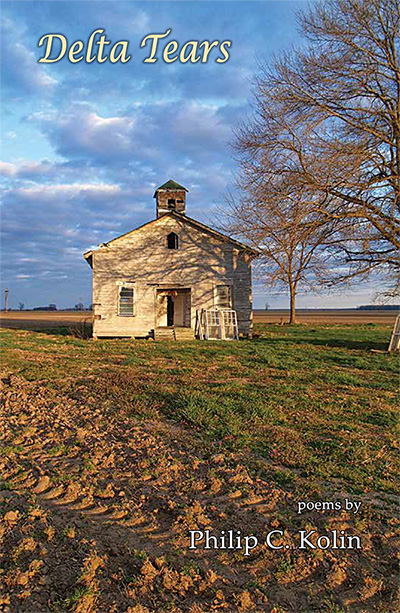
I’ve spent some time reading and dipping back into this resonant new collection by Philip Kolin, and I highly recommend you do the same: as a book of poetry, it’s a slim volume, but it has a depth and range of material that suggests a longer, fuller work. It also shows a poetic control and sense of phrase and form that makes each poem an impressive piece in its own right.
As the collection’s title suggests, Kolin’s overarching setting is the Mississippi Delta: the vast northwest region of the state of Mississippi, as well as the great Mississippi River itself. Rich in natural history; deeply scarred by the troubled and shameful past of racial and economic exploitation, the Delta provides a wealth of subjects, both geographical and historical. This collection gives ample and informed attention to each; it provides (this British reader with) an education that is not always comfortable to read. There are many human stories and poetic snapshots here, including those well-documented by history and those whose names and lives were brutally suppressed. This poetic witnessing is complemented by an imaginative engagement with the natural world in all its seasonal moods.
Helping the reader navigate this project’s wide reach, the collection is divided into coherent sections, each lucid and multifaceted in its own light. We begin with the history of the river itself, ‘That Old Mud River’ a vast, flowing entity depicted by Kolin in deft poetic strokes. The river’s ebb and flow, its (sometimes severe) floods, and its scars from human infringement are documented and juxtaposed. Serving as an archive of life and loss, the river ‘flows like a clothesline/ across a country of shadows/ where lovers hang dreams’ (‘The River’s Music’), it cries ‘muddy tears/ for these lost lands swallowed/ by erosion, blocked by leaves, destroyed/ by oil or gas pipes (‘The River Cries Muddy Tears’); ‘never random’, it is ‘history’s ledger’ (‘Elegy for the River’). To an extent this phrase also describes Delta Tears, the collection.
Kolin is a versatile poet, and the poems here range from the tightly structured to those appropriately loosened from formal moorings. While the majority are in couplets, tercets or quatrains, also notable is the prose poetry of ‘Flooding, 2017’ appropriately filling its page, as well as the slim fragments of ‘Bodies in Bondage’ that initiates the second section, ‘Centuries of Tears’. This hard poem ends with a slim reed of hope: ‘Song became the only salve for their tongues.’
Race and racism is unavoidable as a topic in this geographical location, so scarred by slavery, and the collection gives full due to the horrors of history. Poetry evokes through image and detail as much as through names and dates however, and poems such as ‘A Cotton Kiss’ do that powerfully:
It looked like a snake
uncoiled from the overseer's

hand and arm that bit
slaves so hard, so often

it left them speechless
or brain dead
This section looks steadily and soberly at the ‘Delta dead from the Great Migration’ and the ‘soul-sucking bill collectors and company store men/ with sharp white teeth’ who destroyed black lives and individuality. The right to a name is withheld, as is the right even to breathe, a detail with all too raw immediacy in the disgrace of George Floyd’s death: ‘Only Let Us Breathe’ refers not only to Emmett Till and the Freedom Summer of 1964 but also how
Countless black faces since have tried
to warn us about tortures in cottonmouth
fields, river towns, and gut-splattered
streets only to have hate seeking
bullets shatter their voices. "I can't
breathe", "I can't breathe," their last words.
This poem ends with a plea for legislative change ‘guaranteeing black men and women/ the right to breathe in America’. But the stark acknowledgement of racism’s visceral horrors and the need to acknowledge and make amends is clearly more universal still.
Section three, ‘Jukes and the Blues’ showcases the floating lines (still with their shadow and bite) of ‘Juke Houses’, and the sharp enjambment of ‘Hospices for the Blues’ where we find ‘pain so thick you could cut it with a buzz// saw’. Poetically, this is a fine section, pain-plied wordplay unfolding in edgy harmony, and homage paid to blues heroes and heroines in poems such as ‘Three Ladies Blues’:
It's Bessie's cry too,
for all the big-souled women
left by the roadside to bleed.
The only black the Capt. likes to see
is the asphalt under his Cadillac.
The Blues are succeeded by a fourth section, ‘Delta Dogs and other Critters’ a gathering of nature-based pieces which are by turns bracing and delightful. On the bracing side, here are some appropriately scraggy lines from ‘Maud’s Dogs’:
Their owners are the wind and dank shadows.
They drink swamp water and eat field rats
and stubble with cracked teeth, their scraggy ribs poking out
like bent piano wires
Elsewhere, Delta minibeasts are presented, sometimes as menaces (‘Demon Mosquitos’), more often as charming (‘My Fair Ladybug’). In ‘Sheep, Caterpillars and Fish’ spring arrives to sow ‘color/ and fragrance/ everywhere,’ and we are graced with this lovely musical image:
Across the Delta
the air provides a concert

of warbling and chirping,
an opera of wings.
After the human suffering of the Delta Blues, birdsong in particular offers us a slender cadence of hope: for those who keep the faith even in seasons of aridity, ‘the sparrow’s song/ is enough.’ (‘The Sparrow’s Song’)
‘Seasons’ are in fact the subject of the collection’s next section, with storms and weeds vying for Kolin’s poetic attention along with the more tranquil subjects of ponds and sunlight. Notably, we have the unpunctuated and freshly phrased ‘A Day in the Life of a Pond’ followed some poems later by ‘A Year in the Life of a Pond’, gorgeous in its four seasons of natural costume. As I write this review in April, I’ll quote a few lines from ‘The Blessings of Spring’, a poem that echoes the traditional poetic reverdie of new life and ‘re-greening’ as it celebrates:
In a bounty of green,
trees rustle to touch each other
as if limbs and leaves were searching
for lost lovers.
Later we see mallards baptizing ‘ponds, creeks, rivers/ rippling with their blessings.’ This poem ends with a twist however, as so many of Kolin’s here do, with a reference to Eden and the ‘fall’ that comes after.
I find it subtly redemptive that blessings come into play by the end of this excursion into natural history. And it’s in the collection’s final section, ‘Places to Store Memories’ that the worldly and the heavenly, history and nature, even time and eternity seem to blend and shimmer together. Feminine references glimmer throughout; cultural figures recur and fade in poems such as ‘Moon Lake’. Further poetic moonlight leads us to ghostly churches (‘The Old Cotton Field Church’) and the Delta’s soul-rich memories of earth and sky (‘Soil’, ‘Voices in the Delta Never Die’, ‘Cloud Paintings’). The collection ends with ‘Mary, Mother of the Delta’: the Madonna placed within the Delta’s wild grace, where ‘roses lavish love on trellises// and a pond and fountain promise/ a new baptism of spirit and place.’ Memories are seen in the light of mercy, as the new perspective offers ‘a hospice of hope’.
‘Hospice’ here surely has its historical meaning of a place of healing and hospitality. Without minimising the injuries and traumas of Delta life, Kolin’s poetry shows us too that nature is not yet spent, and restorative wellsprings may flow even now. Such, indeed, is the essence of Delta Tears.
Conclusion of a Report into the Condition of an Urban Graveyard

In conclusion, the condition of the graves themselves
Makes mockery of the permanence to which the stone aspires.
A considerable number are suffering from ‘heave’,
As if the occupants were impatient for the Judgement Day
And suggests a degree of subsidence which would
Imply that the land was unsuitable for alternative utilisation.

Crosses are littered around the graves
As if the deceased had laid their burdens down
As they stepped into their final receptacles.
Angels had indeed fallen on their faces
But we doubt that the Lord in whose worship they fell
Was that for whom the memorials were originally erected.

The paths, however, were in good to fair condition
Suggesting a significantly lower level of utilisation
Than was originally envisaged for them. They represent
In our view, a reasonable amenity value.
All in all we would recommend, in the absence of commercial interest,
That the present policy of benign neglect be continued.
Edward Alport is a retired teacher and proud Essex Boy. He occupies his time as a poet, gardener and writer for children. He has had poetry, stories and articles published in a variety of webzines and magazines. He sometimes posts snarky micropoems on Twitter as @cross_mouse.
Lazarus Dies

My brother died in my arms the day I
thought of you. He saw you once, asked for you,
called to you, in his dying days. Sick as a pup
without his mother— drunk again, high again,
tearing his love and childhood memories of
sweet-sassafras hugs into tiny
indistinct pieces scattered to the four
winds to evaporate with time. He replaced her,
he replaced you. Felt you once, your
warmth, your talks of forgiveness, of love.
Closer than a brother. He let it go
somewhere down that bumpy road, or
someone thieved it, shattering it, sticking
the shard of doubt in his brain like the glass
you missed with the dustbin. I wrap him in his
burial clothes and somewhere the shard sticks
me. Lord, if you were here, my brother’d be alive.
Lord, if you’d a been here, he’d a healed. If
you’d a been, he’d a believed. If you were
here, if you were here.
Veronica McDonald is a poet, fiction writer, artist, mom, and editor of Heart of Flesh Literary Journal. Her poetry, fiction, and art have been published in Lost Pen Magazine, Jersey Devil Press, and Five on the Fifth, among several others. Find out more at: VeronicaMcDonald.com.
Old Trout

Somehow beneath all this
weaving under the graft and the forms
I swim merry as a trout
gilded by God, I gleam
and slide away from
the reach of Midas
I cannot hear envelopes crammed with fear hitting the doormat
fish do not pay bills
(except when drachma leap unexpectedly into their open mouths
along with hooks and sinkers)
fish only swish and let holy water
pass over their waiting gills.
time to breathe, and glimmer
and let good things pool.
Keren Dibbens-Wyattis a chronically ill writer and artist with a passion for poetry, mysticism, story and colour. Her writing features regularly on spiritual blogs and in literary journals. Her latest book is Recital of Love (Paraclete Press, 2020). Keren lives in South East England.
Wherein Old Tom, Bent with Age, Imagines

Sit here and conjure what
your life might have been. A sip of English

craft to steady—now see yourself not
a glimmer of stone, but a grizzled

man of words, as book-smart ladies listen,
aflutter with your magnum

opus. The unwritten, like a London
fog hangs on dang’rous mews, obscures

like fingers of a phantom limb to read
the secret face in the what-if crypt, where you

suffer the eternal doddering of Horace
the Lesser, who grasps your ankles

as you raise your ink-stained fingers above
your head, ready to ascend.
Author’s note: this poem is from the book Cheapside Afterlife (April 2021, Longleaf Press at Methodist University). The book reimagines in 57 sonnets the life of the 18th-century poet Thomas Chatterton. At age 16, Chatterton invented the imaginary persona of a 15th-century poet he named Thomas Rowley and tried to pass off the poems as the work of a previously unknown priest to the literati of London. When that and other attempts to help his mother and sister out of poverty failed, at age 17 he committed suicide. Decades after his death, he was credited by Coleridge and Wordsworth as the founding spirit of Romanticism.
George Rawlins has recent poems in The Common, New Critique (UK), and Nine Mile. He has a BA from Ohio University and an MFA from the University of California, Irvine. His book, Cheapside Afterlife (Longleaf Press at Methodist University, April 2021), reimagines the life of Thomas Chatterton in 57 sonnets.