Haruspex

See
A robed man
Sitting on a ragged
Throne, wondering
Why the Whispering World
Won’t start bleating before
He’s sat down to rest.

He rises to follow
The interminable hum
Like he follows his forbearers
And their stringent sagecraft
Into foretold uncertainties.

The sound leads him towards
A mournful glade where
He kneels down to grope
The blistered ground.
Where the dirt is torn
He reaches down to run
His hand along the gut.
It reads like braille,
Like a palimpsest pressed
Deep into the heaving soil.

It says little at first, knowing
His creed, its bloodshed not
Forgotten by the earth.
Finally sensing some flocks
Might need a guide and
This one might not stray,
The dirt spells out
‘Flood.’

He runs back to his sanctuary
To consult the written and
The dead through rites
Left for him to keep and
Pass down; well-worn ways
Strain to survive these rapidly
Transforming times. The days
Snigger at whatever vainly
Resists the relentless turning.

He wanders out to where
He can see the skies only
To hear the tides growling
At the base of his hill,
Enclosing. He wonders how
Much time is left to turn
His temple into an ark.
Tuur Verheyde is a twenty-four year old Belgian poet. His work endeavours to capture the weirdness of the 21st century; its globalised art, culture, politics and problems. Tuur’s poetry seeks to further cultural, spiritual, political and emotional connectivity on an international level. His work is personal and outward looking.
Stargazer


In the centre of the frame
There sits a woman,
Wreathed in cobalt,
Her body like a wind chime
Following the rippling air,
Bending to the music
Of the greater Whole.
Unlike her Majesty
She does not
Seek to master mystery,
Her magick is symbiosis;
Her story weaves like a wiggle
In a wondrous tapestry of clouds;
The Great Goddess is the wind
That guides her course;
Her craft, the rain and light that
Falls upon the soil of
Immovable minds and
Draws forth bloom.
She sits sheltered in a room
Like an altar and a web,
Each piece of art, of tech, of space,
A thread to lead her towards
The pregnant lands that expect
Her spring. She is Ariadne
Of the many mirrored maze,
Following a multitude
Of pulsing strands,
Ever on her way to find
The Goddess at their ends,
Or from absence
Bring Her forth.
Tuur Verheyde is a twenty-four year old Belgian poet. His work endeavours to capture the weirdness of the 21st century; its globalised art, culture, politics and problems. Tuur’s poetry seeks to further cultural, spiritual, political and emotional connectivity on an international level. His work is personal and outward looking.
Ruach

the wood sighs for us

we walk the sandy path
unaware
of its green breath.

	the wood sighs
even on a day
while all is still

as if
the trees have ceased
			breathing

	the wood sighs
to be known
	for us to touch
and smell

	listen
to its fragile dawn

receive its darkness

	the holly bush burns
with light

	the grey oak
a sacrament of leaves
			sighs out
its breath for us

as God sighs to be known in us


Quotation: Ibn al-Arabi, Sufi mystic, 1165 — 1240

Ruach — Hebrew for  breath/wind/spirit
Noli Me Tangere


I know why she ran to tell her friends you’d arrived.
She must have felt it in the belly, too,
the rush of understanding
when the face of a stranger becomes one beloved,
the moment you said her name—
and in an instant, in the blink of an eye,
everything was changed.

She loved you enough not to touch you,
though I know, too, how she longed
to embrace you as she had before,
to bury her face into your shoulder,
to find whether the oils she’d poured upon you
had settled into your skin or been washed away
by days of darkness and blinding, terrible light.

And she loved you enough to fade
into the corners of the rooms where she’d sat at your knee,
loved you enough to stand silent and astonished
as the clouds swallowed you up,
to go home, perhaps, and feed them,
though she ached to sit beside you again,
to touch you, and while the others slept,
she wept at the thought.

I know why she ran,
for to love you and not to tell of it
was too much to bear,
and in the silence she carried to death
she suffered the greatest of them all.
Kathryn Muensterman is a native of Indiana and is currently pursuing a BA in English Literature at Washington and Lee University. She is the winner of a 2020 Academy of American Poets University Prize for her poem “Eschatology” (https://poets.org/2020-eschatology), and her poetry also appears in Washington and Lee’s literary magazine, Ampersand.
Trelawney is a food campaigner, environmentalist and new poet living in London, drawing on a past spent as an archaeologist, musician and Cornishman. He has been published in 192 poetry magazine. Twitter: @BenTrelawney
My Neighbour’s Sideways Complaint

He peers across my wall on the pretext
of admiring a rose, but is quick to make
snide reference to the dandelions
that busily consort with thyme and daisies.

(Why does no-one like the dandelion, I wonder:
they’re as yellow as the daffodil
and so, so easy to grow!)

I tell him I am trying to breed a blue one,
that gardens one day might be filled with them
as woods in spring are full of bluebells.

Everyone wants a bit of Heaven, I say,
though no-one dares to get too close to the sun.
Gill McEvoy won the 2015 Michael Marks Award for The First Telling (Happenstance Press). She is a Hawthornden Fellow. Her recent collection is Are You Listening? (Hedgehog Press 2020) and a “Selected” is forthcoming from Hedgehog Press in 2022.
The Rising

I wait on the mountaintop,
hearing the symphony of wind
in leafless trees, lifting my hair,
rising from unseen streams,
canyons of air, the sound

like ocean surf, rising,
falling, rising again.
A few white clouds
sail the sky’s blue sea.

Two eagles rise over me,
wheeling infinity symbols
around each other.

I wait as the gentle,
unburning, low sun
goldens the weary grass,
the scattered fallen leaves.

I wait, but hear only the empty wind,
growing louder, echoing
the emptiness inside me,
rising to meet
the nothing I was seeking.
Laura Foley is the author of seven poetry collections. Why I Never Finished My Dissertation received a starred Kirkus Review and was among their top poetry books of 2019. Her collection It’s This is forthcoming from Salmon Press. Laura lives with her wife among the hills of Vermont.
Faith and Fever

Dengue fever floats along the river.
Capuchin monkeys and clouds alternate domination
in the canopy.
                      A caiman
opens wide his jaw to release
the spirits of the jacanas, basilisks, and anhinga
he has eaten. They drift across the water
and mingle on the far bank
                                             with the Morphos
blue as fragments of the sky
carried down by rain
that nails the forest to the earth
                                                       and drums
upon the heights the quetzal occupies
with green fire streaming from his back. His breast
is red as the mosquito’s swollen abdomen
in the green, green world where conquerors
                                                                           cut paths
through lianas, steam and epiphytes
finding it impossible among such foliage
to tell which leaf is God.
David Chorlton is a longtime resident of Phoenix, who has grown into the desert climate and likes it. Visits to Costa Rica and the rainforest made a significant and vastly contrasting impression on him compared to his usual dry surroundings.
Rupert Loydell is a writer, editor and abstract artist. His many books of poetry include Dear Mary (Shearsman, 2017) and The Return of the Man Who Has Everything (Shearsman 2015); and he has edited anthologies such as Yesterday’s Music Today (co-edited with Mike Ferguson, Knives Forks and Spoons Press 2014), and Troubles Swapped for Something Fresh: manifestos and unmanifestos (Salt, 2010)
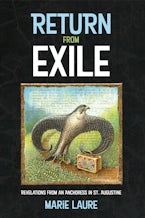
Marie Laure’s Return from Exile is compelling read: part personal memoir, part spiritual memoir, part travelogue, and part pilgrimage, it is uniquely of our time, but is rich with history and a certain timelessness too. Laure is an American writer who longs to travel to Norwich, feeling a particular affinity for Norwich’s famous medieval anchoress, Mother Julian (1343-c.1416), author of the Revelations of Divine Love. Laure is drawn to Julian’s life of sacred seclusion, her many years spent in prayer after a series of visions experienced (Julian tells us) during a severe illness when she was thirty. She imagines Julian in later life, writing, reflecting, and gaining new perspectives, just as Laure plans to do herself.
Laure’s route to Julian’s anchorhold is circuitous, digressive; her first planned journey stymied by an overbooked flight and further plans suspended during months of lockdown due to the pandemic. But this very much suits the nature of creative nonfiction, allowing for events to be juxtaposed with theological insights (Laure wears her learning lightly, but is fluent in several spiritual traditions), and embedded in historical or biographical contexts – these include some fascinating revelatory flashes that foreshadow Laure’s future path. In the book’s first half, we get to know Laure and her family, especially her much-loved adult daughter Hannah, from whom Laure is loosening her maternal bonds in a process that is painful, slow, but ultimately transformative. Just as Julian once did, Laure too is embarking on a new state of life, in her own case in St Augustine, Florida. While Laure’s fascination with Julian as anchoress grows, so too does her appreciation of her own parallel vocation of ‘forest dweller’, the spiritual path she ultimately embraces; a state of life particularly attuned to trees, landscape, the elements, and the cosmos. But she often feels alone, an existential loneliness many of us can identify with, particularly now: how true it is that ‘we often feel alienated, separated, apart from one another, as if in exile’ (p.21).
Finally, the ‘auspicious time’ to make her pilgrimage arrives. At first wary of identifying herself as pilgrim rather than tourist, Laure encounters history, culture, and spiritual serendipity in London, including the spine-tingling privilege of viewing an early manuscript of the Revelations in the British Library. Her stay in Norwich is of course the heart of the pilgrimage, (and particularly interesting to me, being Norwich born and bred!). She takes a great delight – understandably – in the magnificent Cathedral, as well as its lesser-known library. It’s delightful to learn, too, that Laure has followed the progress of the peregrine falcons nesting in a cathedral parapet, via webcam from across the Atlantic, and now in close range.
If Laure experiences some aspects of her Norwich sojourn as joyful, she is also honest about the realities of her visit to the reconstructed anchorhold (a quiet cell with altar and candles) in St Julian’s church. The visit leads her to review and refine her plans for her own spirit-filled ‘third life’. Like most of us, Laure would find the enclosure of a literal anchorhold too much to bear, even while Julian’s wisdom is very much ours to cherish. But we can all benefit from cultivating an inner anchorhold, and consulting the wisdom of Julian as we learn about her life and writing. And what a Julian-like insight that Laure later has, when she understands the profound words from the Revelations inscribed in the cell, ‘Thou art enough for me’, as spoken to her by God, as much as the other way round.
Reading Laure’s memoir, I was struck by how much she trusts us, her readers, to hear her story with all its hurts, tangents, encounters and insights. It is almost as though we are asked not just to journey along with her, but to welcome her story into our own hearts with the attentive compassion of Mother Julian herself. We are, implicitly, invited by Laure to be Julian, even as she invites us to consider how much we also need Julian.
Two of Laure’s more explicit insights also stood out as particularly valuable. The first is not a new one, but a reaffirmation of Julian’s experience of Christ as maternal. We do not know, but many suspect that Mother Julian had her own experience of biological motherhood, possibly losing her family in one of the waves of plague that swept over England in the fourteenth century. Julian specifically mentions her own mother being present at the time of her own illness. Her visions and understanding of Christ as mother have only increased in resonance. Laure puts it wonderfully: ‘This is what Julian is all about: mothering love guaranteed unconditionally, endlessly, and eternally’(p.100).
The second insight Laure shares is the centrality of healing in the spiritual life, and the value of praying for healing as spiritual practice. Healing in a wide, symbolic sense, of course, but also healing as specific and relevant to our embodied selves. Particularly so at time of the book’s writing, when the global pandemic has forced us to confront our physical frailty with some urgency. Laure is gently guided to pray for healing; in particular, she asks for, and experiences, healing of the heart, on both spiritual and physiological levels.
A pilgrimage is a personal journey, especially when travelling alone, as Laure did. It is full of meaning, both scheduled and unexpected: Laure quotes Phil Cousineau’s 1998 book The Art of Pilgrimage: ‘In sacred travel, every experience is uncanny. No encounter is without meaning.’ (p.81). However, the fruits of a pilgrimage are certainly not limited to the pilgrim, and here they are not limited to Laure’s own spiritual growth. For Julian, and for all those who follow a contemplative way, ‘activity within the heart is ongoing and lively’ (p.32), and leads to connection, not isolation. This is made manifest in a powerfully poignant encounter with a bereaved grandfather on Laure’s flight home. No longer in existential exile, Laure responds as an authentic listener, offering something of Julian’s own compassion in the enclosed, liminal space of an aeroplane in flight. And now we have Laure’s published book too, which I warmly recommend for reading and revisiting.