John Cage: Organ²/ASLSP (As Slow As Possible)

John Cage: Organ²/ASLSP (As Slow As Possible)

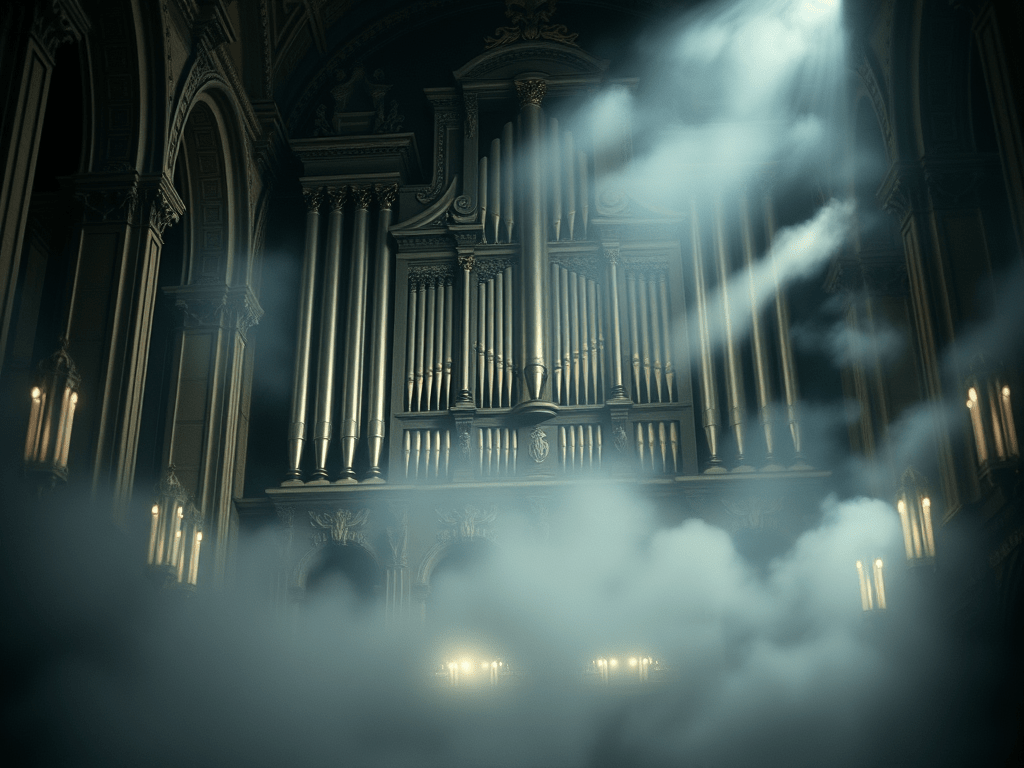
On Monday, February 5, 2024, after a period of two years, a chord was changed in the longest musical composition in history. There have been only sixteen chord changes since the work, written for organ, began in 2001; the piece is slated to finish in the year 2640.

with a phrase from Pierre Teilhard de Chardin


White-gloved and rigid, they slide two more pipes
into place, solemn as gray-haired priests
bending over the Blessed Sacrament. Women adorned
in facemasks and fanny packs stand, eyes closed,
lit with a rapture usually reserved for discalced nuns.
Here, in Halberstadt, they take time seriously.
Truth takes the time it takes, and so they are satisfied
to eke out transcendence over centuries.
No matter. No matter, either, that the long-awaited chord
is less than lovely, that after two years of the same
pitches, an endless far-off buzzing like a leak
you can never find, the new notes do nothing
to make the music prettier. Pretty was never the point.
There is beauty enough in the world if you are willing
to seek it out. Hope is harder to find. But today
we come together, listen to a piece of music meant
to last six hundred years, affirm our faith in the slow
work of God
, a psalm stretching into infinity,
the promise that someone will be in this cathedral,
listening, when it ends.

Erika Takacs is an Episcopal priest, teacher, and poet originally from Wilmington, Delaware. Her writing has been published in Earth & Altar, The Christian Century, Braided Way, The Orchards Poetry Journal, and as a part of the North Carolina Poetry Society’s Poetry in Plain Sight. Outside of her work and her family, her three great loves are the music of J.S. Bach, books, and baseball. She currently resides in North Carolina, where she and her husband serve at the pleasure of their very spoiled beagle.

Apple – a poem by C. John Graham

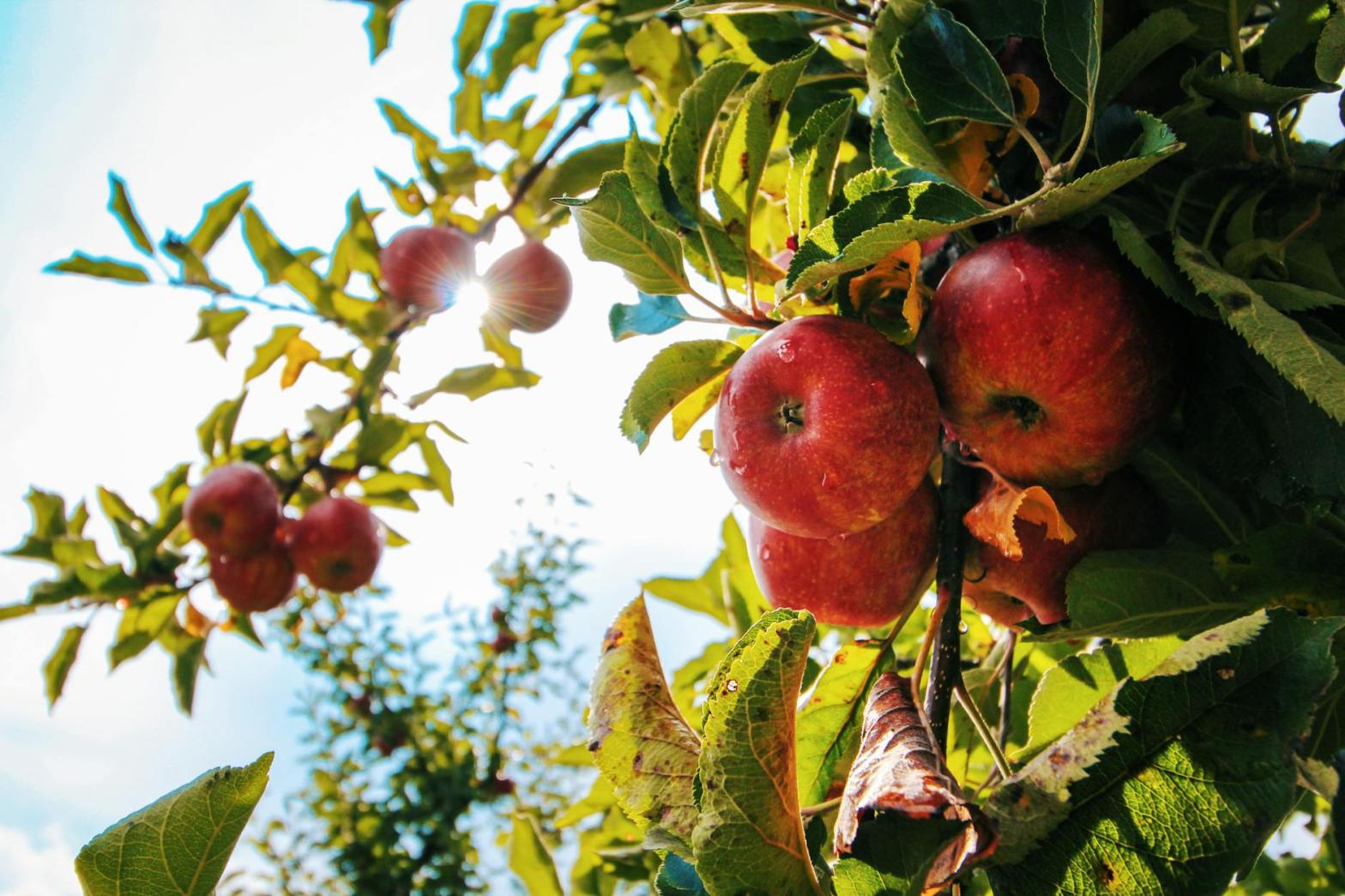
Apple

bite &
break open
cricket tunes

ambrosial blooms
white flesh
and incandescent

cocoons swoon
& fancy bee dances branch-tangled
moon lantern leaf

green susurrus
root vein
heart wood un

pretentious
chalice of light
turning

whereto who
discovered the seed and
the original fruit?


C. John Graham’s poetry has appeared in The Laurel Review, Birmingham Poetry Review, Painted Bride Quarterly, Kestrel, Taos Journal of Poetry and Art, and the anthology Off Channel, among other publications. Graham lives in Santa Fe, New Mexico, and before retirement, worked for a rocket engine manufacturing company and a particle accelerator facility. He is now owns an aerobatic aircraft and serves as a volunteer search and rescue pilot while continuing a lifelong spiritual inquiry. A selection of published work may be found at https://sites.google.com/site/cjohngraham/home/poetry.

Thin Air – a poem by Dan Campion


Thin Air

The questions to our parents that we did
not think to ask when they were here must be
allowed to dissipate in air, set free,
as have our parents been, the answers, hid
from us, persisting in the air amid
the other clouds of pollen, sympathy,
and dust of universal inquiry.
The questions, though, will not do as they’re bid.
They stay with us, unasked forever, now,
until we too regain the freedom of
thin air, the weather then our avatar.
Though Noah sent a raven and a dove,
the form his answer took, the olive bough,
was just a wisp, as revelations are.

Dan Campion is the author of The Mirror Test (2024), A Playbill for Sunset (2022), and Peter De Vries and Surrealism (1995) and is a co-editor of Walt Whitman: The Measure of His Song (1981, 2nd ed. 1998, 3rd ed. 2019). Dan’s poetry has appeared previously in Amethyst Review and in Able Muse, Light, Poetry, Rolling Stone, THINK, and many other magazines.

Advice for Sojourners – a poem by Brendon Sylvester

Advice for Sojourners

Sit still. Take time to stare off
at the mountains or the sky, or a flock of birds
(seabirds work best),
or, if you’re stuck inside
find something that can hold your gaze
and look at that, and think.
Do this every day.

Meander. Put away
each inhibition that prevents you
from turning aside down unplanned walks
to unplanned swims or dinners,
to unplanned talks with neighbors, Godloved sinners.

Take nothing with you,
least of all those things you think you need.
Instead beg everything from others.
Beg love.
You cannot give love till it is given you;
accept hospitality from strangers,
and let your peace be upon them.

Preach the Kingdom
of Heaven is among you.
Sing. Play.
Become more like a child than you were.
For you are only now beginning
to find out what all music is about
and whom it is you play with.

Find halfway houses to rest yourself:
somewhere good folks feast
but do not start to feast till they have shared
some marvel, like a hymn or prayer,
or a memory of dust in sun-filled air—
Join in the breaking of the bread.
I prefer a place with music or near mountains
but anyplace eyes light up
at a fire, a joke, a story that won’t end,
a toast with wine, the company of friends,
rest there, for there God’s Spirit lives.

Walk until you reach the edge of everything.
And when you have peered over, into eternity,
at the ice, the tundra, the midnight sun, the stars,
that holy stretch of road with no more cars,
reach the end of all your sojourning.

Your roots are prickling from being pulled up:
Find good shores where you can cast your cares,
streams and soil where lush trees root
and burrow deeply as you can.
Then show hospitality to strangers—
you may make them angels unawares.

Brendon Sylvester is a poet near Philadelphia, PA. He teaches English at Cairn University, and he has published his work in Touchstone, Ekstasis, and Autumn Sky Poetry. His influences include Edmund Spenser, T.S. Eliot, Fyodor Dostoevsky, and the landscapes of the American National Parks.

Now That I Know – a poem by Gloria Heffernan

Now That I Know

Now is the time to know
That all you do is sacred.
Hafiz


I will live today as if I know
that all I do is sacred.

I will shower under clean water that purifies all
it touches, including this body that I too often neglect.

I will pour my coffee and yours as if each mug
were a chalice brimming with a holy offering.

I will make our bed with cool white sheets
like clean Irish linens spread across an altar.

I will fold our clothes like origami cranes
and arrange them like ceremonial vestments.

Hafiz says he is a divine envoy upon whom
the Beloved has written a holy message.

I unfold that message like an ancient scroll
and find the only truth I need to know:

If I do everything with love
each task is a sacrament.


Gloria Heffernan’s forthcoming book Fused will be published by Shanti Arts Books in Spring, 2025. Her craft book, Exploring Poetry of Presence (Back Porch Productions) won the 2021 CNY Book Award for Nonfiction. She received the 2022 Naugatuck River Review Narrative Poetry Prize. Gloria is the author of the collections Peregrinatio: Poems for Antarctica (Kelsay Books), and What the Gratitude List Said to the Bucket List, (New York Quarterly Books). Her work has appeared in over 100 publications including Poetry of Presence (vol. 2).

Talmud – a poem by Louis Faber

Talmud

She asks the rabbi what God looks like, and he has to admit he doesn't know. She doesn't know either, but she's only three so she isn't expected to know. The rabbi doesn't tell her he is no longer certain where to look for God. She knows that beyond the clouds and behind the stars, at the very edge of the universe, that’s where God is. Her daddy said there was a restaurant there. She doesn't ask it is Chinese or Indian. She thinks God's favorite food is chickpeas. She is sure God also likes pineapple. She is going to have a baby brother soon. She wonders how soon he will talk to her, because she has so much to teach him. She doesn't know if God is a boy or a girl. She wanted to ask the rabbi but he didn't know what God looks like. She wants to meet God one day, she thinks. It will probably be in an Indian restaurant. She is sure God likes the buffet. Especially the chickpeas.

Louis Faber is a poet and blogger. His work has appeared in Cantos, Amethyst Review, Alchemy Spoon, New Feathers Anthology, Dreich (Scotland), Tomorrow and Tomorrow, Erothanatos (Greece), Defenestration, Atlanta Review, Glimpse, Rattle, Cold Mountain Review, Eureka Literary Magazine, Borderlands: the Texas Poetry Review, Midnight Mind, Pearl, Midstream, European Judaism, The South Carolina Review and Worcester Review, among many others, and has been nominated for a Pushcart Prize. A book of poetry, The Right to Depart, was published by Plain View Press.

The Stormcock – a poem by Elizabeth Barton

The Stormcock

The night you died,
you planted an acorn in my heart.
At first, I thought the ache

of all the unsaid words
would choke me
but the seed was patient —

I watered it with my grief,
warmed it with the sunlight
of my longing.

Spring came,
a taproot anchored my loss,
a sapling grew, leaves

opened their wings in my mouth.
An oak tree flourished
in my head,

songbirds nested there,
the ones that do not fear the dark
and from the highest branch

I heard a mistle thrush —
it sang through wind,
rain, thunder.

Elizabeth Barton’s debut poetry pamphlet, If Grief were a Bird, was published by Agenda Editions in 2022. She was a prizewinner in the Shelley Memorial Poetry Competition 2023 and was Highly Commended in the Ver Poets Open Competition 2024. Her poetry has been published in journals such as Agenda, Acumen, Mslexia, The High Window and the podcast Poetry Worth Hearing. She is Stanza rep for Mole Valley Poets and editor of their anthology.

Mi Fu Bowing to the Stone – a poem by Richard Collins

Mi Fu Bowing to the Stone

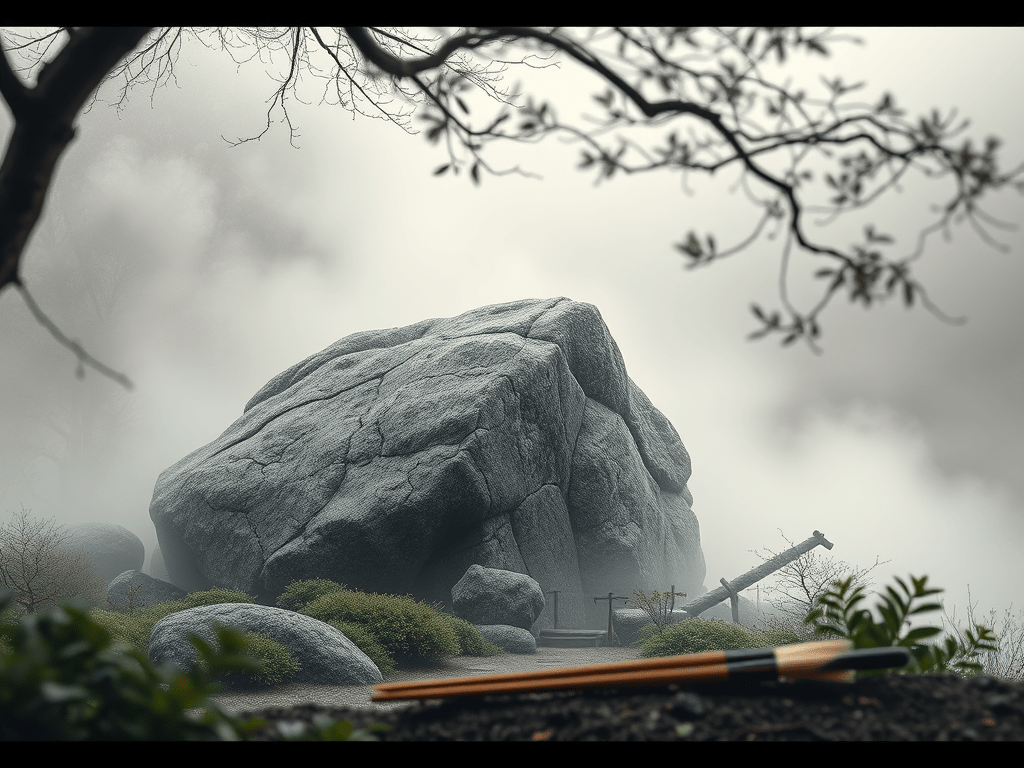
They say he was mad. Before visiting
his flesh and blood he would pay his respects
by bowing to his adopted elder
brother in the garden: a great huddled
boulder of gray weathered stone.

People round here are polite. When I came
to the mountain and changed the grass hut’s name
from The Laughing Place to Stone Nest Dojo,
no one minded, they laughed, as if I were
another old Madman Mi.

We sit together, Mi and I, and share our art,
sketching the fog with brushes heavy with fog.

Note: Mi Fu (米黻) — or Mi Fei (米芾) — (1051-1107) was an eccentric Chinese painter, poet, and calligrapher of the Song Dynasty, and friend of Su Dungpo (Su Shi). As a painter, he was known for his misty landscapes. As a subject for painting, he is often depicted bowing to a huge stone in the garden, which he was known to address as his elder brother.

Richard Collins is abbot of the New Orleans Zen Temple and lives in Sewanee, Tennessee, where he leads Stone Nest Zen Dojo. His recent poetry, which has been nominated for Best Spiritual Literature and a Pushcart Prize, appears in The Dead Mule School of Southern Literature, MockingHeart Review, Pensive, Sho Poetry Journal, Think, Urthona: Buddhism and the Arts, and Willows Wept Review. His books include No Fear Zen (Hohm Press). a translation of Taisen Deshimaru’s Autobiography of a Zen Monk (Hohm Press), and In Search of the Hermaphrodite (Tough Poets Press, 2024).

Abundant Seeing – a poem by Gopal Lahiri

Abundant Seeing

Into the distances of the early morning,
the loose gravels break into golden sediments.
a blue oriole floats over, looking for the tree top.

The half-awake sun is lazy, stirring space and colour,
my two palms meet tenderly in silence under the canopy
of Madhavi creepers near the Ashram gate.

A lean Santhal boy carries a bamboo stick,
walk across slowly, perhaps in search of two ancient
Chhatim trees,

Dewdrops sparkle on the white hibiscus petals,
in a field of mild sunlight between two Sal trees,
the rays come from far afar and say, ‘See’,

At this exact moment,
dip in anywhere, and delight follows.

Gopal Lahiri is a bilingual poet, critic, editor, writer and translator with 31 books published, including eight solo/jointly edited books. His poetry and prose are published across more than one hundred journals and anthologies globally His poems are translated in 18 languages and published in 16 countries. He has been nominated for Pushcart Prize for poetry in 2021 and received a Setu Excellence Award, Pittsburg, in 2020. Recent Credits: One Art Journal, Poetry Breakfast Journal, Verse-Virtual Journal, Setu Journal, Kitaab Journal, Himalayan Diary, Dissident Voice, The Piker Press, Confluence, Ink Sweat & Tears, The Wise Owl Journal and elsewhere.

Mending Words – a poem by Paul Attwell

Mending Words


The Universe whispers.
I obey.
Fresh beginnings, excitement.

Pages penned –
trails of words to ease –
to reapportion facts, to heal

mind and soul. Letter folded,
enveloped,
I briefly chanted.

Vibrations sent through space and time.
These pages offered
to the universe

to accept. Then, I burned bridges
and scratched
a record into this stanza.


Paul Attwell lives in Richmond, London with his cat Pudsey. Paul received a Masters degree with the Open University a year ago. Paul is currently wading through biographies on Marcus Aurilius, Virgil, and Cleopatra.