When I read the poet’s words: One must mourn things daily I knew one must praise what one mourns daily, our task to continue to love what has loved us, not to fold and stash in an attic corner where one seldom goes, not to forget, nor replace as if assuming this moment is all there is – Now being only one portion of the vastness that holds us.
Andrea Potos is the author of several poetry collections, most recently HER Joy Becomes (Fernwood Press), and Two Emilys (Kelsay Books). A new collections The Presence of One Word is forthcoming from Fernwood in fall of 2025. andreapotos.com
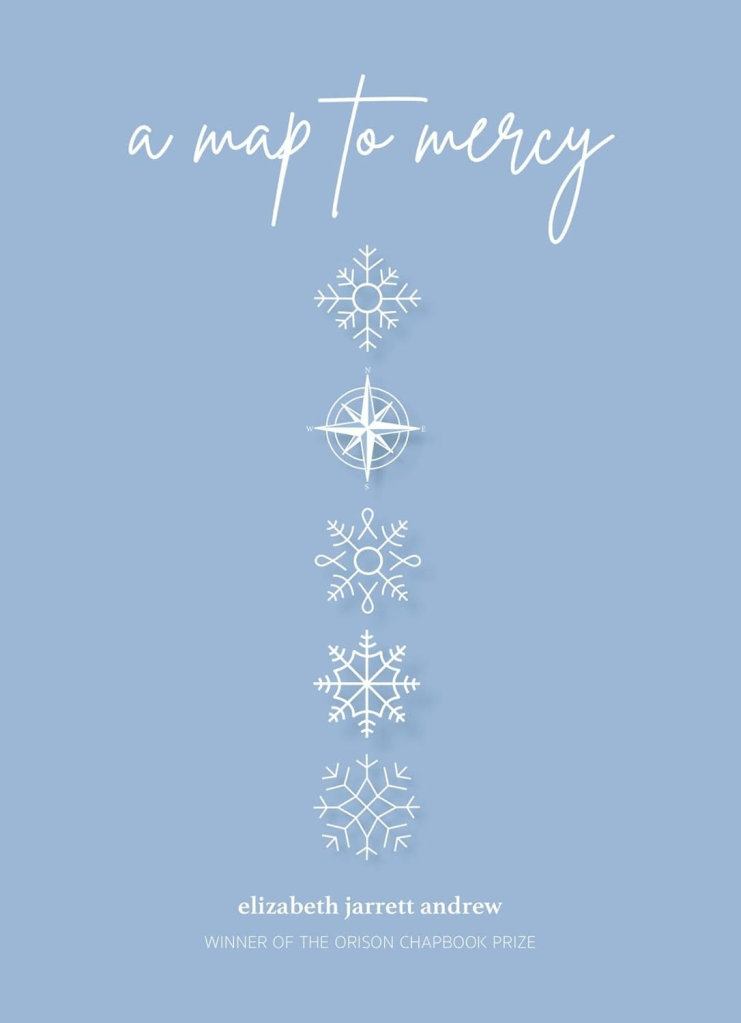
A Map to Mercy by Elizabeth Jarrett Andrew (Orison, 2025)
Reviewed by Lory Widmer Hess
Finding a way into prayer has not been easy for me. I find myself questioning whether I’m doing it right, what it’s really for, whether it’s worth the time, what I’m getting out of it. Of course, all this questioning gets in the way of prayer … or does it? Maybe, if I would sit honestly with my questions, I might be shown a different kind of answer than the one I’m pressing for, a way to sidestep my spinning thoughts and see things in another light. Maybe the desire to pray, even a thwarted desire, is itself enough of a prayer, to start with.
That kind of desire is beautifully described by the writer Elizabeth Jarrett Andrew in her newly published A Map to Mercy, winner of the Orison Chapbook Prize. It starts with the memory of a dream, in which she experienced an indescribable sensation of sinking into peace, along with a solemn announcement of death. Seeking to experience that peace again, and wrestling with the necessary sacrifice, led her along a twisting path, full of questions and thwartings and obstacles and revelations. It led her to explore ancient forms of prayer, while stubbornly asserting her right to be who she is in the postmodern world. And as we walk with her along this path, we may find our very own individual way to be both ourselves and part of a greater whole, to connect ourselves with sacred realms without losing the value of our particular personhood, in the spirit of freedom and joy.
Jarrett Andrew candidly shares her struggle, her questions and doubts and frustrations, in a way that removes all the preciousness and bleached-out piety from her discussion of prayer. The title refers to her choice of a word to return to in contemplative practice, symbolizing her intention to allow the presence and action of the divine within, setting aside other thoughts for the time being. She didn’t at first want to use a word at all, nor did she like the one that kept whispering to her. “Mercy” smacked to her of helplessness, of grovelling and condescension. It sounded like the “sorry remnant of a theology I’d discarded ages ago,” a patriarchial power structure that had done nothing but harm to our planet, and that continued to oppress anyone who fell outside the categories of dominance. Letting “mercy” in seemed an admission of defeat.
But grappling with the word leads her, and the reader, toward a valuable insight: prayer might be less about demanding what we want, and more about how we deal with the realities we don’t want. “In prayer I see my habitual grasping after significance, anything, and know this to be the least of my flaws…All my relentless thoughts present the perfect opportunity to choose, again and again. I choose quiet. I choose patience and deliberation and receptivity. I choose life.”
To what shall we choose to surrender? We can all think of times when we submitted to something out of convenience or fear or inattention, and found ourselves diminished and frustrated, dropped into a hole where further struggle only seemed to push us deeper. How and when can surrender actually enlarge us and set us free? As she moves back and forth between considerations of ancient practices and ordinary, everyday experience, between the wise words of sages and monks and the messy lessons of life lived with her wife and daughter, Jarrett Andrew admits she still loses the way. But then, she comes back to the essence: “And while I get confused about it, endlessly confused, love—that searing silence which is love—is my God. Prayer is how I remember. Mercy is how I bow down.”
I find it consoling to know that such an articulate writer and teacher of spiritual memoir admits to getting confused, and needs constant reorientation. After reading A Map to Mercy I was left wondering what my own map would look like, where it would take me, what I would find. I was newly inspired to take up the path of prayer without pre-existing assumptions, simply trusting that the divine world wants me to be my fullest self, and will show me how if I allow it.
In the end, the word “mercy” opens up new meaning for Jarrett Andrew; the mysterious tug of something unwanted can indeed turn out to be a pointer toward our deepest desire. And this word, or any word, can be both of the greatest significance and of no significance at all. What matters, she concludes, are the bonds with one another that are also our union with ultimate mystery.
Each of us has our way of walking toward that knowledge. Here is one writer’s way, one very human and relatable way, which could open up new and different perspectives for each reader. This small book has huge vistas inside it, much like contemplative practice itself. Why not open it, and see what you find there?
Lory Widmer Hess grew up near Seattle and now lives in Switzerland, where she works with adults with developmental challenges. Trained as a spiritual director, she companions individuals in their spiritual journey and leads online groups in the practice of Sacred Reading. Her writing has been published in Amethyst Review and other magazines and journals, including Parabola, Vita Poetica, Anglican Theological Review, Pensive,and Motherwell. She is the author of When Fragments Make a Whole: A Personal Journey Through Healing Stories in the Bible (Floris Books, 2024). Find her online at enterenchanted.com.
She holds the mirror to my lips: thin breath Confirms I’m still alive. But still, it’s time. My rings she slips off first, symbolic death Of love’s earth ancestry. Then clothes, poor mime, Thin skin and bones’ old structures shedding touch. She tugs from brain cells pressed-flower scents, long past Their sweet stage. Deaf to death, my ears still clutch Sung music I once wrote. But no forms last, Eyes blind with clearer vision. Out she pours Life’s box of paradox: doubt’s faith, love’s hate, Virtue’s redemption, history’s settled scores. Will’s exiled shadow, clarified through fate, Just flashed past “me.” Soul sloughs this universe, My spirit kissing Death goodbye. Good nurse.
Beth Houston has taught writing at ten universities and colleges in California and Florida. She has published a couple hundred poems in dozens of literary journals. She edits the Extreme formal poetry anthologies (Rhizome Press). http://www.bethhouston.com
Stephen C. Curro hails from Windsor, Colorado, where he works as a high school paraprofessional. He has previously published fiction and poetry with The Fifth Di…, Scifaikuest and Daily Science Fiction, among other venues. When he isn’t writing or working, he enjoys scuba diving, collecting fossils and watching bad monster movies. You can keep up with his shenanigans at http://www.stephenccurro.com.
I woke wanting to remember but could not except in gold-gray flashes. Throughout the day it would return when I was driving or when my hands
were full and I could not jot down the image. Later I made time to write but the fragment vanished at the touch of my attention though I sensed it still
like the scent of the sea through an open window. Even now it goes and returns, like the sensation of hearing her voice, a brightness
on the line where sky and ocean meet. It rises and falls as if it sews a world where it cannot stay to a world where I can’t go.
It’s difficult to see in all that light.
Rose Strode is a poet, essayist, rehabilitator of overgrown gardens, and naturalist. Her work appears or is forthcoming in Wild Roof, Hare’s Paw, New Ohio Review, Terrain.org, and The Ecopoetry Anthology: Volume II from Trinity University Press. When not writing or helping others with their writing she wanders around in the woods with her dog. Read more of her work at rosestrode.com
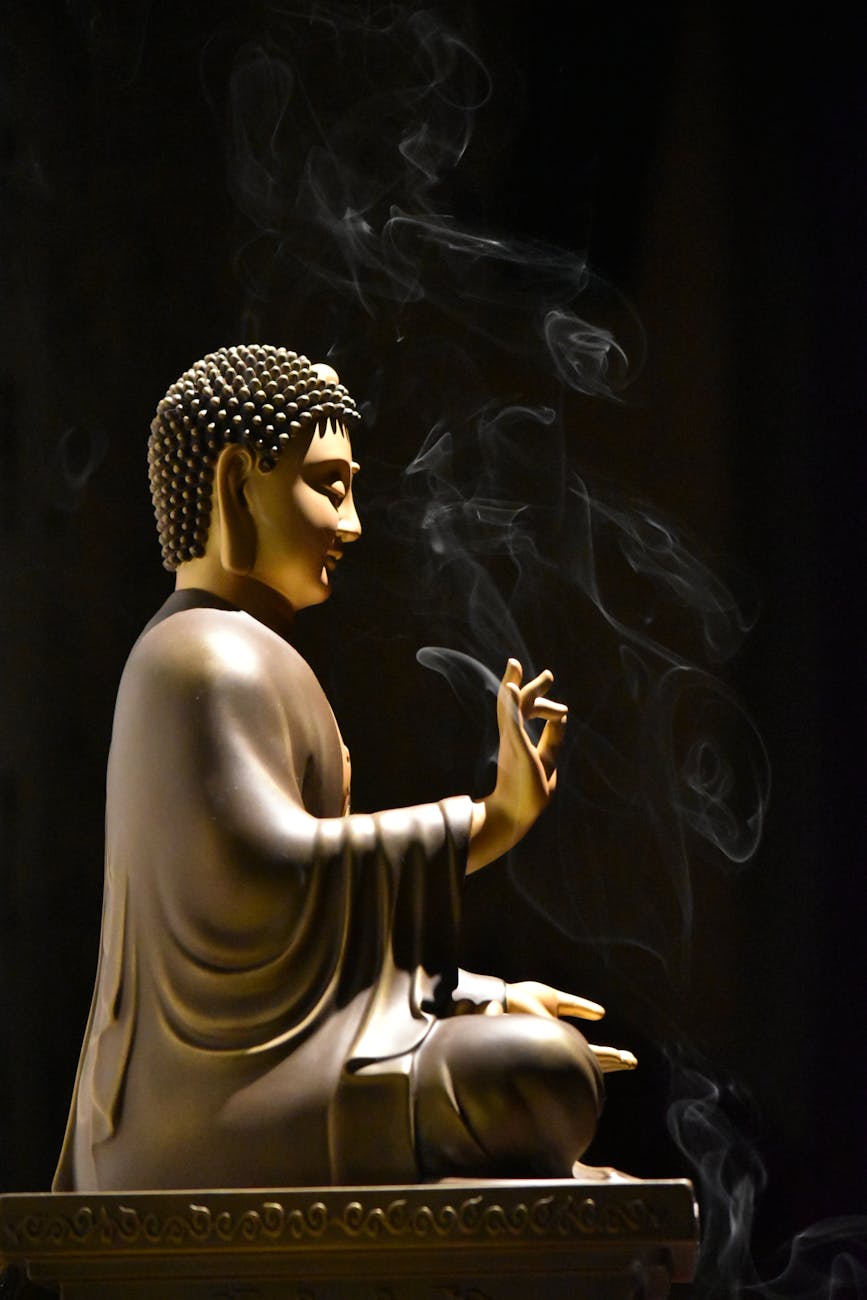
Strike a match— coo-whik-shhhooh! Let silence bloom.
Catch a whiff of sulfur’s pungent essence. Dopamine.
Ignite the incense. Can you hear it smolder? Breathe in
the scent of cinnamon, sandalwood, benzoin. Let bliss be.
Settle in. Lift each vertebrae and spread your collarbones
until your heart goes tippy-toes, can’t wait to fledge,
lets you hold it and place it, gently on the altar
at the Buddha’s feet where incense whorls, compassion flows,
and consciousness can’t help but twinkle.
John Whitney Steele is a psychologist, yoga teacher, assistant editor of Think: A Journal of Poetry, Fiction and Essays, and graduate of the MFA Poetry Program at Western Colorado University. A Pushcart Prize nominee, his poems have been published widely. His two collections, The Stones Keep Watch, and Shiva’s Dance, were published by Kelsay Books. John lives in Colorado and enjoys hiking in the mountains.
The day my dad died it didn’t rain. There was no flooding, no trees toppled over, no violent hurricane, no water lashing the earth. There was just a vast void in my life, a chasm too difficult to cross. I didn’t leave the house.
Late in the afternoon, it arrived unexpectedly—a large, square, flat package, there, on the porch, from Rebecca, one of my dearest friends I’d not seen for seven years.
When I opened it, I discovered the portrait I’d seen her working on all those years ago, the painting I had asked if I could buy.
It’s not finished yet, she said.
So I returned to my life on the opposite coast, writing letters to cross the distance between us. I forgot about the painting.
Now, on the day my father died, October 18, 2022, it came without expectation, without fanfare, the painting I dearly loved: A woman’s serious face surrounded by flowers, alive with color, the colors strange and vibrant.
And I knew it was meant for me, on this day, that in the divine order of the universe I was remembered and cherished. This was a sign from God. Now the work is finished.
Anderson O’Brien lives in Winston-Salem, NC with her devoted husband and two terribly spoiled cats. She has published in Iodine Poetry Journal, The Kentucky Review, Blue Fifth Review, Red River Review and Heavy Bear.
There’s no going back to summer, to that spring. The past is fading and it’s beautiful, beautiful... The world is always healing,
always shedding old weight, riding the current for Now... Now a decision must be made:
Will you lie and squander in the briars of your sorrow?
Or push up, out—
into the new life?
Ahrend Torrey is the author of This Moment (Pinyon Publishing, 2024). His work has appeared in Denver Quarterly, storySouth, Panorama: The Journal of Travel, Place, and Nature, The Greensboro Review, The Westchester Review, Welter, and West Trade Review, among others. He lives in Chicago with his husband, Jonathan; their two rat terriers, Dichter and Dova; and Purl, their cat.
Theodora, I know so little about your life, and you haven’t heard of mine, lodged in this unthinkable future.
You sleep on a coarse mat with sheepskin for cover, own two clay jars for water and oil, a lamp casting shadowy light.
My soft-cushioned life is the kind you escaped from. Brightness in my home is dimmed at a touch. While you wash
your own clothes, I have a metal box that performs that task. Entertainment winds around my days, noise grips them firmly.
Discarding linens finely beaded, you wear a rough tunic, dress as a man to avoid unwanted attention.
I’m comfortable lounging in jeans, nevertheless own more than one dress and coat.
You’re tired of men who wield power, live to excess. That world is also familiar to me, so I vote, sign petitions.
Yet I know large gestures are not the answer, it’s cutting my own excesses— a new jumper, endless cups of coffee,
hoarding books — that will change how I view the world, allow me to walk gently on our fragile planet.
This is why, sometimes, I feel the need to meet with you in your desert-solitude, sink into layers of silence
where we circle our deepest hopes, then face our reality— you weaving mats, me mopping the kitchen floor.
In about the fourth century, groups of men and women moved out into the desert to live a different kind of life. The desert fathers are remembered, the desert mothers mostly forgotten.
Yvonne Baker’s debut poetry pamphlet, Tree Light, was a winner in the Cinnamon Pamphlet Prize 2022 and her debut collection, Love Haunts in Shades of Blue, won the Cinnamon Literature Prize and The Rubery Book Award for best poetry collection 2025. Her other collections with Cinnamon Press are Light Still, Light Turning and Backwards forwards across the sea. Her pamphlet Becoming Wetland will be published in 2026.
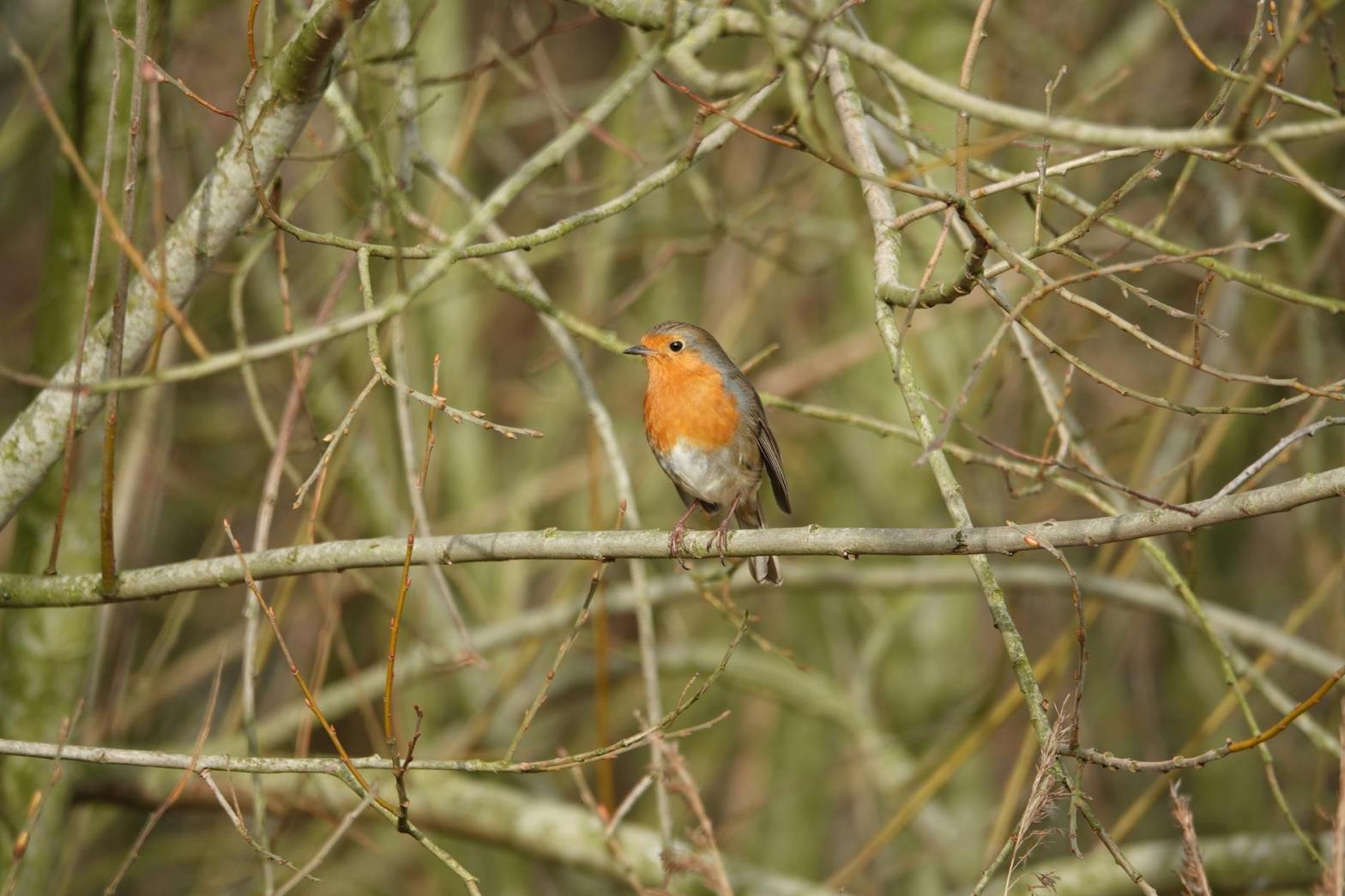
It’s time to watch now for the smallest things: How quick the little baby up the block Has grown and now begun to walk; How early in the day the robin sings; How even just a passing stranger’s smile brings The sense we’re still somehow quite interlocked One to the other, still can feel, can talk, Can whistle in the dark, can even sing. For big things, so it seems. have all gone bad: Decayed, collapsed, betrayed our deepest trust. They totter strangely, just about to fall. And yet we must not let ourselves be sad; Must hold to faith and not become nonplussed: The Greatest Thing is hiding in the small.
Jeffrey Essmann is an essayist and poet living in New York. His poetry has appeared in numerous magazines and literary journals, among them Dappled Things, the St. Austin Review, Amethyst Review, Pensive Journal, Forma Journal, and The Society of Classical Poets. He is a certified catechist with the Archdiocese of New York, a Benedictine oblate of St. Mary’s Abbey in Morriston, NJ, and editor of The Catholic Poetry Room page on the Integrated Catholic Life website.