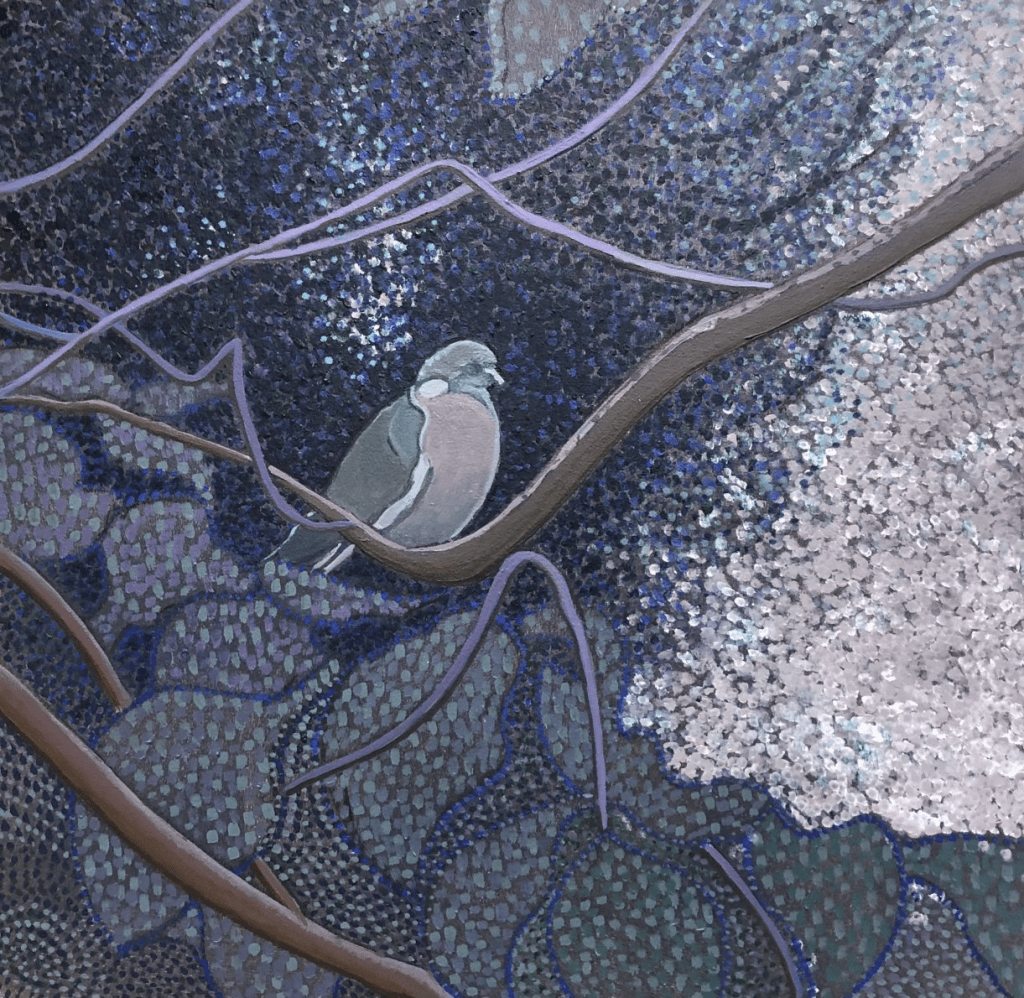
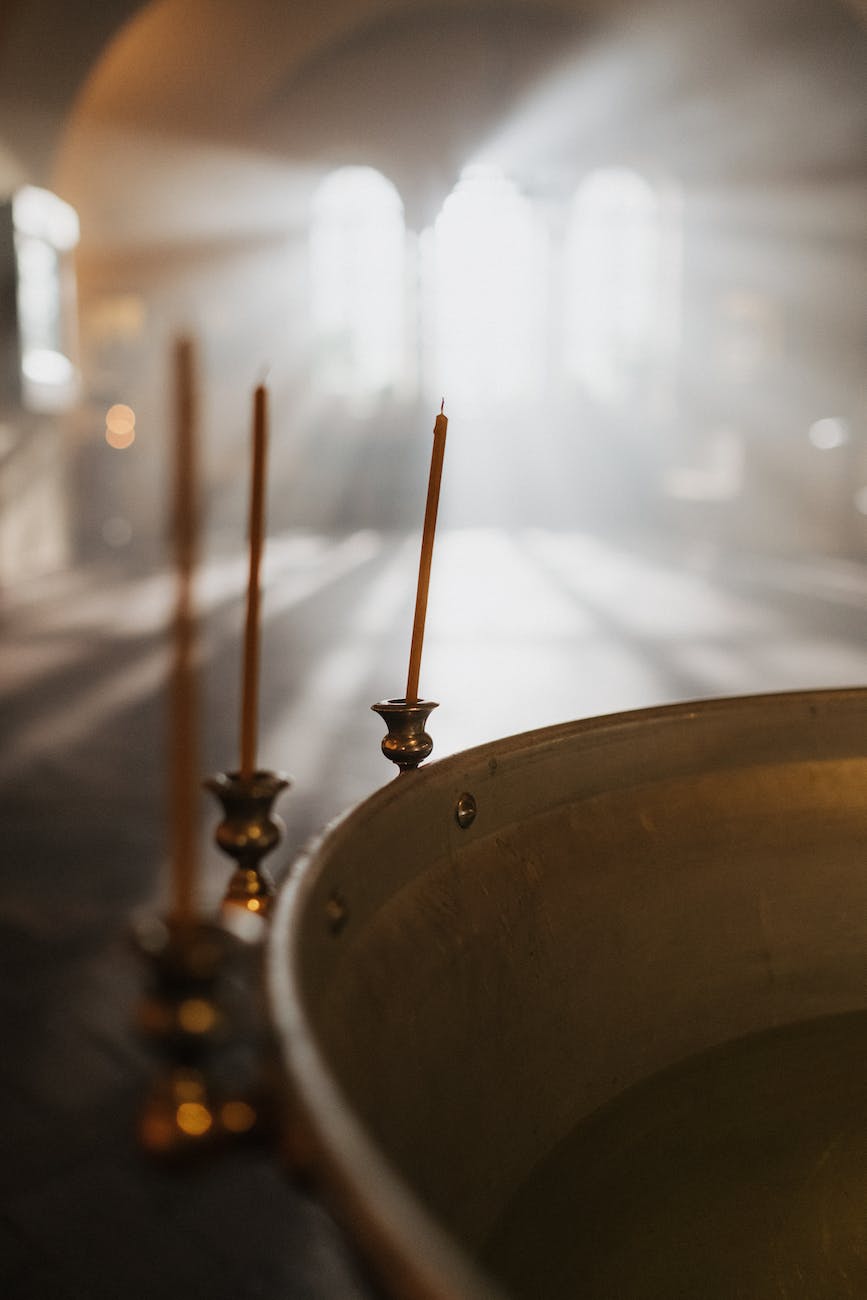
feels stars rise to the surface of her skin spangled
out of the heart traces running under her nerve
behind her ears burrowing down in the dusky woods
beneath her hair dark hinterlands configured in names like ash or willow
trees of long slim leaves like rowan - rowan for faithfulness
longevity and sleep, buds and berries night’s brightness a forest that shines
Lesley Sharpe teaches literature and creative writing, and enjoys living by the river which is always changing. Her poems, reviews and essays have appeared in several journals and anthologies, most recently Aesthetica, Tears in the Fence and The Alchemy Spoon, Finished Creatures and Spelt. Her poems have also been short/long-listed, including for The London Magazine, Rialto, Fish, Paper Swans Pamphlet, Primers, Cinnamon Debut Collection, Live Canon and Bridport Prizes.
Each spring wears the perfume of baptism, of coming up for air; we’ve been so down below
our toes have wrinkles frozen in months of ice, and now we crack loose, open our screaming eyes like newborns
dipped in a chalice of blood. Waking blooms press into the bottoms of feet
and we are one—a fungal scent like earth damp too long—and we are one
more year beyond our fishy histories, lively and twitching like nerves afire. I am
a weeping chain, you the ancient lock, and we rust in pleasant streams unfrozen.
Brian Baumgart (he/him) is the author of the poetry collection Rules for Loving Right (Sweet, 2017), and his poetry has appeared in a number of journals, including South Dakota Review, Spillway, Whale Road Review, and has been nominated for both the Pushcart Prize and Best of the Net awards. Brian is an English professor and previously served as the Director of Creative Writing at North Hennepin Community College. He was 2018 Artist-in-Residence at University of Minnesota’s Cedar Creek Ecological Science Reserve and co-coordinated the Minnesota State Write Like Us Program. He is the father of two teenagers. For more: https://briandbaumgart.wixsite.com/website.
And make for the tent a covering of tanned ram skins, and a covering of dolphin skins above.
—Exodus 26:14
Dolphin skins? What? Where would the Israelites find dolphins in the desert? We sit at a table and debate, thick books with footnotes open.
Is the Hebrew translation off? Was it some other animal?
The woman on my right offers a theory from the Talmud suggesting a unicorn, a miraculous multi-colored creature appearing for a single Divine purpose only to disappear thereafter.
Perhaps it’s just semantics, the man across the table posits. Cheesecloth isn’t made of cheese. Dolphin skin could be a color, goat leather dyed purple or blue.
Speculation continues in our cozy synagogue room where we study with bagels, Shabbat mornings 9 a.m., returning week after week to puzzle over an ancient document revered for centuries as a doorway to the Divine.
Gripped by the desire to decode what we cannot know, we examine each word, turning it over and over like a precious gem, gleaming with finely cut facets.
Jacqueline Jules is the author of Manna in the Morning (Kelsay Books, 2021) and Itzhak Perlman’s Broken String, winner of the 2016 Helen Kay Chapbook Prize from Evening Street Press. Her poetry has appeared in over 100 publications including The Sunlight Press, Gyroscope Review, One Art, and Amethyst Review. She is also the author of two poetry books for young readers, Tag Your Dreams: Poems of Play and Persistence. (Albert Whitman, 2020) and Smoke at the Pentagon: Poems to Remember (Bushel & Peck, 2023). Visit www.jacquelinejules.com
That’s what Virginia Woolf called them, those evaporating flashes of insight that give us for a few brief seconds a conviction of our own significance in a larger, well-planned scheme.
Such fits of faith are not life-changing. They do not merit an augmented chord in the soundtrack of our lives. They might happen while we are cutting carrots or brushing our teeth or waiting in line at the post office.
We might have three or four in a lifetime, but at those times we know with saintlike certainty that an unknowable artist has placed us as a spot of color on a pointillist canvas that can only be understood from a million light years away.
Glenn Wright is a retired teacher living in Anchorage, Alaska with his wife, Dorothy, and their dog, Bethany. He writes poetry in order to challenge what angers him, to ponder what puzzles him, and to celebrate what delights him.
Every weekday morning, a gray striped cat droops on the other side of our sofa. In 1886 a girl in France took over her older sister’s room. For months I have held a photo of my wife in mind. We are all doing the same thing.
* * *
The other side of our sofa is my wife’s side. Visit us any weekend and you’ll find her ensconced there, making her online jigsaw puzzles, Sir Charles sprawled over the fleece blanket on her lap. On Saturdays they can sit this way for hours.
On weekdays they can’t. So every morning, minutes after my wife leaves for work, Sir Charles curls his muscular frame into the back of her seat. He sleeps there till noon, next to where I sit with my laptop. Some experts would tell you her scent makes him feel safe. He cannot be where she is, but he canbe where she was.
* * *
No one should ever have to live through what Thérèse Martin endured. At four, “my happy disposition completely changed after Mama’s death,” she wrote in her autobiography, describing her girlhood in France. “I, once so full of life, became timid and retiring, sensitive to an excessive degree.” Right after the funeral, a friend lamented that “you have no mother any more.” Thérèse threw herself into the arms of her older sister Pauline and cried, “It’s Pauline who will be my Mama!”
Thérèse’s second Mama coddled her, instructed her, shared wisdom from their Catholic faith, and Thérèse glommed onto her with abandon. But Pauline didn’t last either, entering the monastery in their Normandy town in 1882, when Thérèse was nine. This would have been the perfect time for Thérèse to take over Pauline’s room, while the scent of her sister lingered there, but she didn’t. If she had, she might not have come undone.
* * *
I’ve seen more attractive pictures of my wife. After all, no one looks good in a hospital gown. Her eyes gaze at the camera, expressionless, the tube in her mouth delivering oxygen to her lungs. She’d had the tube and the gown for maybe four days. I never saw any of this in person, since her COVID (and mine) made visits impossible.
During those four days she’d sent me a terse text or two. Then, voilà: photographic evidence that she lived. I gasped, my body’s way of rising to good news.
People keep photos of their beloveds in their phones, or as wallpaper on their laptops. I did neither: the photo of my wife clung to my memory like her scent on the sofa, and I carried that memory with me everywhere.
* * *
Losing two mothers must be more than any nine-year-old can stand—let alone someone as sensitive as Thérèse—and the hallucinations proved it.
No one paid much attention to her headaches, which began after Pauline’s departure. The tremors—“nothing was able to stop my shaking,” she wrote, “which lasted almost all night”—were a different story. Everyone, the doctor included, agreed they were serious. Her father moaned that his little girl was either going crazy or about to die.
Worse was to come, and it went on for weeks. “I often appeared to be in a faint, not making the slightest movement…. Once it happened that for a long time I was without the power to open my eyes…. My bed seemed to be surrounded by frightful precipices; some nails in the wall of the room took on the appearance of big black charred fingers.”
With no help and no answers, Thérèse turned to a statue of the Virgin Mary by her bedside, and she credited the statue’s smile for her cure. Something else might have helped as well: a letter from Pauline. “My greatest consolation,” Thérèse wrote. “I read and reread it until I knew it by heart.”
* * *
Two nights before my wife entered the hospital, we’d spent eight hours in a different ER—the dreariest shift of all, 4:00 p.m. to midnight—and neither of us wanted to return. But then she blacked out in the shower and dragged the glass doors off their rails; her blood oxygen plunged to eighty-three, her speech slurred, her eyes barely opened.
The nurse on the phone listened quietly to our ER aversion. “There’s another ER in town that isn’t a trauma center,” she explained, her voice a comforter. “So the wait time is shorter. I’ll get an ambulance to your door.”
Slowly, gingerly, I helped my wife down the stairs when the EMTs came. Just off our front porch they laid her on the gurney and started carting her away. We didn’t lose eye contact until they loaded her in. The ambulance drove off, and I rushed to my place on the sofa to sob.
There was much to do in the next few days, so I couldn’t have imagined my need for the photo of her and the breathing tube and the hospital gown. My body knew, which is why it saw the photo and gasped.
* * *
Sir Charles may know more about scents and loss than he lets on. He could have learned it from Max, his gray striped predecessor, even though they never met. Max and his best friend Beorn would curl up into my wife’s seat as well, partly for her scent—Max adored her too—but more for each other’s presence. They’d form a yin-yang symbol, exchanging pheromones while each groomed the other’s head.
Beorn died first, after a long wasting in which he never lost his high spirits. Two yowls from his cat bed and he was gone. Amid our sorrow, we looked forward to the extra time we’d have for Max, to give him more cuddles, in the few years he had left. Max had other ideas. He drooped in his friend’s old haunts and eventually turned away from food, his life’s great pleasure. It was only six months later when grief carried him off.
This is what Sir Charles may know, and why he insists on lying where he does, never too far from the scent, and the ghosts, that sustain him.
* * *
Four years after Pauline’s departure, Thérèse finally took over her old painting room in the attic and “arranged it to suit my taste.” She used a whole page in her autobiography to describe her bric-a-brac: a cage full of birds, a massive cross in black wood, statues of saints, baskets made of seashells, schoolbooks scattered all over, an hourglass, a doll’s cot that was once Pauline’s.
She also dedicated a wall to a portrait of Pauline. The portrait was not her sister in the flesh, of course, but that didn’t keep Thérèse from sitting in its shadow.
* * *
Six days after the photo I pulled up to the hospital’s main entrance and waited till a nurse wheeled out my wife: wan, befogged, but more herself than when she left our home in the ambulance ten days earlier. Years ago we began to point at each other when meeting somewhere—there’s the one I love—and my arm shot out, index finger extended, of its own accord.
At some point I got hold of her discharge papers, settled into my seat on the sofa, and ran web searches on the medical terms in the one-line diagnosis. Two or three times, I read and reread the definitions to make sure I hadn’t imagined the phrase in front of me: often fatal. Each time, something deep inside me rattled like a china teacup during a tremor, threatening to shatter.
* * *
Some years ago, when visiting Thérèse’s childhood home in France, I bought the photo of her that I love best: face close up, enshrouded in her nun’s habit, a steady gaze, a hint of weariness around the eyes. Now the image occupies a space on my sitting room wall, just as Pauline’s portrait did for Thérèse herself.
Amid the darkest of my dark moods, I trudge to the sitting room, lay my body on the futon, and talk with the photo as one would a friend. Conversations like this are easier when I can see the person, I’ve found. As we look at each other and chat, I can sense my place among all those who’ve gazed at icons, kneeled before crucifixes, or ranted at statues, pouring our hearts out and hoping, more than anything, for the solace of a response.
* * *
The image of Thérèse, my wife’s photo, Pauline’s old room, Sir Charles’s place on the sofa: whenever a comfort does its work, an ancient practice plays out again. We relearn this practice from our children, who know from instinct how to use such things.
On most nights in the late 1980s our toddler clutched her hand puppet, a pink bunny, while she lay on her bed. The bunny traveled everywhere with her: to Boston for play days, to child care, on walks to see the cows at the nearby farm. Her index finger slid in and out of a fold in the puppet, which was trimmed with satin edging. Today parents call them loveys: those objects that no child—that none of us—can ever, ever, be without. We didn’t know what losses our toddler warded off with the pink bunny, but she must have known they would inundate her, as they inundate us all, without her friend by her side, bearing the scent of everything she loved.
# # #
John Janelle Backman (she/her) writes about gender identity, ancient spirituality, the everyday strangeness of karma, and whatever else comes to mind. Janelle’s work has appeared in Catapult, the tiny journal, Typehouse Literary Magazine, Tiferet Journal, and Amethyst Review, among other places. Her essays have made the shortlist of the Eunice Williams Nonfiction Prize and Wild Atlantic Writing Awards. She can be found on the web at www.backmanwriter.com.
I know I’m not supposed to believe That the bees bee-lieve in some God and a heavenly hierarchy of hives
but, this morning, so many sister bees were piously harvesting each bloom’s vaulted altar of nectar and pollen
that their work seemed like worship; and I dreamed of a rosary bead of bees to keep me alert to this single-mindedness
on sweetness, light, and the source, maybe, of all being where a Hildegard Von Bingen of queen orchestrates this holy order
of receiver bees (can you believe) ingesting arriving nectar then transferring it—mouth to mouth— to the interior hive while others, unseen,
all day, flap wings inside dark chambers to keep the hive between eighty-five and ninety degrees. Oh, by noon, I swooned over this last supper
of summer as I witnessed some arriving with half their weight in pollen and willing, one book says, to die in flight for the sake
of the hive. Now, it was all too much not to kneel over the gravel’s pew of duff and lift a chalice of nectar-filled blossom up
to get a God’s eye view of sister bees’ transubstantiating nectar into honey that heals the human body. Forgive, then,
my seduction by these sweet, Carmelite nuns plunging me beneath the pool of buds before rising to be born again into the
First Universalist Church of all things bloom. And forgive these ceaseless sermons on these blessed bees almost walking on water
as hovering over flowers, they taste buds with their feet to see if it’s worth burning calories to land then launch. And, yes, musing on earth’s own looming colony collapse,
I bought the hive, don the suit, and feel my own being communing with some sacred body each time I raise the host of honeycomb
and proclaim “Amen” to the priestess bees giving their lives, so joyfully, to tend one of God’s rods of fall goldenrod.
Dennis Camire is a writing instructor at Central Maine Community College. His poems have appeared in Poetry East, Spoon River Review, The Mid-American Review and other journals and anthologies. An Intro Journal Award Winner and Pushcart Prize nominee, his most recent book is an Anthology of Awe and Wonder, Deerbrook Editions. Of Franco-American origin, he lives in an A-frame in West Paris, Maine.
brief chapels along the way
An alphabet of birds
lettering the sky.
The meaning of their words
moves in velocity.
They huddle on the wires,
movement at a rest
till morningsong requires
another verse, at least.
The language of the hymn
has some theology
of God-in-things, whose claim
rests in locality
JBMulligan has published more than 1100 poems and stories in various magazines, and has published two chapbooks: The Stations of the Cross and This Way To Egress, as well as 2 e-books: The City of Now and Then, and A Book of Psalms (a loose translation), plus appearances in more than a dozen anthologies.
Window, shadow, god: Hiddenness as a path to the holy
Window, shadow.
Windows have a steady historical presence in religious spaces. And while the sanctuary I grew up attending had a surprising lack of portals to the world outside (literal and metaphorical), religious institutions were powerful enough to afford windows at a time when they were a considerable expense. Thus, we have the Romanesque clerestory windows to provide light from above, the Gothic lancet windows lined up along the walls, and the towering rose windows, which are considered characteristic of Gothic architecture despite their presence in pre-Christian ancient temples.[1] Windows do not feature heavily in Baroque architecture. The Baroque style was a counter-reformation endeavor which sought to keep parishioners through the sensory, sweeping, and dynamic contrasts that heighten emotion.[2] The windows served to illuminate the ornate, overwhelming figures gilded onto every surface, giving these spaces a dramatic, spiritual energy.
Despite the dubious expense spent on manufacturing religious zeal, these windowed, churchy spaces contain a steady hum of the holy— not necessarily the overwrought ornamentation of the baroque, but the large, window-lit rooms where light and dark play. When traveling in the historical seat of Catholic power, I was overwhelmed by the many religious spaces with their enormous feats of artistic grandeur. But it was the 11th century Abbazia di San Miniato al Monte in Florence that held true spiritual fervor: the long, shadowy path, the echoes casting around, the tomb-like stone miniaturing us, the light emanating from the apse and upper vestibules alone. If you google it, you will see photos where the synthetic light is piped in and, like so many other churches, the art is illuminated with the bright glare of a bulb. But on the day that we were there, they didn’t turn the lights on. The art was allowed to play in shadow, where god also dwells. It’s not the quantity of light that awakens the spirit: it’s the movement of light, the communion with the dark, the ever-shifting brightness and shade of day, the unsteady glint of moon.
Darkness is important to the life of the spirit. Perhaps this was common knowledge before electricity could be wired into our churches, synagogues, and mosques. Dark is the domain of the unseen, the question, the hard to know, the impossible to trace. Here in the West, we are not well versed at being in the dark. We like to bathe things in the light of certainty and progress. We move quickly, darting frantically from one answer to the next. This is not the only way.
For another way, we can turn to Pseudo-Dionysius, a late fifth and early sixth century Christian Neoplatonist who wrote as if he were the first century Bishop of Athens, St. Dionysius the Areopagite.[3] This is what he says of the spiritual life:
Leave the senses and the workings of the intellect… and through unknowing reach out, so far as this is possible, towards oneness with him who is beyond all being and knowledge. In this way, through an uncompromising, absolute and pure detachment from yourself and from all things… you will be led upwards towards that radiance of the divine darkness which is beyond all being. Entering the darkness that surpasses understanding, we shall find ourselves brought, not just to brevity of speech, but to perfect silence and unknowing. Emptied of all knowledge, man is joined in the highest part of himself, not with any created thing, nor with himself, nor with another, but with the One who is altogether unknowable; and, in knowing nothing, he knows in a manner that surpasses understanding.[4]
This is the spiritual life we so often forget in the West. The protestant urge is to make religion about an individual’s assent to a set of beliefs, and this is not a wholly bad impulse— in its best form it removes the hierarchical intermediaries between God and person. But in centering an intellectual agreement, the experience of God is organized around exegesis. The sermon is the centerpiece of worship, and the intellectual study of scripture is how we come to know God. The space for unknowing and for undefined experience becomes slim. While the above passage was not written by the historical first century figure, St. Dionysius is a meaningful vessel for this meditation. According to church history, St. Dionysius encountered the Virgin Mary and was so overcome with her divine radiance that he told the Apostle Paul he would have mistaken her for the very God if it weren’t for Paul’s instruction. Before he converted to Christianity and eventually became the Bishop of Athens, St. Dionysius went to study the stars in Egypt. I imagine Pseudo-Dionysius’ delight when he found a figure for his work who had such capacity to be overcome by divine radiance and who spent years gazing into a night sky. A man who stares into an inky void night after night has experienced a darkness that goes beyond understanding.
Reflecting on Pseudo-Dionysius, Bishop Kallistos Ware says, “A mystery is, on the contrary, something that is revealed for our understanding, but which we never understand exhaustively because it leads into the depth or the darkness of God. The eyes are closed—but they are also opened.”[5] Bishop Ware does not see the mysteries of religion as a problem that cannot be solved. He sees them as shimmering truths, oscillating between known and unknown, asking more of us than just a simple assent. How rarely do we approach the great mysteries of faith as contemplative fodder to pull us into the darkness of God? What if the great tenets of our religions are not simply things to agree to, but possibilities to imagine and contemplate? Those of us, dwindling though we may be, who were raised in a culture bent on the fusion of intellect and religion— we may discover that religious belief carries more meaning when allowed to dwell in the darkness. We must make space for the hiddenness of god.
We resist that something should be hidden from us. But there is a purity and a spaciousness to hiddenness: the hidden can let go of performance and roles and masks and just be; the seeker can allow the imagination to swell as they ponder round and round what is hidden. The poet Jane Hirshfield advises her readers “Definitiveness can diminish; an alert unknowing keeps open the range of what may be possible.”[6] What if belief in God did not circumscribe a life, but opened it up to broader imaginings of what could be possible? What if sitting by a window is not only about the light, but about the shadows casting about? What if questions are more important than feeling certain of the answer? This is a very old idea, often forgotten. Hirshfield shares a traditional Hasidic story in which a tortured man travels many weeks to ask a famous Rebbe a question. After arriving, the Rebbe’s disciples do not let him in. He finally slips into the teacher and asks his question: “What is the essence of truth?” The Rebbe pauses, walks over to him, and slaps him very hard, then returns to his books. Later, one of the Rebbe’s disciples explains: “The rebbe’s slap was given you in great kindness, to teach you this: never surrender a good question for a mere answer.”[7]
***
On an early morning jog near the Mount of Olives, I wandered into the Church of the Sepulchre of Saint Mary, also known as the Tomb of the Virgin Mary. As I peeked my head into this window-less space, I saw a darkly robed man with a long, gray beard lighting the incense and candles, preparing the space for the holy tours that would come through that day. The steps wander downward, away from the light of day and towards the soft, flickering light of controlled fire. It was a space of echoes, and for that moment, of quiet dark. A place brimming with spirit. Spirit is not attached to the form of stories we are drawn to-– spirit does not need a hero’s journey to well up within us, it does not even need the light of day or window; it can abide in the deep of a tomb or the dark corner where the light diffuses into shadow. We are not heroes, and the spiritual life does not ask that of us. It asks silence, community, action. It asks attunement to that which is outside, beyond us.
Descending into the tomb of a saint has a distinctly un-European flair to it. In churches across the European continent, they favor “holy ghost holes” that let in light from above. Despite their participation in the Christian symbolic order, these dome windows predate Christianity. The most famous “holy ghost hole” is in the Pantheon, which was built as a Roman temple commissioned by Marcus Agrippa during the reign of Augustus before it was turned into a Catholic church in the 7th century. According to some, these ceiling windows are designed to remind the faithful of the coming of the holy spirit at Pentecost. Those of us who lack that symbolic background do not think of any future comings of spirit; it is a hole in the roof that lets in the shifting light. In place of the steady, standard overhead lights, this window reminds of the earth’s movement around the sun, of the clouds covering and revealing bright rays of light, and the unsteady relationship of illumination and day. It’s not the dove descending through its aperture that comes to mind, instead a reckoning with the shifting ground on which we stand and a voice saying that life is out there, just as it is in here. That hole in the dome, more aptly called the oculus, bridges the two worlds-– illuminating the interior with the songs and swings of day. In the changing light, a holy ghost can be found; of Roman, Christian, or other origins, who is to say?
***
Many universities and sites of study are born from religious spaces or orders. The ancient scribes, the learned monk, and the puritan clergyman built the foundation of what has become education. While this link between classroom and church is rightly severed in many institutions, both the classroom and the clerestory remain sites of meaning making. At their best, classrooms are spaces for communal learning, imagination, and curiosity, where a learned guide leads you through discovery of yourself and the world you inhabit. Here, we must bring in Audre Lorde, the brilliant teacher and poet who, in a talk on teaching, insists that the surrounding world fundamentally impacts what must happen in the classroom. She writes, “the exercise I choose for a rainy day with the same group is different from that which I’d have chosen had the day been bright, or the day after a police slaughter of a Black child, for make no mistake, these emotional climates are absorbed and metabolized by our children with frightening thoroughness— so more than technique, I consider as basic my total perception.”[8] A teacher who looks first to the window for how to begin.
But just like churches, classrooms can hold vestiges of racism, sexism, and a rigid way of understanding intelligence and knowledge transfer. In the case of church and classroom, many have justified reasons for hating to cross the threshold into these spaces. Much like the sanctuary I grew up in, there were lecture halls that lacked windows, and we made do. But there was one particular building in college that was comprised of crumbling bricks, old stairwells, and low, inefficient tables. There were many windowed rooms that looked out onto a single row of tall, old trees casting thin shadows about the class. I would spend my afternoons looking out the window while the class discussed Kafka, and I had many daydreams in these rooms swirling with meaning.
My junior year, they tore these buildings and trees down to expand the quad, and we were moved to a looming, gleaming white academic building called the Wedgewood Academic Center. In this new hall of learning, I took many classes that transformed me: a poetry course, literary theory, and a senior seminar where I met my partner. Formative and glittering things happened here. But if you were lucky enough to be in a classroom with windows, they looked out high over the city into a context-less expanse of sky that hardly allowed the shadows of day to enter our space. This loss of windows may be seen as arbitrary by those who destroyed the old and designed the new, but when you enter a space where the quality of natural light (or lack thereof) has been carefully attended to, the place is shot through with possibility.
In the spaces we try to make meaning of our lives— church or classroom— an absent window is sorely missed. Windows illuminate. But not in the same way that modern technology illuminates. Jun’ichirō Tanizaki, in his tract In Praise of Shadows, says “so benumbed are we nowadays by electric lights that we have become utterly insensitive to the evils of excessive illumination.”[9] We flood ourselves in bright, cool light, trying to dissolve the mystery by seeing something on all sides. But perception is never whole. Knowledge is never final. Unknowing makes space for spirit. Windows allow for darkness and the tide of light to shift around us, and in so doing they come to our aid in the spaces we inhabit; we must allow them to make way for the preeminence of questions, especially in our rooms of knowledge production. Part of their importance to the halls of religion and learning is escape. When the pastor or professor or student wanders off into boring or triggering territory, the window is a well of absence. You can look out and remember there is a vast world out there that is not concerned with the exact words being preached. You can find your imagination activated by the world that is not attached to your being. You can look to the dark corner and know that spirit and enlightenment are not the same.
Windows shepherd in light, yes, but the shadows they cast are guides as well. They mean that things are taking shape— that like it or not, the world around us is not projected on a screen of manufactured dimensionality. The world we are in is real, solid, and much of it opaque. The spirit and the body are not distinct, and if we can pay attention, the speechless world is humming and brimming with meanings we can observe, but never fully know. The light comes to shine on my skin as much as the skin of my table, it streams into Fauntleroy Church’s ceiling to floor windows that are facing east, the same direction the earth is spinning. This light is filtered first through tree and hill, softening its landing on the old, massive bible at the back of the apse, and I am in the final pew, where the light is cool and diffused. I look out through the window, asking questions of the trees.
[8] Lord, Audre. “Poet as Teacher— Human as Poet— Teacher as Human.” I Am Your Sister: Collected and Unpublished Writings of Audre Lorde. Oxford University Press, 2008, pg. 182.
[9] Tanizaki, Jun’ichirō. In Praise of Shadows. Translated by Thomas J. Harper and Edward G. Seidensticker, Leete’s Island Books, 1977, pg. 36.
Danielle Isbell writes poetry and essays, most of which circle questions about life in a body and practices of meaning making. She studied theopoetics, religion, and conflict in graduate school. Her home is Seattle, Wa, and she is grateful every day to live in a wondrous, delightful, shifty land.
Jerusalem
Time is invisible at night—
the sound of premonition echoes in the dark,
thousand years ahead of eclipse,
and every night we give ourselves,
as if we found something precious
that it overwhelms all our wishes.
That star drifts above the black smoke.
Our loneliness is fading away.
The answer dwells in flickering flames
beyond the waters, mists, and dust,
showing us the meaning of trust,
expecting a miracle at dawn,
and we, reading the lines of lights
through the centuries of mysteries,
want to feel each other again,
we’d like to taste this second—
time of a miracle when truth emerges
in between echoes of explosions,
on the other side of alone.
David Dephy (he/him) (pronounced as “DAY-vid DE-fee”), is an American award-winning poet and novelist. The founder of Poetry Orchestra, a 2023 Pushcart Prize nominee for Brownstone Poets, an author of full-length poetry collection Eastern Star (Adelaide Books, NYC, 2020), and A Double Meaning, also a full-length poetry collection with co-author Joshua Corwin, (Adelaide Books, NYC, 2022). His poem, “A Senses of Purpose,” is going to the moon in 2024 by The Lunar Codex, NASA, Space X, and Brick Street Poetry. He is named as Literature Luminary by Bowery Poetry, Stellar Poet by Voices of Poetry, Incomparable Poet by Statorec, Brilliant Grace by Headline Poetry & Press and Extremely Unique Poetic Voice by Cultural Daily. He lives and works in New York City.
Cave Heart
Absence, its invisible domination
hollowed-out my growing heart
no water slide valves and vessels
no flowing, pumping, beating
but stalactites dripping
with name calls and neglect
no clarity but thoughts hanging
like bats in the daytime
and an open mouth
no voice but void
tongueless
a vehicle with no road
shock-widened and crystallized
an acquiescent entrance
a capacious plea
David Hanlon is a poet from Cardiff, Wales. You can find his work online in over 90 magazines, including Rust & Moth, Barren Magazine, The Lumiere Review & trampset. His first chapbook Spectrum of Flight is available at Animal Heart Press. You can follow him on twitter @davidhanlon13 and Instagram @hanlon6944