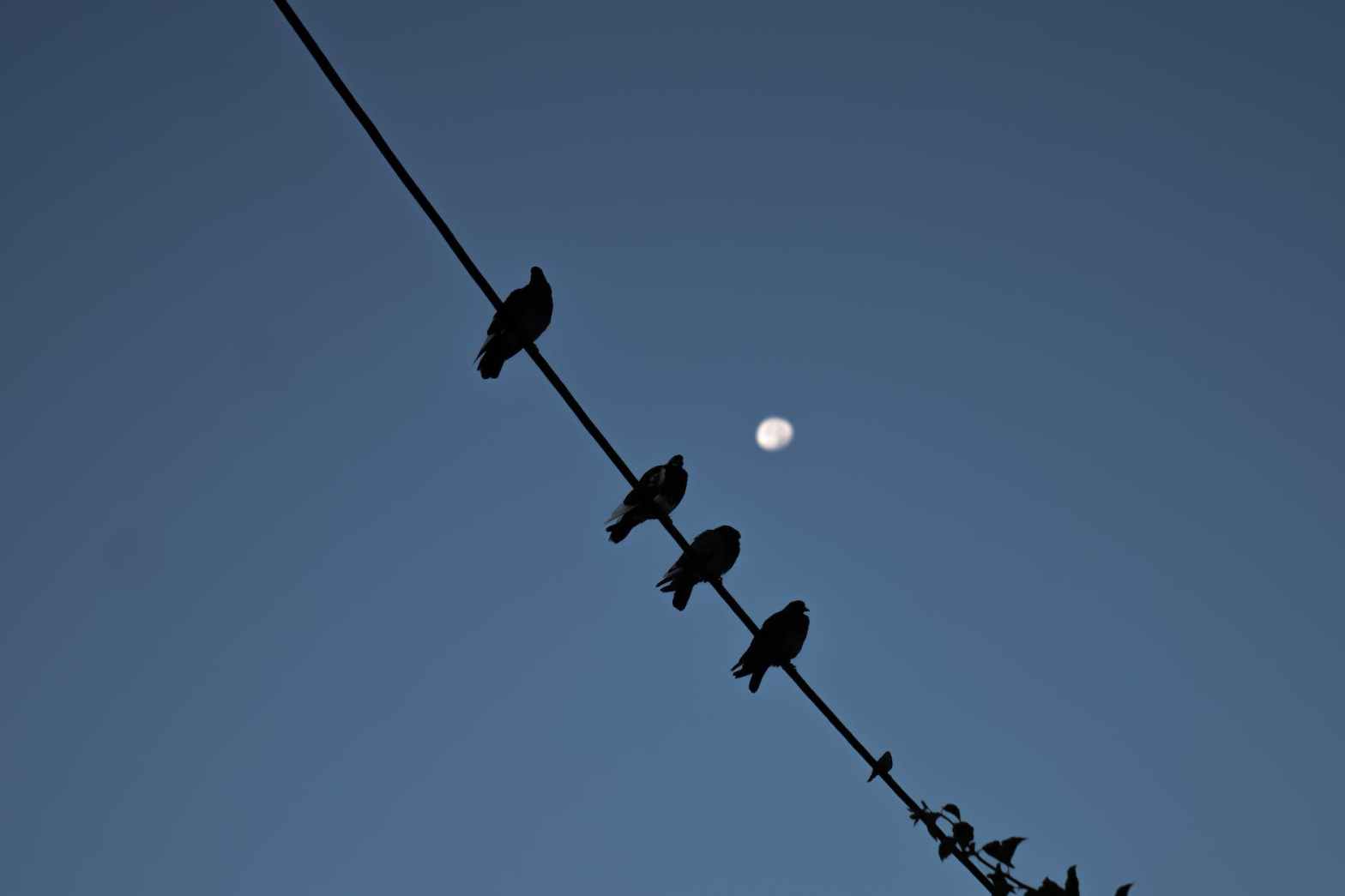

Roots – a poem by Joel Moskowitz

Roots

                          
I’ve been soaking them in a wheelbarrow, 
a little like bathing a baby,
rubbing off any remaining dirt 
to see their vital darkness,  
smell their resin, 
feel their bumps, U-
turns tapered like tusks,
reaching like rays of light.

A buckthorn’s jagged root 
the length of my keyboard 
seemed ancient and lonely.
I scraped off the dark red bark,
peeled off the softer layer of phloem,
then, whittled a blocky crescent moon 
out of the lemon-yellow wood, which,

when it lived in this moist New England 
ground among voles, fungi, and sow bugs,
did not rot; while my father lies 
in his Jerusalem grave;
and our forebears mingle 
in the fertile soil of Poland.

Some nights, I hear them calling me in Yiddish,
telling me, I think, to rise from my warm bed
for some kind of familial duty;
and I promise them I will 
finish the sculpture.

Joel Moskowitz, an artist and retired picture framer, is writing poems about living in a house at the edge of a forest in Massachusetts. His poems have appeared​ in The Comstock Review, Ibbetson Street Press, J Journal, Midstream, Naugatuck River Review, The Healing MuseMuddyRiverPoetryReview.comBostonPoetryMagazine.comAmethystMagazine.org and Soul-Lit.com. He is a First Prize winner of the Poetry Society of New Hampshire National Contest. 

The Substance of Things Not Seen – a poem by Deborah A. Bennett

The Substance of Things Not Seen 

we begin 
here
in the middle of the ocean 
clinging to 
whatever will float 

a rock 
a leaf
a voice from the door 
we hold
to the scent of his old clothes 
hoping his face will stay 
hold to the 
stumps of flowered walls and 
tar-papered floors 
our faith 
on wooden angels 
and pockets of gin 

on pomade braids and 
processions of little girls in 
communion white dresses 
on cornbread skillets and 
pots for sunday greens 
we cling to the spirits that hold to 
the bodies of chairs 
the shadows of halls 
the blue lines of paper 

shades that lie in 
the folds of veils 
and rings
and locks of hair 

the substance of things 
not seen
the evidence of things 
not known 

a rock
a leaf
a voice from the door 

a tide 
of salt 
and stone. 

Deborah A. Bennett is an American poet who was long-listed for The Haiku Foundation’s Touchstone Award for 2022. Her work is spiritual in nature and inspired by her life-long affinity for solitary walks in the woods.

Adherent – a poem by Sanjeev Sethi

Adherent


Exaggerated emotions like in the Big Boss house 
are kosher for capturing eyeballs 
but the meatspace has other exigencies.

The unfalsifiable often belong to faith 
and its fasteners. Those on the circuit 
do not wish to validate it. 

From the cut of his jib, I know that co-traveler 
also, a seeker and I share a dialect—
the dialect of disciples.

Our paradigm isn’t to question the ways of
the cosmic; we are in a lilt with lauds. Our 
pursuit caps at His presence—intrinsic or imagined.

Sanjeev Sethi has authored seven books of poetry. His latest is Wrappings in Bespoke (The Hedgehog Poetry Press, UK, August 2022). He has been published in over thirty countries. His poems have found a home in more than 400 journals, anthologies, and online literary venues. He edited Dreich Planet #1, an anthology of Indian poets for Hybriddreich, Scotland, in December 2022. He is the recipient of the Ethos Literary Award 2022. He is the joint winner of the Full Fat Collection Competition-Deux, organized by Hedgehog Poetry Press, UK. In 2023, he won the First Prize in a Poetry Competition by the prestigious National Defence Academy, Pune, during its 75th anniversary in the “family members category.” He lives in Mumbai, India.

X/ Twitter @sanjeevpoems3 || Instagram sanjeevsethipoems

Canterbury Ghost – a poem by Paul Attwell

Canterbury Ghost 

I could sleep in the fireplace.
Flat out, fingertips

to toes. I saw him there.
The resident ghost is agitated,

unsolid and pale.
He shakes my plate and cup

with thought alone.
Unfazed, I want to talk.

Not before I sip my first
cup of Jamaican coffee.

Not before my first bite
of my fruit scone, a mini monster,

poised to expand and conquer.
It’s surprisingly light, crumbly,

unlike the ghost beside me
asking for a piece.

I explain that ghosts don’t eat.
He growls that no one told him that.

I laugh and offer him a mouthful.
Confused, he disappears.

Paul Attwell lives in Richmond, London and is recovering from doing a Masters in Creative Writing with the OU. Paul loves to read and is a fan of Startrek. He spends time as servant to his cat, Pudsey.

No Earthbound Thing – a poem by John Claiborne Isbell

No Earthbound Thing

The Cantus Mariales now have ended.
I’m gazing at the heavens, and they seem
serene, unchanging. They are not. A bird

swims through that vast expanse as if it had
no project to set foot on land. The pale
pink clouds of dawn are white now, on their blue

unbroken canvas. At their feet – the squat
and jumbled realm of earthbound things, which are
my stamping grounds. If there should come a day

when more than light descended on the globe
as we pursued our business – when the clouds
might open to reveal some entity

whose home is unlike ours – I would not bat
an eye, I would not spill my cup of tea:
each newborn instant threatens it. Above

our busy heads, the sky calls out to all
the dreamers, the far-sighted. And it says
that it is quite unlike our world. The things

that matter to us, it holds cheap. And we
have little time for sunrise in the East,
but it comes daily. As the birds propel

themselves through air, I hear the singer yet.
He’s speaking of what’s holy. And my heart –
no earthbound thing – climbs up with every note.

John Claiborne Isbell was born in Seattle, USA and later lived in Europe and the United Kingdom, where he went to school. He has been teaching languages for some time, teaching French and German at universities in the United Kingdom and the United States. He has published various books, including a volume of poetry, Allegro, with a picture of a cello on the cover. Two more books came out recently, both about women authors.

The Artist’s Touch – a sonnet by Dan Campion

The Artist’s Touch


The hawk affords no harbor for remorse.
It waits and captures, carries off, and feasts
in shady privacy on lesser beasts,
a practice owls and eagles both endorse.
The sparrows do not take long to come back.
Their raptor, after all, is feeding now,
not hunting. Parent birds show fledglings how
to peck at seedcakes, safe from an attack.
A feather and a strew of husks attest
to much hectic activity, a lull,
the continuity of breed and cull,
those specialties of weather, need and nest.
There’s not a breath of wind, each leaf in place,
held still remorselessly, as if by grace.

Dan Campion‘s poems have appeared previously in Amethyst Review and in Light, Poetry, Rolling Stone, and many other journals. He is the author of Peter De Vries and Surrealism (Bucknell University Press) and coeditor of Walt Whitman: The Measure of His Song (Holy Cow! Press). A selection of his poems was issued by the Ice Cube Press in July 2022: https://icecubepress.com/2021/10/01/a-playbill-for-sunset/

Practice – a poem by Deborah J. Shore

Practice

I settle into a chair named forgiveness—
for observation the best seat in the house.
Multitudes pass before me—faces ringing
as gusts blur the flowers, drawing their fragrances out.
Soon my table is crowded—
my challenge now to absorb 
detail of iris and mouth
as family and strangers lean in
without getting up to walk out.
As I laugh with new friends’ fortunes
or painfully cradle their woes
but turn and send away others 
because behaviors are boundaries proposed, 
my own comfort in its commodious arms
and cushioned seat—its lumbar support bolstering me—
costively grows. Some come hoping
to catch a reflected vision, 
to hear an unsinkable tongue, 
or to visit an unruffled aspect—
to provoke or perhaps
to learn how it’s done.
But no tricks exist to tell them.
My derrière steers the way, still in its spot, 
imprinting the harsh weight of my person;
the work of the sit bones is hard.

Deborah J. Shore has spent most of her life housebound or bedridden with sudden onset severe ME/CFS. This neuroimmune illness has made engagement with and composition of literature costly and, during long seasons, impossible. She has won poetry competitions at the Anglican Theological Review and the Alsop Review. Her most recent or forthcoming publications include THINK, Thimble Lit, Ekstasis, Reformed Journal, The Orchards Poetry Journal, Christian Century, Relief Journal, and the Sejong Cultural Society.

Louise Glück’s Sacred Invitation: a Reflection on Nature and the Voice of God in The Wild Iris by Jonathan Cooper

Louise Glück’s Sacred Invitation: a Reflection on Nature and the Voice of God in The Wild Iris

I received The Wild Iris, Louise Glück’s 1992 poetry collection, as a birthday present.  Glück, who died this past September, was a prolific American poet and essayist.  A former U.S. Poet Laureate, she was also the recipient of many other accolades, including the 2020 Nobel Prize in Literature.  Though The Wild Iris came highly recommended, I admit that had it not been a gift from someone I love and respect, I would have abandoned it after reading the first few poems.  The severely direct, astringent style, combined with the predominance of the second voice, seemed to leave little room for nuance or interaction.  Then, in the last few pages, I encountered ‘September Twilight’ and ‘Sunset’, and something provoked me.  As I re-read the poems, it dawned on me–perhaps belatedly–that throughout this collection, Glück has the daring to speak, quite plainly, from God’s perspective.  

Rendered with a spare elegance, Glück’s voice of God intertwines with the beauty and violence of the natural world.  As we read in ‘Harvest’: ‘Look at you, blindly clinging to the earth / as though it were the vineyards of heaven / while the fields go up in flames around you…’ Glück’s un-simplistic verse invited me to a deeper, more nuanced appreciation of nature, while concurrently rattling the cage of my metaphysical assumptions.  Indeed, The Wild Iris was a re-education in nature poetry, both in its role in elucidating the intrinsic value of the natural environment, and in how it illuminates the interplay between nature, the Divine, and the poet (or reader).      

*

Almost definitionally, well crafted nature poetry is never just about nature.  Alfred Lord Tennyson’s ‘The Splendor Falls’ points heavenwards in its exuberance at the beauty of lakes and mountains, but with its repeated refrain (‘dying, dying, dying’) reminds us of the transience of even the most perfect sunset.  In ‘The Road Not Taken’–arguably the foremost American nature poem of the twentieth century–Robert Frost conveys, in image and sense, an experience of autumn in a New England forest.  The poem also provides a profound exploration of the experience of choice, of consequence, of irrevocability as ‘way leads on to way’.  Frost addresses the futility, tempting though it is, of asking ‘what if?’ We are reading the poet’s life, and our own.

Another American nature poet, Mary Oliver, explores the metaphysical quality of nature in many of her poems, including ‘Clapp’s Pond’: the forest-bound pond, and the doe ‘glittering with rain’, is still present with her even when she is ‘three miles away’, hours after she has left.  In the same way, God is eternally now, eternally present. 

Consistent with this encompassing tradition of nature poetry, encountering the sacred through nature is the dominant theme of The Wild Iris.  The ‘birdsong, scent of lilac in early spring, scent of summer roses’ we encounter in ‘Vespers’ may be ephemeral, but they are also a means of divine interaction.  Glück expresses the voice of God through the natural cycles of flourishing and decline, her poems not ignoring nature’s occasional severe mercies.  The blossoms in ‘Vespers: Parousia’ are no longer colourful, but broken and ‘old, old, a yellowish white’.  

Glück refuses to reduce the natural world to an unthreatening pastel painting that I might find in my doctor’s office.  God is not a tame golden retriever.  Indeed, there is a recurring texture of divine frustration throughout the collection, a sense of God and people not being ‘on the same page’.  In ‘Retreating Wind’, the divine voice says pointedly ‘I gave you all you needed: / bed of earth, blanket of blue air…Your souls should have been immense by now, / not what they are, / small talking things’. 

God’s exasperation, as manifested by Glück, is similar to that which a parent experiences towards a well-loved child.  One of the last poems in the collection, ‘September Twilight’, gives full vent to this frustration–‘I’m tired of you, chaos / of the living world’–but then concludes by referring tenderly to the reader (and to people in general), as God’ s ‘vision of deepest mourning’.  Children can be, at once, a parent’s greatest joy and profoundest aggravation.  But they are always an object of intense love.  

The Wild Iris elucidates nature as a means of articulating this divine affection.  While not shallow or cheap, God is also not capricious, and is always reaching out to us.  ‘Clear Morning’ explores this pattern of nature as a means of divine communication: 

…observing patiently

the things you love, speaking

through vehicles only, in 

details of earth, as you prefer, 

tendrils

of blue clematis…

I would be remiss if I did not also mention that engaging with the metaphysical through Glück’s nature poetry lent a new dimension to the importance of environmental conservation.  If we heedlessly despoil a forest, we not only deprive ourselves of natural beauty and the psychological respite of a quiet walk in the woods: we also muffle the voice of God.  Perhaps this is the unstated (or at least understated) impetus behind the increasing urgency of ecological concerns, but this is a topic to be more fully explored in a different essay.  Suffice it to say for now that The Wild Iris invites the reader into a deeper contemplation of God, and a correspondingly deeper appreciation of the natural world.

*

The French Priest and spiritual writer Father Jacques Philippe said that ‘in nature we can recognize an imprint of God’s love.’  The Wild Iris explores this imprint, present both in nature’s beauty, and in its inescapable severities.  Certainly, Glück’s incisive poems challenge trite notions of God, and asked me, again and again, to question my own sacred paradigms.  Unsettling as this was, ultimately this collection left me with an abiding–if not simplistic–sense of divine patience and affection, a sense perhaps best captured by the last stanza of ‘Sunset’:

And yet your voice reaches me always.

And I answer constantly,

my anger passing

as winter passes.  My tenderness

should be apparent to you

in the breeze of the summer evening                                                  

and in the words that become

your own response. 

Jonathan Cooper‘s poems and essays have appeared or are forthcoming in various publications including Thin Air, New Plains Review, Amethyst Review, Poetry Pacific, Spindrift, and The Charleston Anvil.  He lives in Vancouver, Canada.

Meenakshi – a poem by Charlotte Couse

Meenakshi


I first met you in Madurai, though I
couldn’t go near you, so I wandered 
the trinket stalls, luck heavy incense
in the air, & bought a miniature of you
incandescent in the temple’s shadow,
skin betel leaf green — the same as your
parakeet’s plumes & strangely since then
I’ve been in possession of parrot pictures –
jewelled wings flaring on my walls. 

Years later I bought a statue of you —
£10 from a beachcomber who’d seen 
your shimmer in the cool water — 
an antiquity he said, but I knew you’d been
left there for luck – in my palm small, weighty,
hips swayed, dress wet against your curves —
& I see you shimmying towards me,
down through darkened arches,
long eyes glistening auspicious fish.


Charlotte Couse lives in Wareham, on the south-west coast of the UK. She has an MA in Creative Writing from Southampton University and works as an acupuncturist and practitioner of Chinese herbal medicine. 

Prayers – a poem by Larry D. Thomas

Prayers

In evening shadows
she finds them
in the gumption
of fallen sparrows

too young to fly,
scrambling for cover,
seeking in the spasm
of their terror

the stillness of a stone.
She finds them
gleaming in the garnet
eyes of gargoyles.

She muses about
their stirring
subtle as a pulse,
occurring for no

apparent reason,
their stirring
deep within the ink-
black darkness

of the rosebud, .
their stirring of pink,
pink at first so pale
it’s hardly pink at all.

Larry D. Thomas served as the 2008 Texas Poet Laureate and is a member of the Texas Institute of Letters.  He has published several collections of poetry, including As If Light Actually Matters: New & Selected Poems (Texas A&M University Press 2015).  Journals in which his poetry has been published include The WindhoverChristian Science MonitorSouthwest Review, Poet Lore, and Relief: A Journal of Art and Faith.