
Window, shadow, god:
Hiddenness as a path to the holy
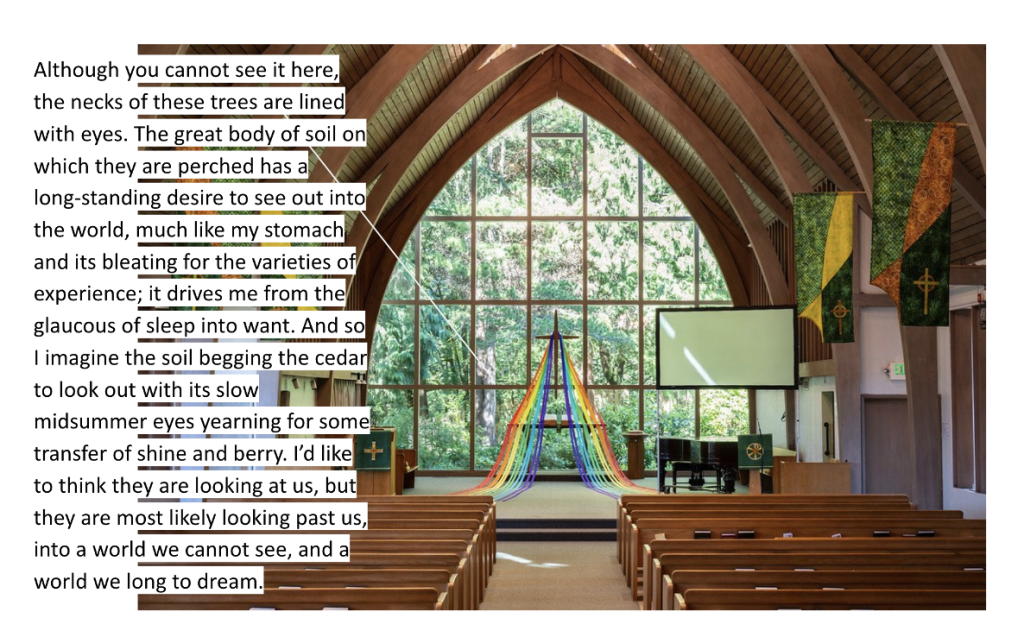
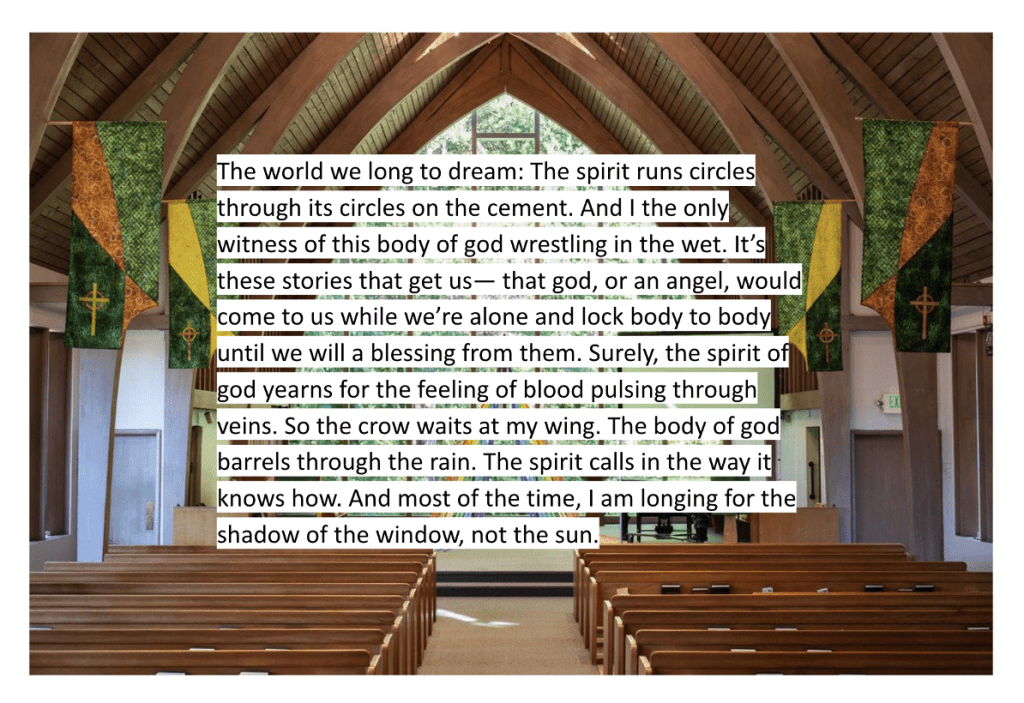
Window, shadow.
Windows have a steady historical presence in religious spaces. And while the sanctuary I grew up attending had a surprising lack of portals to the world outside (literal and metaphorical), religious institutions were powerful enough to afford windows at a time when they were a considerable expense. Thus, we have the Romanesque clerestory windows to provide light from above, the Gothic lancet windows lined up along the walls, and the towering rose windows, which are considered characteristic of Gothic architecture despite their presence in pre-Christian ancient temples.[1] Windows do not feature heavily in Baroque architecture. The Baroque style was a counter-reformation endeavor which sought to keep parishioners through the sensory, sweeping, and dynamic contrasts that heighten emotion.[2] The windows served to illuminate the ornate, overwhelming figures gilded onto every surface, giving these spaces a dramatic, spiritual energy.
Despite the dubious expense spent on manufacturing religious zeal, these windowed, churchy spaces contain a steady hum of the holy— not necessarily the overwrought ornamentation of the baroque, but the large, window-lit rooms where light and dark play. When traveling in the historical seat of Catholic power, I was overwhelmed by the many religious spaces with their enormous feats of artistic grandeur. But it was the 11th century Abbazia di San Miniato al Monte in Florence that held true spiritual fervor: the long, shadowy path, the echoes casting around, the tomb-like stone miniaturing us, the light emanating from the apse and upper vestibules alone. If you google it, you will see photos where the synthetic light is piped in and, like so many other churches, the art is illuminated with the bright glare of a bulb. But on the day that we were there, they didn’t turn the lights on. The art was allowed to play in shadow, where god also dwells. It’s not the quantity of light that awakens the spirit: it’s the movement of light, the communion with the dark, the ever-shifting brightness and shade of day, the unsteady glint of moon.
Darkness is important to the life of the spirit. Perhaps this was common knowledge before electricity could be wired into our churches, synagogues, and mosques. Dark is the domain of the unseen, the question, the hard to know, the impossible to trace. Here in the West, we are not well versed at being in the dark. We like to bathe things in the light of certainty and progress. We move quickly, darting frantically from one answer to the next. This is not the only way.
For another way, we can turn to Pseudo-Dionysius, a late fifth and early sixth century Christian Neoplatonist who wrote as if he were the first century Bishop of Athens, St. Dionysius the Areopagite.[3] This is what he says of the spiritual life:
Leave the senses and the workings of the intellect… and through unknowing reach out, so far as this is possible, towards oneness with him who is beyond all being and knowledge. In this way, through an uncompromising, absolute and pure detachment from yourself and from all things… you will be led upwards towards that radiance of the divine darkness which is beyond all being. Entering the darkness that surpasses understanding, we shall find ourselves brought, not just to brevity of speech, but to perfect silence and unknowing. Emptied of all knowledge, man is joined in the highest part of himself, not with any created thing, nor with himself, nor with another, but with the One who is altogether unknowable; and, in knowing nothing, he knows in a manner that surpasses understanding.[4]
This is the spiritual life we so often forget in the West. The protestant urge is to make religion about an individual’s assent to a set of beliefs, and this is not a wholly bad impulse— in its best form it removes the hierarchical intermediaries between God and person. But in centering an intellectual agreement, the experience of God is organized around exegesis. The sermon is the centerpiece of worship, and the intellectual study of scripture is how we come to know God. The space for unknowing and for undefined experience becomes slim. While the above passage was not written by the historical first century figure, St. Dionysius is a meaningful vessel for this meditation. According to church history, St. Dionysius encountered the Virgin Mary and was so overcome with her divine radiance that he told the Apostle Paul he would have mistaken her for the very God if it weren’t for Paul’s instruction. Before he converted to Christianity and eventually became the Bishop of Athens, St. Dionysius went to study the stars in Egypt. I imagine Pseudo-Dionysius’ delight when he found a figure for his work who had such capacity to be overcome by divine radiance and who spent years gazing into a night sky. A man who stares into an inky void night after night has experienced a darkness that goes beyond understanding.
Reflecting on Pseudo-Dionysius, Bishop Kallistos Ware says, “A mystery is, on the contrary, something that is revealed for our understanding, but which we never understand exhaustively because it leads into the depth or the darkness of God. The eyes are closed—but they are also opened.”[5] Bishop Ware does not see the mysteries of religion as a problem that cannot be solved. He sees them as shimmering truths, oscillating between known and unknown, asking more of us than just a simple assent. How rarely do we approach the great mysteries of faith as contemplative fodder to pull us into the darkness of God? What if the great tenets of our religions are not simply things to agree to, but possibilities to imagine and contemplate? Those of us, dwindling though we may be, who were raised in a culture bent on the fusion of intellect and religion— we may discover that religious belief carries more meaning when allowed to dwell in the darkness. We must make space for the hiddenness of god.
We resist that something should be hidden from us. But there is a purity and a spaciousness to hiddenness: the hidden can let go of performance and roles and masks and just be; the seeker can allow the imagination to swell as they ponder round and round what is hidden. The poet Jane Hirshfield advises her readers “Definitiveness can diminish; an alert unknowing keeps open the range of what may be possible.”[6] What if belief in God did not circumscribe a life, but opened it up to broader imaginings of what could be possible? What if sitting by a window is not only about the light, but about the shadows casting about? What if questions are more important than feeling certain of the answer? This is a very old idea, often forgotten. Hirshfield shares a traditional Hasidic story in which a tortured man travels many weeks to ask a famous Rebbe a question. After arriving, the Rebbe’s disciples do not let him in. He finally slips into the teacher and asks his question: “What is the essence of truth?” The Rebbe pauses, walks over to him, and slaps him very hard, then returns to his books. Later, one of the Rebbe’s disciples explains: “The rebbe’s slap was given you in great kindness, to teach you this: never surrender a good question for a mere answer.”[7]
***
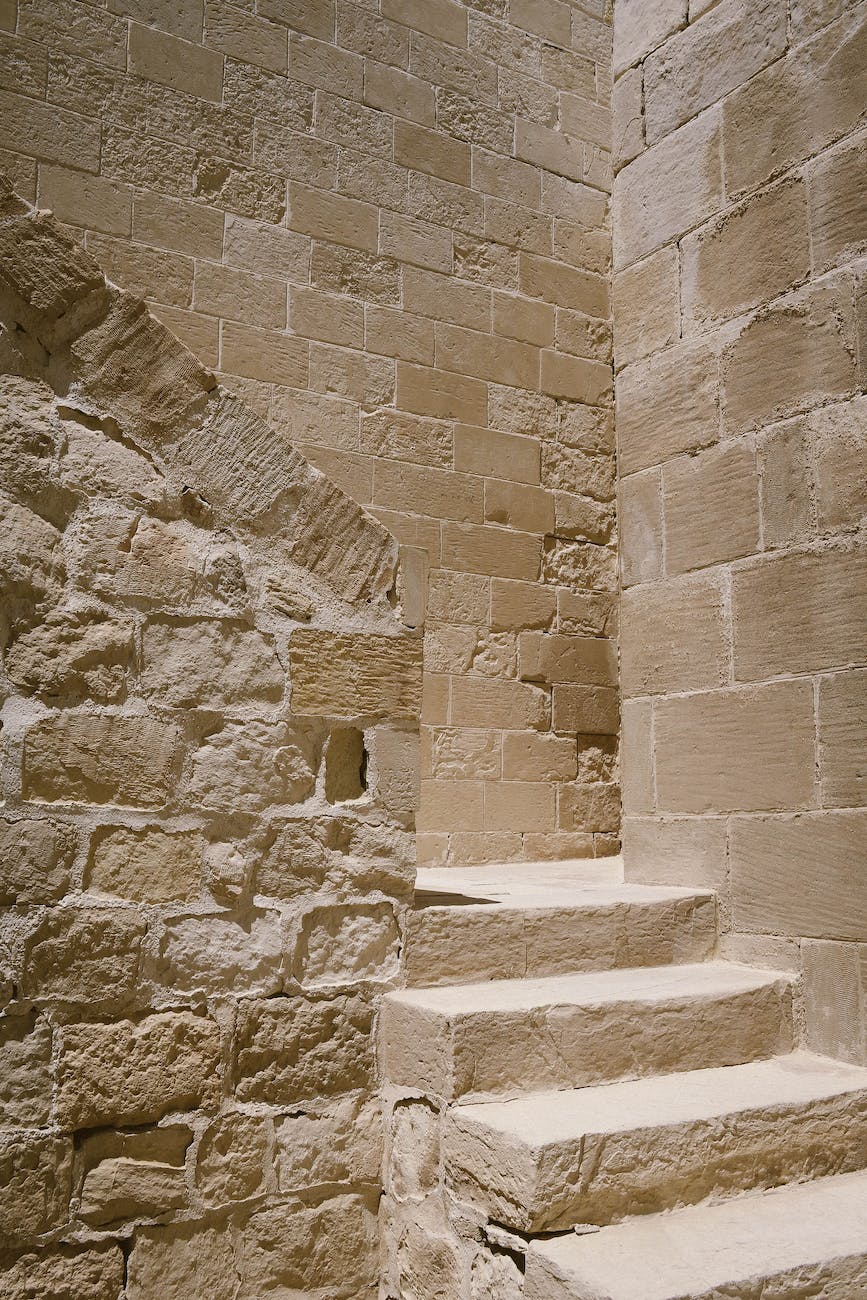
On an early morning jog near the Mount of Olives, I wandered into the Church of the Sepulchre of Saint Mary, also known as the Tomb of the Virgin Mary. As I peeked my head into this window-less space, I saw a darkly robed man with a long, gray beard lighting the incense and candles, preparing the space for the holy tours that would come through that day. The steps wander downward, away from the light of day and towards the soft, flickering light of controlled fire. It was a space of echoes, and for that moment, of quiet dark. A place brimming with spirit. Spirit is not attached to the form of stories we are drawn to-– spirit does not need a hero’s journey to well up within us, it does not even need the light of day or window; it can abide in the deep of a tomb or the dark corner where the light diffuses into shadow. We are not heroes, and the spiritual life does not ask that of us. It asks silence, community, action. It asks attunement to that which is outside, beyond us.
Descending into the tomb of a saint has a distinctly un-European flair to it. In churches across the European continent, they favor “holy ghost holes” that let in light from above. Despite their participation in the Christian symbolic order, these dome windows predate Christianity. The most famous “holy ghost hole” is in the Pantheon, which was built as a Roman temple commissioned by Marcus Agrippa during the reign of Augustus before it was turned into a Catholic church in the 7th century. According to some, these ceiling windows are designed to remind the faithful of the coming of the holy spirit at Pentecost. Those of us who lack that symbolic background do not think of any future comings of spirit; it is a hole in the roof that lets in the shifting light. In place of the steady, standard overhead lights, this window reminds of the earth’s movement around the sun, of the clouds covering and revealing bright rays of light, and the unsteady relationship of illumination and day. It’s not the dove descending through its aperture that comes to mind, instead a reckoning with the shifting ground on which we stand and a voice saying that life is out there, just as it is in here. That hole in the dome, more aptly called the oculus, bridges the two worlds-– illuminating the interior with the songs and swings of day. In the changing light, a holy ghost can be found; of Roman, Christian, or other origins, who is to say?
***
Many universities and sites of study are born from religious spaces or orders. The ancient scribes, the learned monk, and the puritan clergyman built the foundation of what has become education. While this link between classroom and church is rightly severed in many institutions, both the classroom and the clerestory remain sites of meaning making. At their best, classrooms are spaces for communal learning, imagination, and curiosity, where a learned guide leads you through discovery of yourself and the world you inhabit. Here, we must bring in Audre Lorde, the brilliant teacher and poet who, in a talk on teaching, insists that the surrounding world fundamentally impacts what must happen in the classroom. She writes, “the exercise I choose for a rainy day with the same group is different from that which I’d have chosen had the day been bright, or the day after a police slaughter of a Black child, for make no mistake, these emotional climates are absorbed and metabolized by our children with frightening thoroughness— so more than technique, I consider as basic my total perception.”[8] A teacher who looks first to the window for how to begin.
But just like churches, classrooms can hold vestiges of racism, sexism, and a rigid way of understanding intelligence and knowledge transfer. In the case of church and classroom, many have justified reasons for hating to cross the threshold into these spaces. Much like the sanctuary I grew up in, there were lecture halls that lacked windows, and we made do. But there was one particular building in college that was comprised of crumbling bricks, old stairwells, and low, inefficient tables. There were many windowed rooms that looked out onto a single row of tall, old trees casting thin shadows about the class. I would spend my afternoons looking out the window while the class discussed Kafka, and I had many daydreams in these rooms swirling with meaning.
My junior year, they tore these buildings and trees down to expand the quad, and we were moved to a looming, gleaming white academic building called the Wedgewood Academic Center. In this new hall of learning, I took many classes that transformed me: a poetry course, literary theory, and a senior seminar where I met my partner. Formative and glittering things happened here. But if you were lucky enough to be in a classroom with windows, they looked out high over the city into a context-less expanse of sky that hardly allowed the shadows of day to enter our space. This loss of windows may be seen as arbitrary by those who destroyed the old and designed the new, but when you enter a space where the quality of natural light (or lack thereof) has been carefully attended to, the place is shot through with possibility.
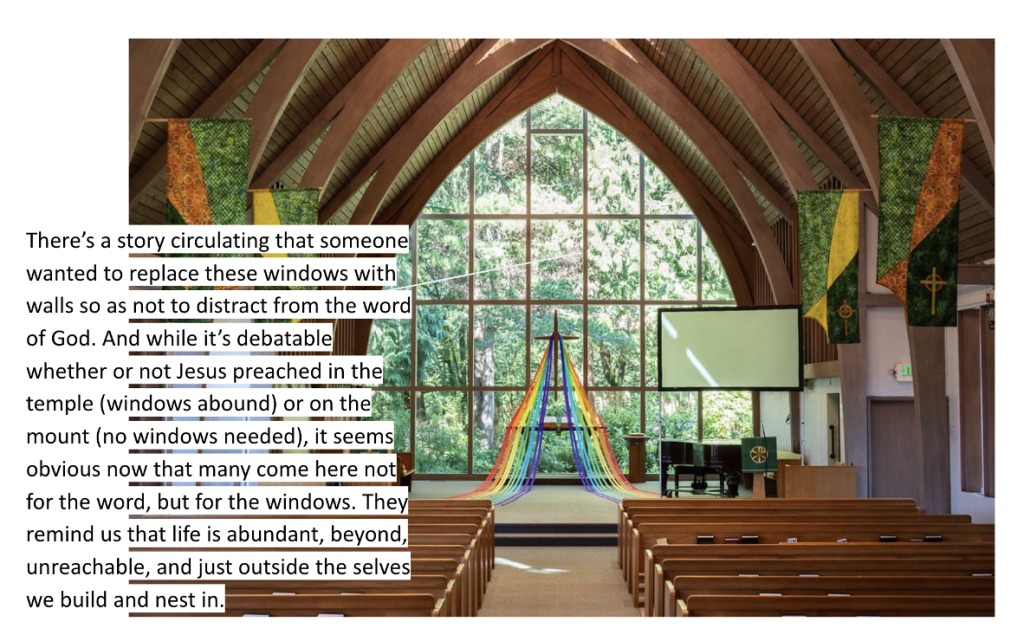
In the spaces we try to make meaning of our lives— church or classroom— an absent window is sorely missed. Windows illuminate. But not in the same way that modern technology illuminates. Jun’ichirō Tanizaki, in his tract In Praise of Shadows, says “so benumbed are we nowadays by electric lights that we have become utterly insensitive to the evils of excessive illumination.”[9] We flood ourselves in bright, cool light, trying to dissolve the mystery by seeing something on all sides. But perception is never whole. Knowledge is never final. Unknowing makes space for spirit. Windows allow for darkness and the tide of light to shift around us, and in so doing they come to our aid in the spaces we inhabit; we must allow them to make way for the preeminence of questions, especially in our rooms of knowledge production. Part of their importance to the halls of religion and learning is escape. When the pastor or professor or student wanders off into boring or triggering territory, the window is a well of absence. You can look out and remember there is a vast world out there that is not concerned with the exact words being preached. You can find your imagination activated by the world that is not attached to your being. You can look to the dark corner and know that spirit and enlightenment are not the same.
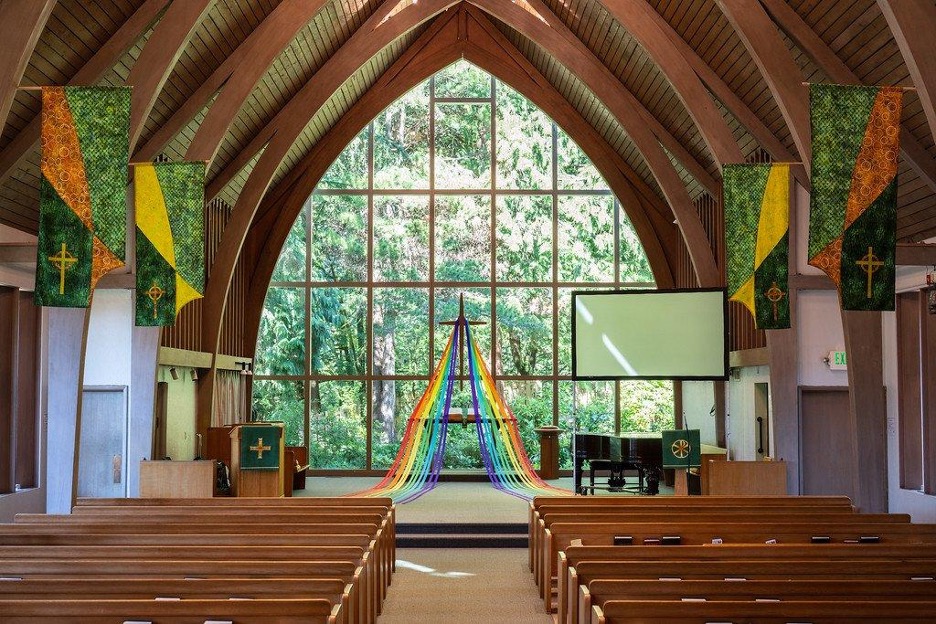
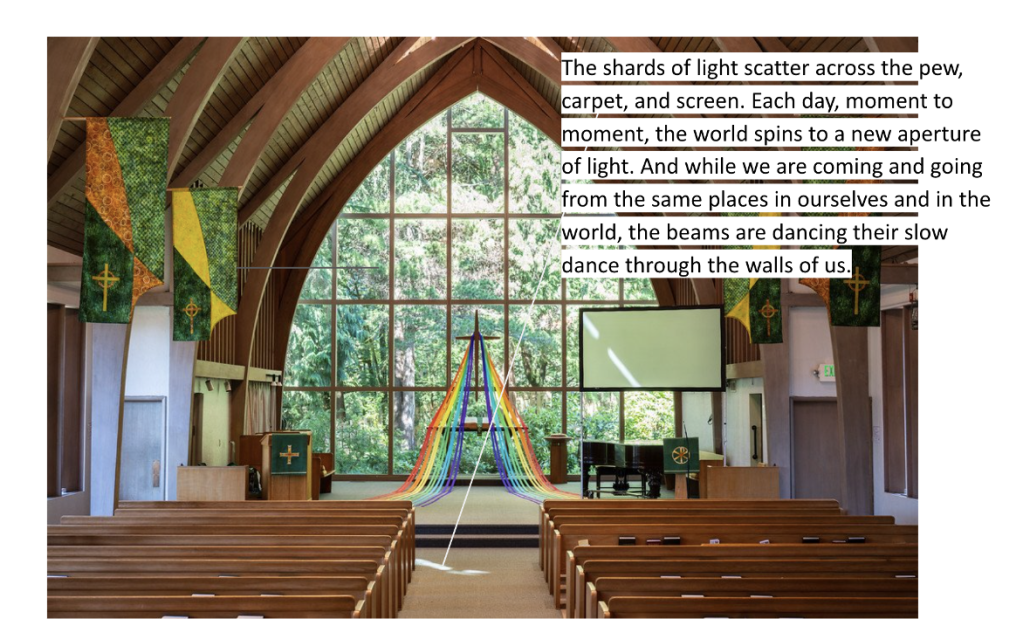
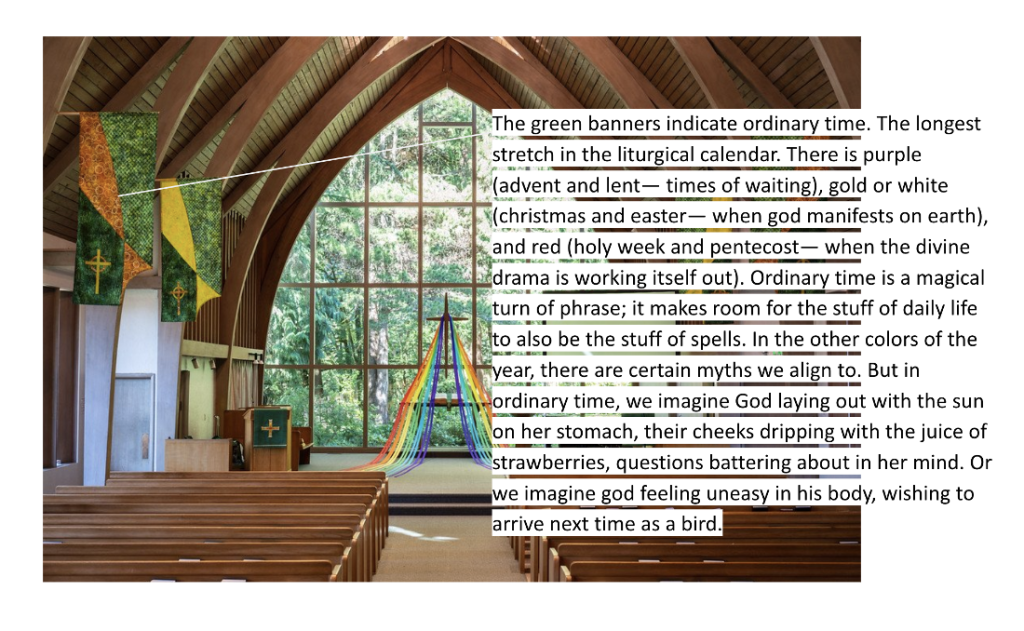
Windows shepherd in light, yes, but the shadows they cast are guides as well. They mean that things are taking shape— that like it or not, the world around us is not projected on a screen of manufactured dimensionality. The world we are in is real, solid, and much of it opaque. The spirit and the body are not distinct, and if we can pay attention, the speechless world is humming and brimming with meanings we can observe, but never fully know. The light comes to shine on my skin as much as the skin of my table, it streams into Fauntleroy Church’s ceiling to floor windows that are facing east, the same direction the earth is spinning. This light is filtered first through tree and hill, softening its landing on the old, massive bible at the back of the apse, and I am in the final pew, where the light is cool and diffused. I look out through the window, asking questions of the trees.
[1] Degnan, David. “Types of Windows for Churches.” Classroom. https://classroom.synonym.com/types-of-windows-for-churches-12081016.html. Accessed 17 July 2023.
[2] “Baroque Architecture.” Britannica. https://www.britannica.com/art/Baroque-architecture. Accessed 18 July 2023.
[3] Corrigan, Kevin and L. Michael Harrington, “Pseudo-Dionysius the Areopagite”, The Stanford Encyclopedia of Philosophy (Summer 2023 Edition), Edward N. Zalta & Uri Nodelman (eds.), URL = <https://plato.stanford.edu/archives/sum2023/entries/pseudo-dionysius-areopagite/>.
[4] St. Dionysius the Areopagite quoted in Fr. Kallistos Ware, The Orthodox Way. St. Vladimir’s Seminary Press, 1986, pgs. 30-31.
[5] Ware, Kallistos.The Orthodox Way. St. Vladimir’s Seminary Press, 1986, pg. 18.
[6] Hirshfield, Jane.Ten Windows: How Great Poems Transform the World. Alfred A. Knopf, 2017, pg 114.
[7] Ibid, pg. 115.
[8] Lord, Audre. “Poet as Teacher— Human as Poet— Teacher as Human.” I Am Your Sister: Collected and Unpublished Writings of Audre Lorde. Oxford University Press, 2008, pg. 182.
[9] Tanizaki, Jun’ichirō. In Praise of Shadows. Translated by Thomas J. Harper and Edward G. Seidensticker, Leete’s Island Books, 1977, pg. 36.
Danielle Isbell writes poetry and essays, most of which circle questions about life in a body and practices of meaning making. She studied theopoetics, religion, and conflict in graduate school. Her home is Seattle, Wa, and she is grateful every day to live in a wondrous, delightful, shifty land.





 Amethyst Review