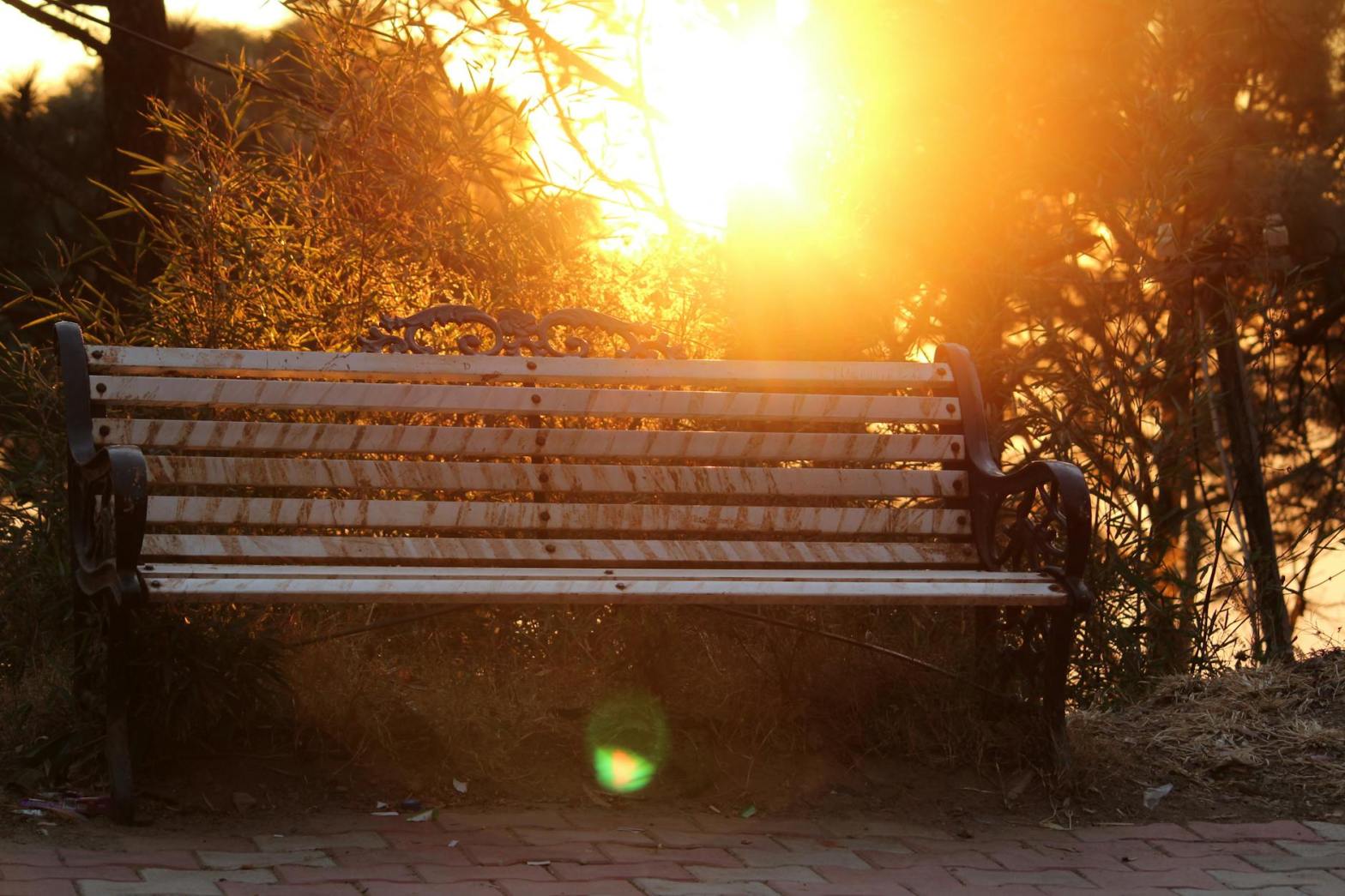
Distant Horizon – a poem by Alka Balain

Distant Horizon
 
Early at dawn, when all is quiet,
the night sky is yet to surrender,
it holds on for a few more minutes
with bated breaths as it
hears the footsteps of the sun.
 
Another hug,
another colour of
meeting and parting —
 
deeper, darker, brighter colour of silence
before the sun breaks open on the earth.
 
There is something that makes me
look forward to the moment.
Possibly a hope
when
it may any moment
culminate into
a final union.
 
But they part again with
a promise to meet at dusk
that they honour,
unlike my merciless beloved.
 
What tapas they agreed to
for the universe to exist
for beauty to unfold
for life to happen
for us.
 
So glad to be a part of it all
and be it all.
 
Glossary:
tapas (in Sanskrit):  deep meditation, asceticism

Alka Balain has been an educator with a short stint in the corporate world. An autoimmune warrior, she resides in Singapore. Alka enjoys going on long walks in nature and loves to paint. Alka’s writings have appeared/are forthcoming in Usawa Literary Review, Kitaab, AlSphere, Dreich Review, Poetry India, The Hooghly Review, Visual Verse, Live Wire, among others. She is one of the shortlisted winners of the Poetry Festival of Singapore Catharsis 2021 and a featured shortlisted writer in the Wordweavers Poetry Contest 2022. She chairs the Writing Enthusiasts’ Club of the Indian Women’s Association and is also the Chapter head, Singapore of the Asian Literary Society. 

Just this – a poem by Sayantani Roy

Just this


Propelled in midlife I take on 
ventures, some of which 
fall apart—mere trifles against 
sobering news big and small, 
like my mother’s failing health,
a cousin’s hardship, a friend’s
broken ankles, and grave news 
such as a boy killing eight 
schoolmates in cold blood that 
I read over breakfast this 
rain-drenched morning, 
gazing at a copse of pine, 
where on a high branch sits
a bald eagle in ascetic patience, 
and lifts its great wingspan
to become the vastness.
 

Sayantani Roy’s writing straddles both India and the U.S., and she calls both places home. Her work appears or is forthcoming in Cold Lake Anthology, Gone Lawn, Heavy Feather Review, Imposter Poetry Journal, Pen to Print, The Hooghly Review, The Seattle Times, and Wordgathering. She dreams of teaching poetry to young children one day. Find her on Instagram @sayan_tani_r. https://www.instagram.com/sayan_tani_r

The Mural – creative nonfiction by Marylou Fusco

The Mural

During my seventh month of pregnancy of my forty-second year I would walk three laps around the park by my house. My big city neighborhood was more like a small town and so I became a familiar sight. I was the pregnant woman in black sweats walking in the late afternoon light. Neighbors would wave and I would wave back. Truthfully, I was only half in my body, barely aware of the chill or leaves crunching around my feet. As I marked each lap done, done, and done the knot in my chest would loosen. Back-to-back miscarriages had shaken me so badly that I created a whole series of rituals to protect this child. Three laps around the park every afternoon was a part of that. Other rituals included: Acupuncturist appointments where I dozed in a chair with needles piercing my forehead and feet. Ditching my vegetarian diet for meals of venison marinated in red wine and fresh garlic in the hope that meat would strengthen my blood. Visiting the national shrine of St. Rita of Cascia, patron saint of Impossible Cases once, sometimes twice a week where my scribbled prayer requests all said the same thing—A healthy child born.  

            Rituals are typically used to mark the holy passage of time or to lead us to a place of greater awareness. Mine were born out of grief and a desire for control. Still, they worked. The acupuncture needles unblocked what was blocked, the venison strengthened my blood, the patron saint of Impossible Cases heard my pleas and my daughter arrived on the feast of the Epiphany. 

            As my daughter grew she developed her own rituals. There were bedtime rituals involving the arrangement of dolls and mealtime rituals involving favorite plates and cups. These days her rituals center around her swim lessons.  She likes the idea of swimming but likes the feel of solid ground beneath her feet more. I watch as she lays her towel just so, adjusts her swim goggles just so. She knows instinctively that to touch and arrange the items connected to the water will impart at least a measure of courage and calm once she is in the water. 

             Still, in the pool she refuses to float, arching and squirming so that her head doesn’t touch the water. Theinstructor is patient and wins her over bit by bit. Each week I watch my daughter relax more and more into the instructor’s arms trusting they would hold her.

            “Kick, kick!”  the instructor shouts and the children all kick, kick, doing their best to stay afloat.

            At the height of the pandemic, my daughter and I would go for a walk to see the mosaic mural a few blocks from our house. Nearly everything was shut down and so a walk outside had become a treat almost as good as ice cream on a hot day. “Let’s look for something on our walk we haven’t seen before,”  I would say to her before we left the house.  Not so easy for me as motherhood has taught me to to take in the bigger picture, to turn my full attention towards potential predators. I’m less attuned to the smaller changes around me. My daughter fills in those blanks although looking from a distance is usually not enough for her. She likes to get up close. She wants to touch.

            Once the contents of a convince store medical kit scattered along the curb.  Antiseptic swabs, wipes, bandages in all sizes and shapes.

            Once a bag full of colorful, crumpled stickers propped up against a tree pit. 

            Once a small dead bird in the middle of the sidewalk. No visible signs of illness or injury.

            While the bandages and bag of stickers disappeared almost overnight, the dead bird remained on the sidewalk for a surprisingly long time. Sometimes my daughter forgot about the bird and I was glad. Other times I would think we had safely passed when she would say, oh! the bird! and we circled back where I did my best to answer her questions about decay and the possibility of resurrection.

            Once a line of ants swarmed over the bird to carry away its flesh. We watched their busy work for a long time and no explanation was necessary. 

            The mural itself was installed before my family moved here. It was meant to celebrate the nearby elementary school as we all as acknowledge a neighborhood grappling with gentrification. It is a riot of colored stones, tiles, and shards of glass that capture and reflect the light. There is a blazing sun, a tire swing, a rainbow. In the center are two hands reaching towards each other as if to say: We have arrived. We are BELOVED COMMUNITY.  Several years have passed since its installation and the mural has fallen on hard times. Many of the stones and tiles have fallen away. The reaching hands are badly chipped. 

            I like the mural’s deterioration. I like how time and the elements have left their mark as if it were a living person. We visited the mural through all four seasons now. Some of those seasons had dramatic moments like when the cherry blossoms drenched the cars and sidewalks around us, and we scooped up the paper-thin petals in hands. Or the time we outran a hailstorm to return home breathless and delighted. We were that strong, that fast.

            Each time we stand before the mural we are different too, if only on some cellular level. I am reminded of those nights when my daughter woke up crying saying her bones hurt. How I sat beside her and rubbed a sweet-smelling, mostly useless lotion onto her shins and forearms. I remembered the mornings when she marched into the kitchen to proclaim, ‘I feel taller’ and I noticed her wrists and ankles poking out of her pyjamas and thought, Of course. How could I have missed it?  She has been growing in the dark.

            After I suffered a rare heart attack at forty-six, my ritual was to sit in the hospital cafeteria overlooking a courtyard twice a week with a container of yogurt waiting for my cardiac rehab session to begin. At cardiac rehab I walked at a moderate to brisk pace on a treadmill with electrodes attached to my chest. Courtyard, yogurt, treadmill. The weeks and months after a heart attacks are strange and filled with silent “what-ifs?”  Peace is elusive. After several months my care team praised my progress and sent me back into the world with few restrictions. I walked, swam, laughed, ran. People were shocked, horrified when I told them what had happened to me. Pretty soon it became a story I stopped telling. 

            The national shrine of Saint Rita of Cascia where I went to offer my prayer requests for my then unborn child is a popular sport for modern pilgrims. People arrive via tour busses and are drawn to the lower shrine where they are greeted by a statue of the saint surrounded by candles and red roses. Her pose is one of welcome although her expression is sad, almost pained as if she is already familiar with our most private griefs. Saint Rita of Cascia’s remains are in Italy, but one of her brown habits is on display in this shrine. We were only allowed to look as I imagined fabric so fragile it would disintegrate under the slightest touch. 

            After writing my prayer request,  I often visited the gift shop looking for an item to mark my visit. I longed for something I could wear against my skin, some scaled-down version of a nun’s habit. After my heart attack my best friend sent me a bracelet of green Aventurine crystals that were believed to hold heart healing properties. I wore that bracelet everywhere, even to bed although the crystals left painful indents on my wrist every morning. The arteries that had torn deep within my chest were invisible to the naked eye, their healing an uncertain process.  The bracelet became a tangible symbol of both my wound and my healing. One day my daughter stretched the elastic of the bracelet so much that it snapped and the crystals scattered across the floor. I sent her to her room and then cried.

            These days we don’t visit the mural anymore. The pandemic has ended leaving our family mostly untouched. We have entered into a different rhythm of school and activities. We pass the mural in passing, and it is something of an accident or what my pastor calls grace that I now recognize it as a sort of shrine—not one attended by statues and roses but one abandoned to time and the elements. Our nightly walks required a necessary sense of wonder and the belief that dragons might appear alongside angels. We wore sturdy shoes and jackets with deep pockets for whatever treasure we collected along the way. My daughter often insisted on bringing dolls so worn from her small child love that I almost felt sorry for them and the witness they were meant to bear. Even the ants swarming over the dead bird were doing holy work although we did not realize it at the time. And the bird lives because the ants do. When we reached the mural, we stood back to consider the mural as a whole then got up close to examine the details we’ve overlooked. The glossy pink flower hiding in one corner. A kite with its tail twisting across the entire length of the mural. We ran our fingers over the chips and gouges, not to mourn what was lost, but to better feel the broken parts that remain.

Marylou Fusco‘s writing has appeared in Carve, Swink, Five on the Fifth, and Mutha magazine. Her short stories have won the Philadelphia City Paper and literary journal, So to Speak fiction contests. Past jobs have included general assignment reporter, GED instructor, and ghost tour guide. She lives with her family in Baltimore where she is finishing a novel about reluctant saints and resurrections. 

The Dishcloth’s Glory – a poem by Valerie Maria Anthony

The Dishcloth's Glory


I admit 
it was only a dishcloth

that had been left, 
scrunched up
on top of a green wheely bin.

Yet the heavy hoar frost
that had come in the night
had decorated it 
with fine shards of ice
that bristled out
into the cold morning light
like a diamond halo.

Or a headdress belonging 
to some lost civilisation,
intended perhaps
for a sacred purpose,
now forgotten. 

There it was
the gorgeous artifact
sparkling wildly
on our unworthy plinth.

My family stood round it, speechless,
but only for a moment,
until uncertainty crept in

and then 
there was a shifting of feet,
a blinking back of beauty
whose gaze they could not meet.

Meteorological facts 
were thrown out
just one or two to break the spell
and allow everyone
to go back into the house
to watch TV
and open Christmas presents.

I stayed however
suffering my joy alone
until the day itself
took 
the dishcloth's glory.

Valerie Maria Anthony is a London and Hampshire-based poet who has published In Oremus Magazine and Amethyst Review. She believes poetry can be an instrument of grace and takes joy seriously enough to look for it everywhere. She has many years of experience facilitating creative writing workshops in social care settings and is a trained visual artist.

Ritual Prayer – a sestina by Marjorie Maddox

Ritual Prayer							

Flannel-heavy midnights where sleep cracks open to grief, the deep now 
of absence curled close, the fog of death and dream a mumbled prayer 
that keeps looping back to hope or, at least, survival: Wisdom, 
Mercy, Kindness, Healing, the cold sheets of sometimes-comfort a mercy 
to embrace—or an urgency, friend, family (sometimes foe) begging the kindness 
we solicit easily from strangers, not those we know, our own need for healing 

forgiveness the necessary first petition. Or in the mid-day gray of the mundane, healing
that joins hands with those unseen saints hovering in the shadows of past and now.
Heavy these petitions we promise for others, our pleas on their behalf a kindness
that covers all our wounded souls. Purifying is the tear-soaked prayer
wept daily for the poor, the afflicted, the sorrowful not-us—a mercy
immersing each intercession in humility, that truest wisdom

confronting who we are without epiphany, the experienced-earned wisdom
of the penitent prodigal. And so, again, Wisdom, Mercy, Kindness, Healing
leaks through cracked lips or, exhaled from restricted lungs, blooms to mercy,
the letters of me/you/us/them merging into, if not understanding, the now
of examination that eventually breathes the deeper dispensation of grace. Prayer
pulls closer to God both the petitioner and the stricken, such Divine kindness

measured out daily in small syllables and seeds of belief. “Pay forward kindness,”
scriptures and billboards recommend. But more so, the kindest yet—this wildflower wisdom
that daily digs and sows, but also scatters, prayer begetting prayer
begetting action—is ritual that rinses even the grittiest intentions from the unhealed
on the path to healing. Which always brings us back to now
and each minute’s need and choice for empathy and mercy. 

What, then, will we answer, deep in the night, when the Merciful
calls out for us? “Here, am I”? Wisdom, Mercy, Kindness
Healing. Or better, “Speak, Lord, your servant listens now,”
an obedient if not immediate faith, even as, half-awake to wisdom,
we murmur words that put in motion healing.
O Great I AM, accept our inarticulate prayers—

mid-day or midnight—you the first and living Prayer
for us, penitents and portals of your mercy
when we bow to Word and words. Heal us.
Bestow again your unearned kindness
of grace. Re-shape these abbreviated intercessions, Wisdom
of All Ages, into shining orisons for others. And now,

may we repeat and renew the well-worn prayer
that brings us near to you: Wisdom, Mercy, 
Kindness, Healing, Forever and now.
					Amen.

English and creative writing professor at Lock Haven University, Marjorie Maddox has published 14 collections of poetry—most recently Begin with a Question (Paraclete, International Book + Illumination Book Award winner and CMA Award, 3rd) and the ekphrastic collections Heart Speaks, Is Spoken For (with Karen Elias) and In the Museum of Her Daughter’s Minda collaboration with her artist daughter (www.hafer.work). She has poems included in the anthology Christian Poetry in America since 1940 . In addition, she has published the story collection What She Was Saying (Fomite) and 4 children’s and YA books. She has poems included in the anthology Christian Poetry in America since 1940 (Paraclete Press), edited by Michael Mattix and Sally Thomas, and in Taking Root in the Heart, edited by Jill Baumgaertner. Please see www.marjoriemaddox.com 

Hermit Lessons – a poem by Laura Sheahen

Hermit Lessons
 
around your throat at all times
a muffler
the phone must be always broken
or full of static
your would-be friends
all their hearing aid batteries dead
 
you must have one book
that repeats itself
and a garden with only tubers
 
in the night in the day overhead
silence spills slowly like oil
black on oil
 
the pool shines
can even catch fire
but no one can drink it
 
strong winnowing hands
separate atoms from air
and no sound can travel
 
your vocal cords heal up like wounds
become smooth
your two lips knit together
no line
 
in the depths of the pool
the blind eyes of a fish
cannot see
that its body shines blue


Laura Sheahen has published poems in Four Way Review, Posse Review, and other journals in the US and UK. Her poetry book The Genie Smiles was printed in India. She lives in Tunisia.

Gods, Humans and Beasts – a poem by Anthony DiMatteo

Gods, Humans and Beasts   

On a gray day, reaching down to lift 
a classic from the lowest shelf, I found  
my rabbit had chewed yet another book,   
The Bacchae, with a jail-housed Elvis   
on the cover, my Euripides ripped.  
At first mad, I surmised an omen - 
 
How the young let weeds grow wild 
and the old regret how often they mowed.     
But no matter the generations, we’re 
little creeks that flow down the mountains 
though we think ourselves the dazzle of stars 
flung across otherwise meaningless skies. 
 
No matter the age or time of our kind,  
we thump upon the ground, on four  
or two or three, crawl, dance, and limp,  
too proud and more than a little sad,  
sex toys of the gods we construe and blame 
for being who we are and what we do.   
 
The rabbit sits in her cage nibbling the grass 
I’ve brought to her, fresh and green 
the way she’s trained me though any book  
would serve her turn. She might as well  
be my god the way a Cherokee myth   
has a rabbit at the center of the world.

Anthony DiMatteo’s third poetry collection Secret Offices is just out. Why secret? One can’t take credit for an office dedicated to the pursuit of beauty and fairness as a poet must be. No one knows what one is doing in such a search, a prerequisite for it. Recent poems have appeared in The Connecticut River Review, Cimarron Review, The MacGuffin, North Dakota Quarterly and The Galway Review. A full professor of English, he has defended the mysteries of literature and art at the New York Institute of Technology for over 30 years. He lives on the Outer Banks with his wife Kathleen O’Sullivan, pianist, designer and fellow empty nester. Please feel free to leave a trace at his e-tent: https://anthonydimatteo.wordpress.com   

Amen – a poem by Rupert M Loydell

Amen
 
He is his own patron saint,
martyr to the cause, victim
of well-meaning ignorance.
His halo is a dinner plate,
his piety affectation.
 
He is his own saviour,
interlocutor between life
and death, will do anything
to avoid humiliation,
even crucify himself.
 
He is his own prayer
but does not know
how to talk to absence
or persuade the world
to find its own salvation.
 
He is his own proclamation
about what is to come;
his own declamation,
his own exclamation mark,
own unfulfilled prophecy.
 
He is his own creation,
trying hard to become
who he has decided to be,
yet often seeing himself
walking the other way.
 
He is his own undoing,
will betray and desert
all he knows and loves,
will lay down and die
just like everybody else.
 
He is his own resurrection,
stepping in footsteps
left in the desert,
endlessly circling,
out of his thirsty mind.
 

Rupert M Loydell is a writer, editor and abstract artist. His many books of poetry include Dear Mary (Shearsman, 2017) and The Return of the Man Who Has Everything (Shearsman 2015); and he has edited anthologies such as Yesterday’s Music Today (co-edited with Mike Ferguson, Knives Forks and Spoons Press 2014), and Troubles Swapped for Something Fresh: manifestos and unmanifestos (Salt, 2010)

Evening Prayer – a poem by Gail White

Evening Prayer


Not wanting it said that only desperation
drives me to prayer, I’m trying giving thanks
this time. Thanks for the whole creation,
especially my patch on Bayou Teche.
Thanks that the bayou overflows its banks
in heavy rain, bringing the herons in.
Thanks for the sunset flinging golden mesh
on the stone streets of an Italian town
seen long ago. Thanks that I’ve reached old age
with not so many burdens of the flesh
as I expected. Thanks that I’m at the stage
of contemplating death with open eyes
and without bitterness or dread or rage.
Thanks for my readiness to meet surprise.

Gail White is a contributing editor of Light Poetry Magazine and a frequent contributor to formalist poetry journals and anthologies. She is a 2-time winner of the Howard Nemerov Sonnet Prize. Her most recent books, Asperity Street and Catechism, may be found on Amazon. She lives in Breaux Bridge, Louisiana with her husband and cats.

Exaltation – a poem by Faith Allington

Exaltation


On the other side
of the glass separating me 
from wind and wilderness,
I see the quick black arc
of a crow’s descent.

I’m half-convinced
they only do this 
for the rapture of wings.

The next time we travel
the mournful grey sidewalk,
no matter how busy
we must all stop to bear witness–

see the delicate tips of a tree
reaching for the sun,
how the crows alight on them, 
this new growth
just strong enough 
to bear the weight.

Faith Allington is a writer, gardener and lover of mystery parties who resides in Seattle. Her work is forthcoming or has previously appeared in various literary journals, including Bowery Gothic, FERAL, Cosmic Daffodil, Gold Man Review and Crab Creek Review.