sutras – poetry by luke kurtis

西教寺
sutras


when i stayed
in Tokyo
i took walks
every day
—wandering—
with my camera

one day
i found myself
—alone—
at a hushed temple
tucked behind a wall
in a quiet neighborhood

i admired the architecture
from the outside
which is all one can do
at most temples in Japan

but then i saw a genkan
off to one side
with a shoehorn
and getabako
—signs of welcome—
but still
ambiguous
or even uninviting
to western eyes
with nothing posted to say
either “come inside”
or “no guests please”

the cubbies were empty
so no visitors were there
but i assumed
it was ok to
remove my shoes
place them neatly
and enter

and so i did
thankful my socks were new
and had no holes
as i put my shoes away
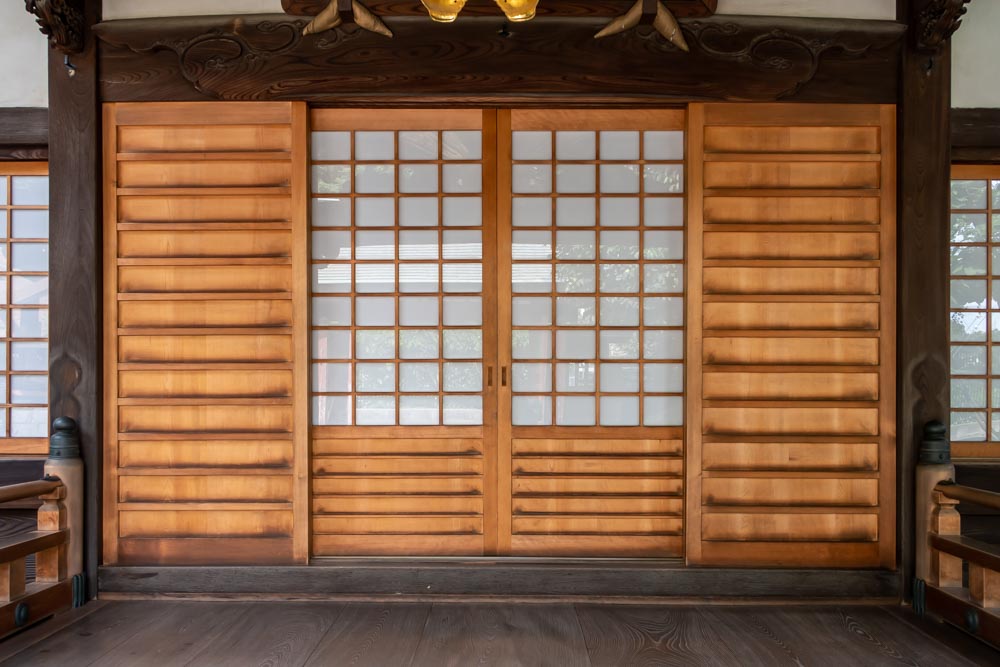
then pushed the shoji screen
just far enough
to step through

the wooden floor
was soft and smooth
and felt soothing
to my feet

i shuffled
farther along
quietly down a hall
lined by blond wood
and delicate screens
calm light dancing
like petals in a breeze

i emerged into a garden
with stone lanterns
and green moss
under shade of leaves
and pine

i heard someone coming
when a monk passed behind me
and turned my way

i nodded
he bowed

i crossed a bridge
to the other side
of the small garden
and found myself
in the main hall
tatami underneath
like soft grass in spring
glorious screens with birds
panels with gold leaf

i felt at peace
—yet—
still unsure
if i was supposed to be here

but i took a seat
joined my hands
and gazed
toward Buddha

his face was
serene
—without shadow—
eyes hovering
between worlds
a calm expression
of accord
light and life
—immeasurable—

i said a prayer
for my family
who i had been apart
from for so long
while living in the east

then i noticed a stack
of booklets
printed only
in Japanese

the cover was red
and opened
to the right
—folded—
like an accordion

i knew it was
a sacred text
—a sutra—
from the Chinese
with hiragana
which i could read
and chant
so i put it
in my bag
a bit of Buddha
to go

but later
back home
when i pulled it out
and used my phone
to translate
the words i didn’t know

i found it said
“do not remove”
right across the front

what could i do
with stolen sutras?

i did not mean
to steal
 
i thought it was
free to take
like the pamphlets
and tracts
in so many
churches and temples
in other countries

but in Japan
things are different
and my Japanese
is not good enough
to always know the way

to this day
i wonder
if i was supposed
to be in that hall
at all

or had i
wandered
—strayed—
from the path

and maybe the monk
who saw me
just didn’t know
how to say

“do not enter”

but perhaps
his bow was a welcome

and i found myself
where i was
—am—
supposed to be


luke kurtis is an interdisciplinary writer, editor, and artist. His books include Angkor Wat: poetry and photography and Springtime in Byzantium. bd-studios.com is his long-term art and publishing-as-practice project where he helms all aspects of the studio while collaborating with a range of artists and writers to realize their projects. He lives and works in New York City.

Morning Meditations – a poem by Moná Ó Loideáin Rochelle

Morning Meditations


Mid-winter monarchs
whispering wings, half-shadowed,
bless hourless whiteness.

A white robed monk chants.
A frog croaks. A crow caw caws
in winter’s warm rain.

The pond’s iced over.
Muskrats feed beneath my blades.
We share bitter fruit.

Today’s clouds a caul,
and wombs an infant cradled 
in blue hues and gold.

A mockingbird’s poem
flutes syllables of love from
night’s tallest oak tree.

A palm warbler psalms.
Heat lightening crowns the night.
Terror strikes her dreams.

Dawns pond’s ashen. A
limping Limpkin screams repent
repent all is woe.

A billion locust
swarm.  Children starve. Cruise cancelled.
Refund? One million.

They get their millions back.
Cruise cancelled. Children…billions
starve. Locust swarming.

Moná Ó Loideáin Rochelle’s poetry can be found or is forthcoming in The Southern Review, Spiritus, Notre Dame Review, Southword, and Wales Haiku Journal. She volunteers for Médecins Sans Frontières. Visit: https://www.linkedin.com/in/monatheresalydon/

Ways of Becoming a Flower – a poem by Devika Mathur

Ways of Becoming a Flower - 

Watch a tulip,
The buds that shine
Of fever, pink neck
A wobbly way of uttering words,
Watch the body-
A lacuna resting on the tip
The vein is a transparent home of hope.
Watch the petals,
Smaller earlier now growing.
Growing out of something unsuitable,
sit and observe,
The wind choking its existence
The wind caressing its existence
Sit and observe
The pink that glimmers
Between our small hands,
It fits.
Between our prayers, it delivers hope.
Sit and observe
The nocturnal sniff of boredom,
Of resting in a same place
The flower speaks of rising
Like the mud’s only wail.


Devika Mathur resides in India and is a published poet, content writer, Editor. Her works have been published or are upcoming in Madras Courier, Modern Literature, Two Drops Of Ink, Dying Dahlia Review, Pif Magazine, Spillwords, Duane’s Poetree, Piker Press, Mojave heart review, Whisper and the Roar amongst various others. Her works have been included in the US-based Indie Blu(e) Publications- The Kali Project, As the World Burns to name a few. She writes at https://myvaliantsoulsblog.wordpress.com/. She recently published her surreal poetry book Crimson Skins available now worldwide. insta- @my.valiant.soul

Distance – a poem by John Valentine

Distance 

Let us love this distance, since those 
who do not love each other are
not separated.
- Simone Weil
 

You seem to see her eyes
everywhere
in the vast afterimage of desire.
You carry her voice the way
a conch carries the sea,
no matter the shore
or the miles.
The same sweet rustling far away
in the wind.
The same soft hands that miss exactly
and only
what they miss.
And even Death is like a friend
who understands absence,
the beauty of despair,
the one pure poem you’re destined to write
to try to hold her
in the palm of the clouds
while the sky sweeps everything away.

John Valentine lives in Savannah, GA, where he teaches philosophy at a local college.

Spark – a poem by Terry Tierney

Spark


In Bleak House, by Charles Dickens, a character’s death is attributed to spontaneous combustion.


You say he deserved it,
rag collector, slumlord 
mining misery from broken tenants, 
any coin for a flask of gin,
his bloated body like an artillery shell
with fumes straining its rusted case.

Until the spark ignites and wicks
inside his windpipe, chases 
saturated blood through arteries,
devouring his flesh in seconds.
Cloud of oily smoke hangs over 
his bed, ash on last night’s dinner,
scraps of bread not even a dog will eat.

No sign of match strike or boot scuff,
no storm clouds releasing their charges 
across the sky of his room. The spark 
arose inside him, as if he balanced 
his internal ledger, always a gap, 
flint spleen scratching rib, or vertebrae 
gnashing against forgiveness, 
then the flash like a wink of usury.

You say his bedding survived,
his legs still planted in leather soles,
his hands extended toward the table,
the loose bundle of bills, glass of spirit, 
as if he thirsted for one last swallow,
one more squeeze for his still heart
now melted into the charred trunk
of his body, compressed like coal.

Easy to fault the gin, the fermented soul,
but what if you misread his gesture, 
what if he reached for his papers
to rend their threads like a widow’s clothes,
a surprise cancellation, an epiphany.

Terry Tierney is the author of The Poet’s Garage and the novels Lucky Ride (December 2021) and The Bridge on Beer River(July 2023), all published by Unsolicited Press. His poems have recently appeared in Rust + Moth, Typishly, Valparaiso Poetry Review, The Lake and other publications. His website is http://terrytierney.com.

Floral Collar from Tutankhamun’s Embalming Cache – a poem by Grace Massey

Floral Collar from Tutankhamun's Embalming Cache  

cornflowers, poppies, three thousand years 
of dust, beads indigo among olive leaves 
already withered even as the tomb was sealed

and you who wove and sewed into the night
we have met, you know, among the licorice-scented
olive trees, in the poppy fields, wading among the reeds
as fish prod our ankles, we have together 
pricked our thumbs stitching nightshade berries 
to the boy king’s collar, our blood staining the blossoms 

we have exchanged lovers' glances, flirted
from across rooms and millennia, kissed
secretly and so briefly in alleyways and gardens

I have touched your hair

I reach for your calloused hands, cradle them in my own,
know that you endure in the flowers, the beads, 
the brittle papyrus

Grace Massey‘s poetry combines careful observation with elements of the spiritual and mystical. She has been published in Vita Brevis, Soul-Lit, Spry, and Ekphrastic Review, among others. When she isn’t writing, she’s dancing, in her garden, or working with shelter cats.

Listening to Elgar’s Enigma Variations While Thinking about My Son’s Soul – a poem by Valerie Bacharach

Listening to Elgar’s Enigma Variations While Thinking about My Son’s Soul


Perhaps the soul is a rogue cell 
from an unknown
god
slipping its wonders among the body’s atoms, weaving,
knitting organs and muscle. An amorphous something
residing in the heart’s chambers, sparking
neurons in the brain.

Cellos underlie violins, notes rise 
like a charm of goldfinches.
Some think the soul takes flight when it leaves
the body. 
A photo of my son on his snowboard, one arm raised,
body airborne in blue sky.

Woodwinds join, an upswelling
until grace notes fade.

I want to believe in my son’s soul.
All rough woes soothed.

I think of words from psalms

lie down		        bless		        his life
	
        gather breath		        console

Valerie Bacharach’s writing has appeared or will appear in: Vox Viola, Vox Populi, Whale Road Review, The Blue Mountain Review, EcoTheo Review, and Kosmos Quarterly.  Her chapbook, Fireweed, was published in August 2018 by Main Street Rag. Her chapbook Ghost-Mother was published by Finishing Line Press in July 2021. 

The Night It Culminates – Creative Nonfiction by Nathaniel Lee Hansen

The Night It Culminates: July 7, 2015

It began as a way to cope with a broken engagement in December 1997.

*

My single dorm room stifles me, so I drive to the Super America, buy a 20-ounce Mountain Dew, bag of Lay’s Sour Cream and Onion chips, and Little Debbie Cosmic Brownies. I drive around this college town, drive out in the country, alternating between sad songs and songs by Christian music artists I like. I sing. I sob. I stuff my face.

*

An April 2015 evening, the kids in bed, I’m waiting for my wife to return from work. I am (for the thousandth time) searching online for different weight-loss tricks and tips. By some fluke (or maybe not) I am scanning the 20 possible symptoms of food addiction. Check. Check. Check. All but three apply. You’re advised to talk to your doctor if you’ve experienced even one.

Even one? I think. What if you’ve experienced almost all of them? 

*

The first 8 weeks of my summer break I tabulate my food intake, most days managing between 1,800-2,000 calories. I exercise at least four days a week. On Saturday afternoons I pull on all my dress pants, and they still fit exactly the same.

*

My son, who is 5 and who can read, has been reading nutrition labels. He comments on the grams of sugar, the grams of fiber, the protein, the carbohydrates, the fat, and (God help him) the calories. For him it is about the ability to read and learn more. My family knows I try to minimize my sugar intake. I went through this year’s Lent without having anything sweet, without having any dessert. Not even my 90% cocoa. Later, after I seek help, I will look at my son’s behavior as a warning sign.

*

Whenever I glance in my mirror, my shirt off, I am repulsed. Disgusted. Hate festers. Cellulose gathers above the waistband. I grab the flesh, wish I could rip it off with my hands. I wonder if I could somehow slice it off. These last months, those thoughts have become more common. I wonder how overweight one has to be for bariatric surgery, how much it costs. A former student had undergone the procedure, wrote a personal narrative about the process. That could work for meright? I think.

*

Whenever I’m eating, I’m thinking about food (the calories, the fat, the sugar). Whenever I’m not eating, I’m thinking about the food I will be (or should be, or won’t be) eating next (the calories, the fat, the sugar). Sleep is the sole stretch of time my thought patterns don’t cycle around food. Sleep is becoming my only escape. I look forward to it more and more. There’s a seven-to-eight hour window where I’m free.

*

Over these last months, I’ve been regularly imagining what it’d be like to see my ribs again, just as I did in junior high when I was so skinny. My nickname was beanpole. Oh, what I would give, what I would pay, what I would do for that to happen.

*

I am not supposed to have this problem. I’m 40 pounds lighter than at my food-binging worst in 2001. I’m a Christian, supposedly not consumed by the things of this world. I’m “educated.” I should know better.

*

I like being in the water. As a child, I loved going to the local swimming pool, going to a lake, especially the one at my grandparents’ cabin in Northern Minnesota. Now I live in Texas. 

This July evening, while my wife is working, I take my two kids, 5 and 2, to the municipal waterpark. Our towels on plastic chairs, sandals askew on sweltering concrete, they charge into the shallow pool, shrieking. Even though I know no one is studying me, I am dreading my final preparation. I wince as I remove my T-shirt, thinking everyone is disgusted by how fat I am. I know that, more than likely, no one is looking at me, but logic cannot always defeat folly. There are so many other things I’d endure rather than take off my shirt: eat a plate of steamed broccoli, attend a Nickelback concert, visit an NRA convention, work for a Texas roofing company.

*

More and more often I am often thinking of my skinny friends: Adam, Austin, Tim. I think of musicians I admire, men tall and sinewy. I am so jealous. I want skinny more than I want anything else. Even more than having a book published. I’m a writer. Short of my giving up my wife or kids, there’s nothing I wouldn’t give to button a pair of size 32 jeans and need a belt.

*

In junior high and high school, basketball is what I live for—I talk about it whenever I can. I play it whenever I can. I watch NBA and college games with my mom and dad. I skip lunch most days, instead taking the dollar lunch money and buying snacks at mid-morning break, so I can play basketball in the gym during lunch time.

My stomach rumbles through afternoon classes, through basketball practice, through track practice. I get hunger pangs that hunch me over in my desk. The pain is the most intense and uncomfortable I’ve ever felt.

*

Maybe this problem precedes college.

*

My kids asleep after their joyful playing at the waterpark, I sit in the recliner. In that span before my wife returns from work, I am wandering, aimless. I look at information about food addiction and eating disorder symptoms, and it is so glaringly obvious.

I turn to social media for connection, and a friend’s post on Facebook reads, “There seems to be a lot of pain and loneliness in the air tonight. I love you.”

I want to cry. It is the nudge. I begin writing.

*

When my wife returns from work, I’m sitting in the darkened living room still writing. I have not bothered to switch on a light.

After pleasantries, I grab my Bible, return to the recliner. It’s time for our evening devotions. I read the account of the Ethiopian eunuch, his conversation with Philip. 

My wife prays for me, for my summer class to go well, prays for our son, and then it is my turn to pray for her, and to pray for our daughter. And the tears start. My conscience (or the Holy Spirit, or two labels for the same thing?) is saying, just express your emotions; don’t hold all this in anymore; you don’t have bear this burden alone anymore; admit that you can’t handle it on your own; you’re becoming out of control.

She prays for people in our small group, leaving the other half of the group for me to pray for. And the tears are more regular, but I keep somewhat intact. I have to swallow hard a few times to keep going. 

I sign off with our usual, “And I pray that you would watch over us this night, and that our sleep would be restful. In Jesus’ name. Amen.”

Before we had started praying I took some ibuprofen, telling her I have a headache (which I do), but I know that it’s also a result of the dam about ready to burst. I’m ready to admit defeat. To hoist the white flag. 

She asks, “Are your eyes watering or are you crying?”

I throw this burden into the day’s last light that is a line running from the entry way window across the hardwood floor to me.

“Crying,” I say. And then without turning to her, I tell her about how I’ve spent the last hour in the darkened living room, writing about my unhealthy relationship with food, about how I have 17 of the 20 symptoms of food addiction. My face is a mess of tears and snot. I tell her I want to eat like a regular person, without thinking. Just enjoying. Not obsessing. Not spending my day thinking about what I just ate, what I’m eating next. Not adding up numbers. I’m so tired of numbers.

That I have a problem. That I need help. 

I tell her I wanted to convince myself that I don’t have a problem, an eating disorder, but when I read her the symptoms I have (or have had), being the counselor she is, she says, yesyou have a problem.

And because one of my weaknesses is sweet things, and because she makes baked goods for friends, for us, I tell her that sometimes I feel as though I’m an alcoholic trapped in a liquor store. After all, I have on occasion, eaten so much leftover frosting and so many cake scraps that I have eaten the equivalent of half a cake. On occasion, I have dug old cake and frosting out of the trash can.

And in this, she just holds me as I sit in the recliner. She is crying, now, too, but she is listening, listening as she always has. 

I tell her that I realize that my problems with food go back, way further than a broken relationship two decades earlier.

I tell her it feels so wrong to have this problem when so many people in the world lack sufficient food. There is the ongoing civil war in Syria. There is police violence. One in 6 Americans are in poverty. 90 percent of the world lives on less than $1 a day.

She hugs me. Yes, she says, you need help, but it’s going to be okay.

When the crying has subsided, and as has my headache, I feel spent, exhausted. 

She tells me that she had been planning to have sex. I don’t have a desire for that. I just want to hold her. To be held. The thought of being naked with her, after all, rarely fills me with gleeful abandon. Rather, I see my obese body on our bed, and I am disgusted. If I were a woman, I would be repulsed by my body, say, Pull up the sheet! or For God’s sake, you really need to work out more.

*

Yes, this problem has a history.

#

Nathaniel Lee Hansen is the author of the short-story collection Measuring Time & Other Stories (Wiseblood Books, 2019) and the poetry collection Your Twenty-First Century Prayer Life (Cascade Books, 2018). His website is plainswriter.com. He is on Twitter @plainswriter.

Cemetery Park – a poem by Will Griffith

Cemetery Park
 
Row upon row of recovered slabs
ease back onto iron railings,
clustering in renovated space.
 
Sixty-nine, forty-nine, nine,
here and there, a full house.
 
Half-covered verses slant into earth,
trite end-rhymes thrown up
like Titanic’s terminal gasp.
 
Causes of death flatly declaimed
like news of a passing train:
drowned, killed, passed, taken,
stand well back from the platform edge.
 
Where headstones once affixed their plots,
sandwich crumbs pepper consecrated land
in strange, eucharistic slow-motion.
 
A giant sundial is the crowning glory,
a noble, great, uplifting thing, towering arm raised
above granite quoins to bisect the hours.
 
Tired kids shuffle on their way to shops,
scuffing an inscription which sticks in the throat:
remember those who are buried here.
 
And so we strain in abstract prayer
for solemn applause of our own devising,
while mourners have long quit the stage.
 
All the while, we forget small pieces of ourselves 
sunk in airless pits,
pieces of time, pieces of love 
laying low,
just for a while,
until the great call comes.

Will Griffith is a theology graduate and former chorister who now teaches philosophy in a secondary school. He has had poems published online and in print, and has work forthcoming in Reach Poetry (Indigo Dreams), and The Chamber Magazine.

How Sisters Speak in January – a poem by Sarah Mackey Kirby

How Sisters Speak in January
 
On nights so thick with winter
the deer tracks fade in seconds
and truck tires settle, trapped,
nestled deep in snow,
I hear you move through trees.
 
Your laugh reviving happiness
in forest yellow pine. Your sadness,
bare-branch dogwood, spring-pink
blossoms you forgot would come.
Oh, if only you’d have waited…
 
You sing sugar maple songs to me
and beat the oaks, drumming
falling twigs to ice. And dance 
with finger-snap-sound umph
to blue spruce needle turns.
 
That lovely musicality. You call me on those
cold-air nights between weeping willow
spaces. Sweet compassion perfect pitch.
Your timbre, leafy smooth magnolia,
as our harmony becomes the wind.
 
You left me here without a word, but I’m
still here to listen. To gather up your stories
and seek forgiveness for us both. With tulip
poplar sways in January chill’s expanse, while
sun pushes through Kentucky’s lonesome ache.

Sarah Mackey Kirby grew up in Louisville Kentucky. She is the author of the poetry collection, The Taste of Your Music (Impspired, 2021) Her work has been published in Impspired Magazine, Muddy River Poetry Review, Ploughshares,  Third Wednesday Magazine, and elsewhere. Sarah loves to cook and feel summer dirt on her hands. She and her husband split their time between Kentucky and Ohio. https://smkirby.com/