
If we could only imagine a better arc of flight – a poem by Alfred Fournier

If we could only imagine a better arc of flight


we might spring from the bough     ascend 
with the instinct of light      without goal 
or weight of loss on our wings      
cut      with the diamond-blue edge
of fresh hope      through cool air 
to the thinness      at apogee’s breath      
where we bow      then descend
riding gravity’s flow 
like a boat bent from spirit     
muscle and bone


The title comes from “One in the Hand,” by Jorie Graham.

Alfred Fournier is an entomologist, writer and community volunteer living in Phoenix, Arizona. His nonfiction and poetry have appeared in Amethyst Review, Delmarva Review, American Journal of Poetry, Lunch Ticket, Gyroscope Review, The Indianapolis Review and elsewhere. New work is forthcoming at Blue Unicorn and Drunk Monkeys. His Twitter handle is @AlfredFournier4.
The Feast of Booths – a poem by Gershon Ben-Avraham

The Feast of Booths

A willow which has dried up, or most of its leaves have fallen off…is not valid.
	—Kitzur Shulchan Aruch (136.6)


Lost in a worry of wilted willows,
he sat, perched on the edge of a park bench,
leaning forward, hands crossed, lying lightly
upon the curved polished head of his cane.

At Morning Prayer, he'd waved them gently.
Their leaves fell and like little dying fish,
expiring mottled minnows washed ashore, 
lay scattered on the synagogue's floor. 

He turned his closed eyes to the sun. Its light
shone brightly through his drooping, shuttered lids—
two sheets of yellowed maps, with red borders,
and dark blue, silent, slow-moving, rivers.

He saw the pale thin hands of his teacher,
heard the clay-cold lips of the man long dead:
"Do not become like a willow, without 
taste or smell, a willow which has dried up."

The damp autumn wind smelled of coming rain;
the earthy scent of soil enveloped him.
Pushing against his cane he rose. Buried—
lost in a worry of wilted willows.

Gershon Ben-Avraham’s writing has appeared in journals and magazines, including Amethyst Review, Big Muddy, Gravel, Image, Jewish Literary Journal, Poetica, Psaltery & Lyre, Rappahannock Review, and Tipton Poetry Journal. His short story, “Yoineh Bodek,” (Image) earned “Special Mention” in the Pushcart Prize XLlV: Best of the Small Presses 2020 Edition.

More – a poem by Shane Schick

More


We can ask, we can imagine,
and we can even make friends
with what’s finite the way we wait 
for the wafer to waste away
on the warmth of our tongues.

Yes, we can ask; to constellate
the stars into fresh formations 
so that we could look up nightly
and leave horoscopes behind
for a glimpse beyond astrology.

Yes, we can imagine: to forgive
the sun for shining a rectangle
through the window, a brick 
worthy of an eternal kingdom 
but just one, without mortar.

We can even imagine more
we might ask; not to request
but to interview. And perhaps
the power working in us is
the answer we know is coming. 

Shane Schick is the founder of a publication about customer experience design called 360 Magazine. His poetry has recently appeared in EkstasisMacrina Magazine and other publications. He lives in Whitby, Ont. with his wife, an Anglican priest and their three children. More: ShaneSchick.com/Poetry. Twitter: @ShaneSchick.  

Private obsession – a poem by Melaney Poli

Private obsession

for Michael


Nobody ever asks why I write. They seem to know,
or at least assume. But art leaves me full of excuses.
Is truth the best ruse? I wonder if I should disclose

what goes on—or keep the trade secrets stumm? 
Would I be believed if I admit, “I throw it a few
sentences to keep it quiet, save my skin. So 

the neighbours won’t hear. It leaves me alone 
as long as I feed it.” Or spin, “Translation’s 
a hard work, mining everything. There is no 

language for saying what you do not know.”
No, truth’s the best muse. Better just to confess:
“I am a hunter-gatherer. Every line is a lantern.

Take some paragraphs—my daily bread. Carrots. So 
I can see, have something to eat. A poem is a booth,
gives shelter, thorns. Music forms a scaffolding

to coax me across the impossible. This is a story
I am telling you. See how I scale a morning,
draw down the other side. When night comes

I mark it with blazes. It doesn’t have to be nice, only
make light of risk. I will pick up the pieces, stitch, show
you why nothing can destroy me. Not even this.”

Melaney Poli is an artist, writer, and Episcopalian nun. She is the author of the accidental book of poems You Teach Me Light: Slightly Dangerous Poems and an accidental novel, Playing a Part.

I’m religious only when I speak Spanish – a poem by John Van Dreal

I’m religious only when I speak Spanish.


I don’t actually speak it. I have woven the effort to learn it 
into my daily rites—an app on my phone; smoking Indica 
while watching Telemundo; using Translator to read passages 
from Cormac McCarthy’s Border Trilogy.

I hurriedly learned the basics with hopes of singing in a mariachi 
band but was limited by my lack of voice and talent.

I flirted with old-time Catholicism—took delight in the sparkle and 
texture of its grandeur but veered from tradition—

              I imagine a god who speaks Castilian and admonishes 
              my transgressions in the husky voice of the taxi driver 
              Esmerelda from Pulp Fiction: “Juan, usted es impaciente, 
              arrogante, crítico y en estreñido emocionalmente.” Such 
              is a deity easily adored. 

I adorned loved ones with nicknames: 
              Gatito Asesina—my commandment-breaking, 
              rodent-murdering cat; Perrito Tortuga—my 
              unconditionally loving, elderly, sluggish chihuahua-
              poodle; Dama Deliciosa—my gently seductive, 
              tempting spouse; Gar-Chico—my childlike son, 
              whom I called Buster Boy when he was a youngster; 
              Tejonita—my righteous daughter, who won every 
              argument, earning the title of Badger.

I adopted prayer but limited it to simple requests for redemption 
and the care of those who crash around in my heart— 
              Jesús, mi amigo. Por favor, perdona mi grandiosidad. 
              Por favor, cuidar mi familia y mis mascotas. Ah, y por 
              favor dame una voz para que pueda cantar en español.

A third-generation artist, John Van Dreal began painting and writing at age seven. He earned his formal education in Fine Arts at Humboldt State University and Brigham Young University and educational psychology at Brigham Young University, maintaining careers in both fields while writing. A musician and award-winning artist with work featured in collections throughout the Pacific Northwest, Van Dreal uses his creative vision and accessible writing style to explore both the darker and quirkier sides of human behavior. He resides in Salem, Oregon and is currently preparing his poetry book, titled Sand to Glass, for publication with WordTech Communications’ Cherry Grove Collections imprint (January of 2023).

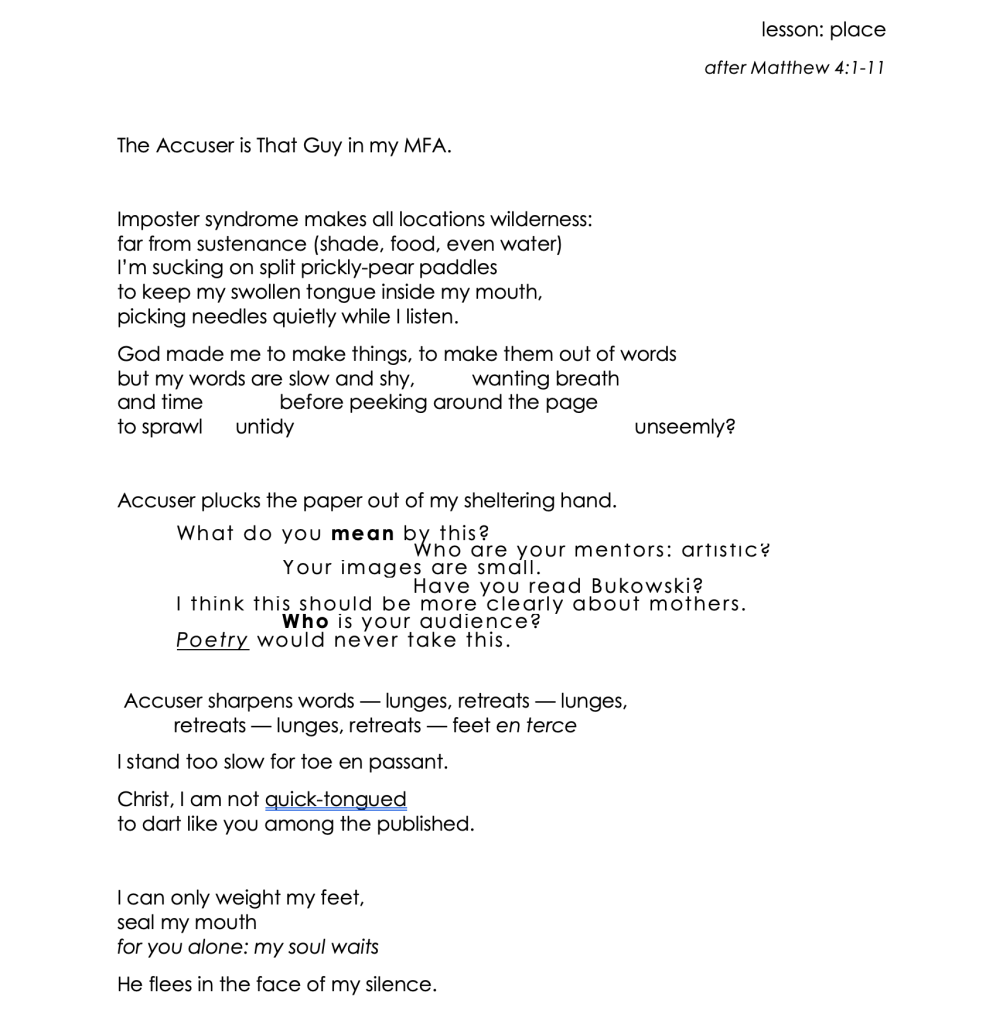
Lesson: place – a poem by Kimbol Soques

Kimbol Soques has been writing since before she got her first typewriter at age 3. Her work has been included in a variety of publications, including Non-Binary Review and  Windhover, and has been nominated for Best of the Net. She lives and writes in Austin, Texas. Visit kimbol.soques.net for links to her published poetry online.

Transfiguration – a poem by Michael T. Young

Transfiguration
 
There will be days
remade in the image
of losses that overtake me.
There will be sadness
that steals my daylight,
and jams the clocks.
Memories will be born
of someone gone
holding hostage
my sleep and dreams.
 
But there will follow
a quiet rising from
that pain and exhaustion,
a clarity in which
these sorrows
find their words,
and turning back to God
and friends, 
I will hold them out,
saying, “Here,
this is the song
I have made of them.”

Michael T. Young’s third full-length collection is The Infinite Doctrine of Water. He received a Fellowship from the New Jersey State Council on the Arts. His poetry has appeared or is forthcoming in numerous journals including BreakwaterFRiGGThe Inflectionist Review, and Talking River Review.

Constellations – a poem by Brian Kates

Constellations

The Farmer’s unseen hand sows
the furrowed sky by day
and at night it blooms

Brian Kates holds a Pulitzer Prize, George Polk Award and Daniel Pearl Award for Investigative Reporting. His poetry has appeared or is forthcoming in Spirit Fire Review, Paterson Literary Review, Broadkill Review, Banyan Review, Third Wednesday, Common Ground and other journals. He lives with his wife in a house in the woods in the lower Hudson Valley.

rounds unpetal – a poem by JBMulligan

rounds unpetal

Into the Fall, and the Insect Orchestra
still plays through the night, rasping and chirping, soft
and persistent as hope, as bats tumble aloft
through brevities of feasting, throbbing with hunger
like song beneath the silent music of stars,
the rush and stumble of lost beginnings swift
as desire to fill what is not, till nothing is left
of nothing, and emptiness, voided, disappears.
The urgencies of moment, the lazy sprawl
of time; one point in space that spread to all:
watching the spin and rattle, the shiny ball
that chases the wheel to fall into its slot,
to racket and hop and hiss, and finally stop
while songs continue that sound like what is not.

JBMulligan has published more than 1100 poems and stories in various magazines over the past 45 years, and has had two chapbooks: The Stations of the Cross and THIS WAY TO THE EGRESS, as well as 2 e-books: The City of Now and Then, and A Book of Psalms (a loose translation). He has appeared in more than a dozen anthologies, and was recently nominated for the Pushcart Prize anthology.

Restoration – a poem by Linda Starbuck

Restoration   
				10/08/2011-10/08/2021

In the family of the remnant prairie 
every member has a purpose;
the hardy bluestem grass anchors the soil 
and protects the delicate iris from floating away.
A simple scene from a distance, but up close,
the relationships are as deep and intertwined 
as the root systems scribbled by a mad artist.
There is a purpose for every curve
in this strange language called Harmony.  

In October, the steely blade of death
tore through nature’s beautiful tangle
like widowhood tore through me.
Bloodlines were destroyed, grasses 
turned under, spirits turned under; 
the faces of the wildflowers buried, no longer 
able to interpret the message from the sun.

Once broken, the prairie takes a decade to recover.
The seedlings struggle in perpetual night;
dormant, but not dead, 
hoarding pain inside like a tiny ember, 
until that day God’s light bends toward the earth 
and starts the burn to recovery.
The new language is shaky but legible;
a charcoal line is drawn from the stream, 
to the bee, to the flower, to the bird. 
Life here now is all about staying above ground.  

Linda Duede Starbuck left her life in Iowa behind and retired to the beautiful Black Hills of South Dakota in 2017. In addition to writing, she loves to draw, is a historic interpreter, and volunteers at various art and history venues. Her poems have been published in both traditional and online journals. Her first book, Willing Pioneer, was published in 2020. http://www.lindastarbuck.com.