
Heloise Speaks: A verse novel by Irina Kuzminsky – review by Diana Durham

Review of Heloise Speaks: A verse novel (Amethyst Press, 2022)
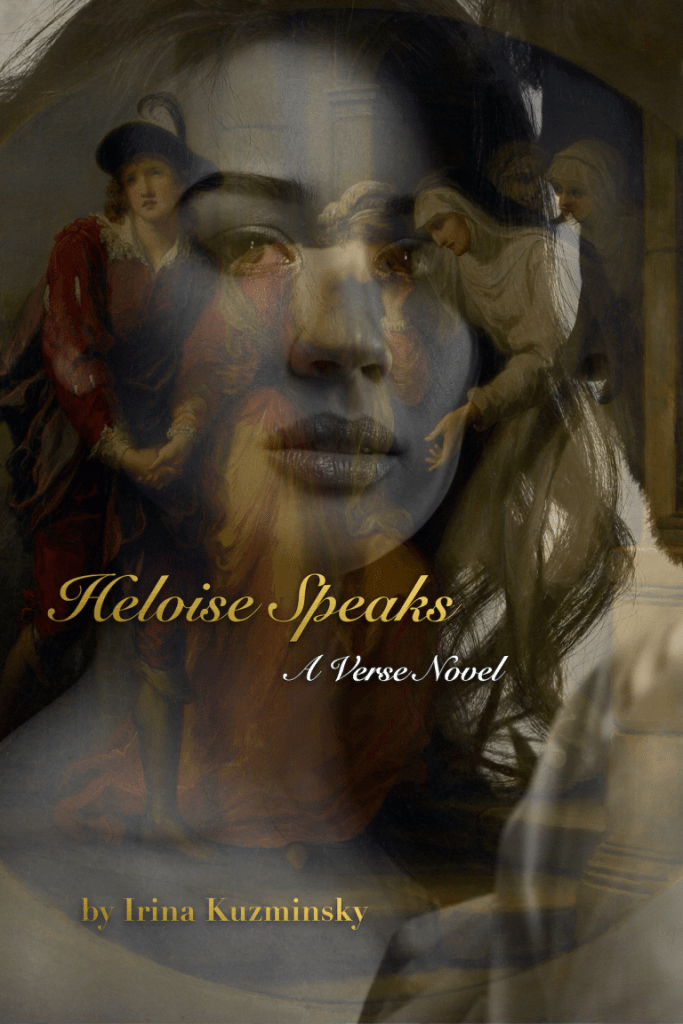
Deftly folding in scholarship, historical names and references without overloading the verse, Kuzminsky traces the 12th century story of Abelard and Heloise in a series of verse ‘letters’ based on existing letters that the two figures exchanged. Except Kuzminsky’s stanzas are from Heloise alone, we hear of Abelard through them, not from him. 

Heloise’s love, her insights, her ambitions, her entreaties and the events themselves are wrought skilfully into a language that is accessible to our modern minds, while imitating faintly a medieval style of expression, an effect which is sustained throughout the text without ever sounding forced:

       ‘He prophesied a future for me golden and bejewelled
        Like the fair heavenly Jerusalem
	But all I felt was the unused to warmth of his caress
	And when I kissed his ring
	I made a silent vow:
	I would not be a nun or learned Abbess
	I would be learned, of course,
	But, though a woman, I would find another way.’


Verse by verse, we are taken through the painful journey of love – body and soul – into the lovers’ separation, followed by disaster when Abelard is castrated by order of Heloise’s guardian as revenge for seducing and marrying her in secret. Early on in the collection Heloise describes the embodied experience of her love for Abelard:
       ‘I am adrift
	I am aflow
	I’m me – and more than me
	I’m matched and mated’

But all too soon, she feels alarm at Abelard’s subtle drawing back:

        ‘But I can’t reason with a razor’s edge
	Or have your categories plague
	The living touch out of my speech.’

And much of the power of these verse letters lies in the tension Kuzminsky’s sometimes blunt sometimes wistfully idealistic lines convey as Heloise oscillates between celebrating her love, and bemoaning the gradual betrayal of it:

        ‘I thought we were beyond misunderstandings
	That you should think I should need proof of you
	Of your fidelity
	(or maybe it is you who wanted proof of mine?)
	Means to me that we are no longer one’
                    

Heloise fears the betrayal not of Abelard the man so much but of his conditioned mind, of the intellect’s ability to rationalise away the reality of physical and spiritual union. But after Abelard’s terrible maiming, Heloise wonders if she herself was not to blame:  

                                           ‘What prompted me
	To marry you and bring about your fall?
	Now claim your due, and see me gladly pay…’
                                                          
So ends Part I, in which Heloise speaks as student and lover. In Part II she is scholar and abbess, and what she ‘pays' for Abelard’s ‘fall’ is to enter a convent where:
Years darken the threshold of my cell
      In a monotonous procession.’

The former lovers continue their correspondence, but Heloise’s oscillation from love to loss intensifies as present events give way to memories and hopeless longing for the past. These stunning lines convey her anguish: 
        ‘I’d swallow up the universe in that hole
	And crush all particles till they released their light-filled essence
	And then I’d swallow that light too
	And still it would not still nor sate me’

                      
All the passion in the universe flows through her but she cannot reach back to what used to be, expressed again brilliantly in this stark, poignant counterpoint: 
       ‘You knew how to speak true
	Once’
                       
While in beautiful, swift imagery Irina evokes the barren convent and Heloise’s desolation:
       ‘Your words to me are colder than
	A bare stone floor
	And just as comfortless
	As sleet in winter’
                        
Even as she achieves renown and status as Abbess, Heloise’s story of agony and ecstasy rolls on through her reflections. And perhaps Kuzminsky’s greatest achievement in this finely crafted retelling is to convince us – after so much turbulence – of the peace which the elderly Heloise, her hair now ‘pristine white’, finds as she contemplates her life and her love one final time: 
       ‘At last, now, I know better.
	I should have loved you even more,
	With more surrender, greater selflessness,
	For when I measure up my love to Christ our God
	And to Our Lady’s love for Him,
	Her Son, Whom She knew dying, broken,
	buried by Her hand
	I’m but a tiny midge
	Caught up in a huge swarm
	And all my suffering could never merit
	The joy of knowing that I knew a little
	What Love is
	Through this, my love for you.’
                        
The skill and beauty of this telling is in itself a substantial accomplishment. But ‘Heloise Speaks’ also offers the modern psyche vital nourishment through the expression – and reminder – of the sacred power of feminine passion. 

Heloise was exceptional in her time for her achievements. Throughout these verse letters she ponders her roles of scholar, lover, wife, mother, abbess. While our own stories are not as dramatic –  usually nowhere near as tragic –  we also balance love, marriage, motherhood and career or artistic calling and find that we are not fully any one aspect. Gradually –  and often catalysed by passionate love for another – we free up from our roles and our heartbreaks, and embody the lightness of love:
       ‘For I am Woman
	Holy Spirit
	Shekinah
	Sophia
	Mary
	Eve
	Mysterious Dove
	Wings strong enough to break through any cage’
                    

Heloise Speaks: A Verse Novel at Amazon UK

Heloise Speaks: A Verse Novel at Amazon AU

Heloise Speaks: A Verse Novel at Amazon USA

May the Circle be Unbroken – a poem by Jessica Mattox

May the Circle be Unbroken   

At nineteen,
I learned I couldn’t hold
anything in my hands.

Even my heart sat on sinews,
waiting for directions
from my soul, waiting for my 
bones to call it beautiful. 

When I took my whole
heart to a holy 
space, I reached for a
long, slender door handle, installed
by hands I never touched.

The grey-green
slate seemed impenetrable
until I put one sandaled foot 
in front of the other, stepping on well-
worn stones. The absent voices
stored in the wood beckoned me. 

In this sustained,
constrained-open
place, I knew the high triangular ceilings
would catch me if I faltered. 

God stirred together
a strange alchemy, 
wrapping me in warmth
while hushing me
in awe. 

My fingers gripped 
the rosary
I received at Confirmation
with its 
black
obsidian beads.

All the way around,
ten to a set, I held
each bead between
index and thumb,
saying one Hail Mary
after another 
into reverie. 

Fingers on black beads;
atom on atom—there’s still
space

between everything
we touch. 

Jessica Mattox is a PhD student in English at Old Dominion University and an adjunct English professor. In addition to writing poetry, she is passionate about the teaching and learning of technical/professional communication and first-year composition. Her poems have appeared or are forthcoming in Last Leaves Magazine, The Album at Hollins University, Exit 109 at Radford University, and others. In addition, her academic scholarship has been published in the Virginia English Journal.

Basho and Wallace Stevens – a poem by John Valentine

Basho and Wallace Stevens


What I like about language is what I like about fog. 
What comes between us and things grants them 
their shine.
- Mark Doty


How many times can a koan
stub the mind’s toe?
Or a sensei clap his hand
with no sound?
Here it is, late at night,
and you’ve come together,
like two old friends
who never knew each other.
Stillness, whispering leaves,
and a promise that only
things themselves can make,
or the moon as the ghost
of everything possible.
Step in, step in…
and together we’ll go down the long
darkened hallway
in the House of Being,
down to the last window
at the end
where the stars glimmer
in the flickering light, 
like a scatter of coins.
And later, when fog is a thief
clouding the moon,
what better veil than the mist?
I’ve fallen in love with illusion.
And if I whisper,
tell you the truth of a life,
that I lean on your lines,
will you come and sit by my side
while I read,
read everything into your worlds?

John Valentine has recently retired from 45 years of teaching philosophy courses at various colleges. 

I Was, and then Was Not – a poem by Andrew Taylor-Troutman

Lightning flashed before my eyes - 
I lay in bed near death.
I felt bright colors on my chest,
and smelled the warm sunrise.

I heard my dear priest’s throaty rasp 
proclaim an ancient prayer; 
his water words flowed up the stairs,
outpacing my weak grasp - 

and rose into a golden climb, 
which beckoned to the top. 
I left my failings far behind -  
my overtrying stopped. 

As water once was turned to wine, 
I was - then I was not - 

Andrew Taylor-Troutman is the author of Gently Between the Words: Essays and Poems. He is a Presbyterian pastor in Chapel Hill, North Carolina where he shares life with his spouse, also an ordained minister, their three young children, and dog named Ramona after their favorite literary heroine.

Eve’s Theme – a poem by David B. Prather

Eve’s Theme
 
 
Rumor suggests that the name of things originated with me,
even those distinct variations of rain.
 
But this is not exactly the truth.
Even the smallest creature, the least observed plant,
 
the most distant star has a voice and speaks
its own appellation.  I’m sorry
 
if you don’t understand.
If you are still enough, long enough, you can hear
 
all those who speak.  And as for the gossip of temptation,
don’t be so quick to judge.
 
Even the seeds inside the fruit call out.
I listen.
 
They say bite into the flesh,
let them see the light.
 

David B. Prather is the author of We Were Birds (Main Street Rag Publishing). His second collection will be published by Fernwood Press. His work has appeared in many print and online journals, including Prairie Schooner, Psaltery & Lyre, The Meadow, Cutleaf, Sheila-Na-Gig, etc. He studied acting at the National Shakespeare Conservatory, and he studied writing at Warren Wilson College.

Diet of Worms – a poem by Bud Sturguess

Diet of Worms

The boys at the conference feel so sorry for me
"He thinks the Diet of Worms is a diet, of food,"
they say among themselves
"He knows not enlightenment
He is simple, he is not truly Reformed"
Another says,
"I heard him once say he had never heard
of the Nicene Creed!"
And another adds,
"I heard him say he reads Beth Moore!
Has he never heard of Piper or Bonhoeffer?"

So I sit alone and eat my dish of worms
while the others, careful to avoid me
for fear of catching some Baptist sniffle,
indulge in big, lofty cakes
The icing is too rich, but they chew
and make the most absurd faces,
faces one makes when pretending his nose doesn't itch
The bread is too tough for any of them to slice and share
So they proclaim it predestined to be uneaten
I ask them what this means, 
but there are worms in my teeth
and they tell me they'll send me an email
with a link to explain it so I'll understand

So I sit alone and eat my diet of worms
They are sweet to the taste but bitter in my stomach
I remark to one of the boys passing by
that truth and revelation from God are like my worms,
or like the scroll eaten by John -
so sweet to the taste, but when we must face them
and apply them with all our grit and tears,
they're so trying on our guts

He suggests I read The Pilgrim's Progress
and walks away

Bud Sturguess was born in 1986 in the small cotton-and-oil town of Seminole, Texas. He has self-published several books, his latest being the novel Sick Things. Sturguess’s work appears online at New Pop Lit and Erato, as well as in the print anthologies Mid/Southfrom Belle Point Press, and The Daily Drunk’s From Parts Unknown. He lives on disability benefits and collects neckties.

Trumpet Morning – a poem by David W. Parsley

Trumpet Morning


It is no cloud surrounding the horizon, 
that silhouette revealed now 
in the growing light along its range.

Around each peak the coming sun’s
announcement glows
like tongues of cleaving fire.  Canyons

exhale on the last lights of the city
as a thunderhead flotilla
emerges from the west

acquiring the migration trails.
Fig trees shiver along the stream
like a weave of trembling chalices.

Beneath the aerial schism the sleeping
earth dreams on:  not the dream
of storm’s omened contact

at the mountains’ first ridges, where light
flies up in face of the blackness, climbs wing
upon wing from the dwindling blue

which at the moment before engulfment
sends the only calling ray
to a waiting rose of sharon in the field.

A former Pastor’s Assistant, David W. Parsley is an engineer/manager at NASA’s Jet Propulsion Laboratory where he works during the day (okay, and some nights and weekends) on interplanetary probes and rovers. His poems appear in London Grip, Poetry LA, Tiny Seed Literary Journal, Autumn Sky Poetry, and other journals and anthologies. “Kyoto: A Cycle” was a semi-finalist for the Able Muse Award.

Dusk Fog – a poem by Steven Searcy

Dusk Fog

As pastel clouds bloom, stretch, and slack,
mist rises from the hillside’s back.
Dishes get washed. The kids get hugs
and story time. The lightning bugs
and bats show up to flash and flit.
The treetop’s now a silhouette
in the fading light. All the day’s rough
words and anxious thoughts are enough
to bleach the evening’s beauty, when
they’re fully felt. The softness in
the warm air whispers wordlessly
that maybe wrecked hearts can still be
restored, as this simple, lonely place
awaits the night, shrouded in grace.

Steven Searcy lives with his wife and three sons in Atlanta, GA, where he works as an engineer in fiber optic telecommunications. His poetry has been published in Ekstasis MagazineReformed JournalFathom MagazineThe Clayjar Review, and Foreshadow Magazine. You can find him on Twitter @ithinkiamsteven

An Angel Flies Over – a poem by Mark J. Mitchell

An Angel Flies Over


You think—at first—it’s a wind
battering trees at sunset.

Or perhaps an airplane, lower
than usual on a flightpath by moonlight.

But it is his wide wing,
enfolding a weary, guilty earth.

You cannot hide from it.

Mark J. Mitchell was born in Chicago and grew up in southern California. His latest poetry collection, Roshi San Francisco, was just published by Norfolk Publishing. Starting from Tu Fu   was recently published by Encircle Publications.

A new collection, Something to Be and a novel are forthcoming.

He is very fond of baseball, Louis Aragon, Miles Davis, Kafka and Dante. He lives in San Francisco with his wife, the activist and documentarian, Joan Juster where he made his marginal living pointing out pretty things. Now, he’s looking for work again.

He has published 2 novels and three chapbooks and four full length collections so far. His first chapbook won the Negative Capability Award.

https://www.facebook.com/MarkJMitchellwriter/

https://www.mark-j-mitchell.square.site/

@Mark J Mitchell_Writer

This Material World: A Benediction – a poem by DB Jonas

This Material World: A Benediction

                                    World-mothering air, air wild, /… fast fold thy child.
                                     GM Hopkins

Morning’s heron drifts
low over the sycamore.
A solitary, saurian flap
astonishes the cedar-tops.
Far past seeing, 
through the gun-metal dawn, 
a thousand cranes 
in weary squadrons 
bellow joy.

Out in this air a wildness cries out only to itself, lives only 
once to hear its whispered voice alive among the swaying trees.

A wildness cries in every air where only silence ought to be.
Here a tiny voice disturbs the quiet space where each one lives alone,

where each thing dries its leaves in the trailing fragrance of the rain, 
in the dispossessions that engender and expose each stark enfolded self,

in the cry that draws us one and all and time and time again into this 
mordant, murderous world’s life-mothering atmosphere, as far

from spirit as things get, as far from things unseen as those dark
quantities themselves: the compromising body, the uncompromising

body of evidence that rises to our life-denying eye, into our joyous 
pulsing heart, into all we struggle not to see. So if it please, o world, 

do grant us each and every day our dread day’s daily crumb, 
and deliver us each moment from the life of worlds to come,

for here, from somewhere far past seeing,
you can hear the wild clamor
of your interrupted solitude.
Listen as, within your precious
silence, above the pearly dawn, 
a thousand cranes in weary squadrons 
make joyful noise.

DB Jonas is an orchardist living in the Sangre de Cristo mountains of northern New Mexico. Born in California in 1951, he was raised in Japan and Mexico. His work has recently appeared in Tar RiverBlue Unicorn, Whistling ShadeNeologism, Consilience Journal, Poetica Magazine, The Ekphrastic Review, Innisfree Poetry Journal, Amethyst Review, The Decadent Review, The Amphibian, Willows Wept, Sequoia SpeaksRevue {R}évolution (https://www.revuerevolution.com/en/db-jonas) and others.