
Still Life


The view from a window changes
while that of a painting next to it doesn’t

‘what comes to us has chosen us’
she says setting down her coffee cup.

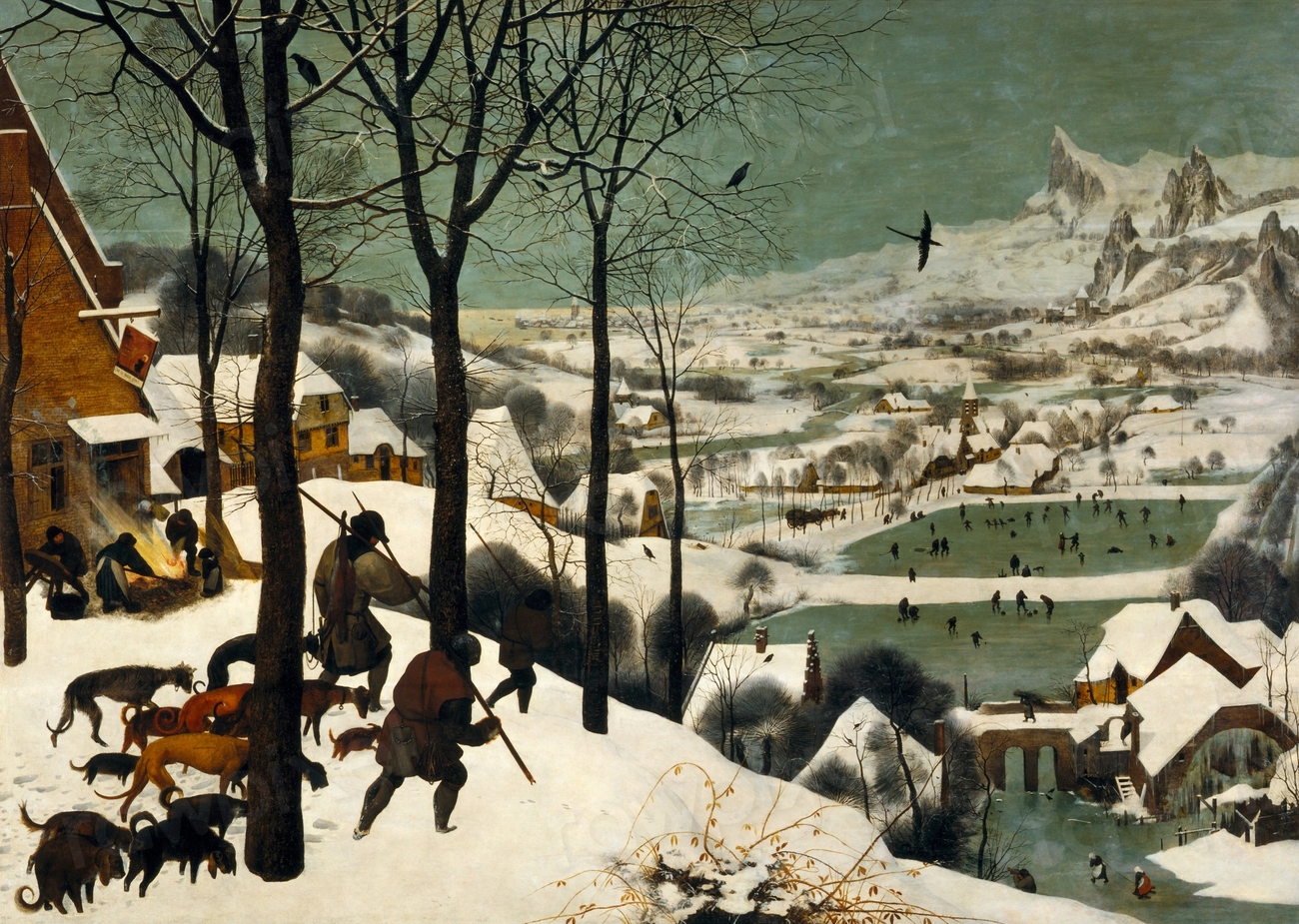
Bruegel’s returning hunters lean into each snowy step
or just the step we see assuming others
ankle-deep in snow’s deceptions
masking known to unknown ground as the hill drops away.

Leaning into steps aids balance with caution
of slicks, trips, errant falls
their long-pole spears hung with rabbits
over shoulders, in front probing for the next step
a pack of dogs following nose to ground

the hunter’s faces turned away from us
in a scene with dozens of people none face us
only the next step’s hidden offerings
some walking iced-over ponds and streams
some skating, some fishing through holes in the ice
we are the scene’s only witness
a face seeing itself.

Slowly we begin to feel chosen
by a frozen moment outside ordinary time
yet within it not as contrast
but as what is there naked
saved for us caught up in a moment’s motions
not seeing its stillness.

Outside the window seductions of movement,
its singularity masking our duplicity, our multiplicity
tasks us.  We are only a white van racing a grey road
for a few seconds. An erratic scattering
of bright yellow-orange leaves falling like impulses,
each a glance of sunlight at just this angle
missing some branches, fenceposts
favoring others.
Overhead is a sizeable hawk, wings outstretched
in a turn: we see both wings at once      one above
one below its body neither flying nor falling.
Don Brandis lives quietly outside Seattle writing poems. He has a degree in philosophy and a long fascination with Zen. Some of his poems have been published by Black Moon Magazine, Amethyst Review, Blue Unicorn, Leaping Clear, and others. A book of his poems is out – Paper Birds (Unsolicited Press, 2021).


I was referred to this page by Sarah and found it amazing to read a poem about the same painting, and to read a different poet’s interpretation. I really enjoyed reading Don’s poem. “Slowly we begin to feel chosen / by a frozen moment outside ordinary time” particularly resonated.
LikeLiked by 1 person