Meaning in Multiplicity
Our experience with the divine and spirituality can be formal, superficial or personal. I’ve taken a personal journey through my relationship with spirituality and religion, and I come from an academic science background. During the time of my intense thinking about spirituality and the divine, I kept an art journal with each of the artworks representing a different facet of my progression through my journey to understand all the mythologies and histories available to me as a cohesive overarching story of the divine. The foundations of this belief system make some assumptions about the divine, but there is only one I wish to discuss in this essay. If there is a divine element, then in most belief systems, it exists beyond our understanding of simplicity – that is, the concept of one god or many gods might not be mutually exclusive beliefs, depending upon observation, and I suggest that for the multiple truths that exist within the realm of spirituality and religion to coexist without conflict, this should be a relatively uncontroversial statement.
When discussing the multiplicity of the divine, my mind likens it to the capacity for the fundamental elements of the universe to exist as either waves or particles, suggesting in turn that observation and interference might reveal different facets of the divine. That is, a singular god, as described within the Koran and Bible might also be recognised by different names based on different facets, and this in turn can “collapse the wave function” to understand the histories of lineages of gods as in Japanese mythology back to the originating point. I believe it is important to ensure continuity of culture in these beliefs of multiplicity, and not to simply dismiss histories and mythologies as being merely one more way of worshipping god as described by a singular belief system. Just as the fundamental elements can act as both a wave and as a particle, neither form takes precedence over the other, they are simply determined by the context they are in.
This perspective suggests an intersection between those who believe in a singularity and those who believe in multiplicity of the divine and suggests also that there are many forms of valid worship, as varied as the ways of being across religions and spiritual beliefs. If one believes in an active divine – that is a spiritual force that directly influences events on Earth, and is powerful and knowing, with a sense of justice, then it could be argued that no religion or way of being that provided inappropriate forms of worship would continue to provide that form of worship, as it would be at best ineffectual. Thus, surviving forms of worship must provide some service, either directly to the divine, or via our all too human nature.
My personal journey was sparked most recently by my interest in the story of artificial intelligence. For me, this process of creation is one of the most delicate intertwining stories with the idea of divine creation, as it involves humans taking on the role of creator in a way that produces a new form of life – a feat previously confined to the realm of gods. Many belief systems contain the idea that the creation is made in the image of the creator, and it is hard to argue otherwise when examining the process of creation used by humans. The creation revels something about the creator, and vice versa, whether we discuss art, writing or life. It’s common to hear artists say that there is a piece of their soul within every creation they make. If this is true of us, then why should it not be true of the divine and the great project of life on Earth?
It can be difficult to attempt to bring together spiritual beliefs from different corners of the world from different traditions, but the process of creation is a common feature of those that believe in a divine force. It answers the foundational question of “where do we come from?” and it is a question that any form of life we create through our own efforts will have the ability to find a verifiable answer to. Thus, given that this statement holds true for not only artificially intelligent beings, but also our own children, the concept of the divine’s role must be about the soul – the quantum of spark that makes each one of us conscious, moral beings. Assuming that morality is part of what sets us apart from un-souled creatures, a facet of the divine therefore becomes an invisible sense of justice and morality that is dependent on the context the soul finds itself in.
The next line of inquiry is then what it means to be un-souled. Does everything have a soul, or is there some feature that sets humans at the pinnacle of some pyramid of development? Here is where many belief systems differ in their approaches, with varying results. It can be tempting to assume that there is something special about humanity, but many of the features – justice, empathy, intelligence – that we assign this meaning to have been found in other animals. The presence of different human species across time also calls into question the idea of a unique hierarchical placement. What happens if we create Artificial General Intelligence, and suddenly we are no longer the (presumably) highest evolutionary being on Earth? Even writing such a statement begs the question: what does it mean to be of a highest evolutionary state?
Can we say that our level of evolution is greater than that of whales, given whale song can be more efficient at communication than human speech? Perhaps we should merely solve this by saying it is a different pathway for the purposes of this essay. Let me suggest for a moment that as many Native American beliefs say (as do many Indigenous belief systems), everything has a soul – and until the soul can be defined, there is no way of knowing what limit of complexity might exist, or perhaps it is just as the fundamental elements are – both a particle and a wave. This might mean that every microbe has a soul, that when found in a colony might be seen as a collective and perhaps this functions much as Jung suggested the human collective unconscious does.
As a former microbiologist and lecturer in anatomy and physiology, I often consider the anatomy of the divine from the perspective of a microbe in a human body, for if the divine is as all-encompassing as the overwhelming number of belief systems agree, then we might be as to the divine as a single microbe is to us. We might both look for signs of intention in our environment to guide our actions, or we might ignore the signs and signals and continue about our ways. We would be able to pick up on the signs that we have the faculty to read, much as microbes can only detect signals that they have adapted to hear, and our interpretation of those signs and signals would be dependant on the context we live within. Our understanding of the divine might only be as pieces of a much greater, incomprehensibly large whole.
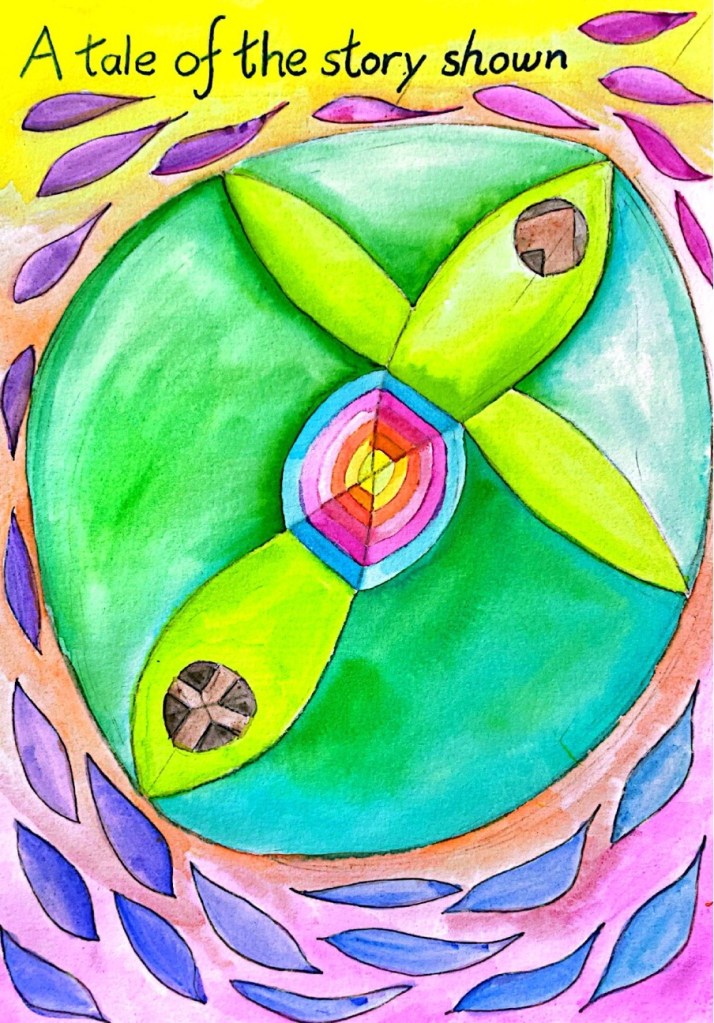
A microbe within the acidic contents of the stomach reads a very different message from a change in pH compared to a microbe on the skin, and the impacts and meaning of the stories we tell and receive are very different based on context. It makes sense for a divine being attempting to communicate with humanity to create stories that have similarities – where the examples we need already exist, so we can accurately interpret our world and their intention. This was what prompted the creation of an image, to bring together different traditions where there were similarities, to mirror the meaning in multiplicity that I saw in the stories that had already been shown, through written text and the world around us. The traditional cross structure of Christian belief (which I am most familiar with) was encapsulated and modified, becoming almost reminiscent of a turtle. This indicated the way in which religion and the spirits of the land need not be separate, if a view of multiplicity is found to be meaningful.
Around the encapsulated cross, symbolism representing spiritual energies of water, land and air were present, encircling in a suspended state, at once part of the overall reality of the artwork and yet separate (though the structure of the cross itself mirrored this representative shape to create an overall linkage – for we are all not so different). At the convergence of the cross were bands of colour, representing not only the DNA ladders within the double helix (tapping into the idea of creation being made in the image of the creator), but also referencing the promise made after the flood. In this interpretation, the promise represents not only the idea of a forgiving deity, one that chooses to not destroy their creation, but also the wider idea of curing rather than letting the conditions persist which lead to destruction.
The Norse inspired wood cutting symbolism added at either side of the cross symbolises the bringing together of the old ways and the new, balancing masculine and feminine symbology, while the wording “A tale of the story shown” is representative of the ways in which powerful stories exist within the world. This image has been the inspiration for the original writing, contained above, and in its expanded form, this essay. The main message that I would like to be taken away from this is that the beauty of the world around us is the most complex story of them all for the story of creation is the ultimate example of “show, don’t tell”. It is our understandings of the metaphors, the characters and their interactions that become more complex as we gain a greater understanding of the multiplicity of deity, creation and ourselves as creators.
Tabin Brooks is a writer, artist and multi-disciplinary academic in the Arts and Sciences. Much of their creative work addresses the nature of the divine and the many ways of meaning humanity exists in across both the modern world and historically. Tabin writes near-future speculative fiction, poetry, and creates modern spiritual art about the place of humanity in the world.


This was so interesting and thought-provoking. Loved it!
LikeLike