
Sarah Das Gupta
Three Women
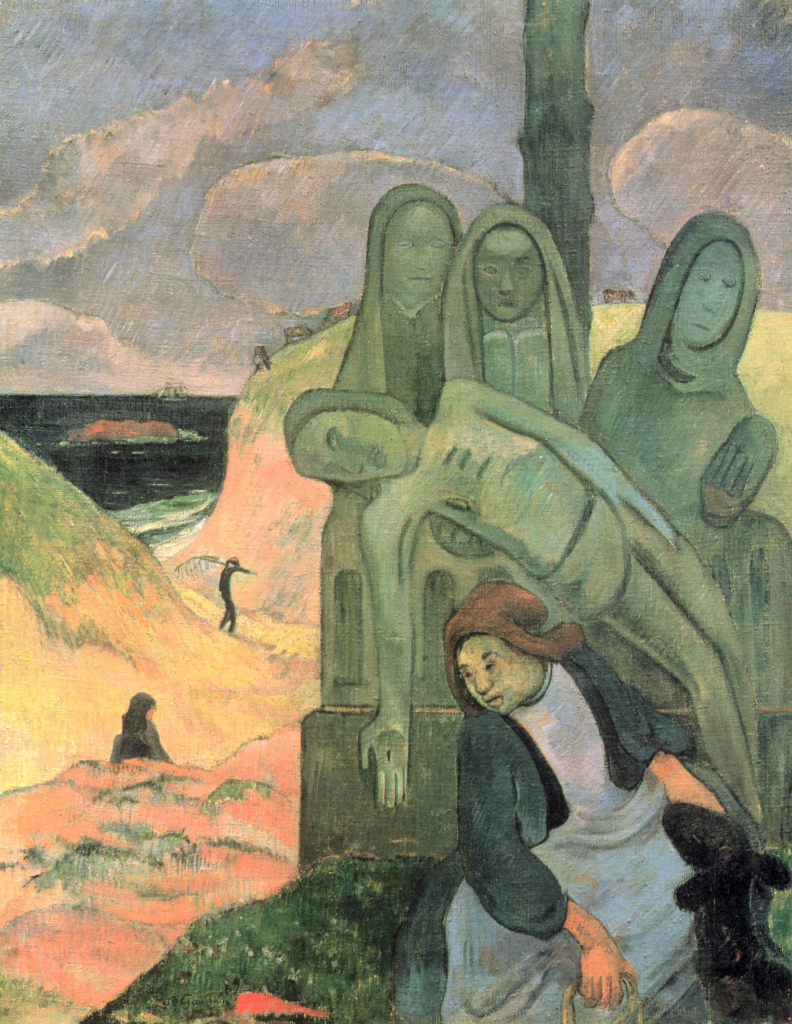
(The Green Christ – Gauguin)
Jeanne- Marie could simply not forget what she had seen the night before. It might be 1890 but in the Brittany hamlet of Yaudet things took decades, even centuries, to change; she thought ruefully. She herself knew that better than most. She stood pressed close to the dark granite rocks which had been carved years before, to shelter the wooden image of the crucified Christ. She had rushed out in such a panic, that she had forgotten to bring the bright bunch of pansies she had picked to lay at the pierced feet. Quickly she gathered a bunch of golden buttercups and laid them on the wood, smoothed by centuries of village mothers, many of them probably in a similar state.
She whispered a few prayers, then peered round the edge of the rock. Stone steps, carved from the granite, led between the cliffs to the beach. The sea was lapping over the bottom step, leaving a strip of white lace as the wave retreated. Jeanne guessed the tide was on the turn. A young woman with black hair, as dark and shiny as the cormorants flying overhead, was sitting looking down to the sea. The fishing boats will soon be back, that’s why the gulls are gathering. Jeanne stepped into the shadow of the rocks. She didn’t want Veronique to see her.
The view down the steps had disturbed her more than she had expected. How often she had sat there waiting for Luc to run up those stairs two at a time, carrying the creels full of wriggling fish. He’d balance the baskets on the rocky path before holding her tightly in his arms. Then they’d walk to the cottage together. She pushed back her hair which had once been as black as Veronique’s, but now it was impossible to hide the streaks of grey.
As she stood looking at the crucifix, the old wooden carving began to fade. Three women appeared holding the body of Christ taken down from the cross. Between them they held the dead figure. They looked with sadness but also with a strange sort of joy. Jeanne found it difficult to read the emotions of the three mourners. In the shadow of the rocks the images took on a green shade – the colour of the fields round Yaudet in spring when the lambs were born.
Like most of the village girls, Jeanne had had to attend catechism classes but she had found the priest’s lugubrious voice sent her off to sleep or into a daydream. This was so different. The love of the three women for this broken body they held was palpable, as they carried Him somewhere beyond death. Jeanne remembered the day Luc and the rest of the crew were lost in a freak storm when the waves had come right up the steps and the coast guard had carried his body to her as she waited. Apart from a cut on his hand, Luc looked peacefully asleep. She had stared up at the crucifix as the men carried his body into the village. You don’t care a damn. Perfect and unreachable stuck up above everyone.
She looked back down the steps. A young man ran up two at a time and Veronique disappeared in his arms, her dark hair falling over his shoulders.
Jeanne looked back at the wooden image. The three women had gone but the sense of their love remained. She turned back to Yaudet. It wasn’t going to be easy. The young man, as she had suspected, was a Guillou, the outcasts of the village, but Jeanne knew her love for her daughter was stronger than any village feud.
Sarah Das Gupta is an 83 year old, retired English teacher from Cambridge who has taught in UK, India and Tanzania. She lived in Kolkata for some years. Her interests include, Art, the countryside, Medieval History, parish churches, early music and ghosts. She has had work published in journals and magazines online and in print, in countries, from New Zealand to Kazakhstan. She has recently been nominated for Best of the Net and a Dwarf Star Award.
 Amethyst Review
Beautiful story. The love a mother has for her daughter is stronger than so much of what life throws at us.
LikeLike
Beautiful, Sarah!
LikeLike