
Going to Alaska
I’m grounded, no matter how fast I’m going, I can come back.
My legs may take me far away, but my soul will come back home.
~Ellen Bindman-Hicks, “Night Leaping”
My daughter Ellen should be thirty-four now. When she was a toddler, I opened a daycare in our home. For many months the children played a game they’d invented called, “Going to Alaska.” Sometimes they traveled by plane, sometimes by train, sometimes they rode in a sled, sometimes they walked. Underneath the kitchen table, in the well of the half-pulled-out sofa, or on the lid of the sand-table were some of their imaginative vehicles. Many animals and dolls accompanied them to Alaska. It was a game full of excitement where ideas emerged organically, in call and response, like a song.
The children always asked me to play, but I’d usually just reply,
You’re going to Alaska? Have a nice trip!
Beyond that, I had discovered my participation would immediately throw a damper on the game. Occasionally, I’d try again, squeezing under the table with the kids, their eyes joyful.
This is a plane! one announces, We’re going to Alaska!
I wonder, “Is it my turn?” So I say something dumb like,
What are we going to do when we get to Alaska?
The kids look at me. Pause. One picks up the thread again: We’re going to Alaska!
Okay. Try again. Make plane sounds.
Me: Look out the window at the clouds!
Again, no takers. The game fizzles out, to be resumed another day.
What am I not getting? It occurs to me that to learn the rules I need to shut up and pay attention. I begin to listen to how the children play the game.
We’re in a train!
We’re going to Alaska!
We’re going to a museum.
There are gonna be bears in the museum—and dinosaurs!
There’s airplanes in the museum!
Let’s go to a fair.
Yeah! Let’s go to a fair!
There are cows at the fair. Remember the cows at the fair?
Let’s go to a restaurant.
We’re going to a restaurant!
We’re here!
The children climb out of the train and play restaurant for a while. Suddenly the game makes sense: I see how I’ve been missing the mark. My adult ideas about what Alaska is—what creatures live in Alaska, how people actually get to Alaska, and what one might see out the window while traveling—are far outside the children’s real life experiences. My attempts to impose my own sense of realism missed the point. What’s important is going.
The going can be to anywhere, by any means. And it can be simultaneous. The ideas of one child don’t have to fit with those of another. Once the kids get there, wherever there is, the game is over. The excitement is rooted in the game’s action, its flexibility and the room it leaves for each child to fill in details with their own imagination. My attempts to play had stifled all of these. I’m surprised they’d kept inviting me back.
Not long after my revelation, Ellen sat on the floor of our mudroom pretending it was a car she was driving.
You sit here, she told me, patting the floor.
I sat.
We’re going in the car! she announced happily.
For the first time ever I did not ask what we were going to do, but responded:
We’re going in the car!
Ellen paused, looked at me carefully, then her face lit into a huge smile.
* * *
Ellen’s life ended in a car crash days after she’d graduated from high school. In that moment my world ended. I was left to continue on without her, trying to preserve the music, art and poetry she had created in her seventeen years, trying to not let her memory fade, to not let her disappear completely.
I had no guide for this. I was not raised in a religious tradition. My family is Jewish, but secular and intellectual, so I did not have faith in an almighty to anchor me to a hereafter, or a certainty that our physical separation is just a pause. My mother’s life was taken when I was thirteen, and I had held her memory close, writing to her in my journal when becoming a new mother myself, consulting her when facing difficult decisions, but still I had no firm belief in an afterlife. Despite craving these conversations, I often felt that I was playing pretend to comfort myself. And yet. The glimmer of possibility of something more remained and would not allow me to dismiss it completely.
When Ellen’s life ended, my need that our essences remain somehow connected beyond our physical beings, became acute. Though I could not believe she was flying around with a golden trumpet, I also could not ignore the slightly surreal moments that feel like visits. My intellect tells me wishful thinking. My heart says otherwise. My struggle between hope and reason an ongoing ebb and flow.
My therapist, an energy psychologist, suggests I might to try to speak with Ellen through him. Struggling to suspend my disbelief, I say yes. Glenn asks me to concentrate on Ellen’s voice in my mind, then he closes his eyes. I close mine as well. The room fills with the soothing sound of water trickling in the tabletop fountain.
Ellen wants you to know she loves you, Glenn says after a pause.
Everything falls away. She is there, smiling before me.
I love you too, honey! I miss you so much! There’s so much I want to tell you. Like, David ate with the cat fork—I didn’t have the heart to tell him. We would have laughed so hard!
Her smile shines even brighter. Then her face becomes serious.
Mom, I don’t want you to be sad.
I know, I whisper. I’ll keep trying.
Ellen fades from my mind’s eye. Glenn rematerializes in front of me.
If you picture Ellen’s love as light, what color do you see?
This I’m not expecting.
Purple, I answer without much thought. But then, No wait. Gold? Hold on.
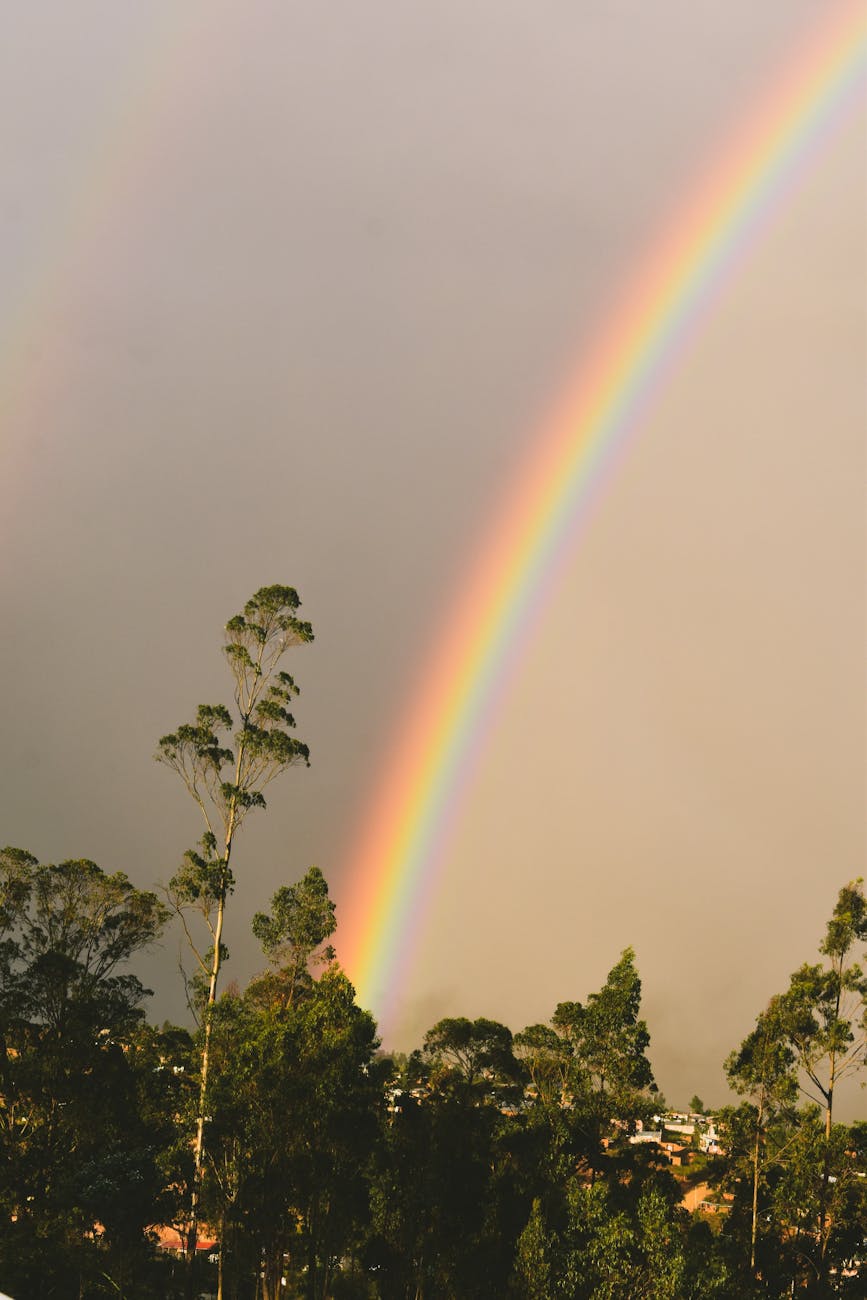
I close my eyes again. The light divides itself, revealing an entire spectrum.
All colors, I reply slowly. Her love is all colors of light. I see the whole rainbow.
I carry this gift with me. It offers a beacon through the interminable darkness. Rainbows appear everywhere. Iridescent reflections in street signs, shimmering in drops of dew, dancing in the spray of a fountain, even painted rainbows on store signs, on a boat’s sail, or a whirligig spinning. Everywhere the colors of light: Iris dipping her pitcher into the river Styx, sprinkling it in the clouds, turning sorrow into beauty.
Whenever I reach the point of deepest despair, some sort of rainbow appears. I see sunbows, mistbows, moonbows. I wonder if they’ve been there all along, but only notice them now that I’m learning to pay attention. Each feels ethereal, like a link beyond time and through space. I want to believe this. It is difficult.
I have moments where it seems obvious: of course there is a dimension beyond this. How could this one lifetime be all there is? Where does this thing, this spirit, our essence, the spark called “Life” go? Where does it come from? Sometimes it seems clear that all our energy is connected and there must be another, or many, levels of being. But at other times that just seems like a comforting fantasy, a foolish fairy tale, and it’s really all completely random. So I continue to swing back and forth between skepticism and hope.
* * *
The sky is dark, the clouds swollen. I stand on the rock in the fields where Ellen and I often walked together, where our family held a ceremony to celebrate her life. The trees in the distance bend and sway in an undulating mourning dance. Finally I speak to the swirling sky.
Honey, Grandpa died this morning. I hope he wasn’t too scared. I hope he is with you. I hope there is more. I want this all to make sense.
Directly above me, the low cloak of clouds slides apart, not sideways like curtains, but the way a camera’s aperture spirals open, revealing a brilliant blue circle behind the veil that had obscured what had been there all along. A stream of blue light pours down on me. I stretch my arms to it, palms up, accepting the magic. The magic and the mystery. The blue beam moves around briefly, then the mantle of clouds slips closed.
There is a knowing that goes beyond what can be understood with the mind.
I have never been to Egypt or Mount Everest or Alaska or the Moon. That doesn’t make them not real. So my ability, or inability, to comprehend dimensions beyond this physical realm is irrelevant to whether or not they exist. A friend recently told me of seeing her dog playing happily—hours after having buried her. My friend concluded sheepishly: It felt like a visit, but maybe it was just my mind.
To my surprise, I heard myself respond: Your mind is just the conduit.
Years ago, another friend described connecting energetically with her newborn across the room. “I’d wake up, and if I put my consciousness at all in the direction of the baby, the milk would let down. And other times I’d hold myself separate, almost like a meditative state, and I could hold a little acupuncture on the energy thread. And then I could let it go. And then the milk would let down.”[1]
If energy can bridge short distances, why shouldn’t it cross larger ones, like dimensional planes, like life and death, as well?
“Dying is the opposite of leaving,” poet Andrea Gibson offers in their Love Letter from the Afterlife. “When I left my body, I did not go away. That portal of light was not a portal to elsewhere, but a portal to here. … Why did no one tell us that to die is to be reincarnated in those we love while they are still alive?”[2]
Every night I whisper to Ellen’s photo the bedtime mantra I said to her for years: May all the forces of the universe protect you. You are the love of my life. The girl of my dreams.
And I repeat to her the words she used to say to me: I love you infinity groups of infinity, never stops, goes forever and ever.
One night, new unbidden words and a flash of understanding come through me: May we always shine together, grounded in grace and gratitude.
Ellen’s eyes beam into mine. I hear her voice in my mind: Now you’re ready to go to Alaska!
[1] Rites of Passage: Mothers’ Stories of Giving Birth, Naomi Bindman, unpublished
[2] https://andreagibson.substack.com/p/love-letter-from-the-afterlife
Naomi Bindman’s poetry and prose has appeared in magazines, literary journals, anthologies, and on podcasts. They won Dogwood Journal’s Creative Nonfiction Award, and received funds from the Vermont Arts Council and Vermont Humanities Council. Naomi is on the faculty of the Vermont State Colleges. Her memoir, You’re the Words I Sing, the story of Naomi’s journey back to life performing the songs of her daughter Ellen, is currently on submission with major publishers, and a film based on the memoir is in active development with a leading Hollywood story development company.
 Amethyst Review
I enjoyed this so much, and it’s beautifully written.
LikeLike
That’s lovely !
LikeLike