
Patrick Trombly wrote and published poetry at the College of the Holy Cross in 1989-1990, and upon graduation in 1991, he took a 35-year hiatus before picking the genre back up again in 2025. His poems have been published or accepted for publication in a number of journals, including Loch Raven Review, Beyond Words, the Dewdrop, Hemlock Journal and multiple Wingless Dreamer anthologies. His writing explores the relationships among humans, nature, God/the afterlife, and time. His poems are visual, use approachable language, and use various forms and literary devices such as personification, metaphor, and symbolism.


This was really cool, an enjoyable read.
LikeLike
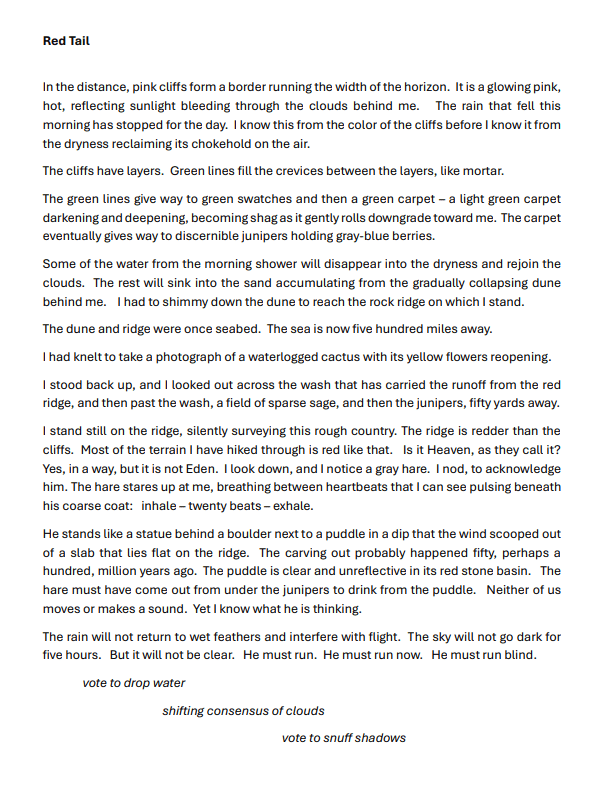
Thank you. It’s a textbook example of my approach to poetry. I call it “ontological structuralism.” The theme is the intersection of the metaphysical and the physical – the divine and the natural, which is something I’m exploring from many angles, with several poems that I hope to bring together in a collection to be titled Eden. There is a resurgence of that these days, which is good. I kind of bring it front and center though – treat nature as if we are not the only beings that have consciousness, that reflect on the condition of our souls and have a sense of the moral architecture, rather than merely the functionality, of the ecosystem. Why assume we are the only creatures who have that sense? Is it just because animals don’t speak our language? But others have made that point. What’s unique is the structuralism – the degree to which I use the poem as a visual, like a painting, and use its physical attributes to carry the meaning – which can be something as subtle as using justified font and layered sub-paragraphs within the prose section to resemble the horizon-wide walls of our exile, as described in the same paragraphs, followed by a haiku that drifts across the page like clouds. It’s not always a concrete poem, or a concrete adaptation of a traditional structure. Sometimes it’s punctuating with slashes that resemble rain that is mentioned in the piece, or omitting commas from a description of a Debussy musical movement that just runs on and on. I make every aspect of the poem carry the weight of its meaning. I combine this with textual elements – for example, the transition between red and green is signaled with a yellow cactus flower – the yellow is the yellow of a traffic signal, cautioning both the narrator and the reader. That the flower is a cactus is a reminder of how precious the water is – the water that the mercurial clouds gave the hare, but in such a way as to force him to come out of safety under the junipers to the exposed position he now occupies on the red rocks, where they’ve left him stranded (either raining a bit more, or breaking apart and letting the light through, would have helped the hare, but he gets neither). The trick is to not force it – there are yellow flowers and magenta flowers in the setting I selected for the poem, and I referenced the yellow only, because the symbolism worked. I’ve never used yellow as the lead color in a poem – even the sun in Betsy “paints the room orange.” And the refracted light coming through the water-covered plastic to the drowning rat in Commendation of the Damned is red and blue WITH green, white and gold – gold, not yellow. There must be some subconscious reason why I avoid yellow as the main act. Betsy’s pills are yellow – maybe that counts. The daylight is yellow in To Be Noticed. Okay, maybe I use yellow enough.
LikeLike