
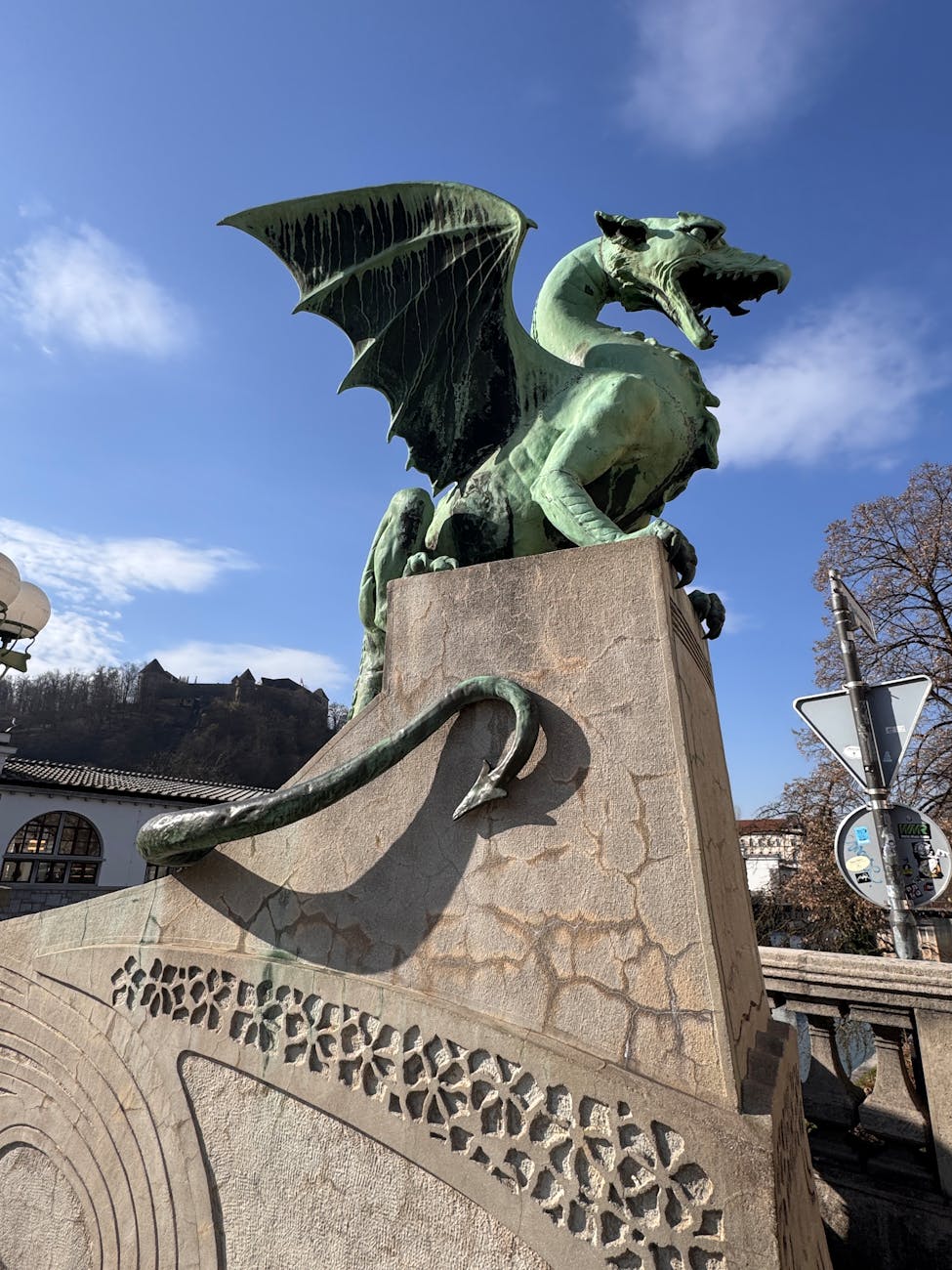
The Dragon at Lane’s End
Ron Wetherington
It does not do to leave a live dragon out of your calculations,
if you live near him.
J. R. R. Tolkien
They said it had been lurking there for decades, in the abandoned house at the end of the short lane. I’m not sure anyone had actually seen the dragon. No one I spoke to had, anyway, except maybe Billy Hogan, age 12. When I interviewed him he hedged a bit. “I might ‘a seen part of him,” he offered, not looking at me directly but rather down at his hands.
“Which part?”
“Well,” he mumbled, “his tail.” He looked up at me. “Or part of his tail, not the end.” He returned to examining his lap. Billy clearly didn’t want to talk about it, but I couldn’t tell if it was because he was frightened or embarrassed. Or making things up.
I had to piece this story together from several accounts, and most people willing to say anything about it spoke reluctantly. Everyone, though, admitted that accounts had been lingering for as long as they could remember, surfacing now and again in whispered talk. Never introduced directly.
“I remember my granddaddy mentioning it,” Edna McCreary told me. She must be in her eighties. “He saw him a couple times.”
“In the old house?” I asked.
She hesitated. “Not in the house. He was always outside. Once on the porch.” She was pouring us tea at her kitchen table. “One time it was in the side yard, under that old oak.”
“Did he say what it looked like? How big it was? What color?”
“Well, he said he couldn’t see it really well.” She sat at the table. “It was early evening, first time.” She took a long sip, cautious about her words, or maybe just trying to remember. “Same color as the ground, or the tree, sort of gray.” She looked over at the hound lying near the stove. “’Bout the size of old Duke there,” she nodded. Duke raised his head and looked at her. I figured Duke was about three feet long, sixty pounds or so. “But longer, with its tail,” she added.
“How about the second time?”
“That was on the porch. Just lyin’ there. Nose between the slats of the railing.” She looked at me curiously. “You writin’ a story ‘bout the dragon?” She frowned, as if to scold me. I nodded but didn’t say anything. “Nothin’ to write about,” she said.
No one else I spoke to had any direct accounts of the dragon. The townspeople were aware of it and kept it in mind, but not close to mind. Strange. Winton is a town of several thousand people and one matter-of-fact dragon. And what about the house?
“Been vacant for years, I reckon,” the chief of police told me. “Least, never seen anyone in it.”
“You ever been up there?”
“Nope.” He glared at me. “Sign at the front says to keep out.”
❧
The old clapboard two-story house sat back on the big lot at the end of Harmony Lane, in a cul-de-sac. The places on each side were vacant, a for-sale sign in one yard. The house didn’t seem to be in disrepair, and the land it rested on was almost solid ground cover. No weeds. One large oak stood on the left side. Nothing more. A tall wrought-iron fence appeared to surround the property, and a double gate crossed the concrete driveway. I stood on the sidewalk, studying it. I guess I could imagine something evil or threatening or scary there, but in fact no one had used those words.
“Curious about the old place?” a voice behind me asked. I turned and saw an elderly man wearing a black shirt and clerical collar.
“Waiting for the dragon to come out,” I laughed.
“You may be here awhile,” the cleric said. He smiled and introduced himself as Father Timothy, from Christ the King Church just off the town square.
“Haven’t seen you before. You visiting?”
“John Fremont,” I said as I took his hand. “I freelance for a few of the state’s weekly papers and heard some rumors about the town dragon.” I looked back at the house. “Haven’t spotted it yet. Haven’t spoken to anyone who has.” I tried not to sound judgmental.
He stood beside me, following my gaze at the old house. “Maybe we should have a chat,” he finally said. The note of gravity in his voice was interesting, and we walked to the rectory, just a block away. The front room of the small house was quite welcoming. I accepted his offer of coffee and examined the room as he left to fetch it. A traditional sofa and love seat faced each other across an old walnut coffee table. An armchair was at one end. It was the kind of room where a priest might counsel parishioners. Warm and safe.
“What kind of story are you planning to write?” Father Timothy sounded tentative as he brought the coffee. He looked at me as he lifted his cup, sizing me up.
“Don’t know yet,” I answered. I took a sip. “Maybe none at all.” It might be good to reassure him. “I haven’t heard much to even confirm that there is a dragon.” I looked closely for either affirmation or dismissal. His expression was calm but reserved. Since he had initiated this, I kept quiet. Still holding his cup, he said, “You’re not likely to get much.”
“Have you seen it, Father?”
He studied me a moment, put his cup down, then said, “In my line of work, John, you don’t need to see a miracle performed to accept it.”
The odd intersection of dragons and miracles was unsettling. “What strikes me, Father, is that no one I’ve spoken to denies there is a dragon, and yet no one seems apprehensive about it.” We sat quietly, each taking a sip of coffee. “It’s as if people take the dragon’s presence for granted.” I looked at him directly. “As an act of faith.”
The priest nodded slowly. “Yes,” he said.
“But why?” I asked. “And why not talk about it?”
“Are you a man of faith, John?”
The old priest seemed to love non sequiturs. “I was an altar boy when I was twelve,” I said. “Haven’t been to church in a while.”
His gray eyes sparkled. “Faith, you may know, goes beyond the church.” He leaned forward. “Church is often where it’s secured.” He relaxed in his chair, his creased face softening. “There are congregations of different religious faiths here, John, but all are single-minded in a collective devotion to the past.” He paused, choosing his words. Finally, he said, “That devotion is protected by a faith that’s both sacred and secular.”
“Protected?” I asked. “Why does a sentiment need protecting?”
He folded his hands and leaned forward. “Because, John, the past is endangered. Every time a house goes on the market. Every time a storefront becomes vacant.” There arose a sense of urgency in his voice. “The world beyond Winton has many a shiny object and many people, especially the young, fancy shiny objects.” He leaned back, holding out his hands in a beseeching gesture. “Even while they value the spiritual security of home, the temptation to explore is always strong,” he said, refolding his hands, “until something—perhaps an insistent memory—invites them back.”
“But…a dragon?”
He only smiled. This was all he seemed inclined to say. We finished our coffees.
❧
I thought about this as I wandered back into the village. People here are mostly farmers, shopkeepers, tradesmen. Pretty isolated. Maybe wanting to keep it that way. How deep does it go, I wondered, this devotion? I caught the police chief leaving the coffee shop and asked him, “Are there historical records in the town hall?”
“What kind of records?” He was a bit impatient, but not hostile.
“Like property records,” I said. “Like deed records for that old house where the dragon lives.”
“Well,” he hesitated, “for that, you need to go to the parish office at Christ the King. They own that property.”
I was dumbstruck. What was the church’s interest in such a place? And why hadn’t Father Timothy mentioned it? I crossed to the small church, an unimposing stone building with a small belltower. In the vestibule, hymnals were stacked on shelves and a bulletin board displayed personal announcements. A dozen pews were set on each side of the aisle, which ended in a communion rail separating a small platform and altar. There was a simple altar screen behind it holding a wooden crucifix. The church was empty. The sacristy office to the left of the altar was closed. The smoky scent of incense, slightly pungent, lingered in the air, mixed with the faint smell of oak. I walked back to the entrance.
As I approached the vestibule, my attention was drawn to the small lunette above it. The painting on the semicircular panel was faded, but it was clearly the figure of a dragon, covered in blue-gray scales. Its tail was wrapped around it and its long neck was raised in a graceful curve. The mouth bore sharp teeth. Its reptilian eyes were intense.
I remembered European cathedrals I’d visited over the years, where images of St. George slaying the dragon are common. Dragons and the Church were never strangers to one another, were they? But those dragons embodied evil, and the labor of St. George declared the triumph of good. This dragon occupied a place of benevolence—looking over the faithful as they entered and left the house of God, sort of protecting them from evil that lurked out there somewhere; preserving the common good that dwelled within.
Maybe the priest was right. In this small settlement, both the sacred and profane had a common mission. It was late afternoon as I walked back to Harmony Lane and stood, again, looking up at the vacant house. I recalled Father Timothy’s words: the past is endangered. Does the very idea of a dragon help to preserve it? Does the church’s deed help protect this devotion, as it preserves its dragon? That’s such a tightly wound illusion, I thought; a really decent communal myth. I suspected that a news story would likely misrepresent that notion if I ever actually wrote it.
As I turned to go, I had a disarming flash of something climbing the large oak next to the old place. I looked closely, coaxing my imagination to pause. Did a tail curl as it dissolved into the heavy foliage? Maybe so—yet the fuzzy-edged parts were beginning to run together like iridescence on an oily surface: the foliage hiding the dragon, the dragon curling its tail, Billy Hogan’s memory and Edna McCreary’s story and all of the discreet whispers wrapping the town in a comfortable cloak of identity and anonymity.
As I drove off, I was pretty certain I wouldn’t be coming back. I also knew I wouldn’t be writing that story, either.
Ron Wetherington is a retired professor of anthropology living in Dallas, Texas. He has published a novel, Kiva (Sunstone Press), and numerous short fiction pieces in this second career. He also enjoys writing creative non-fiction. Read some of his pubs at https://www.rwetheri.com/

