
Possessed
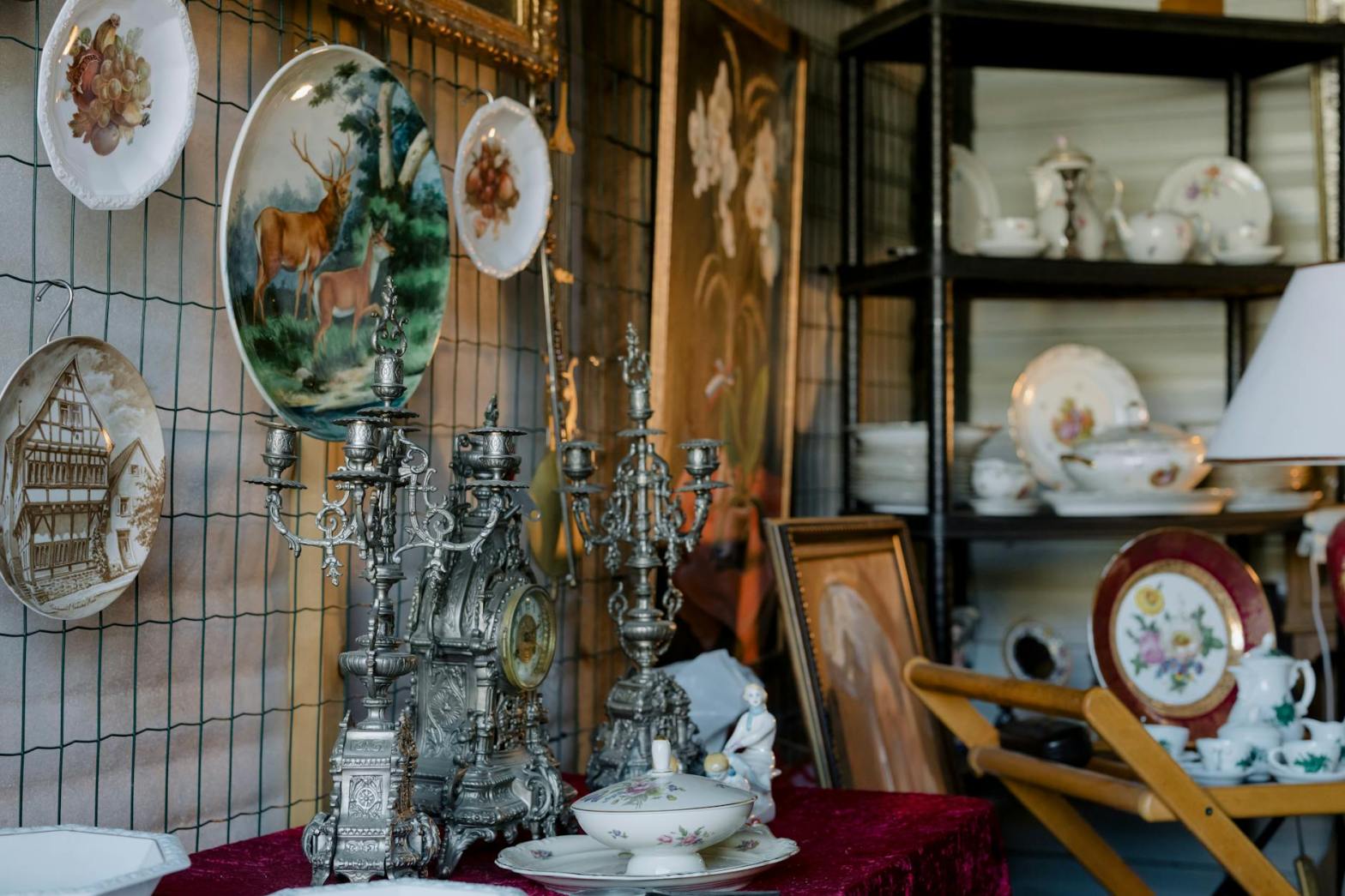
At first sight, Mary struck me as an eighty-something Jane Austen in Spandex—barely five feet tall, thinning hair spun into limp ringlets and a messy bun, as compulsive a talker as Mrs. Bennett in Pride and Prejudice or Miss Bates in Emma. At the antique mall where she still worked, she led me past glass cases crammed with vintage jewelry, along shelves stuffed with piggybanks and music boxes—their tiny dancers frozen mid-twirl—and around a six-foot suit of armor. Chattering nonstop, she traipsed to the back of the store and back in time, where dealers had jammed their booths with china cabinets, spindled bassinets, wooden snow shoes, and cross-stitched platitudes. Like Mary, the place went on and on.
My stepfather, still spry at 92, strode behind us. Carl met Mary here shortly after my mother died, and they have spent countless hours gleefully thrifting. Her home was a miniature mirror-image of this sprawling asylum for castoffs—every surface littered with tchotchkes, walls covered with framed jests, closets brimming with musty clothes and canned food stockpiled during the pandemic. Whenever Mary’s nephew hauled away the excess, she replaced it all within weeks.
Every visit made me shudder. A purger by nature, when I downsized from 2,500 square feet to 500, I felt freed to live a larger life in a smaller space. I do hoard one thing—words, specifically words for every essay: descriptors for a sculptor’s tools, a horologist’s watch parts, and cloud formations for a piece about cloud spotting. But Carl doted on Mary, so I submitted to these visits, taking deep breaths until we could leave.
Prompted by falls, frailty, and forgetfulness, last year Mary moved into a nursing home, which curbed her hoarding. While my move allowed my soul to expand, Mary’s circumscribed hers. Reduced to one room of possessions, she left those behind when congestive heart failure took her to hospice, where she slept and raved, slept and raved.
As her organs began shutting down, she entered that liminal timespace where no one can predict how long dying can take. I saw with Carl, now frail enough himself to fade away, amid his own clutter. Did dying wrench away all of Mary’s acquisitions—the belongings that, to me, encumbered her life but which may have shielded her from the losses of aging? Will my death be just one more relinquishment? Will I take my time going where I don’t know what to expect, the place only words take me, the home they’ve given me all these years? The words Austen wrote when she was forced to leave behind her birthplace come to mind: “when shall I cease to regret you!—when learn to find a home elsewhere?”
Gail Tyson’s writing includes The Vermeer Tales, a chapbook of prose published by Shanti Arts, and recently her creative nonfiction has appeared in About Place Journal, Catamaran Literary Review, and Still Point Arts Quarterly. An alumna of Stanford’s Creative Writing Program and the Dylan Thomas Summer School at the University of Wales, she has made her home since 2023 in Santa Cruz, CA.


I read this piece with interest, Gail. I think a lot of people can relate to your downsizing experience, but there will be those who can relate to Mary’s experience, too.
LikeLike