
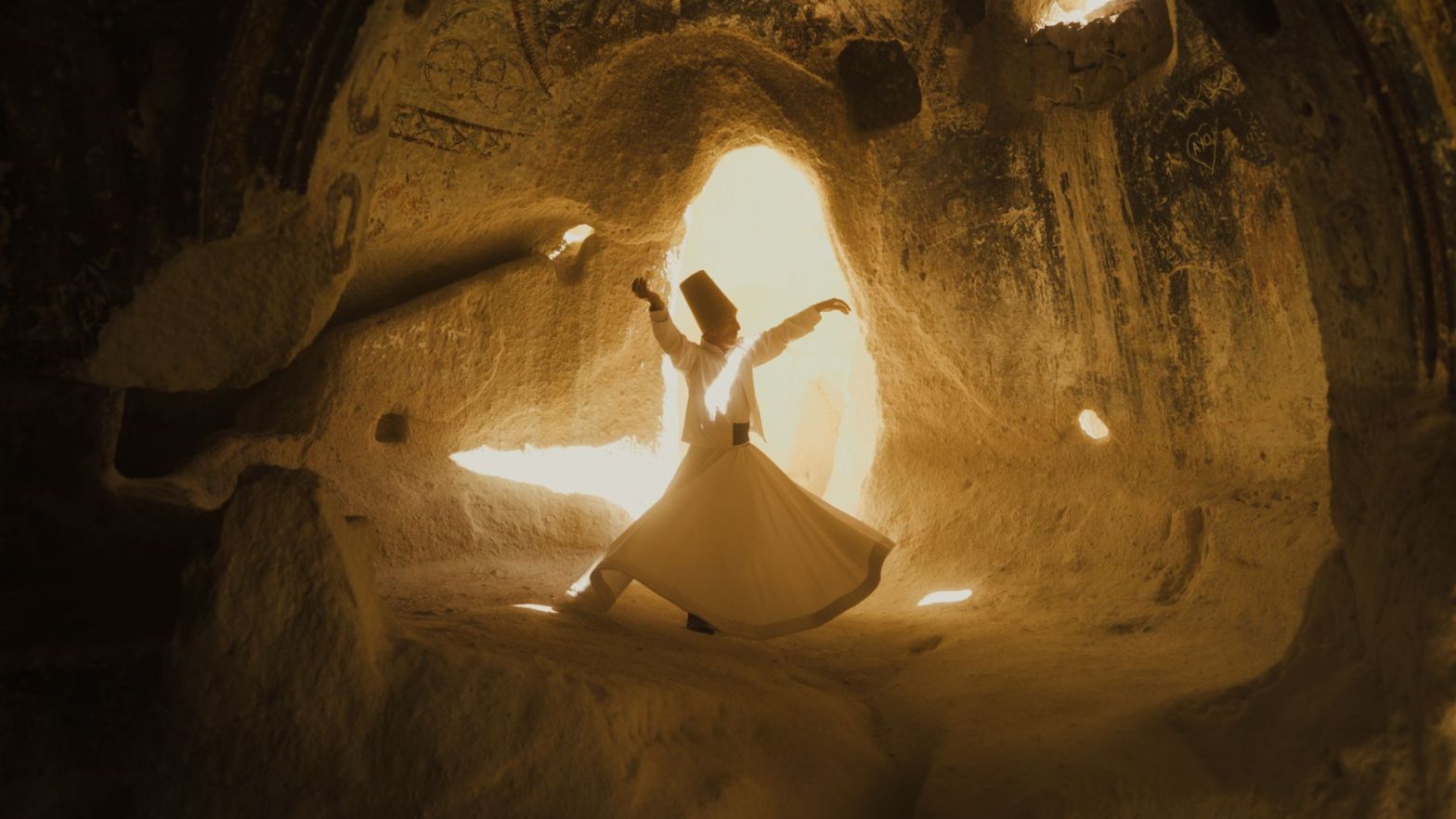
Ecstatic Axis

In an old Turkish city,
a black cloak is worn to be shed,
as dancers align themselves
with the turning world.

Meshing gears move clock hands
to the right, around the face.

The dancer-as-axis spins left
and the ensemble flows right,
spin and counter-spin in balance.

A tall black hat is worn throughout,
a still point within movement.

Arms are lifted
with the right hand palm-up,
receiving grace, and the left hand
palm-down to share what is received.

The long white skirt
lifts and turns,
like vast star-field spirals
that wheel in the black,
and hidden turnings
too fast to see.

The reedy ney,
all fire and longing,
and heartbeat drums
that keep the dancers whirling,
wind down and pause.

Heads bow
in rippling silence
as incense rises.

A man dressed in red
recites Rumi softly.
Bob Rama lived and studied in East Asia for thirteen years, primarily in Japan. His work draws on Japanese aesthetics. He now works as a translator in Ann Arbor, Michigan.


beautiful, thank you!
LikeLiked by 1 person
I read this deeply spiritual poem until I realized how Bob utilizes incredibly rich, precise imagery and specialized terms to ground the physical and spiritual geometry of the dance. I encountered words and phrases that built a vivid picture of the ritual:The ney is an ancient, reedy end-blown flute central to Sufi music. Rama describes it as “all fire and longing,” which perfectly encapsulates how it mirrors the human soul crying out for the divine. Phrases like “the dancer-as-axis” and “spin and counter-spin” introduce the physical mechanics of the ritual. The “axis” is the stationary center around which the entire universe seems to revolve. The mention of the “tall black hat” acting as a “still point within movement” is a beautiful nod to finding inner peace amidst outer chaos.
Simply put it: I love it!
LikeLike