Overheated  (Tamid)


Three places—in the chamber of incense,
in the chamber of the spark, and the fire chamber itself,
the priests keep watch in the temple,
The fire chamber, the largest, was vaulted,
surrounded with stoney outcrops,
much in the manner of the time.
This is where the elders used to sleep,
having with them for safekeeping the keys of the Azarah.
But in the upper chambers—a secret place—above the spark
the priestly novitiates keep watch themselves--
they did not sleep in their sacred garments,
but took them off, folded and placed them
beneath and covered themselves
with their ordinary clothes.
If an accident happened to one,
he would go out and take the air
much in the manner that his elders
have ever since recommended—
and sometimes have commanded
surely, since the beginning of our people,
the beginning of time.
And he has obeyed, as if listening to the law
was nearly the equal of heeding a parent,
And who among us is to say it is not?
Alan Walowitz, from Great Neck, NY, is a Contributing Editor at Verse-Virtual, an Online Community Journal of Poetry. His chapbook, Exactly Like Love, comes from Osedax Press. The full-length, The Story of the Milkman and Other Poems, is available from Truth Serum Press. Most recently, from Arroyo Seco Press, is the chapbook In the Muddle of the Night, written trans-continentally with poet Betsy Mars.
Meditation


I sit, wrapped in a duvet, by the window.
Outside, the streetlamp sends a yellow glow
across the blankness of the neighbour’s wall.
What else? a pole, a clothesline made of cable.

A distant train horn sounds its two-note warning;
somewhere its headlamp slides towards a platform
where people hang about with bags and coffee,
ready for doors that open on urgent journeys.

Meanwhile, the sun is rising, the wall whitens.
Someone unlocks their door. A scooter guns
between the houses, joins the traffic sounds
that heave and flow about me. The pole is rusting,

the empty cable sways upon the breeze.
I sit among the beingness of things.
Rowan Middleton teaches English Literature and Creative Writing at the University of Gloucestershire. His pamphlet The Stolen Herd is published by Yew Tree Press.
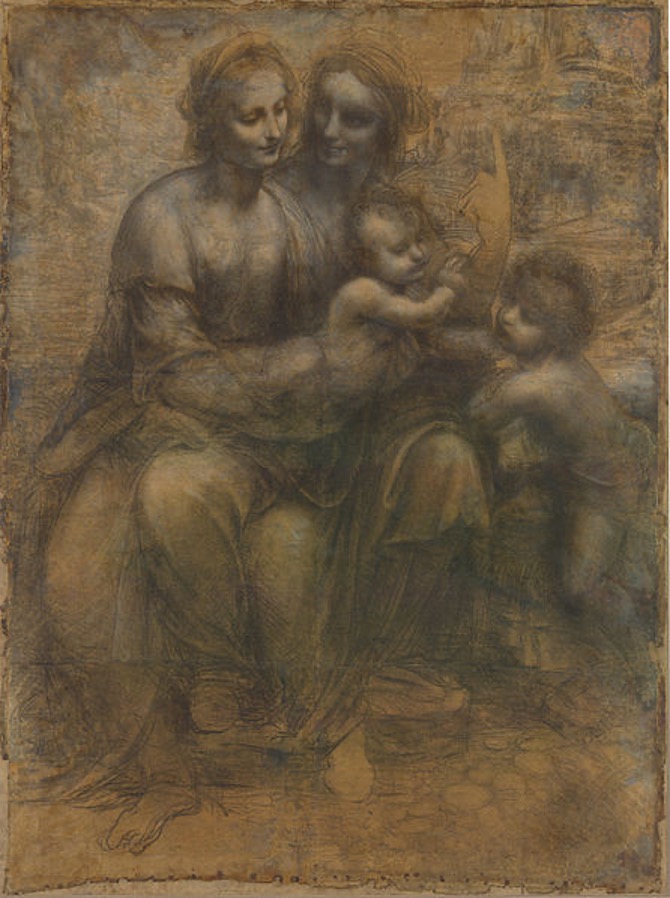
Leonardo da Vinci, The Virgin and Child with Saint Anne and the Infant Saint John the Baptist ca. 1500 National Gallery, London
About Blessings and Fish


My son,
the Blessing,
squirmed like a fish in my arms.

My mother
said, You are
my blessing. Now sit on my knee, she teased.
I perched, and my squirmy Blessing
blessed John with his little
fin,
swimming,
tummy-down,
as John gazed
at him.
We all grew
still.

Then I saw: blessings,
can often be squirmy things.
I said so to her, part play.  But I pondered
their ways
and turns:

blessings have their own intent–
divine
design squirms against
our restraining
embrace.

My mother blessed me then, eyes
deep as a spectre’s abyss,
she pointed upward,
her hand so like
a sceptre
Johanna Caton, O.S.B., is a Benedictine nun. She was born in the United States and lived there until adulthood, when her monastic vocation took her to England, where she now resides. Her poems have appeared in The Christian Century, The Windhover, The Ekphrastic Review, Green Hills Literary Lantern, The Catholic Poetry Room, and other venues, both online and print.
Carlene Kucharczyk is an American poet and essayist, who lives in Vermont. Her work has appeared or is forthcoming in journals such as Mid-American Review, Conduit, Green Mountains Review Online, and Tupelo Quarterly, and has been nominated for a Pushcart Prize. She holds an MFA from North Carolina State University.
Going for RefugeBuddham saranam gacchami
singing from the singing bowl
sandalwood scented smoke
loving-kindness Oh longing
for kindness and for escape
from all that weighs down -
from samsara - into this refuge
sangha set up it seems to outface
my lonely unlovedness with
chanting brothers and sisters
I go for refuge untie my
family try to untie my other knots
with love before Teacher I bow
my eyes lowered to his sandals
I offer him a wispy-white scarf
Insider now I call him Venerable Sir
in Pali - it sounds like Daddy
Like a number of the younger men
his cadre of committed votaries
I am invited to Teacher’s bed
where I am very special
till he shows his non-attachment
so that I may come at last to see
the tantric juxtaposition -
my young heat with his cold
white body jolting me
out of my ego conditioning
Mark McDonnell had a long career in industry, living and working in Barcelona, Miami and Cambridge, England. He then trained as a psychotherapist and began to devote more time to writing. His work has been published in Rialto, Ink Sweat and Tears, Morphrog and The London Grip.
While Listening to Fleck, Hussein and Meyer,
I Consider Children's Book Titles,
Hops and the Ongoing Search for Meaning


If we unravel the threads, removing
context, by what means do we regain it?
You say monstrous glisson glop, behooving
me to counter with a Willamette
and Azacca, or whole cone Mosaic,
which inspires a reply of Dooly and
the Snortsnoot. But my life is prosaic,
bulging with the commonplace - gritty sand
in shoes, cobwebs on shelves, an unshaven
chin and a mind for the ordinary
seeking refuge in words, a cool haven
in summer's long grip. Feathered or hairy,
I ask of the glisson glop, seeking insight.
Does it giggle, does it love? Do you bite?
Robert Okaji lives in Indiana. His work has appeared in Buddhist Poetry Review, Evergreen Review, Midwest Zen, Vox Populi and elsewhere.
Lament

One morning, after a quick
thaw, the frozen creek begins
 to breach beneath blue ice

a slow crack becomes an
exuberance of water shifting
its weight, bank to bank, until

slabs of ice rise like monoliths
in this wilderness, shimmering
in its moment of being

solid and striking, despite
the flood’s ability to take
everything with it

One day . . .
I imagine I will see
it happening
M.J. Iuppa’s fifth full length poetry collection is The Weight of Air fromKelsay Books, May, 2022, and a chapbook of 24 100-word stories, Rock. Paper. Scissors. from Foothills Publishing in 2022. For the past 33 years, she has lived on a small farm near the shores of Lake Ontario. Check out her blog: mjiuppa.blogspot.com for her musings on writing, sustainability & life’s stew.
Don’t Tempt Me

eve   drop the apples
keep your hands up
and mouth closed
here  take a mango
Patricia Biela is a UVA grad with a BA in Psychology. Biela is a Cave Canem South Fellow and has participated in 19 writing workshops. Her poem “Back Speaks” won The Best of Poetry from Around the World Award from Wild Sound Festival Review. Biela teaches poetry workshops to retirees.
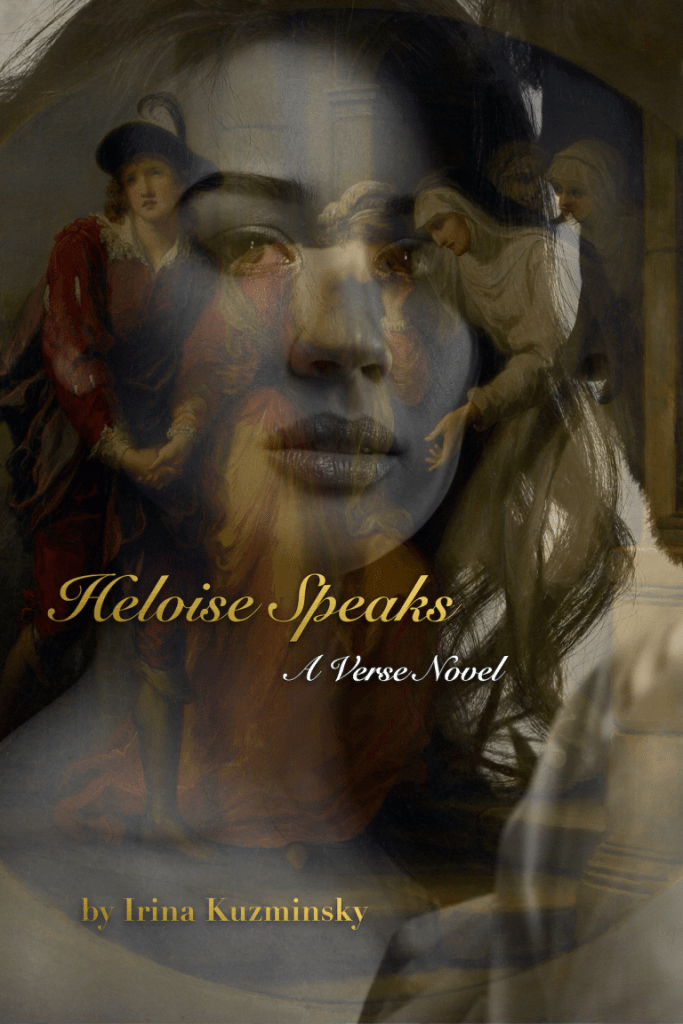
Review of Heloise Speaks: A verse novel (Amethyst Press, 2022)
Deftly folding in scholarship, historical names and references without overloading the verse, Kuzminsky traces the 12th century story of Abelard and Heloise in a series of verse ‘letters’ based on existing letters that the two figures exchanged. Except Kuzminsky’s stanzas are from Heloise alone, we hear of Abelard through them, not from him.
Heloise’s love, her insights, her ambitions, her entreaties and the events themselves are wrought skilfully into a language that is accessible to our modern minds, while imitating faintly a medieval style of expression, an effect which is sustained throughout the text without ever sounding forced:
       ‘He prophesied a future for me golden and bejewelled
        Like the fair heavenly Jerusalem
	But all I felt was the unused to warmth of his caress
	And when I kissed his ring
	I made a silent vow:
	I would not be a nun or learned Abbess
	I would be learned, of course,
	But, though a woman, I would find another way.’


Verse by verse, we are taken through the painful journey of love – body and soul – into the lovers’ separation, followed by disaster when Abelard is castrated by order of Heloise’s guardian as revenge for seducing and marrying her in secret. Early on in the collection Heloise describes the embodied experience of her love for Abelard:
       ‘I am adrift
	I am aflow
	I’m me – and more than me
	I’m matched and mated’
But all too soon, she feels alarm at Abelard’s subtle drawing back:
        ‘But I can’t reason with a razor’s edge
	Or have your categories plague
	The living touch out of my speech.’
And much of the power of these verse letters lies in the tension Kuzminsky’s sometimes blunt sometimes wistfully idealistic lines convey as Heloise oscillates between celebrating her love, and bemoaning the gradual betrayal of it:
        ‘I thought we were beyond misunderstandings
	That you should think I should need proof of you
	Of your fidelity
	(or maybe it is you who wanted proof of mine?)
	Means to me that we are no longer one’
Heloise fears the betrayal not of Abelard the man so much but of his conditioned mind, of the intellect’s ability to rationalise away the reality of physical and spiritual union. But after Abelard’s terrible maiming, Heloise wonders if she herself was not to blame:
                                           ‘What prompted me
	To marry you and bring about your fall?
	Now claim your due, and see me gladly pay…’

So ends Part I, in which Heloise speaks as student and lover. In Part II she is scholar and abbess, and what she ‘pays' for Abelard’s ‘fall’ is to enter a convent where:
     ‘Years darken the threshold of my cell
      In a monotonous procession.’

The former lovers continue their correspondence, but Heloise’s oscillation from love to loss intensifies as present events give way to memories and hopeless longing for the past. These stunning lines convey her anguish:
        ‘I’d swallow up the universe in that hole
	And crush all particles till they released their light-filled essence
	And then I’d swallow that light too
	And still it would not still nor sate me’


All the passion in the universe flows through her but she cannot reach back to what used to be, expressed again brilliantly in this stark, poignant counterpoint:
       ‘You knew how to speak true
	Once’

While in beautiful, swift imagery Irina evokes the barren convent and Heloise’s desolation:
       ‘Your words to me are colder than
	A bare stone floor
	And just as comfortless
	As sleet in winter’

Even as she achieves renown and status as Abbess, Heloise’s story of agony and ecstasy rolls on through her reflections. And perhaps Kuzminsky’s greatest achievement in this finely crafted retelling is to convince us – after so much turbulence – of the peace which the elderly Heloise, her hair now ‘pristine white’, finds as she contemplates her life and her love one final time:
       ‘At last, now, I know better.
	I should have loved you even more,
	With more surrender, greater selflessness,
	For when I measure up my love to Christ our God
	And to Our Lady’s love for Him,
	Her Son, Whom She knew dying, broken,
	buried by Her hand
	I’m but a tiny midge
	Caught up in a huge swarm
	And all my suffering could never merit
	The joy of knowing that I knew a little
	What Love is
	Through this, my love for you.’

The skill and beauty of this telling is in itself a substantial accomplishment. But ‘Heloise Speaks’ also offers the modern psyche vital nourishment through the expression – and reminder – of the sacred power of feminine passion.

Heloise was exceptional in her time for her achievements. Throughout these verse letters she ponders her roles of scholar, lover, wife, mother, abbess. While our own stories are not as dramatic –  usually nowhere near as tragic –  we also balance love, marriage, motherhood and career or artistic calling and find that we are not fully any one aspect. Gradually –  and often catalysed by passionate love for another – we free up from our roles and our heartbreaks, and embody the lightness of love:
       ‘For I am Woman
	Holy Spirit
	Shekinah
	Sophia
	Mary
	Eve
	Mysterious Dove
	Wings strong enough to break through any cage’
May the Circle be Unbroken

At nineteen,
I learned I couldn’t hold
anything in my hands.

Even my heart sat on sinews,
waiting for directions
from my soul, waiting for my
bones to call it beautiful.

When I took my whole
heart to a holy
space, I reached for a
long, slender door handle, installed
by hands I never touched.

The grey-green
slate seemed impenetrable
until I put one sandaled foot
in front of the other, stepping on well-
worn stones. The absent voices
stored in the wood beckoned me.

In this sustained,
constrained-open
place, I knew the high triangular ceilings
would catch me if I faltered.

God stirred together
a strange alchemy,
wrapping me in warmth
while hushing me
in awe.

My fingers gripped
the rosary
I received at Confirmation
with its
black
obsidian beads.

All the way around,
ten to a set, I held
each bead between
index and thumb,
saying one Hail Mary
after another
into reverie.

Fingers on black beads;
atom on atom—there’s still
space

between everything
we touch.
Jessica Mattox is a PhD student in English at Old Dominion University and an adjunct English professor. In addition to writing poetry, she is passionate about the teaching and learning of technical/professional communication and first-year composition. Her poems have appeared or are forthcoming in Last Leaves Magazine, The Album at Hollins University, Exit 109 at Radford University, and others. In addition, her academic scholarship has been published in the Virginia English Journal.

 Amethyst Review