
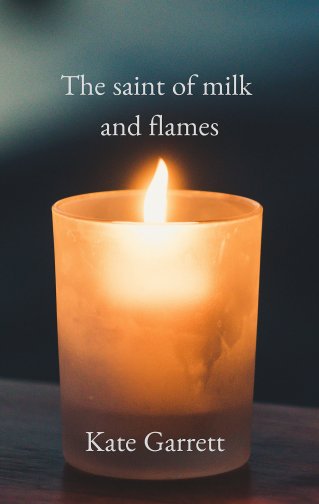
Review of The saint of milk and flames: poetry collection by Kate Garrett
78pp, Rhythm and Bones Lit
Review by Anne Maguire
Reviewing poetry is never easy as it is such a subjective art. What I like (or dislike) changes according to mood and how it sits with what else I’m reading. There is an excellent article in the Spring 2019 Poetry News, from The Poetry Society, about poetry reviewing. Written by Sarala Estruch it says that it is important to deduce what the work is doing – or trying to do. It also suggests the reviewer should have sensitivity, imagination and generosity.
I’m not sure Kate Garrett needs much generosity from me when considering her new collection The Saint of Milk and Flames. Published by Rhythm and Bones Press, the book is beautifully produced and presented. There are several truly memorable poems, some phenomenal lines and as ever some poems I’m not sure I understand. That’s fine by me as I like a collection where I have to revisit and maybe even do a bit of research.
My way of reading poetry is to read fairly quickly through the whole book once, not marking or noting anything, just getting a feel for the whole collection and how it builds and fits together (or doesn’t). Then I read the second time, slower, with a pen and I underline, I draw little stars on lines I want to revisit and I make notes beside words or references which I’ll need to look up. Then I read the notes etc on the third time through and look up what I need to. I put the book away (length of time depending on my TBR pile and how much I enjoyed it) and revisit again. At this stage I make notes in the front of the book with a date. When I revisit the book, months/years later I can get straight into the mindset and I may revisit the poems I struggled with to see if my understanding has changed. Often it has – as I mature as a poet and a reader.
The second reading of “The Saint of Milk and Flames” generated a lot of writing! Underlining beautiful lines, starring particularly interesting combinations and noting things I want to look up. Ms Garrett gives notes and explanations for some of the poems but 3 lines about a man horribly effected by the death of Joan of Arc, just left me wanting more. I love it when a poetry book does that to me. The need to know more so I can revisit the poem from a stronger position. There is a lot going on in this slim volume.
Poems about birth and death and every stage in between are interspersed with heart break or humour. There are several poems about babies, about looking after babies and the mistakes they sometimes are. One of my favourites is called “Late/1979” and has the lines:-
‘And his mother said, give the baby
to us, we’ll take care of it. And my mother
said, we’ll keep it, don’t come round here
or I’ll deck you, and my father cried at the table,
and I never wanted it.’
There is an entire season of a soap opera in those five lines. I see the girl’s parents and the young man’s mother sizing each other up and standing their ground while the young pregnant girl despairs. Heartbreaking and yet life affirming in a mere few words. Very skilful indeed.
Another poem concerns the end of pregnancy through an Appalachian granny witch, and another the end of child bearing via sterilisation.
‘…She ends your child-growing years for good,
for life and death reasons, and you feel the pinch and pressure
as she cuts off this handful of possibilities.’
How strong is that last phrase? ‘handful of possibilities’ is such a profound way to think about the lottery of birth.
There is a lot of family and strong emotions in this collection and it is difficult not to superimpose all of the feelings on to the poet because of the strength of the work but that is not necessary to enjoy the poetry and to quietly hope that no one goes through (or has gone through) this amount of heartbreak. Abortion, domestic violence, death, difficult mothers, miscarriage – universal traumas that will speak to many people.
Choosing individual lines or poems to focus on is difficult but needed to give a true sample of the depth of the emotion captured here. In ‘Happy’ referencing a woman who ‘almost had a son’, we learn:-
‘….She is happy.
Of course she is happy.
What else on earth could she be?’
I hear a relative answering a neighbour’s well-meant question. Slightly exasperated but moving on.
There are many real people and mythical people in here, too. Jeff Buckley – ‘…the songs all sound like love and mourning and I don’t know at the time that I already understand them both.’ This use of tense makes the line a jolt and emphasises the emotional hook. Gilles de Rais was the guy never the same after Joan of Arc died ‘angels and demons want the same things’. We have St Winifred, the Salem witches, Mother Shipton, Harry Houdini among many others.
The poems which resonated most with me are the ones which most mirror my own experience. A prose poem called ‘In the brown Camaro’ has a line ‘The other girls will wear neon and spandex, new leotards, but I’ll be wearing sweatpants six months too small.’ I totally get that measurement having often worn clothes like that (my mother loved the Bay City Rollers as she could add tartan to the bottom of my trousers and I’d get another six months out of them as I grew). And in ‘My mother sits in judgement of a nymph, a saint, and me’, the mother sits ‘unbalanced on her pedestal stacked with years of rot’ and reminds us that not all mothers are wonderful, life affirming women.
My favourite line is in a poem about the writer’s son being taken for an ECG (I have no idea if this reflects Ms Garrett’s lived experience) and finishes ‘people say follow your heart, but mine can’t read maps and its compass points south.’ I love that acerbic look at life and all its glories.
This book captures that acerbic nature beautifully while making you think, reflect and, more than once, give thanks. I can’t ask for much more than that no matter how many times I read it. Well done Ms Garrett, well done indeed.

 Amethyst Review