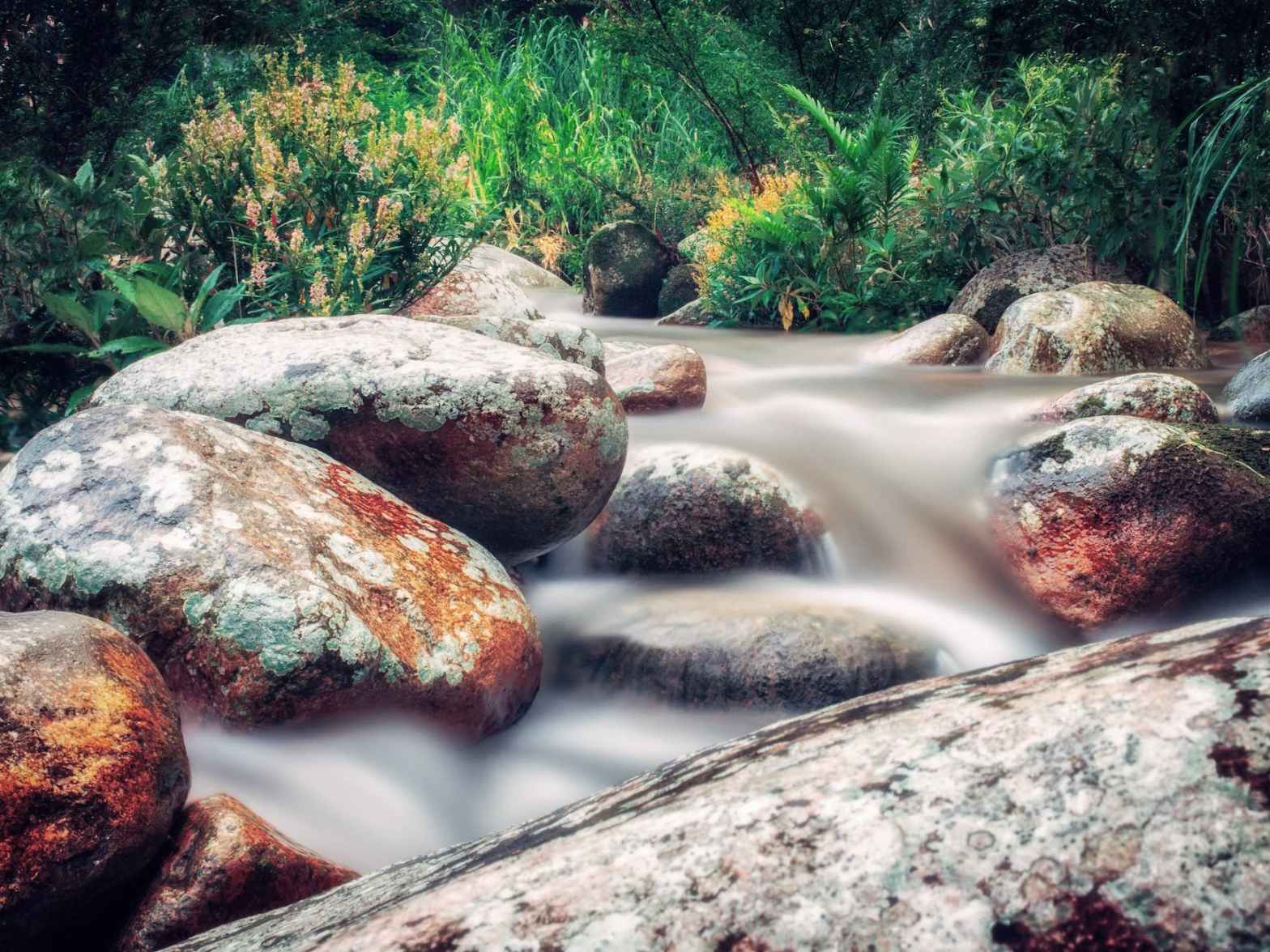
Cresset Stone – a poem by Alice Stainer

Cresset Stone* 

There’s the stillness       and the flicker     
quivering    into the cowled dark.     It sparks   
in hollowed spaces     hallows them     over again.

There’s the meeting       and the passing.
It lights the liminal     the crossing places 
pilgrim pathways     communal     or lone.

There’s the waiting       and the pressing on.
Poignant as a kyrie     that rapiers to rafters
it strives to reach     beyond its deeps.   

There’s the holding       and the letting go
release     from steadying stone     to uncertainties     
of flame     tongues     that seek new speech.

There’s the lasting       and the fugitive.
Let it show you     how to feel your way with fire  	 
earthed hands     learning    to cup light.

*A block of stone scooped into hollows holding wick and tallow, used during the medieval period to illuminate monastic rites such as matins, as well as dark passageways and dormitories. The largest example in the British Isles, comprising thirty cups, is displayed in Brecon Cathedral in Wales.

Alice Stainer is a lecturer in English Literature and Creative Writing on a visiting student programme in Oxford, UK, and is also a musician and dancer. You can read her work in Black Nore Review, Atrium, Feral Poetry, After…, The Storms, and The Dawntreader, amongst other places. Recently nominated for Best of the Net, the Pushcart Prize and the Forward Prize, she is in the process of submitting her debut pamphlet. She tweets poetically @AliceStainer.

Advent – a poem by Lory Widmer Hess

Advent


Bare branch
pale sky
moon over scattered snow

The angel’s imprint 
on empty air 

I strain to catch the echo —
“Fear not!”

Can it be
all this life
is preparation …

For what?

For meeting fear
upright
as a tree
and waiting
to break
into leaf

Lory Widmer Hess is an American currently living with her family in Switzerland. She works with adults with developmental disabilities and is in training as spiritual director. Her writing has been published in ParabolaHeart of Flesh, Solum JournalEkstasisTime of Singing, and other print and online publications. She blogs at enterenchanted.com

fall & resurrection – a poem by Cordelia Hanemann

     fall & resurrection


i
the moon rises behind the tamarack
what rustle of trees the wind ruins
bruises me through the eye of the moon
ruthlessly slicing the world into grids
of shadow and rock : my chilly night.

ii
we have ransomed grief thrown creeds to the dogs
now oblivion stalks us weighty with curses
I stand on the rock nursing my bruises
words falling like water for tears / eyes
that no longer see : the dark complete.

iii
yet gentle the moth that kisses the candle
blue flame hisses--a curse and a ruin
its wings are flaming : it flies out and up
into the tamarack / creeds break open
red fire of the paraclete : dog now rises :
all eyes upon it : a cloud of unknowing.


Cordelia Hanemann, writer and artist, currently co-hosts Summer Poets, a poetry critique group in Raleigh, NC. Professor emerita retired English professor, she conducts occasional poetry workshops and is active with youth poetry in the North Carolina Poetry Society. She is also a botanical illustrator and lover of all things botanical. She has published in numerous journals including, Atlanta Review, Laurel Review, and California Review; in several anthologies including best-selling Poems for the Ukraine and her chapbook. Her poems have been performed by the Strand Project, featured in select journals, won awards and been nominated for Pushcarts. She is now working on a novel about her Cajun roots. 

Mont Sainte Victoire – poetry by Helen Steenhuis

Mont Sainte Victoire


1.
See the mountain as a mountain,
its angular shapes and shadows,
its brush and chiseled limestone
frozen, yet moving under the moving clouds.

I knew the walls, edges and cracks.
My fingers read the rock like brail
as I climbed higher than my fear —
those were the immortal years.


2.
Then see the mountain as something else, 
a white rose with streaks of grey 
or a timeworn face.
In the rain, it turns dark blue like a wet dog	
with oceans of wind that sweep a clean facade.

Once I lived in a hermit's cabin  
reading the Greek philosophers.
I washed outside in a field of thyme,
the towering presence behind, 
and felt closer to the gods.


3.
See the mountain as a mountain.
Anchored, monumental, firm.
When it hides behind a myriad of cloud,
an echo of its form,
one thinks of the age-old proverb —
'something boundless is happening, 
but few are aware'.

Originally from Atlanta, Georgia, Helen Steenhuis has been living near Aix-en-Provence since 1989 working as an English language teacher. Her poems have appeared in The French Literary ReviewEquinox: A Poetry Journal,The Poetry Library: Southbank Centre, London, and Cumberland River Review.

After Moving to Arizona – a poem by John Ziegler

After Moving to Arizona

In the west now, 
high in stone mountains,
among ponderosa pines,
their long needles glisten
when sunlight touches them,
tops sway in the wind,
down from the Canyon.

The crows begin at 5:00, 
in nasal voices,
to share their jokes,
their liminal dreams.

The light here,
is it brighter, cleaner?
The long slant at dusk?

Van Gogh beseeched Gauguin 
to come to the south of France
for the light. This light?

When Nakai plays his flute,
it comes as coyote night chirps from Wukoki.
from yellow mesas and red canyons.

This morning I am still,
a fresh book on my lap, 
the breeze across my bare feet,
I watch the weightless birds 
float on light. 

John Ziegler is a poet and painter, a gardener, a traveler, originally from Pennsylvania, recently migrated to a mountain village in Northern Arizona.

No Great Busyness – an essay by Susan Brice

Attend to what love requires of you which may not be great busyness

(Quaker Faith & Practice: Advices & Queries No 28).

A reflection by Susan Brice (June 2023)

When you are child, life is filled with potential. You can daydream through the hours imagining your world, creating castles in the air; you can knock them down and build others. You can be anything, the possibilities are endless and you know that time is infinite. A kindly aunt or a silly uncle might ask ‘And what do you want to be when you grow up?’ The reply doesn’t matter because at this stage you really can be anything from an astronaut to a ballerina, an engine driver to a hairdresser. 

For all but a fortunate few, aspirations take a tumble when ‘grown-up’ arrives. You have to put away all of those childish dreams, you are obliged to look reality in the face. Work is what you are now that you are an adult, it is the thing that will keep you afloat in life. You will be busy, sometimes life will be hum-drum, sometimes exciting, exacting, annoying but you will be busy. You will be of use to others and to yourself. But there is something else which comes alongside the wage packet and the busyness: it is identity. 

The childhood question changes: ‘What are you, what do you do?’ To which you may respond in many different ways depending on your chosen path but being able to give an answer enables the questioner to place you, simply because you are ‘Something’. 

Kipling writes of ‘the unforgiving minute’ in his poem ‘If’. As I grew up I learned that to be and to do are much the same thing, a salutary admonishment for idlers ‘You’re neither use nor ornament’ was drilled into me. I could never be busy doing nothing. Filling minutes, being of value to someone or something in a tangible way was proof that I was worth the air I breathed.  So in one way or another, I have spent my life being busy. But now, there is a change.

I have been officially ‘old’ for quite a while now, I have a state pension and a bus pass to prove this. Retirement meant a random attack of busyness, unplanned, unfocussed. Because I have had plenty of minutes to give away, I have been profligate with them, over-filling them with things that prove to me that I am needed and that because I am needed I am valued. This has been my privilege, to have time to spend for and with others. For some years now I have taken an active role in the management of a child centre. This has taken up a great deal of my time and has become what I am – ‘What are you, what do you do?’ ‘I work at the child centre… as a volunteer that is.’ I am a Volunteer, I am useful. Then, last October, I fell downstairs and broke my foot. I had no option but to stop and wait for it to heal.

The time of waiting, with the excuse of a broken foot, gave me much pause for thought. In the midst of my great busyness with the centre, I was certain that I could never give up, I was essential to its running. The truth dawned pretty quickly as the younger volunteers rallied round. Without me they were free to progress plans I might have blocked, they were free to talk about their ideas without deferring to me. They were free of me and, although they didn’t say so, it was clear to me that I was no longer needed. Further more, the centre grew in ways I could not foresee. As I waited and reflected on all of this, I knew that my time at the Centre was over and I planned my departure accordingly.

A few weeks ago, I went in for my final day. It was an ordinary day, no fireworks, but it was the end of being on the front line. I said my goodbyes and came home. It felt right. But now that I am home I wonder who I am now? I have been looking for clues, what shall I say now when asked ‘What are you, what do you do?’The space is a gift, it scares me. The space is a gift, dare I enter it? Perhaps it will be safer to look for the next thing to do so that I can be Something? 

When I look back over my life, it feels to me that the Creator has led me to the places I have needed to be. Sometimes this has made no sense, sometimes the reasons have been clear, this time I’m not sure. I have recenlty finished reading I Julian by Claire Gilbert. It is the fictional autobiography of the life of Mother Julian of Norwich. Gilbert’s novel is convincing, founded in facts about the life of an anchorite. Julian was called to a life of contemplation, a stark, startling calling – walled up in a cell for the rest of her life. She was called at one and the same time to wait on the Creator and to be busy in her prayer life. Julian was anchored to one place. I see the parallel with my own life, I have never remained long in one place but now, I believe that I am anchored here, almost certainly, for the rest of my life. Julian believed she was called for a specific purpose, if as I believe I am now anchored too, what is my purpose? What am I called to be now?

I don’t have an answer but the idea that Love may not require of me great busyness is beginning to feel like liberation. Already, I am beginning to appreciate unfilled minutes, I take long rambling walks with my dog. I can breathe the empty air and not wonder what there is to hurry back for, I don’t have to worry about what I ought to be doing. Julian discerned that ‘The light is love, which God in his wisdom measures out to us in the best way for us.’ I am beginning to understand that we are called to wait then, my dog and I: to listen and to learn what we are and what Love requires of us.

Quaker Faith & practice (5th Edition 2010-2013) Advices and Queries No:28. 

Published by The Yearly Meeting of the Religious Society of Friends (Quakers) in Britain.

Rudyard Kipling, The Complete Verse. Published by Kyle Cathie Ltd 1990

Claire Gilbert, I Julian. Published by Hodder & Stoughton 2023

Mother Julian of Norwich, Revelations of Divine Love (1997 impression). 

Published by Hodder & Stoughton

Susan Brice lives in Belper, Derbyshire with her husband and small dog, Sunny. She has meandered through life and has learned to be glad for Light and Joy. She also understands the blessings of Darkness and Sorrow. In 2022, Susan collaborated with two friends to produce an anthology of their poems, Daughters of Thyme (dotipress.com). They are currently working on a second anthology.

Metamorphosis Concerto – a poem by Tonka Dobreva

Metamorphosis Concerto

We forgot the seasons
vividly revered by Vivaldi,
our grip, firm on the train
of Baroque-esque brocade,
woven tightly by tellurian toil.
Like Babylonian occupiers
scoffing and gnashing teeth,
we forgot the seasons.

Oh help us to remember
le quatro stagioni,
spring's nascent lungs devouring
sounds of embryonic chirping,
streams' serene murmurs
and raw thunder staccatos,
storms of spontaneous growth.

We forgot the seasons'
weeps for clamant change,
our striving swelters away
under summer's blazing rays,
giving life to surrendered
metamorphic fragments.

We forgot the seasons'
unrelenting fortitude,
autumnus, as Atlas, holding up
heaping stocks of ripe
sacral promises, gramercy
reverberating in celestial études.

And under the frock of winter,
adjusting cranial pegs
and tuning cordis harpsichords,
His hope, like tender apricity,
kisses the longing heart.

He outlasts the seasons
that we forgot.

Tonka Dobreva is a writer and Christian life coach. Her work has previously appeared in Ekstasis Magazine. Tonka is currently working on her second chapbook, Undoing

The Blessing of an Unfamiliar Place – a poem by Susan Bennett

The Blessing of an Unfamiliar Place


the orb weaver in her web 
outlined in dew greets me 
as I quietly descend the stairs

the damp grass refreshes my bare feet
as I enter the cathedral 
of the pale twilight

light spreading in the east
should be enough to convince me 
of my place In this unexplored landscape

opening my arms to the rising
sun I cannot yet see 
I greet the breath of life
the spark that animates 
the rhythm of my heart
the sea of emotions
on which I navigate my life
the stones, the bones of the old ones
the energy of the earth rises up 
through my baptized feet
up into the steel blue sky

it is enough to begin another day

Susan Bennett is a poet, activist and ritualist, leading women’s spirit circles in Northern Virginia for two decades. Her poems have been published in Ekphrastic Review50 HaikusAmethyst Review,  Gargoyle MagazineRise Up Review, Artemis JournalCauldron Anthology and upcoming in the Arachne Press Menopause Anthology.

Wine in a Cup of Stone – a poem by Maha Salih

Wine in a Cup of Stone

An-oþer tyme ryth as sche cam be a powr womanys hows, þe powr woman clepyd hir in-to hir hows & dede hir sytten be hir lytyl fyer, ȝeuying hir wyn to drynke in a cuppe of ston. 
-The Book of Margery Kempe, ch. 39.

1 Margery Kempe Remembers: Lynn, c. 1431

It was a time of taking and giving. 
Alone in Rome, without her husband or her 
money, she lived with the poor: shared sour wine,
begged alms in the streets, lugged firewood back to 
the slum. Once, a woman beckoned her to drink
and rest in a narrow room. She saw in 
that room the world; the Virgin and Child in a
weary servant and her snotty toddler. The cup
was blessed, the place sacred, she says, thinking of
the woman offering a stranger her cup of stone.

2 – a critical interlude – 

Margery saw with her period eye
(see Baxandall, Panofsky) God pulsing
in mundane stuff. But while Campin’s leisured 
Virgins sat satin-wrapped in their parlours,
boxed in with lilies basins firescreens lamps;
Margery made arte povera.
Woman, child, stranger. Wine in a stone cup.  

3: Rome, July 2023

So I walked the Stations of Mrs Kempe;
chased medieval ghosts through Baroqued churches 
in rygth hot wedyr. I logged her places:
where she wept and confessed, where she sought the saints;
the place where God took her by the hand –

and passed unseeing that place where the world
transfigured as she drank a cup of wine. 

Maha Salih teaches and researches medieval English literature at King’s College London and has published several critical studies of The Book of Margery Kempe.

I Wanna Dance Like God Has Moved In Me Before – a poem by Kristie L. Williams

I Wanna Dance Like God Has Moved In Me Before
 
If God is a man-
let him look like McConaughey.
 
Remind me of the safe loving spaces carved
throughout my childhood,
 
Steel my mind against doubt
sown in the name of someone else’s agenda.
 
If God is a woman-
she’s already perfectly cast as Alanis.
 
Sit with me as I summon forgiveness
and the audacity to paint what I need to feel.
 
If God is a force of nature-
let it be a restless wind that rolls through me,
 
Pushes me forward,
battles the backward pull of regret.
 
When the storm within slows-
let me catch my breath,
 
And maybe-
for the first time
 
Feel the earth
under my feet.
 

Kristie L. Williams started her writing journey to impress boys and found her true voice as a poet during her time at Saint Andrews Presbyterian College in Laurinburg NC where she earned a B.A. in English/Creative Writing. She went on to East Carolina University and received an MAEd in Adult Education. She describes her work as disability adjacent, because although it shapes the context of her work cerebral palsy does not overshadow the arc of her story. She has been previously published by Main Street Rag, Dan River Review, Cairn, Maximum Tilt Solstice Anthology, Madness Muse Press, Hermit Feathers Review Heron Clan 8, Big City Lit, Nostos: Journal of Poetry, Fiction, and Snapdragon: A Journal Of Art And Healing. Her collection Finding Her was published by Finishing Line Press in 2022. kristielwilliams.com