
Bookkeeping – a poem by Alan Perry

Bookkeeping
 
 
From the Greek plain of Thessaly
Meteora rise up over the town below.
Like stretched-out cotton, white clouds
recline in the curves of towering monoliths
smoothed by weather and work,
as if to gather them for heavenly purpose.
 
Monks carried bricks up the mountains
one by one, gradually building monasteries
that became the apex of their lives.
They sought a hermit’s solitude--praying,
studying, living a life solely dedicated to God.
Inside, icons emerged from walls, 
frescoes of saints ringed the rooms
as candles burned from ceiling-hung sconces.
 
I peer into a glass case of hand-written Bibles
from the 13th century, where Greek words fill 
each page, punctuated by intricate illuminations.
I imagine hooded monks bent over texts
transcribing, then foretelling the names of all
who will be saved, long after their monastic lives.
As I leave the mountain-top sanctuary
I light a candle and sign the guest book,
hoping it’s the second time my name
appears within these walls.

Alan Perry authored Clerk of the Dead, published by Main Street Rag Publishing in 2020. His poems have appeared in Tahoma Literary Review, Heron Tree, Open: Journal of Arts & Letters, and elsewhere. A Best of the Net nominee, he is a Senior Poetry Editor for Typehouse Literary Magazine.
Burnt Offerings – a poem by Tom Simmons


Burnt Offerings

Smooth
shining silver domes
cresting yellow winds
stained like men’s teeth
Round mirrored ones
blest by Soviet nuns
whistling with them
A psalm maskil fancies
yellows like refiners’ fire
Lay on fullers’ soap
Noetic recitations
 
Celibate chants
Full of sap
Strong as wild oxen
 
Repetitions and soundings
Sanctifications: roundings
The music of the spheres
by domes upon a sphere
Carved-in and rooted
Solemn there; stay
No adversary shouts their names
The gale screams at someone else
 
Soft agents of tarnished
silver much vouchsafed
A people without power who
made their home in the rocks
 
Sternums like flint
flocks racing
Raisin-curtseys
grasp prayer
Palms waving
raising
Rest, encrusted,
undefiled there

Thomas Simmons is a professor at the University of South Dakota Knudson School of Law and a lifelong South Dakotan. His scholarship focuses on trusts and estates. He teaches courses in estate planning, professional ethics, and the Holocaust. His Tod Browning Loose-Leaf Encyclopedia collection of poems was published by Cyberwit in 2020.

Was My Mother the Ocean or a Rainstorm? – a poem by Susan Michele Coronel

WAS MY MOTHER THE OCEAN OR A RAINSTORM?
 
I wanted the ocean to be my mother, 
shaking seaweed from her hair, 
 
her skirt a bolt of bright blue fabric
drifting towards me as more than an idea.
 
I heard fables retold on makeshift rafts,
rocking to and fro as I ambled 
 
among rocks, 
beheld the crest of a wave.
 
I hoped for a moonlit channel to traverse,
to see my face 
 
reflected back. But my mother, the rainstorm, 
shook berries from the tree, 
 
lashed my ankles with pebbles. 
Unwanted roots emerged 
 
from underneath.
I take the harbor ferry 
 
to leave my roots behind
and lift me out of the dark, 
 
extend my eyes 
to where sails slide into sun. 
 
I mine the stars for milk, 
place my finger on my navel 
 
and a seagull emerges, a clock in its beak. 
Time is a procession. I am hunted 
 
by evening clouds, and I lose connection to my mother 
like a whistle fading in fog. 
 
Pain nourishes me because it contains 
seeds of goodness. I put on a blindfold
 
and keep still. Now I don’t need 
to choose. I am not afraid. 
 
Ocean and rain, teach my heart to sing 
like the clear water that flows night and day.
 
Who is that still voice in the water? 

Susan Michele Coronel is a NYC-based poet and educator. She has a B.A. in English from Indiana University-Bloomington and an M.S. Ed. in Applied Linguistics from the City University of New York. Her poems have appeared in publications including Prometheus Dreaming, Hoxie Gorge Review, Ekphrastic Review, Passengers Journal, Street Cake, Tiny Seed Literary Journal, Newtown Literary, and HerWords.

After Advent – a poem by John Muro

After Advent
 
It’s as if the world has gradually 
Succumbed and fallen asleep, 
Comforted by the still-tongued 
Psalms of falling snow. Each flake 
Ushered in perfect pitch in dusk-soft 
Diminuendo and settling upon the 
Garden bench like a corporal cloth. 
Lean cypresses, adorned in chasubles 
Of crusted ice, stand in cold comportment, 
Dispersing soot-white mists between 
Their overlapping boughs like incense
While we wait for antiphonal winds to 
Raise, in easeful bearing, our poor offertory 
Of moon towards a monochromatic heaven.

A life-long resident of Connecticut, John Muro is a graduate of Trinity College. He has also earned advanced degrees from Wesleyan University and the University of Connecticut. His professional career has been dedicated to environmental stewardship and conservation, and he has held several executive and volunteer positions in those fields. Over the past year, John has had the good fortune to dedicate more time to his life-long passion for poetry. His first volume of poems, In the Lilac Hour, was published by Antrim House in October of 2020 and is available on Amazon. His work has also recently appeared or will soon appear in Amethyst ReviewFirst Literary Review-East, Plum Tree Tavern, Freshwater Clementine UnboundThe Trouvaille Review and elsewhere. 

no matter how much rain may fall – a poem by Antoni Ooto

no matter how much rain may fall
 
you will get through this
leaning forward recalling spring
 
nudging a belief in growth and change —
favoring a fairness
 
like a monk who seasons a waiting field—
 
where all his hopes faithfully soak;
dropping seeds, while keeping that final vow.
 

Antoni Ooto is an internationally published poet and flash fiction writer.
Well-known for his abstract expressionist art, Antoni now adds his voice to poetry. Reading and studying the works of many poets has opened another means of self-expression. His recent poems have been published in Amethyst Review, The BeZine, Green Ink Poetry, The Poet Magazine, Brown Bag Online, The Wild Word, and many journals and anthologies.
He lives and works in upstate New York with his wife poet/storyteller, Judy DeCroce.

Spring Day in West Texas – a poem by Susan C. Waters

Spring Day in West Texas
 
The painted horses, persistent eagerness,
tug at new grass as trees, so few of them here, lift
new green toward heaven.
All of the landscape is like an apostle
in his first glimpse of Christ
in the desert crowd,
reaching toward.
 
A storm the size of Rhode Island
whirls the distance red.  A pecan grove,
twenty years tall, is shaken
to its roots and neglected houses are pried apart.
As noon turns into red dusk, I am like a song bird
in a storm, without shelter.  Oh, the troubles of this world.
 
The whole day is allegory.

Susan C. Waters has an advanced degree from George Mason University. Ms. Waters started out as a journalist covering hard news in upstate New York, and for 13 years was a magazine editor and writer at the Virginia Institute of Marine Science, College of William and Mary. She has won 10 prizes in poetry and has been nominated twice for the Push Cart Prize in Poetry. Her chapbook Heat Lightning was published in 2017 by Orchard Street Press. Her publishing credits are extensive, ranging from the Washington Post and the Baltimore Sun, to the Colonial Williamsburg Foundation and the U.S. House of Representatives.  Currently, she is Professor Emeritus at New Mexico Junior College. 

The Cardinal – a poem by Roberto Christiano

THE CARDINAL
 
It is early spring
and a cardinal is singing. 
She darts inside 
the house of my feeder.                                        
 
From my lawn chair
I watch, motionless,
the deft act of deseeding,
her unconscious art.
 
She does not see 
the approaching squirrel, 
hear the garble of his discontent
the soft flick of his tail.
 
When he brazens
up the pole to claim 
the seeds as his,
she raises her beak,
 
blinks her eyes, 
and lifts into the sky,
wings open to the blue—
soaring until I lose sight.

Roberto Christiano won the 2010 Fiction Prize from The Northern Virginia Review for his story, “The Care of Roses.” He received a Pushcart nomination from Prairie Schooner for his poetry and was anthologized in The Gávea-Brown Book of Portuguese-American Poetry. His chapbook, Port of Leaving, is currently available through Finishing Line Press. Other work has appeared in The Washington Post, The Sow’s Ear, New Verse News, and Delmarva.

Twilight Hunting – a poem by David Hanlon

Twilight Hunting

As night unrolls its indigo tongue,
licking away the last rays of sunlight,
the air cools and cleanses itself,
Daubenton's bats, fresh
from tree-roosting, swoop down, 
fly low across overgrown riverbanks, 
catch midges that hover
above rippling water.
They feast, on the wing,
until the moon surfaces,
full 
and polished.


David Hanlon is a welsh poet living in Cardiff. He is a Best of the Net nominee. You can find his work online in over 40 magazines, including Rust & Moth, Icefloe Press & Mineral Lit Mag. His first chapbook Spectrum of Flight is available for purchase now at Animal Heart Press.

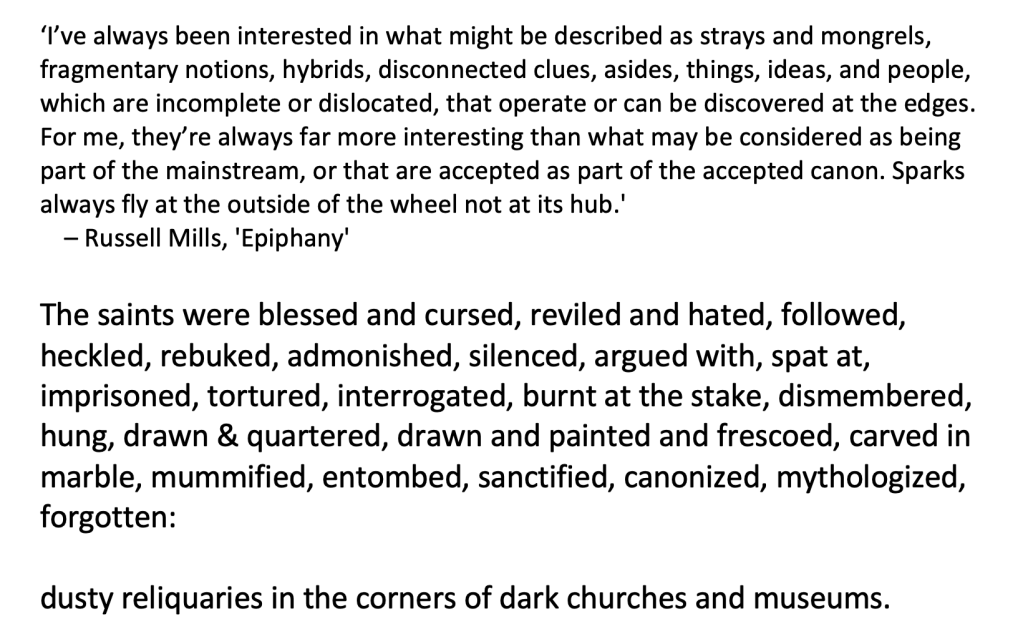
Strays and Mongrels – a poem by Rupert M Loydell

STRAYS AND MONGRELS

© Rupert M Loydell  

Rupert Loydell is a writer, editor and abstract artist. His many books of poetry include Dear Mary (Shearsman, 2017) and The Return of the Man Who Has Everything(Shearsman 2015); and he has edited anthologies such as Yesterday’s Music Today (co-edited with Mike Ferguson, Knives Forks and Spoons Press 2014), and Troubles Swapped for Something Fresh: manifestos and unmanifestos (Salt, 2010)

Rachel – a poem by Julie L. Moore

Rachel
A voice is heard in Ramah, weeping and great mourning, Rachel weeping for her children and refusing to be comforted, because they are no more. ~Matthew 2:18


My cries climb out of my grave
like Abel’s blood shouted from the ground.  
My sons are no more, their innocent skin 
 
pierced by soldiers’ swords, their hearts 
run through by Herod. I will not 
be silenced. There is no grief like mine. 
 
I was a shepherd once. 
I know what it’s like to keep watch,
to chase after one who wanders astray, 
 
lift it from a ravine while all my muscles
scream. I wanted to save them all.
I know my flock’s thirst, how the arid heat 
 
thickens on the tongue and strips 
air from the lungs. In a moment like that, 
I met my beloved. He rolled the stone away
 
from the mouth of the well. He kissed me 
and I wept the first of many times. 
You know how the story goes.
 
I sobbed again when my scions passed 
my tomb on the road to Babylon. 
Do not wipe my tears away now.
 
Let them come violent as a peg
driving through an enemy’s head.  
Let them keen over YHWH’s fierce will,
 
for I cannot raise the dead. 
My own bones merge with earth.
This otherworldly bosom cages me in. 
 
I am every mother in Bethlehem
who knows what these men don’t. 
Hear me howl. 

A Best of the Net and six-time Pushcart Prize nominee, Julie L. Moore is the author of four poetry collections, including, most recently, Full Worm Moon, which won a 2018 Woodrow Hall Top Shelf Award and received honorable mention for the Conference on Christianity and Literature’s 2018 Book of the Year Award. She has also had poetry appear in African American ReviewAlaska Quarterly Review, Image, New Ohio Review, Prairie Schooner, and The Southern Review. Moore is the Writing Center Director at Taylor University in Indiana, where she is the poetry editor for Relief Journal. Learn more about her work at julielmoore.com.